
FAR in Delhi (DDA / MCD) — A 2026 Architect's Working Reference
Floor Area Ratio under MPD 2021 and the Unified Building Bye-laws 2016 — baseline FAR percentage by plot category, DDA-layout overrides, TOD bonus FAR around metro stations, and the LBZ heritage caps in central New Delhi.
Governing framework: Master Plan for Delhi 2021 (MPD 2021) + Unified Building Bye-laws 2016
Working reference tables
Print or screenshot these for the studio wall. Cross-check against the current authority notification before any specific filing.
Residential FAR by plot category (Unified Building Bye-laws 2016)
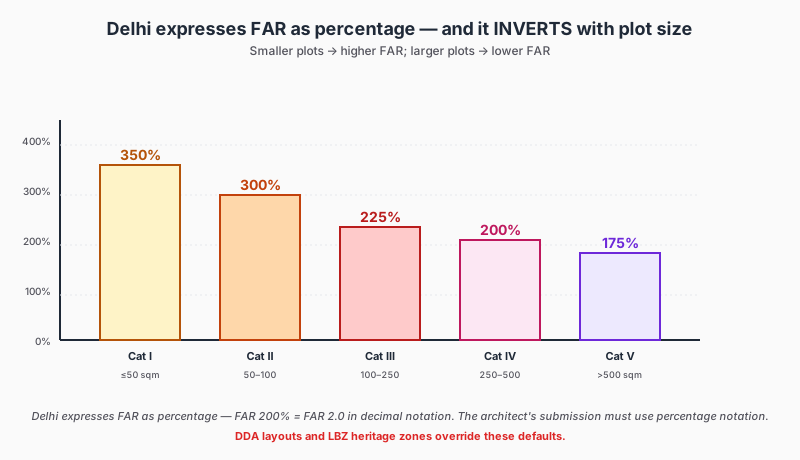
Delhi expresses FAR as percentage of plot area. Smaller plots get higher FAR; larger plots get lower FAR — the opposite of Bengaluru's RMP 2031 matrix.
| Plot Category | Plot Size | Permitted FAR | Ground Coverage |
|---|---|---|---|
| I | Up to 50 sqm | 350% (3.5) | 90% |
| II | 50–100 sqm | 300% (3.0) | 75% |
| III | 100–250 sqm | 225% (2.25) | 60% |
| IV | 250–500 sqm | 200% (2.0) | 50% |
| V | Above 500 sqm | 150–200% (1.5–2.0) | 40% |
Indicative values from MPD 2021 + Unified Building Bye-laws 2016. Specific DDA layouts and special zones (LBZ, heritage, TOD) prescribe overrides. Always verify the current notification.
TOD Bonus FAR — within 500 m of notified metro stations
Transit-Oriented Development zones permit bonus FAR over the baseline against TOD premium fees and infrastructure contributions.
| Distance from metro station | Bonus FAR over baseline | Conditions |
|---|---|---|
| ≤ 200 m (inner core) | +50% | Mixed-use; TOD premium fee; infrastructure capacity certification |
| 200–500 m (outer zone) | +25% | Mixed-use; TOD premium fee; affordable-housing component encouraged |
| > 500 m | No bonus | Standard MPD 2021 baseline applies |
Active TOD corridors include Karol Bagh, Mayur Vihar Phase 1, Dwarka Sector 21, ITO area, and Hauz Khas. Each metro corridor has its own TOD notification.
LBZ heritage FAR caps — Lutyens' Bungalow Zone
LBZ plots follow NDMC heritage-zone regulations with FAR well below the standard Cat IV–V baseline.
| Parameter | LBZ value | Standard Cat IV–V |
|---|---|---|
| FAR / FAR% | ≈ 100% (FAR 1.0) | 150–200% (FAR 1.5–2.0) |
| Ground coverage | ≤ 25% | 40–50% |
| Height | ≈ 11 m / G+1 | Up to 17.5 m |
| Heritage NOC | Mandatory (HCC) | Not required |
LBZ extent is bounded approximately by Kasturba Gandhi Marg, Sardar Patel Marg, Aurobindo Marg, and Mathura Road.
FAR exclusions (Unified Building Bye-laws 2016)
Categories of floor area excluded from countable FAR. The architect's FAR statement must enumerate exclusions clause-by-clause.
| Zone / Use | FAR treatment | Conditions |
|---|---|---|
| Basement parking | Fully excluded | Used for parking + services only |
| Stilt parking | Excluded up to 2.4 m height | On plots above 100 sqm |
| Service ducts / shafts | Excluded | Dedicated, continuous |
| Terrace mumty / lift overrun / water tank | Excluded subject to area cap | Per bye-laws schedule |
| Open balconies | Partially excluded | Per zone clause; stricter caps than BBMP |
Delhi's exclusion regime is broadly similar to BBMP's but with tighter caps on terrace appurtenances. Submit FAR statement in percentage notation to match bye-laws convention.
The working reference, in full
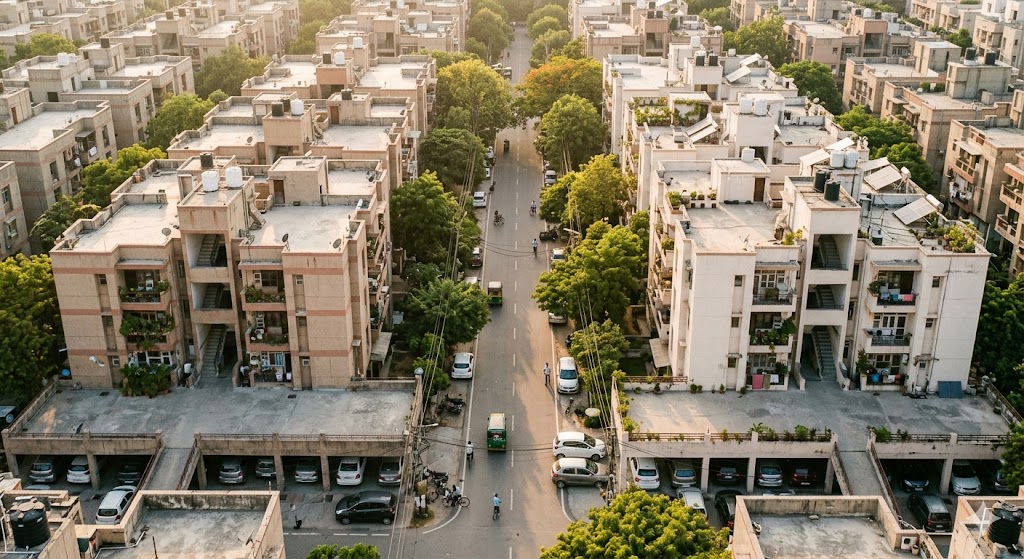
Delhi's FAR (Floor Area Ratio) framework — under the Master Plan for Delhi 2021 (MPD 2021) and the Unified Building Bye-laws 2016 — is plot-category-driven, like Delhi's setback regime. Smaller plots get higher FAR (Category I at 350%) reflecting the dense row-house typology of urban villages and unauthorised-regularised colonies; larger plots get progressively lower FAR (Category V at 150–200%), reflecting the bungalow-zone typology of South Delhi and LBZ. Delhi expresses FAR as a percentage of plot area, not a decimal — FAR 200% is identical to FAR 2.0, but the architect's submission to MCD must use percentage notation to match bye-laws convention and avoid sanction queries.
DDA-layout overrides
DDA layouts (Vasant Kunj, Dwarka, Rohini, Saket, Hauz Khas Enclave, etc.) often have layout-specific FAR caps that override the Unified Bye-laws baseline. Older DDA cooperative-society layouts may have FAR caps as low as 100% (FAR 1.0); newer layouts like Dwarka Sector 22 may permit Category III rates of 225%. The DDA layout sanction plan and the cooperative-society allotment letter are the authoritative documents — the bye-laws table is a default that applies only where the layout is silent. The architect's pre-design verification: which framework — layout or bye-laws — applies to this plot.
TOD zones and the bonus FAR mechanism
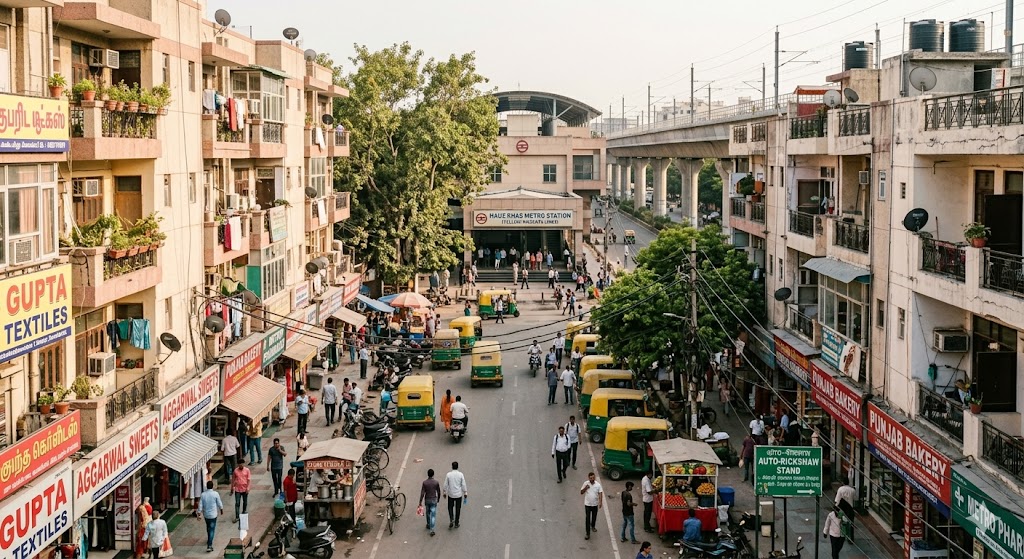
MPD 2021 introduced Transit-Oriented Development (TOD) zones around notified Delhi Metro stations — typically a 500 m radius from each station, with an inner core of 200 m carrying higher bonus. Within TOD zones, plots are eligible for bonus FAR over the baseline (typically up to 25–50%) against payment of a TOD premium fee, an affordable-housing component, and infrastructure-capacity certification. The TOD framework is one of Delhi's most progressive planning tools and is actively used on plots near Karol Bagh, Mayur Vihar Phase 1, Dwarka Sector 21, ITO, and Hauz Khas metro stations. Each metro corridor has its own TOD notification — bonus values and conditions vary.
LBZ FAR caps — heritage overrides everything
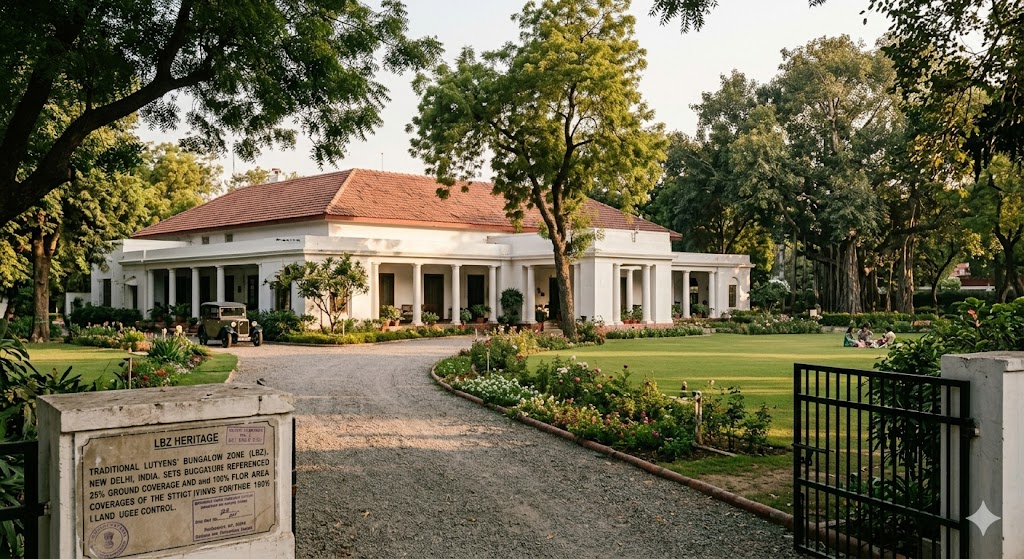
Plots in the Lutyens' Bungalow Zone (LBZ) face FAR caps of around 100% (FAR 1.0) with ground coverage capped at 25% — well below the standard Cat IV–V baseline of 150–200%. Heritage-listed structures elsewhere in Delhi (Daryaganj, Civil Lines, Kashmere Gate) face similar restrictions through the Heritage Conservation Committee (HCC). The architect's pre-design verification must confirm whether the plot sits in a heritage zone or carries a heritage-listed grading; both override the standard FAR matrix. Without HCC NOC, MCD and NDMC will not sanction LBZ work regardless of bye-laws compliance.
Stilt, basement, and terrace exclusions
MPD 2021 + Unified Building Bye-laws 2016 typically exclude from FAR computation: basement parking (fully excluded if used for parking and services), stilt parking (excluded up to 2.4 m height on plots above 100 sqm), service ducts (excluded if dedicated), terrace mumty / lift overrun / water tank (excluded subject to area limits), and open balconies (partially excluded depending on the bye-laws clause). Delhi's exclusion regime is broadly similar to BBMP's and Mumbai's but with somewhat tighter caps on terrace appurtenances — a 30 sqm mumty that BBMP would accept may exceed Delhi's cap.
OBPAS sanction — submission and percentage-notation FAR
MCD's OBPAS (Online Building Plan Approval System) requires the architect's FAR computation in percentage notation matching the bye-laws table — FAR 200%, not FAR 2.0. Submitting in decimal form triggers an MCD query and delays sanction. The FAR statement must enumerate exclusions clause-by-clause against the bye-laws schedule, and any TOD bonus or DDA-layout override must be explicitly cited with the relevant notification reference. JIC inspection at plinth and at completion verifies the as-built area against the certified FAR statement; on-site overshoot is a stop-work trigger.

Common pitfalls
- Treating bye-laws FAR as authoritative within a DDA layout — the layout sanction governs.
- Submitting FAR in decimal notation (e.g., 2.0) instead of percentage (200%) — triggers MCD OBPAS query.
- Missing the TOD zone overlay on plots within 500 m of a metro station — the bonus FAR is a real lever in feasibility studies.
- Ignoring LBZ / heritage FAR caps on plots in central Delhi — heritage rules override the standard matrix regardless of category.
- Forgetting that Delhi inverts the size-FAR relationship — small plots get HIGHER FAR percentage, not lower.
- Counting stilt parking floor space above 2.4 m as excluded — only up to 2.4 m height qualifies; above counts as countable area.
Frequently asked questions
›What is the maximum FAR for residential plots in Delhi?
›Why does Delhi use FAR percentage instead of decimal?
›Do DDA cooperative-society layouts have higher or lower FAR than the bye-laws default?
›What is TOD bonus FAR?
›How much FAR can an LBZ plot consume?
›Are NDMC area FAR rules different from MCD area FAR?
Sources & references
Delhi Development Act, 1957
Act No. 61 of 1957 — DDA master-plan and FAR-prescription powers
Master Plan for Delhi 2021 (MPD 2021)
Delhi Development Authority, MPD 2021 — Volume I and II; FAR matrix, plot-category framework, TOD framework
Unified Building Bye-laws 2016
MCD, Unified Building Bye-laws 2016 — plot category FAR matrix and exclusions
TOD Norms — MPD 2021 amendments
MPD 2021 TOD framework notifications — bonus FAR by metro corridor
NDMC Building Bye-laws and LBZ Heritage Regulations
NDMC Building Bye-laws — Lutyens' Bungalow Zone FAR cap and heritage controls
OBPAS — Online Building Plan Approval System
MCD OBPAS portal — FAR submission in percentage notation, JIC inspection scheduling
National Building Code of India (NBC) 2016
Bureau of Indian Standards, NBC 2016 — Volume 1 Part 3 General Building Requirements
Disclaimer: Regulatory rates and dimensional rules change frequently and may be modified by mid-year notifications. Values reflect the framework as of 2026-05-10; verify against the current authority notification before any specific filing. This page is informational and is not legal or planning advice — engage a registered architect and a qualified planning consultant for project-specific compliance.
Related guides from the library
The companion deep-dives that practising architects keep alongside this reference.
Building Setbacks Across India
A State-by-State Guide to Development Control Regulations, Plot Setbacks, Ground Coverage, and FAR — for Architects, Planners, and Developers
42 min read · Open ConstructionBuilding Plan Approval Process in India
State-Wise Guide — BBMP, BMC, CMDA, GHMC, MCD, PMC & 14 More Cities
30 min read · Open ConstructionArchitect Fee Structures in India
Slab, Lump-Sum, Hourly, and Hybrid — A Working Reference for Indian Practice
21 min read · Open SustainabilityPassive Design Strategies for Indian Climate Zones
A Climate-Zone-by-Zone Working Reference for Indian Architects
24 min read · Open ConstructionThe Architect's Scope of Services in India
COA Conditions of Engagement Decoded — Stages, Deliverables, Fees, and What's Actually Included
23 min read · OpenCompare across cities
The same FAR / FSI topic, different regulatory frameworks, different city quirks. Architects practising across metros should bookmark the adjacent reference.
FAR / FSI in Bengaluru
BBMP Building Bye-laws 2003 + Revised Master Plan 2031 (RMP 2031)
Open MCGM · MaharashtraFAR / FSI in Mumbai
Development Control and Promotion Regulations 2034 (DCPR 2034)
Open CMDA · Tamil NaduFAR / FSI in Chennai
Tamil Nadu Combined Development & Building Rules 2019 (TNCDBR 2019)
Open HMDA · TelanganaFAR / FSI in Hyderabad
Telangana Building Rules 2012 + GO Ms No. 168
Open