
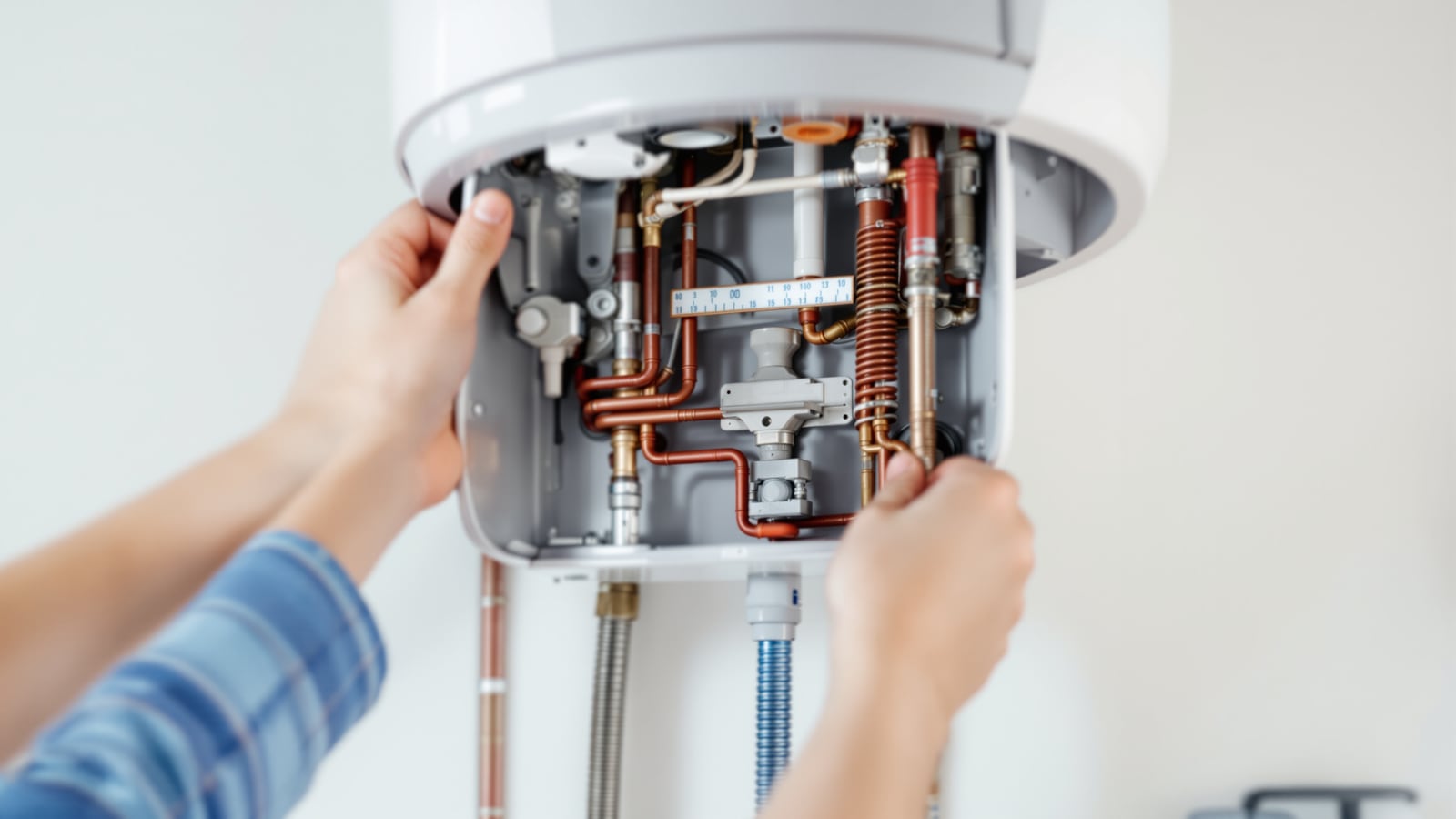
Water Heater (Geyser) Maintenance in India: Descaling, Anode Rods & Safety Checks
A homeowner's yearly service routine for storage and instant geysers — descaling the tank and element against hard-water scale, replacing the sacrificial anode rod, testing the pressure-relief valve and RCD, flushing sediment, and the flue checks that keep a gas geyser safe.
A geyser is one of the hardest-working appliances in an Indian home, yet it is almost never serviced until it stops heating or springs a leak. A little annual attention keeps it efficient, doubles its life, and — because it mixes electricity, pressure and, in gas models, a live flame with water — keeps it safe. This guide gives homeowners a practical yearly routine for storage and instant geysers.
It sits in the Studio Matrx plumbing maintenance guide alongside our appliance references. For how the machine actually works and how to choose one, see the hot water systems guide; for gas-fired units and their ventilation rules, see gas water heaters. To size or cost a replacement, use the Bathrooms hub's geyser running-cost calculator.
Safety first — isolate the power. Before touching any electrical geyser, switch it OFF at the wall and at the MCB, then confirm it is dead. Let a full tank cool for an hour before draining — the water inside can be scalding. For gas geysers, close the gas valve. If you are not comfortable with any step, call a plumber or the brand's service technician.
Why Indian geysers need maintenance
Most Indian municipal and borewell water is hard — rich in dissolved calcium and magnesium. Every time water is heated, some of that mineral drops out as scale: a chalky white crust that coats the heating element and lines the tank. Scale is the single biggest enemy of a geyser.
- It wastes electricity. Scale is an insulator. A coated element has to run longer and hotter to warm the same water, quietly inflating your bill.
- It burns out elements. Heat that cannot escape into the water builds up in the element until it fails.
- It corrodes the tank. Beneath the scale, hot water slowly eats the steel tank — which is exactly what the anode rod is there to prevent.
If your area has genuinely hard water, the long-term fix is to treat it — see our guide to water softeners. Softened water dramatically slows scaling in the geyser and everywhere else.
The annual service, task by task
Set aside an hour once a year — ideally just before winter, when the geyser starts working hardest. Power isolated and tank cooled, work through these.
1. Descale the tank and element
This is the heart of the service. Drain the tank via the drain valve (or by disconnecting the inlet). On most storage geysers the lower cover comes off to expose the heating element and thermostat. Unscrew the element, lift it out, and you will usually find it caked in white scale.
- Gently chip and brush the loose scale off the element. For stubborn deposits, soak it in a mild descaling solution — dilute white vinegar or citric acid works, or a proprietary geyser descaler — then rinse thoroughly.
- Wipe or flush loose scale and sludge out of the tank bottom. Do not use harsh acids inside a glass-lined tank.
- Inspect the rubber gasket; replace it if it has hardened, or the geyser will weep when refilled.
2. Check and replace the sacrificial anode rod
Inside the tank sits a sacrificial anode rod — usually magnesium or aluminium. It is designed to corrode instead of the steel tank: rust attacks the more reactive rod first. Over a few years it dissolves away, and once it is gone the tank itself starts to rust.
- With the element out (or via its own hex plug on top), inspect the rod. If it is thin, heavily pitted, or reduced to bare core wire, replace it with the correct type for your geyser.
- A fresh anode rod every 2 to 4 years is the cheapest insurance you can buy against a tank replacement.
3. Test the pressure-relief / safety valve
A storage geyser is a sealed pressure vessel. The pressure-relief valve (PRV) — also called a temperature-and-pressure or safety valve — releases water if pressure or temperature climbs dangerously high. A stuck valve is a genuine hazard.
- Lift its test lever briefly; you should hear or see water discharge, and it should reseat cleanly when released.
- If it is scaled shut, drips constantly, or does not reseat, replace it. Never plug or cap a relief valve.
4. Test the MCB and RCD / ELCB
Electricity and water are a lethal pairing, so the geyser's protection must work.
- Confirm the geyser runs off its own dedicated MCB on the board, not shared with other loads.
- Press the TEST button on the RCD (residual-current device) or ELCB protecting the circuit; it must trip instantly. If it does not, the earth-leakage protection is dead — have an electrician fix it before using the geyser. This device is what saves you from a fatal shock if the element leaks to earth.
5. Flush sediment
Even between full descales, sediment settles at the tank bottom. Open the drain valve for a few seconds (with the inlet on, so pressure pushes debris out) until the water runs clear. On instant geysers, briefly opening the outlet at full flow helps clear the coil.
6. Check the thermostat
The thermostat sets and limits the water temperature. If water is scalding hot, barely warm, or the geyser never switches off, the thermostat may have failed.
- A setting around 55 to 60 degrees Celsius is a good balance: hot enough to be efficient and hygienic, low enough to slow scaling and reduce scald risk. Above 60, scaling accelerates sharply.
- A faulty thermostat should be replaced, not bypassed — bypassing removes a critical safety cut-out.
7. Gas geysers — flue and ventilation
Gas (LPG or PNG) geysers add a burner and combustion, so they carry an extra, non-negotiable set of checks. Full detail is in the gas water heaters guide, but at service time:
- Check the flue is clear, correctly connected and venting fully to outside air — never into a closed bathroom.
- Confirm room ventilation (a window or vent) is unobstructed. A gas geyser starved of air can produce carbon monoxide.
- Inspect the burner for a clean blue flame, check for gas-smell leaks at the connection with soapy water, and replace the ignition battery if fitted.
Service schedule at a glance
| Task | Frequency | Who |
|---|---|---|
| Flush sediment from tank | Every 3 to 6 months | DIY |
| Test RCD / ELCB (TEST button) | Every 3 to 6 months | DIY |
| Wipe body, check for damp / leaks | Monthly (visual) | DIY |
| Descale tank and heating element | Yearly (sooner in very hard water) | DIY / plumber |
| Test pressure-relief valve | Yearly | DIY / plumber |
| Check / replace anode rod | Every 2 to 4 years | Plumber |
| Full technician service (storage) | Yearly | Plumber / brand service |
| Gas geyser flue & combustion check | Yearly | Qualified gas technician |
Signs your geyser needs service now
Do not wait for the yearly slot if you notice any of these — most point to scale, sediment or a failing part.
| Symptom | Likely cause | What to do |
|---|---|---|
| Water heats slowly or not enough | Scale coating the element; weak thermostat | Descale element; test thermostat |
| Rumbling, popping or hissing noise | Sediment/scale trapping steam at tank base | Flush and descale the tank |
| Discoloured, rusty or smelly water | Anode rod exhausted; tank corroding inside | Inspect and replace anode rod |
| Water too hot / never switches off | Faulty thermostat stuck closed | Replace thermostat (isolate power) |
| Damp patch or drip below the unit | Failed gasket, tank corrosion, or PRV weeping | Find the source; a rusted tank means replacement |
| Geyser trips the MCB or RCD | Element leaking to earth or shorted | Stop using it; call an electrician |
| No hot water at all, no heating | Blown element, tripped thermal cut-out, supply | Isolate power; check MCB, then call a pro |
DIY versus calling a plumber
Do yourself: monthly visual checks, sediment flushing, and pressing the RCD test button. These need no dismantling and involve no live parts.
A plumber or brand technician should handle the full annual service — removing and descaling the element, replacing the anode rod, and swapping a thermostat or PRV — unless you are genuinely confident with the electrical isolation. If your geyser is under warranty, always use authorised service so you do not void it. Gas geyser combustion, flue and gas-connection work must go to a qualified gas technician — never DIY. And any tripping, earth-leakage or persistent leak is a stop-and-call-a-professional signal, not something to keep resetting.
A geyser that trips its breaker is telling you electricity is finding a path it should not. Do not keep switching it back on. Isolate it and get it checked.
References
- Bureau of Indian Standards — safety and performance standards for household electric storage water heaters.
- National Building Code of India — provisions for gas appliance installation, flue and ventilation.
- Manufacturer's installation and service manual for your specific geyser model — always the final authority on anode type, element rating and service intervals.
Treat the geyser like the pressure vessel and electrical appliance it is: one calm hour a year, power safely isolated, and it will run efficiently and safely for a decade or more.
Export this guide
Related Guides — Deep-dive reading
Toilet Maintenance India: Clean the Bowl, Fix a Running or Weak-Flush WC (2026)
The WC is the hardest-working fitting in an Indian bathroom and the quietest money-waster when it fails. This is the practical, do-it-yourself guide to keeping a toilet clean and working: scrubbing the bowl and under the rim, killing the hard-water limescale ring, and fixing the four things that actually go wrong — a running cistern, a weak flush, a leak, and a blockage.
BathroomsBathroom Fire Safety India: NBC 2016 Part 4, Fire-Rated Materials & Electrical Ignition
The bathroom is rarely thought of as a fire risk, yet it hides several: a leaky geyser element, an over-run exhaust-fan motor, cheap flammable PVC panels overhead, and aerosol cans stored beside a heat source. This is an honest, practical reference to fire and life safety in the Indian bathroom — the NBC 2016 Part 4 context that actually applies to homes, the real ignition sources, self-extinguishing false-ceiling and PVC materials, earth-leakage protection as fire prevention, escape considerations, and the carbon-monoxide danger of gas geysers.
BathroomsCCTV Camera Not Working (2026): A Calm, Step-by-Step Fix for Indian Homes
A black screen, no feed or a dead camera almost always traces back to power or a loose connection long before the camera itself has failed. This guide walks a homeowner through diagnosing the cause in order, the safe fixes you can do yourself, and exactly when to call a technician.
SecurityRelated Tools — Try Free
Window Cleaning Cost Calculator
Estimate professional window cleaning cost per visit and per year by access and frequency.
Window CalculatorWindow Cost Calculator
Estimate window price plus installation by type, frame material, size, glass and quantity.
Window CalculatorWater Softener Size Calculator
Size a water softener from your hardness, daily water use and days between regeneration, with the grain capacity needed.
Plumbing Calculator