
Wall Hung vs Floor Mounted Toilet: Which Is Better? (India, 2026)
A fair head-to-head between the wall-hung WC on a concealed cistern and the everyday floor-mounted pan — cleaning and looks, the true rupee cost of the frame and hidden tank, wall and load requirements, serviceability, and an honest verdict by budget and room for Indian bathrooms.
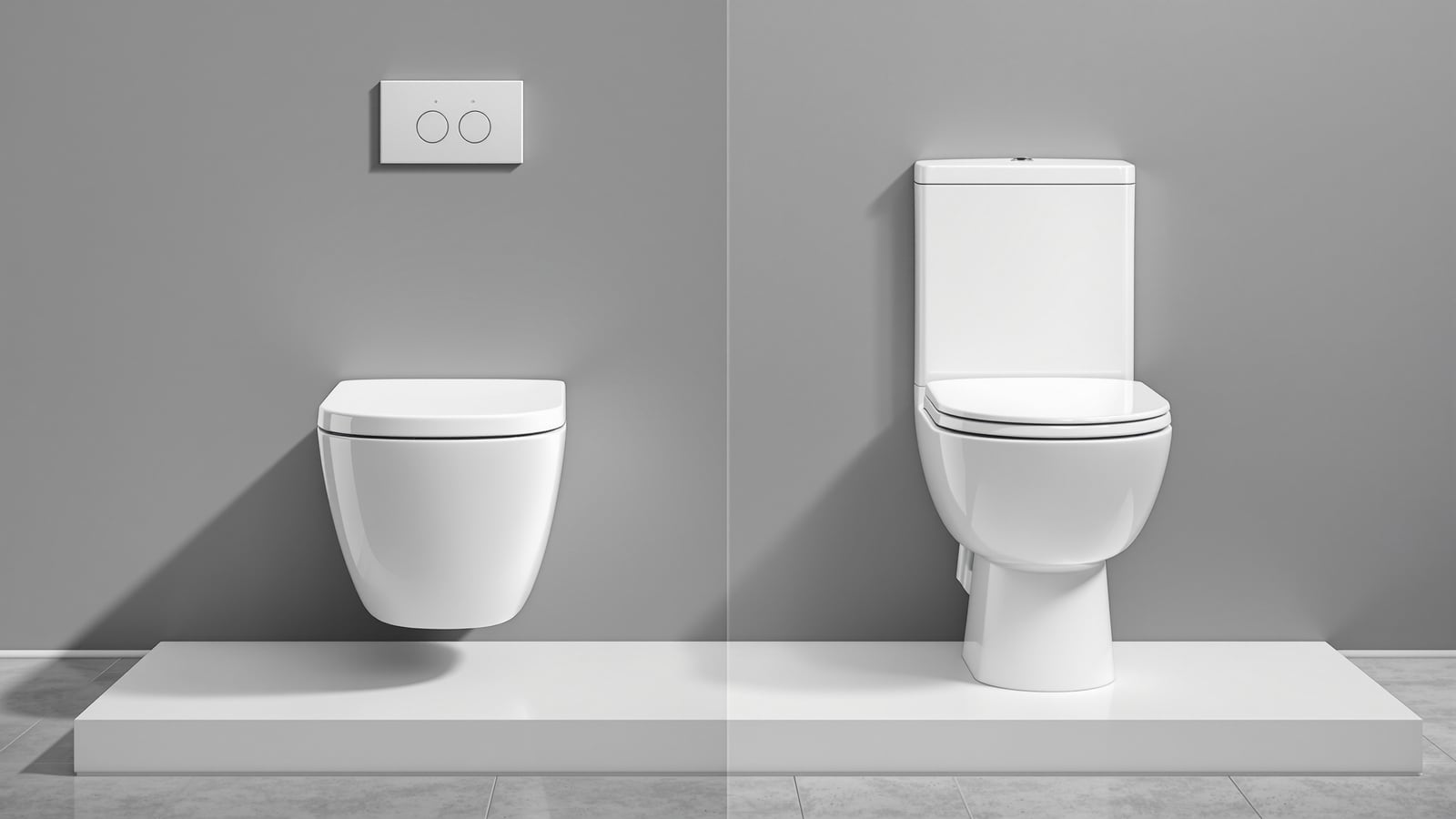
Stand in a sanitaryware showroom in India and two toilets pull at you. One floats off the wall on a hidden frame, its cistern buried behind the tiles, only a slim flush plate showing — the wall-hung WC. The other stands squarely on the floor with its tank close-coupled behind the pan — the floor-mounted WC, the workhorse in nine out of ten Indian homes. The wall-hung unit looks like the future; the floor-mounted one looks like every bathroom you have ever used. So which is actually better for your home?
The honest answer is: it depends on your budget, whether you are building fresh or replacing, and how much you value a floor that wipes clean in one pass. This guide sits under the bathroom toilet guide for India. For the deep dive on each option read wall-hung toilet for India and floor-mounted toilet for India; if you are starting from scratch, begin with how to choose a toilet in India.
Bottom line up front: the floor-mounted WC wins on cost, serviceability and drop-in replacement, and is the right default for most Indian homes. The wall-hung WC wins on looks and floor-cleaning — buy it only when you are building or renovating from the wall out, and you value that clean look enough to pay several times more.
The two designs in one minute
- Floor-mounted WC (EWC): the pan bolts to the floor and connects to your existing drain. The cistern is either close-coupled (visible tank behind the pan) or, in premium versions, concealed. Any plumber in any town can service it with universal spares.
- Wall-hung WC: the pan hangs off a galvanised steel carrier frame bricked or dry-walled into the wall. The concealed cistern lives inside that frame; you flush via a plate on the wall. Nothing but the pan is visible, so the floor runs clean underneath it.
The wall-hung look is not really about the pan — it is about hiding the tank and lifting the bowl off the floor. That single choice drives every difference below: cost, wall work, load, and how you service it years later.
Cleaning and looks
This is where the wall-hung WC earns its price. Because the pan floats, a mop or cloth sweeps the entire floor in one stroke — no bolts, no crevice where the pan meets the tile, no grime line to scrub. In an Indian bathroom that shares space with a health faucet and monsoon humidity, a floor that dries fully and wipes clean is a real hygiene and maintenance win. The concealed cistern also removes the visible tank and the dust-catching gap behind it, giving the minimalist, hotel-like look that magazines love.
The floor-mounted WC is more honest but harder to clean around. The base is sealed to the floor with silicone, the fixing bolts collect grime, and the tile line at the pan foot needs a brush. A one-piece floor-mounted unit closes the pan-to-cistern joint and cleans better than a two-piece, but it still sits on the floor. On pure looks and cleanability, wall-hung wins clearly.
Cost — the frame and concealed cistern premium
Here the gap is wide, and it is not just the pan. A wall-hung setup is really three purchases: the pan, the carrier frame, and the concealed cistern with flush plate — plus the wall-building and tiling to box it all in.
| Item | Floor-mounted (₹) | Wall-hung (₹) |
|---|---|---|
| Pan | 4,500 – 20,000 | 8,000 – 30,000+ |
| Cistern | Close-coupled, included | Concealed 9,000 – 25,000 |
| Carrier frame | Not needed | 8,000 – 20,000 |
| Flush plate | Included | 1,500 – 8,000 |
| Wall + tiling work | Minimal | Extra half-wall build + tiling |
| Installed total, typical | 8,000 – 30,000 | 30,000 – 75,000+ |
A decent floor-mounted WC lands installed for well under half — often a third — of an equivalent wall-hung setup, because you skip the frame, the concealed tank, and the masonry to hide them. The premium buys looks and floor-cleaning, not better flushing or longer life.
Installation and wall requirement
A floor-mounted WC is a drop-in job: match the trap (S-trap through the floor or P-trap into the wall) and the rough-in distance to your existing drain, bolt it down, seal the outlet with a gasket connector, and it is done in a morning. No wall-building.
A wall-hung WC needs a wall that can carry it. The steel frame must be fixed to a structural wall or a purpose-built stud/brick support, then boxed in and tiled — you are effectively building a half-wall or duct. This is easy when you are already renovating or building; it is disruptive and expensive to retrofit into a finished bathroom. A lightweight partition or hollow block wall alone will not hold a wall-hung WC — the load goes through the frame to the floor and the structural wall, not the tiles.
Serviceability of the concealed cistern
This is the wall-hung WC's quiet weakness, and it matters more in India than in a soft-water Western home. The concealed cistern sits inside the wall; you reach the flush valve and inlet only through the access opening behind the flush plate. When a fill valve or flush valve scales up in hard water — and Indian water scales valves faster than most — you are working blind through a small hole, and you depend on that one brand's spare parts still being available years later. If the frame or a bracket fails, opening the wall is a building job.
The floor-mounted WC could not be more different. A close-coupled cistern lifts its lid for a two-minute look; valves are universal and sold in every hardware shop; a cracked cistern swaps without touching the pan. For a country where the plumber down the road fixes things with generic parts, this serviceability is a genuine, underrated advantage.
- Buy protection for a concealed cistern: insist on a well-known frame/cistern brand with guaranteed spares, a generously sized access plate, and an easy-clean glaze to slow scaling.
- Floor-mounted stays simple: any dual-flush valve of the right size drops in; no wall to open.
Load rating and India suitability
A floor-mounted WC transfers weight straight into the slab, so its load capacity is effectively that of the floor — a non-issue. A good wall-hung carrier frame is rated to carry around 400 kg when correctly fixed to structure and floor, comfortably more than any user; the frame, not the tiles, bears the load. The risk is never the rating — it is poor installation: a frame anchored to a weak partition, or skimped fixings, is the only way a wall-hung WC gets into trouble. Use a branded frame, fix it to structure, and load is not a worry.
For Indian conditions overall, the floor-mounted WC is the safer default: hard water is easier to fight when valves are accessible, humidity and a wet health-faucet zone suit a fixture any plumber can reseal, and a replacement drops onto the drain you already have. The wall-hung WC is a superb choice when you control the wall from the start and want the clean look — its downsides are all about access and cost, not performance.
The verdict table
| Attribute | Wall-hung | Floor-mounted | Winner |
|---|---|---|---|
| Upfront + installed cost | High (frame + concealed tank) | Low | Floor-mounted |
| Looks / minimalism | Floating, tank hidden | Conventional | Wall-hung |
| Floor cleaning | Wipes clean underneath | Base + bolts to scrub | Wall-hung |
| Installation | Frame + wall build | Drop-in, one morning | Floor-mounted |
| Fits a replacement | Poor — needs rebuild | Excellent | Floor-mounted |
| Serviceability | Blind, brand-dependent | Universal, easy | Floor-mounted |
| Load rating | ~400 kg via frame | Slab-borne | Tie |
| Hard-water tolerance | Valve hard to reach | Valve accessible | Floor-mounted |
| Space feel | Saves visual space | Bulkier | Wall-hung |
Which should you choose?
- Pick floor-mounted if you are replacing an old WC, working to a budget, want any plumber to be able to fix it, or live with very hard water. This is most Indian homes.
- Pick wall-hung if you are building or fully renovating with the wall open, you can budget for the frame and concealed cistern, and the clean floor and minimalist look genuinely matter to you — typically a master bathroom or a premium en-suite.
| Pick wall-hung if… | Pick floor-mounted if… |
|---|---|
| Building / renovating, wall is open | Replacing in a finished bathroom |
| Budget allows frame + concealed tank | Budget is tight |
| Clean floor + minimalist look is a priority | Easy servicing matters most |
| Premium master or en-suite bath | Rental, guest bath or family bathroom |
| You will buy a branded frame with spares | You want universal, local spares |
For the common Indian case — a family replacing a WC or fitting out a standard flat on a sensible budget — the floor-mounted WC is the right call, ideally a clean-cleaning one-piece with a dual-flush cistern. Reserve the wall-hung unit for the room where you control the wall and will pay for the look. It is a genuine toss-up only in a brand-new premium bathroom where budget is not the constraint — there, choose on aesthetics.
Whatever you pick, match the trap and rough-in to your drain, insist on dual-flush, and for a concealed cistern choose a branded frame with a big access plate and guaranteed spares. Return to the bathroom toilet guide for India for the full fixture picture, or read the dedicated wall-hung and floor-mounted guides before you buy.
References
- IS 2556 — Vitreous Sanitary Appliances (Vitreous China): pan types, trap forms and set-out dimensions.
- IS 774 — Flushing Cisterns for Water Closets and Urinals.
- National Building Code of India (NBC) 2016, Part 9 (Plumbing Services) — drainage, traps and fixture support.
- IS 1172 — Basic Requirements for Water Supply, Drainage and Sanitation.
- Bureau of Indian Standards (BIS) — sanitaryware, carrier-frame and flushing cistern standards.
Export this guide
Related Guides — Deep-dive reading
Wall Hung Toilet India: Concealed Cistern, Carrier Frame & Real Costs (2026)
How a floating WC actually works — the in-wall carrier frame rated to ~400 kg, the concealed cistern behind the flush plate, the wall thickness and duct you must plan for, rough-in heights, and an honest pros-cons-cost comparison with floor-mounted pans.
BathroomsBathroom Toilet India: The Complete Guide to WCs, Commodes & Water Closets (2026)
Indian squat vs Western commode, floor-mounted vs wall-hung with concealed cistern, the S-trap and P-trap outlet and its rough-in distance, dual-flush water norms, rimless and comfort-height trends, the health-faucet rule, and a rupee cost comparison — everything that decides which toilet is right for an Indian home.
BathroomsHow to Choose a Toilet in India: A Buyer's Guide to WCs, Traps, Flush & Budget (2026)
The make-or-break trap and rough-in check, floor-mounted vs wall-hung, one-piece vs two-piece, flush type and water use, seat and rimless upgrades, good/better/best rupee tiers, what's actually in the box, and how to spot a fake before you pay.
BathroomsRelated Tools — Try Free
Renovation vs New Build Calculator
Compare renovating vs building new interiors city-wise across 13 work scopes with GST and per-sqft rates.
Cost ComparisonMonsoon-Readiness Checklist
Pre-rain home audit across 9 categories — terrace, drains, waterproofing, electrical, HVAC, pest, vehicles, documents.
Seasonal AuditBathroom Renovation Cost Calculator
Cost to renovate an existing bathroom with a replace-vs-keep model — demolition, re-waterproofing, tiles, fittings and the money saved by keeping items.
Bathroom Calculator