
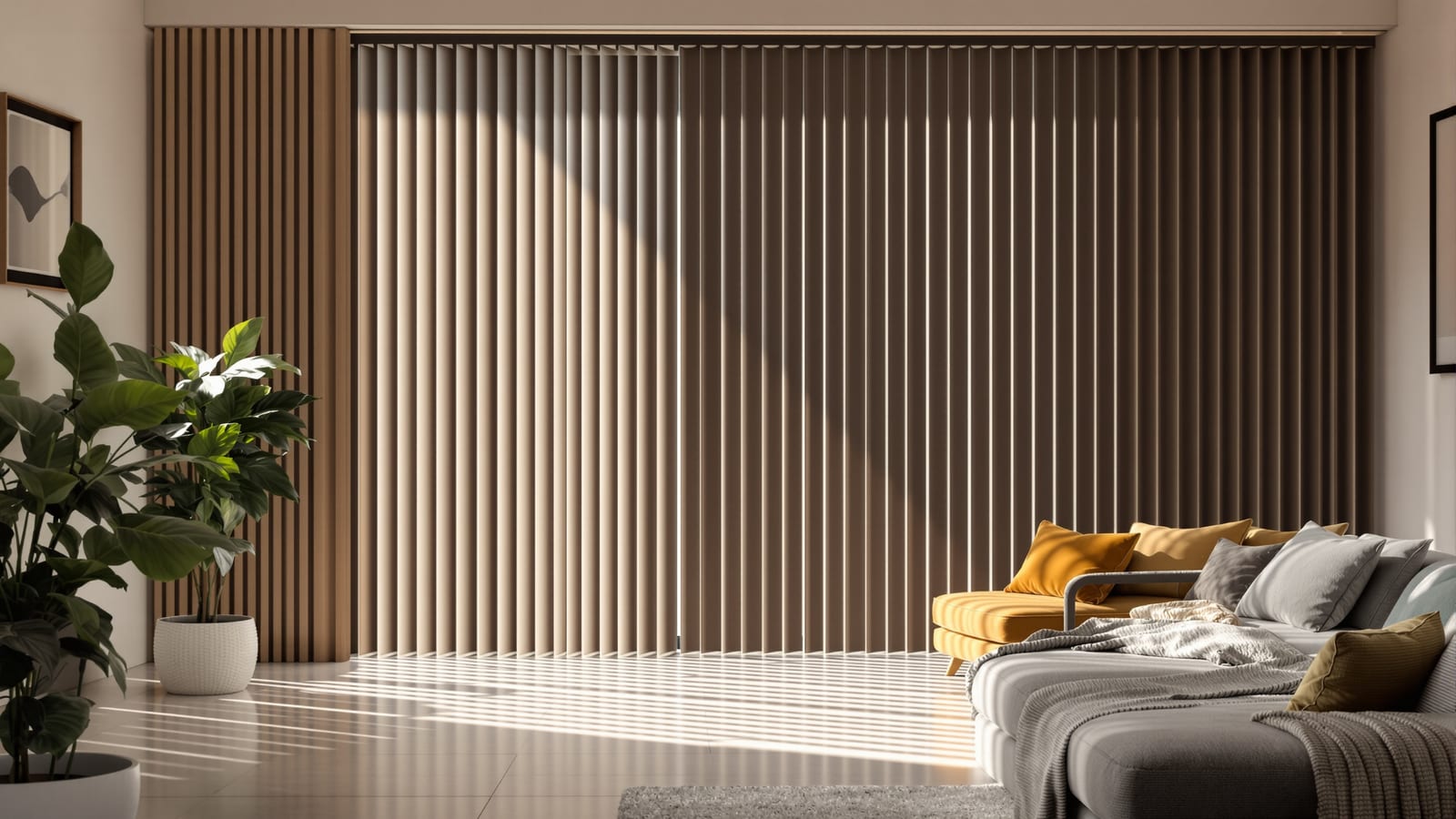
Vertical Blinds: The Guide for Large Windows & Sliding Doors (India 2026)
Why vertical louvres still beat almost everything on wide glazing, sliding and French doors and balconies — fabric vs PVC vanes, real Indian costs, and the honest downsides nobody mentions in the showroom.
Most window treatments are designed for a tidy, upright window. Vertical blinds are designed for the awkward ones — the four-metre living-room glazing, the sliding balcony door you walk through ten times a day, the French doors onto the garden. On those spans, the things that make roller blinds and curtains lovely on a small window start to fight you: a single roller this wide is unwieldy, and a curtain becomes a heavy wall of cloth. A row of slim louvres that rotate to control light and then slide cleanly out of the way is, on big glazing, simply the right tool.
That is also why vertical blinds carry a faint office-cubicle reputation in India. It is half-deserved. The cheap PVC versions of the 2000s earned it; today's fabric vanes, in the right room, look calm and architectural. This guide is the honest case for and against — how the louvres work, fabric versus PVC, what they cost in rupees, where they shine, and where you should reach for something else.
Vertical blinds are not a "look" you choose for charm. They are a span solution: when the glass is wider than it is tall, or you walk through it, the vanes earn their keep where almost nothing else does.
How vertical blinds actually work
A vertical blind is a row of long fabric or PVC strips — called vanes or louvres — that hang from a top track on little carriers, weighted at the bottom and often chain-linked at the foot so they move as one. They do two separate things, and that is the whole appeal:
- Tilt — a wand or chain rotates every vane on its axis at once, from fully open (edge-on, almost all light and view) through angled (soft, glare-free daylight) to fully closed (privacy and most of the light blocked). You get stepless light control without moving the blind at all.
- Traverse (draw) — the vanes stack and slide aside along the track, either to one side or splitting from the centre, so you can clear the whole opening to walk through a door or open a window fully.
That tilt-and-draw pair is exactly what a sliding door needs: angle the vanes for light when the door is shut, then sweep them aside like a curtain to step out. A roller or Roman blind has to be hauled all the way up to clear a doorway; vertical blinds just part. For the wider family of slatted options, the types of window blinds guide sets verticals next to roller, Roman, Venetian and zebra.
Fabric vanes vs PVC vanes
This is the single decision that most changes how the blind looks, lasts and feels. The vane material splits cleanly:
| Fabric vanes | PVC / vinyl vanes | |
|---|---|---|
| Look | Soft, textile, more "interior" | Hard, glossy, more "utility" |
| Light control | Filters warmly; dim-out and blackout fabrics exist | Blocks firmly when closed; flatter light |
| Moisture / damp | Can sag or spot in very humid spots | Wipe-clean, shrugs off splashes |
| Best for | Living rooms, bedrooms, formal spaces | Balconies, kitchens, bathrooms, offices |
| Feel in wind | Lighter, more flutter | Heavier, but clatters harder |
| Price | Higher | Lower |
The practical rule for Indian homes: fabric for the rooms you live in, PVC for the wet and exposed ones. Fabric vanes in a dim-out or blackout weave have quietly closed most of the looks gap with curtains, while PVC remains unbeatable on a monsoon-facing balcony or a steamy kitchen window where cloth would never survive. If you want a softer face still, many designers run a sheer or a light dress curtain in front of fabric verticals — the curtains vs blinds comparison covers that layered trick in full.
The honest pros and cons
The case for vertical blinds is strongest on exactly the windows other treatments handle worst:
- They love big spans. Four, five, six metres of glazing is routine — you simply add more vanes. No giant roller tube, no curtain that weighs a tonne.
- They suit doors you walk through. Sliding, French and balcony doors part cleanly and re-close; the vanes never have to be lifted out of the way.
- Stepless light, easy reach. One wand twist tunes glare all day; no cords to crank on a tall window.
- Replaceable in pieces. A single damaged vane swaps out for a few hundred rupees — you do not rebind the whole blind.
- Affordable per square metre. On large glazing they are often the cheapest decent option going.
The case against is just as real, and the showroom will not lead with it:
- The dated reputation. Cheap PVC verticals read "1990s office". Fabric vanes and a careful colour fix most of this, but it is a genuine style risk in a design-led room.
- Wind clatter. Leave a balcony door open and the vanes swing and knock against each other and the frame — noisy, and over time it bends carriers and pops vanes off.
- Vanes go astray. Bottom weights and chains get tangled, a vane slips its carrier, or one hangs crooked — a fiddly, recurring small annoyance.
- They never fully vanish. Even drawn aside, the stack sits at one end; they do not disappear into a slim cassette the way a roller does.
- Light gaps. Closed vanes leave faint slivers of light at every join — fine for privacy, not for true blackout. For a sleeping room, the roller blinds guide explains why a blackout roller usually wins there instead.
What vertical blinds cost in India
Prices move with vane material, width, brand and city, so treat these as honest ranges, not quotes. Vertical blinds are usually priced per square foot of covered opening, which is what makes them so economical on big glass:
- PVC vanes — the budget end; commonly the lowest per-square-foot blind for large openings, which is why they dominate offices and balconies.
- Fabric vanes — a clear step up per square foot, rising with dim-out and blackout weaves and designer fabrics.
- Wide installations — because cost scales with area, a tall four-metre sliding door runs into a meaningful number even at budget rates; a small window is cheap.
- Replacement vanes — individual vanes are inexpensive, which is part of the long-run value.
The cost drivers people underestimate are width and vane fabric, not the colour. To size the spend before you call a vendor, run your opening through the curtain cost calculator for a fabric-and-area estimate, and read the curtain cost guide for how ready-made, custom and motorised treatments compare rupee for rupee.
Best rooms — and the rooms to skip
Vertical blinds are a specialist, not an all-rounder. They shine where the window is wide or you pass through it:
- Large living-room glazing — fabric vanes, floor-length, often with a sheer or dress curtain in front for warmth. This is the room that rehabilitates their reputation. The living-room curtains guide shows how to layer them.
- Sliding and French doors — their home turf; nothing else parts and re-closes as cleanly on a daily-use door.
- Balconies — PVC vanes handle sun, dust and the odd splash, and sweep aside to let you step out.
- Home offices and study rooms — precise, stepless glare control on the screen wall, which is exactly the office heritage working in your favour.
Where to reach for something else: bedrooms that need true blackout (a blackout roller or lined curtain seals better), small or narrow windows (verticals look over-engineered — horizontal Venetians or a roller suit better), and formal or period interiors where the look simply will not sit. Not sure which way to go for a given window? The window treatment selector walks you from the window's job to the right treatment in a couple of questions.
Care, climate and making them last
Vertical blinds are low-maintenance, but a few Indian-specific habits keep them looking right and stop the annoyances:
- Dust weekly. PVC vanes wipe clean with a damp cloth; fabric vanes take a vacuum brush or a gentle spot-clean. Many fabric vanes unclip for a flat wash — check before soaking.
- Tame the wind. On a balcony or any door you leave open, draw the vanes fully aside before opening the door, or fit a magnetic catch — this is the single biggest fix for clatter and bent carriers.
- Reseat strays early. A vane that pops its carrier or loses its bottom weight is a two-minute clip-back if you catch it; left alone it warps and you end up buying a new vane.
- Mind the UV. West- and south-facing fabric vanes fade and weaken over years of direct sun; choose fade-resistant or PVC vanes on the brightest glazing.
- Keep the track clean. A wipe along the head rail keeps the carriers gliding; grit is what makes them stick and jam.
Two caveats worth stating plainly. Vertical blinds give privacy, not true blackout — the vane joins always leak a little light, so do not buy them expecting a sealed dark room. And every price and dimension here is indicative: measure your own opening and price vanes locally before committing, because width is what really drives the bill.
Get the right treatment for the right window. Match your window to its ideal covering with the window treatment selector, price the job with the curtain cost calculator, and step back to the full picture in the complete window treatment guide. For the neighbouring options, compare verticals against the wider slatted family in the types of window blinds guide.
Export this guide
Related Guides — Deep-dive reading
Sliding Door & Large-Opening Curtains (India 2026)
Dressing wide sliding doors, French doors and balcony openings — wide-span tracks, where the curtain stacks so it clears the door, one-way vs centre draw, floor clearance for the door track, fabric weight, vertical blinds and wave alternatives, plus motorisation and honest costs.
Window TreatmentsCurtains vs Blinds: The Complete Comparison for Indian Homes (2026)
Light, privacy, heat, noise, cleaning, cost and looks — a head-to-head verdict on curtains and blinds, plus the under-rated answer most good designers actually use: both.
Window TreatmentsCurtains vs Venetian Blinds: Precision vs Softness (India 2026)
Tilt-precise venetians or warm, quiet curtains? A room-by-room, rupee-by-rupee verdict for Indian homes — including the dust and wind caveats nobody mentions, and the combo that beats both.
Window TreatmentsRelated Tools — Try Free
Window Treatment Selector
Curtains, blinds or a layered system? Answer five questions about your room and get a specific recommendation.
SelectorCurtain Cost Calculator
Get the fabric metres you need plus the total curtain cost by window size, fabric, pleat, lining and hardware.
Curtain CalculatorCross-Ventilation Analyzer
Estimate airflow and air changes per hour (ACH) from room size, window areas, layout, and local wind — with NBC 2016 Part 8 compliance check.
Ventilation Calculator