
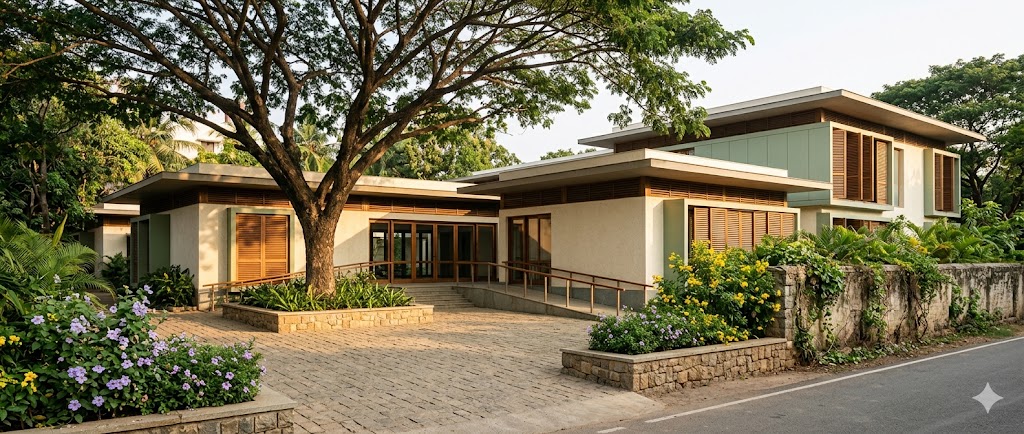
Mental Health & Psychiatric Facility Design in India
An Architect's Working Reference — MHCA 2017 Compliance, Levels of Psychiatric Care, Ligature-Resistant Detailing, Seclusion & De-escalation Rooms, ECT Suite Design, Therapeutic Environments, Forensic Psychiatric Provision, De-Addiction Centres, and the NIMHANS-Influenced Indian Design Tradition
Mental health is the typology of Indian healthcare in which the architecture has historically betrayed the patient. The colonial-era "mental asylum" — the Victorian institutional building with thirty-bed wards, barred windows, walled airing-courts, and the architectural language of confinement — remained the dominant Indian psychiatric building type for a century after the model was discredited in the West. The transition from asylum to therapeutic environment, which began in Britain in the 1960s and in the United States in the 1970s, did not begin in India until the 1990s, and is still not complete. The Mental Healthcare Act 2017, which replaced the 1987 Act, finally placed the patient's rights at the centre of the regulatory framework. The architecture has not yet caught up.
This guide is a facility-type deep-dive in the Studio Matrx healthcare architecture series. It assumes the reader has read the pillar regulatory reference and is familiar with NBC 2016 Group C, the state Clinical Establishments Act schedules, and the basic typology of Indian healthcare practice. Here we focus on what is specific to mental health and psychiatric facilities — the rights-based regulatory architecture of the MHCA 2017, the six-level service typology, the secure-boundary zoning that organises every psychiatric building, ligature-resistant detailing as the most distinctive architectural craft in this typology, the seclusion room and the ECT suite, the eight principles of therapeutic environment, the de-addiction and forensic overlays, the NIMHANS-influenced Indian design tradition, and the failure modes that recur across Indian projects.
The position this guide takes is specific: a mental health facility is not a "general hospital with locked doors". It is its own architectural problem, with its own clinical processes, its own statutory regime, and — increasingly — its own ethical brief. The MHCA 2017 grants the person with mental illness a set of rights that the building must support: the right to live in the community (which means the building should be a way-station, not a destination), the right to dignity (which means no "ward of thirty", no carceral aesthetic, no physical degradation), the right to confidentiality (which means private family meeting spaces, not public corridors), and the right to be free from restraint and seclusion except as a last resort (which means the seclusion room is a clinical safety feature, not a punishment cell). The architect who internalises this produces buildings that the regulator approves, the family trusts, and the patient leaves better than they entered. The architect who designs to the colonial-asylum model produces a building that the MHCA-era regulator will refuse to register and the rights-aware family will refuse to admit their relative to.
"The asylum was the answer of one century to a question that we now realise was wrong. The mental health establishment of this century must answer a different question: not how do we contain the patient, but how do we restore them to themselves." — Dr. R.L. Kapur (1933–2006), Indian psychiatrist and former Director of NIMHANS, paraphrased from a 1991 lecture
"Architecture is not therapy. But the absence of good architecture can be anti-therapy. In mental health, this is unforgivable." — Roger Ulrich (b. 1946), environmental psychologist, paraphrased from his 2018 paper on psychiatric ward design (Ulrich et al., 2018)
1. Why Mental Health is its Own Typology
A general hospital admits a patient for a discrete clinical episode and discharges them when the episode is resolved. A mental health facility admits a person whose illness is often chronic, whose admission may be voluntary or involuntary, whose family is part of the clinical context, whose stay may last days or months, and whose treatment is as much about environment and routine as it is about medication and procedure. The clinical posture is different, and the architectural implications follow.
Seven characteristics make mental health distinct from general inpatient typology:
- The patient is often legally compelled to be there. Involuntary admission, court-ordered admission, and admission of minors by parents introduce a legal-rights overlay that no other typology faces. The architecture must support both the clinical brief and the procedural rights brief — the Mental Health Review Board hearing, the right to consult an advocate, the right to receive visitors, the right to refuse treatment except in defined emergencies.
- The threat is often to self. Suicide is the leading cause of in-patient death in psychiatric facilities globally. The design of the building — the door top, the bedhead, the curtain track, the shower fitting — is part of the clinical safety strategy. This is not true of any other building type.
- The threat is sometimes to others. A small minority of patients are admitted because they pose a risk to staff or other patients. The architecture must allow staff to maintain visual control without the building feeling like a prison.
- Treatment is largely social, not procedural. Group therapy, occupational therapy, art therapy, recreational therapy, and unstructured social interaction are the primary clinical activities for most inpatient stays. The day-room, the activity hall, the garden, and the dining room are the primary clinical spaces — not the consultation room or the procedure room.
- The visit / family is part of the treatment. The Indian family is typically intensely involved in the patient's care. Family education, family therapy, and structured visiting are not amenities — they are clinical activities. A facility without a private, dignified family meeting room is therapeutically incomplete.
- Stigma is part of the design context. Patients and families are often reluctant to be seen entering or leaving a psychiatric facility. The entrance, the parking, the OPD waiting, and the discharge route must be designed with this in mind. A building that looks like a "mental hospital" from the road causes patients to delay seeking care; a building that looks like a wellness centre or an academic building does not.
- The therapeutic timeline is long. A surgical patient is in hospital for 2–7 days. A psychiatric inpatient is in hospital for 7–60 days, or longer in some categories. The building must support a long stay without becoming oppressive — daylight, view, variation in setting, outdoor access, choice of company, and routine privacy are not luxuries but clinical necessities.
The composite effect is that a mental health facility is a hybrid: part clinic, part hospital, part residence, part community centre, with a secure clinical core and an open community-facing periphery. No single building-type analogue exists outside of the typology itself.
2. The Secure-Boundary Diagram — The Organising Architectural Move
Every psychiatric facility resolves to one fundamental decision: where does the secure boundary go? On the inside of this boundary, doors are locked, exit is staff-controlled, and ligature-resistant detailing is mandatory. On the outside, the building functions as any other healthcare facility. The boundary is the single most consequential design decision in the project.
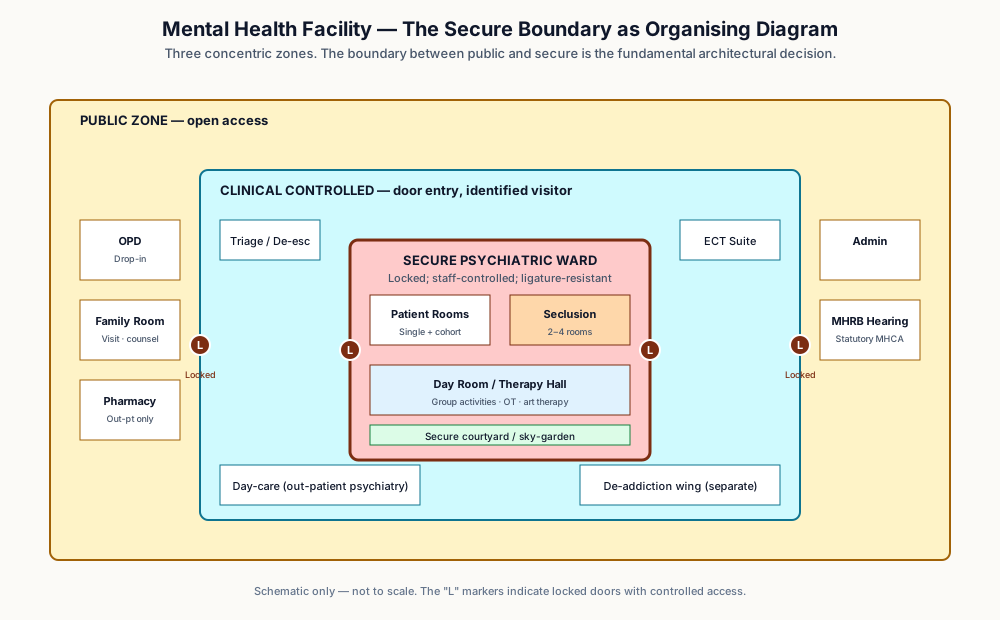
The three-zone model:
| Zone | Access | Detailing | Functions |
|---|---|---|---|
| Public Zone | Open access; identified-visitor only | Standard healthcare detailing | OPD, family room, pharmacy, admin, MHRB hearing room |
| Clinical Controlled | Door entry; staff-controlled; identified visitor | Standard healthcare detailing with reinforced doors | Triage / de-escalation, day-care, ECT suite, de-addiction wing |
| Secure Psychiatric Ward | Locked; staff-controlled exit; ligature-resistant throughout | Full ligature-resistant specification | Patient rooms, seclusion, day-room, secure courtyard |
Design rules at the boundary:
- Door interlocks — staff-controlled doors with vestibule (sally-port) configuration where appropriate; not a single-door barrier.
- Visual transparency at the boundary — observation panels in doors so staff and visitors can see across without opening; reduces the perception of confinement.
- Equipment crossings — dietary trolleys, medication trolleys, linen, BMW, must cross the boundary on a controlled schedule; service-side crossings should be physically separate from family/visitor crossings.
- Emergency egress — fire egress requirements (NBC Part 4) must be met without compromising security; typically achieved with door-position-monitor alarms and break-glass override.
- Family meeting at the boundary — the family meeting room is best placed at the boundary, with one entry from the public side and one from the secure ward; allows family visit without family entering the secure ward.
The MHCA 2017 architectural overlay at the boundary. §95 of the Act prohibits chaining and similar restraints absolutely. §97 permits seclusion only as a last resort, with documentation, time limits, and continuous observation. The architectural implication is that the secure boundary is a clinical necessity (for involuntary patients, for high-acuity patients) but not a punishment instrument. The boundary design must convey clinical safety, not custodial confinement. A boundary with a high stone wall, razor wire, and a guard tower is a 1900s asylum boundary; a boundary with a transparent vestibule, a friendly receptionist, and a courtyard view is a 2020s mental health establishment boundary. The two communicate radically different intentions to the same patient and family.
"The locked door of a mental health establishment must say to the patient: this door protects you, not punishes you. If it does not communicate this, the architect has failed before the clinician has begun." — Dr. Vikram Patel (b. 1964), psychiatrist and global mental health scholar, paraphrased from a 2020 keynote
3. The Six Levels of Psychiatric Care — Typology Decision
Indian psychiatric practice operates at six levels. Each level carries a distinct architectural brief and a distinct registration path under the MHCA 2017. The brief must declare which level (or combination) the facility is at concept stage; an undeclared brief is the source of most subsequent re-design.
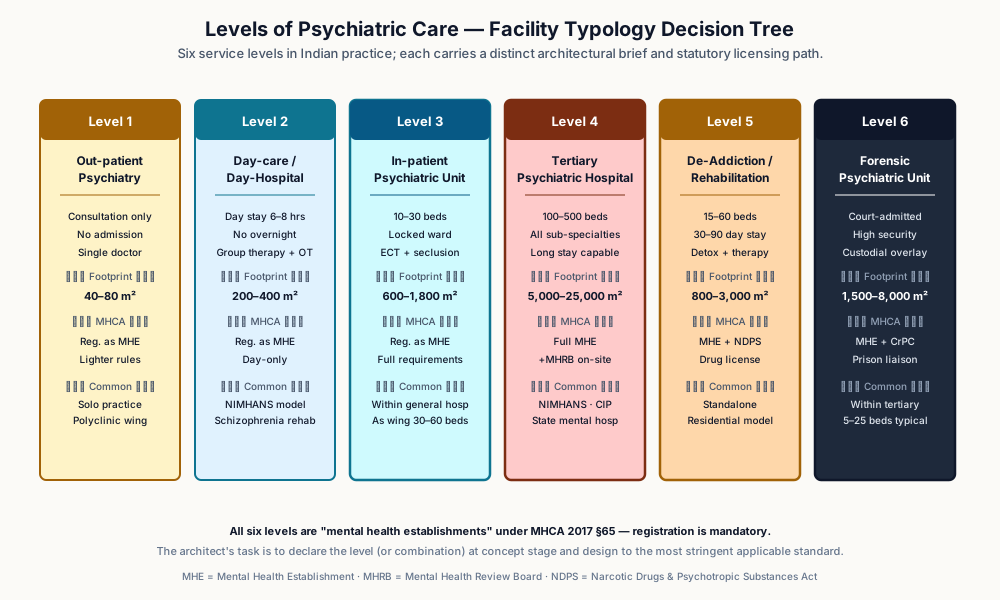
The six levels at a glance:
| Level | Service | Beds | Footprint | MHCA Registration | Indian Examples |
|---|---|---|---|---|---|
| 1. Out-patient psychiatry | Consultation only; no admission | 0 | 40–80 m² | MHE-light | Solo practice; polyclinic wing |
| 2. Day-care / day-hospital | Day stay 6–8 hr; group + OT therapy; no overnight | 0 (chairs) | 200–400 m² | MHE — day | NIMHANS day-care model; rehabilitation day-hospitals |
| 3. In-patient psychiatric unit | Locked ward; ECT; seclusion; 7–30 day stays | 10–30 | 600–1,800 m² | MHE — full | Within general hospital; standalone wing |
| 4. Tertiary psychiatric hospital | All sub-specialties; long stay capable; teaching | 100–500 | 5,000–25,000 m² | MHE — full + MHRB on-site | NIMHANS Bengaluru; CIP Ranchi; state mental hospitals |
| 5. De-addiction / rehabilitation | Detox + therapy; 30–90 day residential | 15–60 | 800–3,000 m² | MHE + NDPS license | Standalone residential; within tertiary |
| 6. Forensic psychiatric unit | Court-admitted; high security; custodial overlay | 5–25 | 1,500–8,000 m² (within tertiary) | MHE + CrPC compliance | Within state mental hospitals; specialist units |
Decision drivers:
- Catchment — Levels 1, 2, 3 work in tier-1 and tier-2 cities; Levels 4, 5, 6 are tertiary referral facilities for state-wide or zonal catchment.
- Bed-mix — Level 4 (tertiary) typically operates with a sub-mix: 60% acute care (mood, psychosis, anxiety), 15% rehabilitation, 10% de-addiction, 5% forensic, 10% specialty (CAP, geriatric, perinatal).
- Voluntary vs involuntary admission ratio — drives the secure-boundary footprint; involuntary-heavy facilities need a larger locked ward.
- Cultural positioning — community-stepping-stone facilities (corporate-adjacent, day-care-led) have entirely different architectural reads from state mental hospital tertiary buildings.
- Government vs private — government mental health facilities under DMHP are bound by IPHS-equivalent space norms; private facilities work within state CEA-equivalent norms but with looser bed-area minimums.
The architect's first contribution is to challenge the brief if the bed-strength, the catchment, and the level positioning are inconsistent. A 30-bed tertiary positioning in a tier-3 town will fail commercially within two years; a 100-bed Level-3 unit with no Level-4 referral relationship will be rejected by patients with complex needs.
4. The MHCA 2017 Regulatory Stack
The Mental Healthcare Act 2017 replaced the Mental Health Act 1987 and is the single most consequential statutory change for psychiatric architecture in India in fifty years. Its impact is rights-based, not infrastructural — but the rights have spatial implications throughout the building.
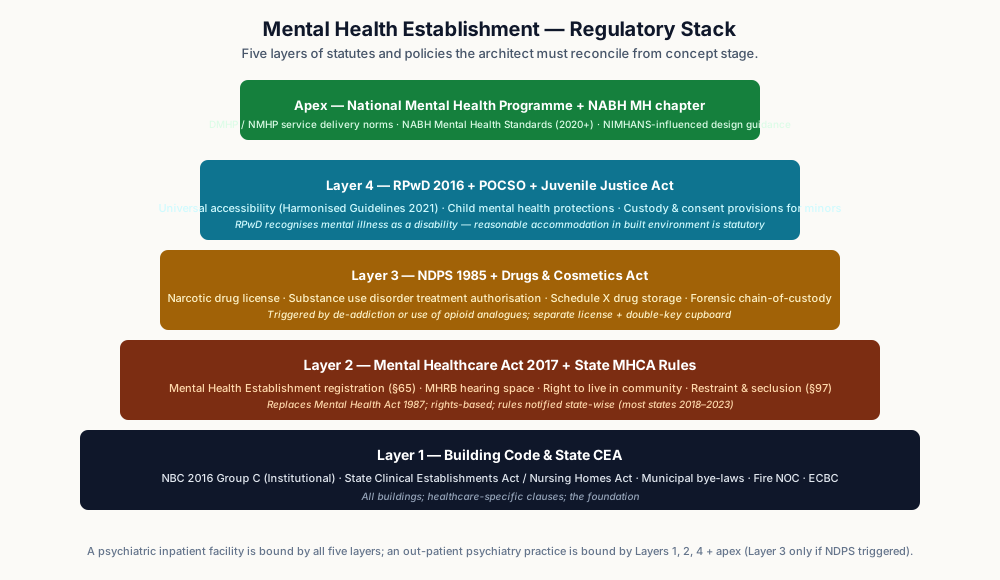
Layer 1 — Building Code & State CEA. The foundation: NBC 2016 Group C (Institutional), the state Clinical Establishments Act / Nursing Homes Act, municipal bye-laws, fire NOC, ECBC. Same as for any healthcare facility.
Layer 2 — Mental Healthcare Act 2017 + State MHCA Rules. The defining layer. Key architectural implications:
| MHCA 2017 Section | Provision | Architectural Implication |
|---|---|---|
| §65 — Registration of Mental Health Establishments | Mandatory registration of any facility providing mental health treatment (in-patient, out-patient, day-care) | Statutory minimum-facility schedule per state rules; architect provides facility-compliance dossier |
| §19 — Right to Live in Community | Patient has the right to be discharged to community living; long-stay default is clinically unjustified | Building design should support short-stay rehabilitation; long-stay residential model is regulatorily disfavoured |
| §20 — Right to Protection from Cruel, Inhuman, Degrading Treatment | Statutory right to dignified treatment | "Ward of thirty" is non-compliant; minimum bed-room area must be sufficient for personal storage and dignity |
| §22 — Right to Live with Dignity | Statutory right | Personal storage in patient rooms; choice of clothing; private toilet; home-like finishes |
| §23 — Right to Confidentiality | Patient information cannot be shared without consent | Family meeting rooms must be acoustically private; staff workstations separate from patient-accessible space |
| §95 — Prohibition on Chaining & Restraint | Chaining is absolutely prohibited; physical restraint only in emergency | Architecture must support restraint-free care: de-escalation room before seclusion; sufficient staffing-by-sightline |
| §97 — Restraint, Seclusion | Permitted only as last resort, with continuous observation, time limits (4-hour seclusion review), statutory documentation | Seclusion room must support observation, time-tracking, documentation |
| §19 (Advance Directive) | Patient may pre-declare treatment wishes; respected when patient lacks capacity | Building should support advance directive consultation space |
| §80–82 — Mental Health Review Board | District-level statutory tribunal; hears patient appeals | Tertiary facilities must accommodate MHRB hearings — dedicated room or scheduled use of a meeting room with privacy and recording capability |
| §103 — Right to Information | Patients must be informed of their rights at admission | Display board in admission area + each ward; bilingual; tactile |
Layer 3 — NDPS 1985 + Drugs & Cosmetics Act. Triggered if the facility is involved in de-addiction, opioid analogue prescribing, or substance use disorder treatment. Drug license + Schedule X controlled-drug cupboard + forensic chain-of-custody.
Layer 4 — RPwD 2016 + POCSO + JJ Act. The Rights of Persons with Disabilities Act 2016 recognises mental illness as a disability — reasonable accommodation in the built environment is statutory. POCSO and the JJ Act apply if the facility admits minors.
Apex — National Mental Health Programme + NABH Mental Health chapter. The DMHP / NMHP service-delivery norms set the public-sector scope; NABH's mental health chapter (introduced in the 5th Edition, 2020) provides the accreditation framework.
The state notification matrix. The MHCA 2017 is a Centre Act, but the State Mental Health Rules notify the operational details — minimum-area schedules, staffing ratios, MHRB constitution, registration fees. As of 2026, most states have notified rules (Karnataka 2018, Maharashtra 2018, Tamil Nadu 2019, Kerala 2019, Delhi 2018, West Bengal 2019, Telangana 2018). A few states are still operating on transitional rules. Architects must read the state-specific rules — a facility design that meets the MHCA Centre Act minimum but falls short of the state minimum will not be registrable.
5. Ligature-Resistant Detailing — The Architectural Signature
Ligature-resistant detailing is the most distinctive architectural craft in mental health facility design. No other typology requires it; once internalised, it transforms how the architect looks at door, bed, window, sanitary, ceiling, and fixture.
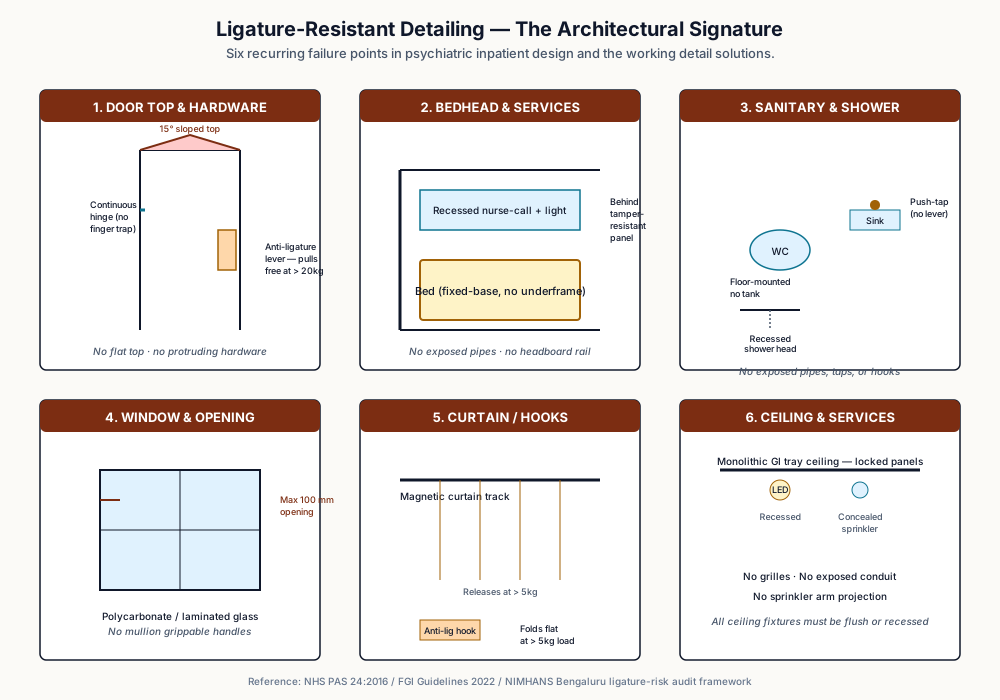
Six recurring failure points and their detail solutions:
| # | Failure Point | Working Detail Solution | Indicative Cost Premium (vs standard) |
|---|---|---|---|
| 1 | Door top | 15° sloped top; no flat surface for ligature anchor; concealed hinge or continuous (piano) hinge; anti-ligature lever handle that pulls free at > 20 kg load | 30–60% on door assembly |
| 2 | Bedhead and services | Fixed-base bed (no underframe); wall-recessed nurse-call and reading light; tamper-resistant panel; no exposed bedhead rail | 40–80% on bed |
| 3 | Sanitary fixtures | Floor-mounted WC (no tank, no pipework); recessed shower head; push-tap (no lever); concealed cisterns; no exposed pipes; integrated grab-bar where required | 60–120% on sanitary fitout |
| 4 | Window | Polycarbonate or laminated security glass; max 100 mm opening (anti-egress); no mullion grippable handles; window restrictors with key release for staff | 50–100% on window |
| 5 | Curtain / hooks / soft furnishings | Magnetic curtain track that releases at > 5 kg load; anti-ligature coat hooks that fold flat at > 5 kg load; no exposed cords (blinds, shower curtains) | 80–150% on soft fitout |
| 6 | Ceiling and services | Monolithic GI tray ceiling with locked panels; recessed LED lighting (no surface mount); concealed sprinklers (with side-wall sprinklers in rooms); no grilles or exposed conduit | 100–200% on ceiling |
The risk-zone classification. Not all spaces require the same level of ligature-resistance. The pattern that has stabilised in international practice is:
| Risk Zone | Required Detailing | Spaces |
|---|---|---|
| Very High Risk | Full ligature-resistance; no removable items; CCTV-monitored | Seclusion room |
| High Risk | Full ligature-resistance; minimal furniture; low-stim aesthetic | Patient ensuite bathrooms; observation rooms |
| Medium Risk | Ligature-resistant fixtures; supervised activity; no high-risk items | Patient bedrooms; therapy rooms |
| Low Risk | Standard healthcare detail; supervised access; some risk items removed | Day-room; OT space; corridors within ward |
| Standard | Standard healthcare detail | OPD; admin; family meeting rooms; ECT suite (anaesthesia-monitored) |
The "low-stim" specification. Beyond ligature-resistance, psychiatric inpatient spaces benefit from a "low-stimulus" specification — minimal pattern, muted colour, soft-but-not-harsh lighting, no reflective surfaces (which can be disturbing for some patients), no fluorescent buzz, no high-frequency equipment noise. This is a finishes specification, not a structural one, but it materially affects patient experience and reduces self-soothing-through-furniture-rearrangement events.
The Indian sourcing problem. Ligature-resistant fittings are largely imported (UK, Germany, USA) and carry a significant cost premium in India. A few Indian manufacturers have entered the market in the last five years (MM Trade in Bengaluru, IndoSafe in Pune) but the catalogue is thin. Architects working on Indian projects should provision early — equipment lead times are 12–20 weeks for imports, and substitution of standard fittings at construction stage produces the most common ligature-failure post-occupancy. A pre-detail review with the equipment manufacturer at preliminary design stage is the single most effective failure-prevention measure.
"Ligature-resistant detailing is invisible when it works and unforgivable when it does not. The architect's craft in mental health is the discipline of making safety look like ordinary good design." — Dr. Mohan Isaac (b. 1953), Indian psychiatrist now in Australia, paraphrased from a 2017 conference on environmental psychiatry
6. The Seclusion / De-escalation Suite
Seclusion is the most regulated single space in any mental health facility. Under MHCA 2017 §97, it is permitted only as a last resort, only with continuous observation, only with time limits (4-hour reviews), and only with statutory documentation. The architectural design must support all of these.
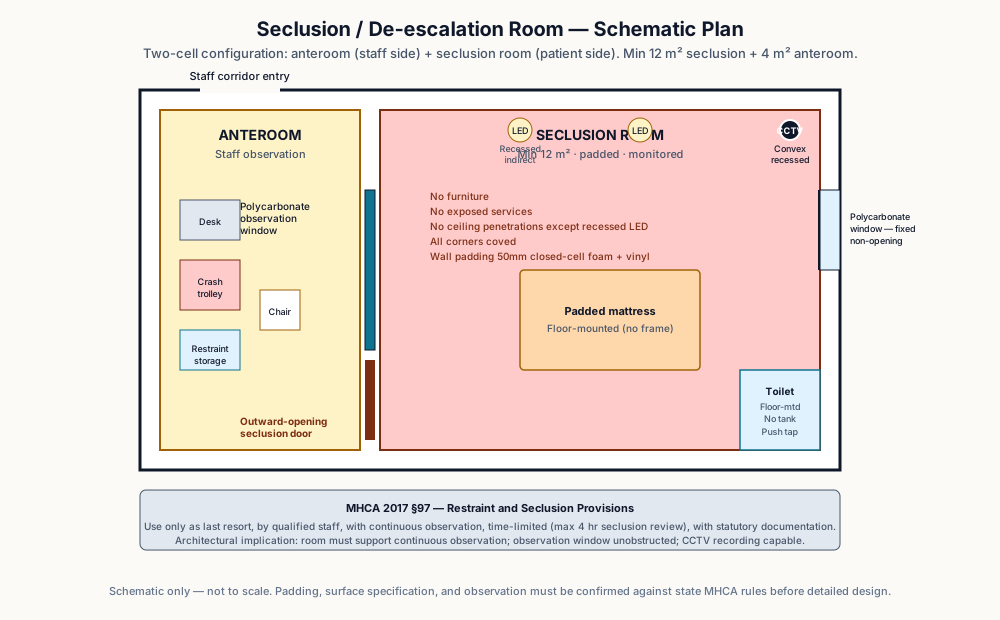
The two-cell configuration:
The standard contemporary seclusion room is a two-cell arrangement: an anteroom (for staff observation, documentation, and equipment) and the seclusion room itself (for the patient). The anteroom is the architectural difference between the seclusion room as clinical safety feature (with continuous observation and documentation) and the seclusion room as "padded cell" (with door checks at intervals).
Schedule of accommodation:
| Element | Specification |
|---|---|
| Anteroom area | 4–6 m² minimum |
| Seclusion room area | 12 m² minimum (FGI / NHS); 14 m² preferred for plus-size patients |
| Total suite | 16–20 m² (two cells + dividing wall) |
| Observation window | Polycarbonate 25 mm minimum; min 1.2 × 0.6 m; mounted at standing eye level; anti-tampering glazing strips |
| Door | Outward-opening (away from patient) heavy-duty; observation pane; emergency-release key from anteroom side; door alarm linked to nurse station |
| Wall finish | 50 mm closed-cell foam padding on all walls + floor coving; vinyl-finished (washable, anti-microbial) |
| Floor finish | Padded vinyl on closed-cell foam underlay; coved at all walls |
| Ceiling | Monolithic; recessed indirect LED lighting (typically 2 fittings); flush sprinkler; no grilles |
| Window | Polycarbonate fixed (non-opening); integrated to padding; max 1.0 × 0.6 m opening |
| Camera | Convex recessed CCTV; 360° coverage; mounted at ceiling level; tamper-resistant; recording linked to nurse station |
| Toilet | Floor-mounted WC; no tank; push-flush; integrated within seclusion (alcove with low partition) |
| Mattress | Floor-mounted; padded; no frame; vinyl-covered; removable for cleaning |
| HVAC | Negative pressure (slight); 8 ACH min; quiet supply (no audible buzz); thermostatic comfort 22–24°C |
| Lighting | Recessed LED indirect; dimmable from anteroom; 100 lux ambient minimum; emergency lighting standard |
| Audio | Two-way audio between anteroom and seclusion (allows patient to call staff and staff to soothe) |
| Anteroom equipment | Documentation desk + computer; crash trolley space; restraint storage; observation chair |
The de-escalation room — distinct from seclusion. A de-escalation room is the first response to a patient in distress: a calm room with reduced stimulus where staff can negotiate before considering seclusion. It is voluntarily entered, has more natural finishes, may have a window (closed-glass), and is not padded. A facility should have de-escalation room before it has a seclusion room. The MHCA 2017 §95 prohibition on coercive restraint implies that de-escalation must be the architectural-first response.
Indian context — the "open ward" tradition. Several Indian tertiary mental health facilities (CIP Ranchi, IHBAS Delhi, parts of NIMHANS Bengaluru) operate "open ward" sections where seclusion is rare to non-existent, and the architecture is designed for community-style rehabilitation. This is an aspirational model, particularly for stable patients in Levels 4–5; the architect should support the option in the design even if the operational model is initially more restricted. Seclusion-light operations need fewer locked doors, more day-room area, larger gardens, and structured occupational programmes — all of which scale with floor area.
7. The ECT Suite — Day-Care Surgery with Mental-Health Overlay
Electroconvulsive therapy (ECT) is, for severe depression, mania, and certain catatonic presentations, an evidence-based and rapidly effective treatment. Modified ECT — administered with anaesthesia and muscle relaxant — is the standard of care in India today. The ECT suite therefore has the architectural logic of a day-care surgical suite with a mental-health overlay.
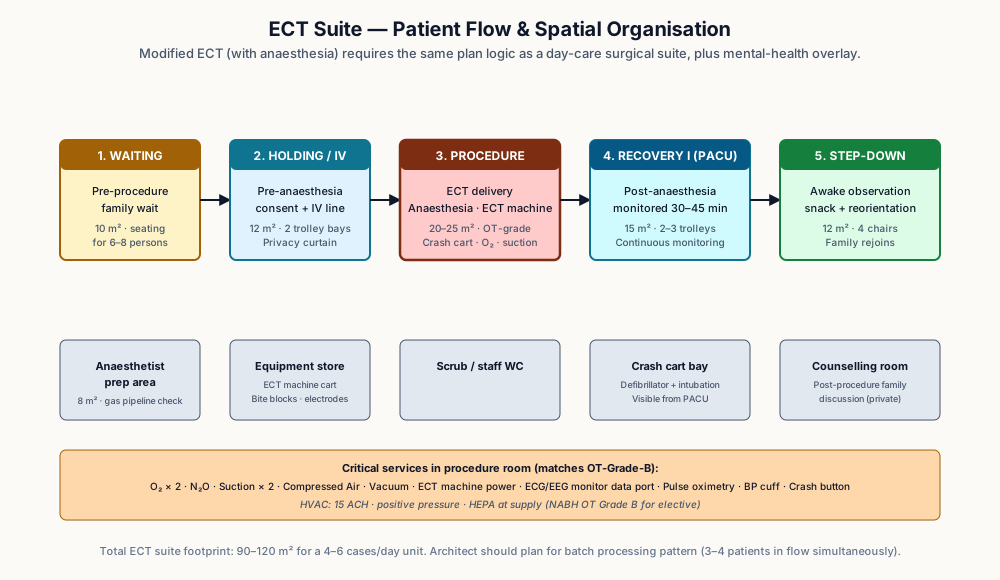
Five-station patient flow:
| Station | Function | Area | Notes |
|---|---|---|---|
| 1. Waiting | Pre-procedure family wait | 10 m² | Comfortable seating for 6–8; access to WC |
| 2. Holding / IV | Pre-anaesthesia consent + IV line | 12 m² | 2 trolley bays; privacy curtain |
| 3. Procedure | ECT delivery under anaesthesia | 20–25 m² | OT-Grade-B environment; HEPA-filtered; 15 ACH; positive pressure |
| 4. Recovery I (PACU) | Post-anaesthesia monitored | 15 m² | 2–3 trolley bays; continuous monitoring; nurse station |
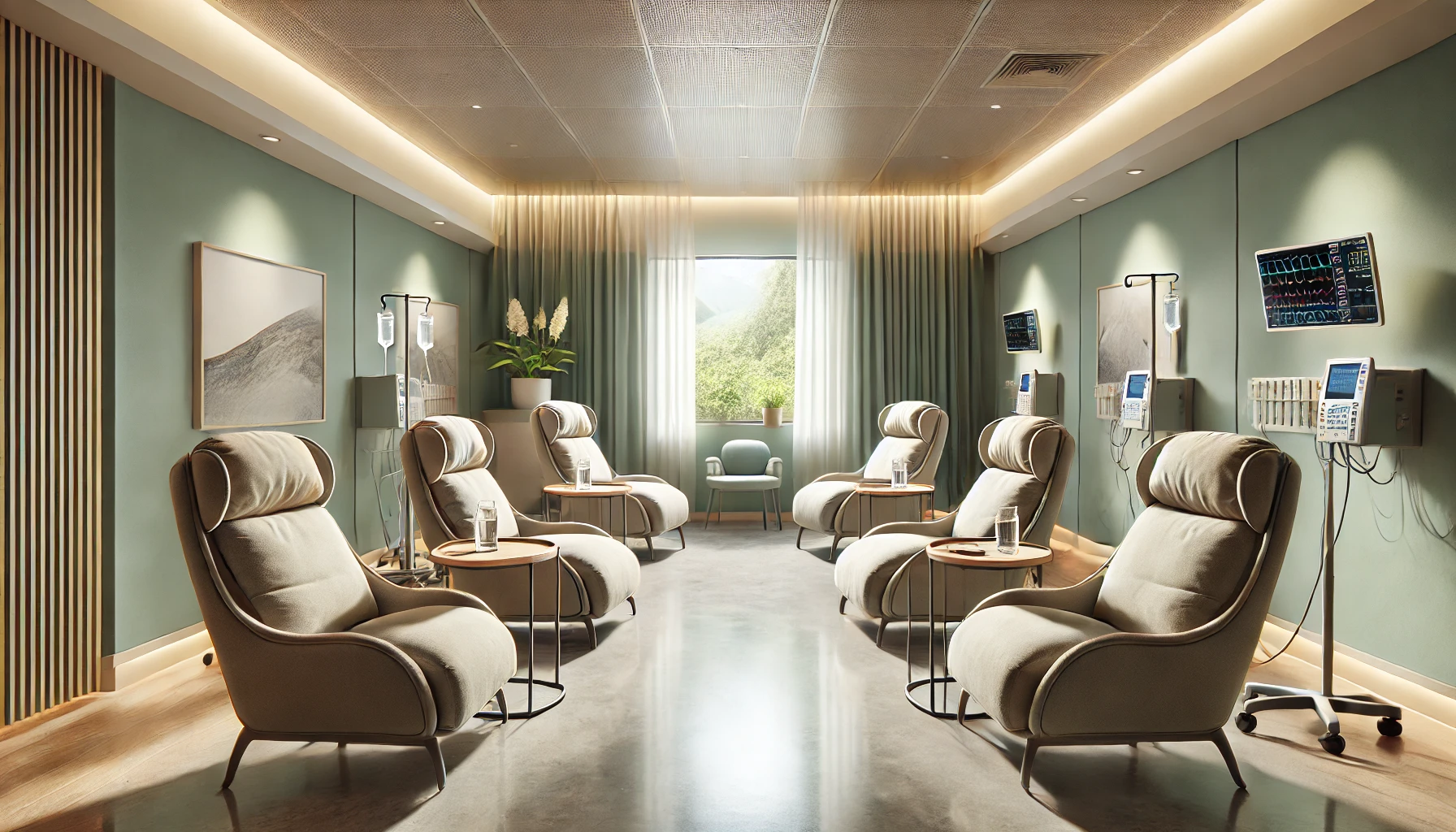
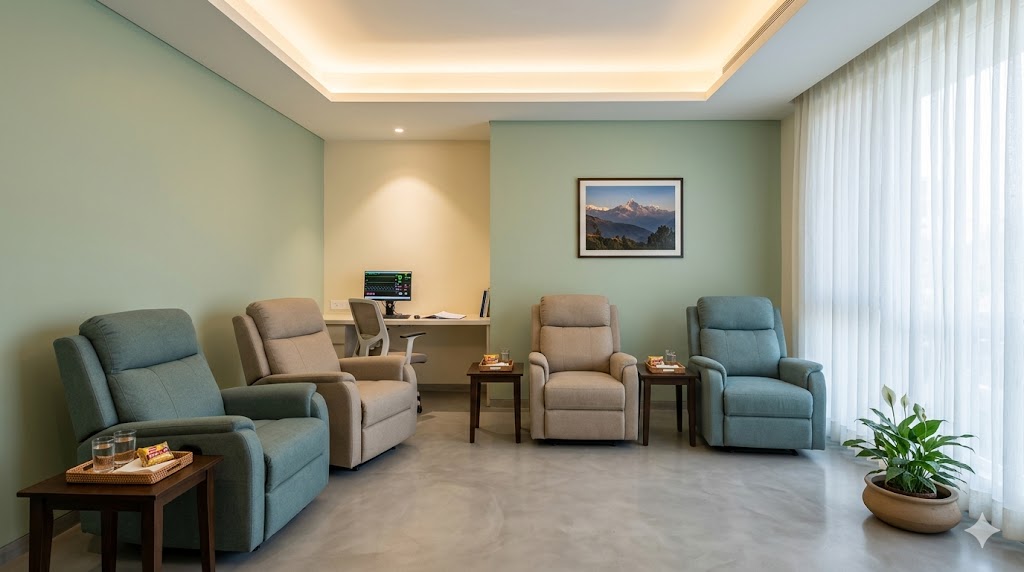
| 5. Step-down | Awake observation; reorientation | 12 m² | 4 chairs; family rejoins; light snack; discharge counselling |
Total ECT suite footprint: 90–120 m² for a 4–6 cases/day unit.
Critical services in procedure room (matches OT-Grade-B):
- O₂ × 2, N₂O, suction × 2, compressed air, vacuum (medical gas pipeline)
- ECT machine power; bite-block storage
- ECG/EEG monitor data ports; pulse oximetry; BP cuff
- Crash button linked to nurse station
- Anaesthesia machine
- Crash cart bay (visible from PACU)
Architectural considerations specific to ECT:
- Batch processing — ECT is typically scheduled in batches of 4–6 cases on dedicated days. The suite must accommodate three or four patients in flow simultaneously (one in holding, one in procedure, one in PACU, one in step-down). A linear suite layout supports this; a clustered layout with a single shared circulation works for low-volume facilities (≤ 2 cases/day).
- Counselling and consent room adjacent — ECT consent is a sensitive process; a private counselling room within the suite supports same-day consent confirmation.
- Family education space — patients return to ECT regularly (often 6–12 sessions over 3–4 weeks); family education on what to expect post-ECT is a routine activity. The waiting area can serve, or a dedicated education corner can be provided.
- Memory of the suite — patients undergoing ECT often experience temporary memory disruption around the procedure. Wayfinding within the suite should be clearly redundant (visual + signage + staff escort) so disorientation does not compound the post-procedural state.
8. The Eight Principles of Therapeutic Environment
Beyond the regulatory and clinical safety requirements, the design of a mental health facility is shaped by a body of evidence-based environmental psychology that has matured over the last forty years. The Chrysikou (2014) framework and the Ulrich et al. (2018) suicide-prevention design study together define what is now widely accepted as the "Rule of 8" for therapeutic environment.
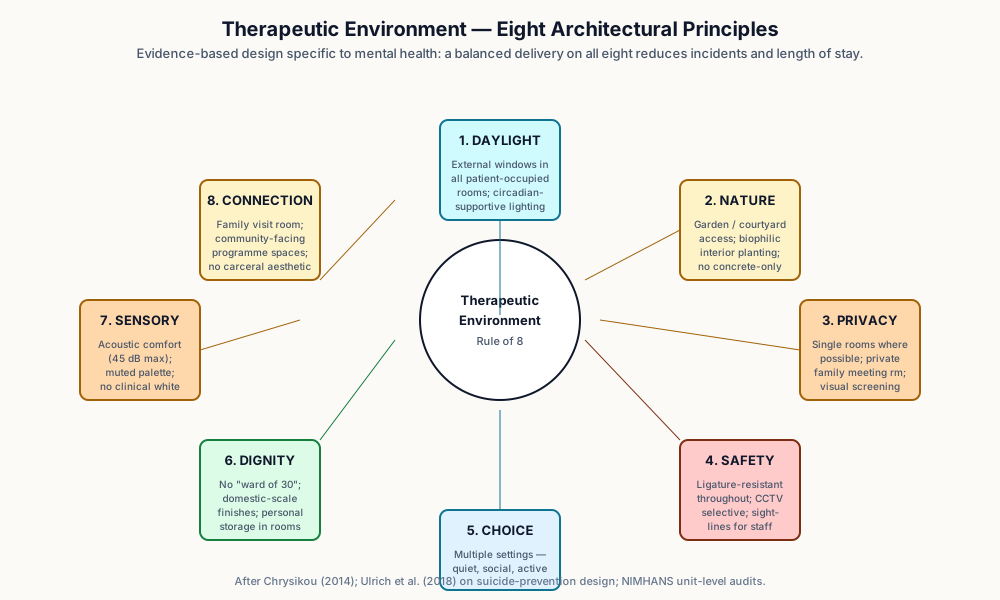
| # | Principle | Architectural Expression |
|---|---|---|
| 1 | Daylight | External windows in all patient-occupied rooms; circadian-supportive lighting; no internal-core wards |
| 2 | Nature | Garden / courtyard access from secure ward; biophilic interior planting; views of outdoor greenery from beds |
| 3 | Privacy | Single rooms preferred; private family meeting space; visual screening at WC and shower |
| 4 | Safety | Ligature-resistant throughout secure zone; CCTV used selectively (not pervasively); sight-lines designed for staff |
| 5 | Choice | Multiple settings within ward — quiet, social, active; choice of seating; choice of privacy level |
| 6 | Dignity | Domestic-scale finishes; personal storage in rooms; choice of clothing; no hospital gown default |
| 7 | Sensory | Acoustic comfort (max 45 dB ambient); muted colour palette; warm CCT lighting; no clinical white |
| 8 | Connection | Family visit rooms; community-facing programme spaces; outpatient and inpatient share community area; no carceral aesthetic |
The "domestic scale" principle. Mental health facilities designed at "hospital scale" (long corridors, large multi-bed wards, central nurse stations) produce poorer clinical outcomes than those designed at "domestic scale" (clusters of 6–8 patient rooms around a shared living area, no through-corridor circulation, decentralised nurse stations). The architectural difference is profound and underpins the international shift from the asylum model to the "household model" pioneered at the Maudsley Hospital in London in the 1990s and replicated worldwide. Indian tertiary practice has begun to adopt this — the new wards at NIMHANS Bengaluru and the de-addiction unit at AIIMS Delhi exemplify it.
Acoustic comfort as clinical priority. Patients with mental health conditions are often more sound-sensitive than other patients. Door slams, overhead announcements, equipment buzz, and corridor footfall can trigger distress. Acoustic specifications for psychiatric wards should be tighter than for general wards: STC ≥ 55 between bedrooms, NC ≤ 35 ambient, no overhead PA in patient areas, and silent door closers throughout.
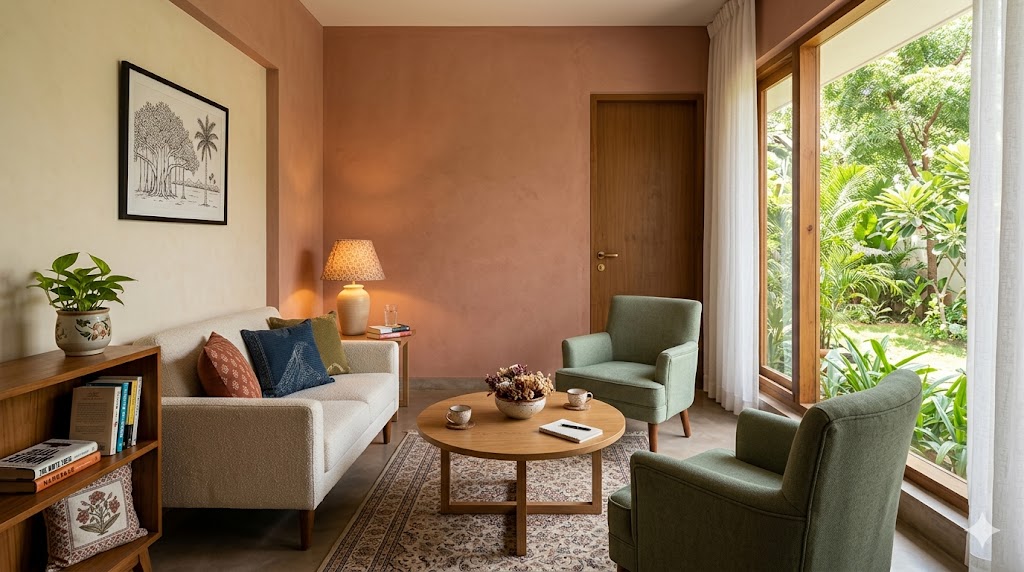
Colour and the "no white wall" guidance. Clinical-white walls produce higher patient distress in psychiatric units than warm-neutral palettes (Ulrich et al., 2018). The contemporary specification is muted earth tones — soft sage, warm grey, dusty cream, gentle terracotta — with selective accent colour for wayfinding. Pure white is reserved for ceilings; even then, off-white (NCS S 0500-N or similar) is preferred.
"In mental health, the building is not a container for treatment; it is part of the treatment. Get this wrong and you treat the patient against the building. Get it right and you treat them through it." — Dr. Pratap Sharan (b. 1959), psychiatrist and former Director, Department of Psychiatry, AIIMS Delhi, paraphrased from a 2018 lecture
9. The Patient Room and the Ward — Single vs Cohort
The single-room ward has become the de facto international standard for psychiatric inpatient design over the last twenty years. Indian practice has largely caught up — most new tertiary wards specify single rooms or twin rooms, with cohort wards reserved for budget-constrained government facilities.
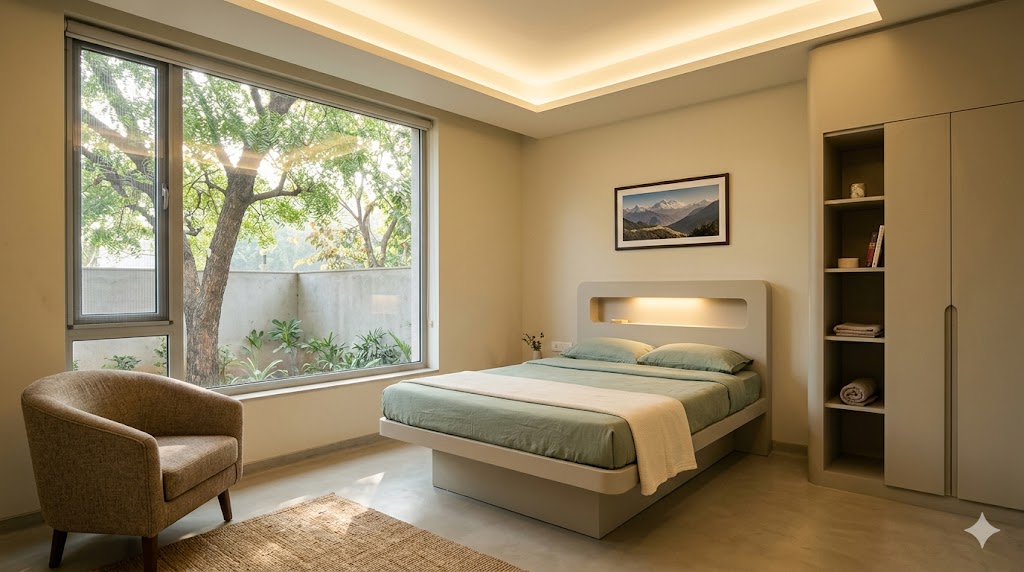
Single room (recommended baseline):
| Element | Specification |
|---|---|
| Room area | 12–14 m² clear (FGI 2022 minimum; 14 m² preferred) |
| Configuration | 4-walled with door opening to corridor; window to outside on one wall |
| Bed | Fixed-base; no underframe storage (limits ligature anchor) |
| Bedside furniture | Tamper-resistant nightstand; no drawers with metal slides; integrated shelving preferred |
| Wardrobe | Built-in; no internal hanging rod (replaced with anti-ligature shelf system); lockable drawer for valuables |
| Personal storage | Minimum 0.5 m linear shelving; signature of MHCA-era dignity |
| Ensuite | Recommended (single-room standard); 4–5 m²; full ligature-resistance |
| Window | Polycarbonate; 100 mm max opening; 1.5 × 1.0 m typical; sill at 750 mm (view from bed) |
| Door | Outward-opening (clinical safety); observation pane (privacy blind on patient side); sound seal |
| Lighting | Two-scene: ambient (300 lux) + reading (500 lux); recessed; staff-controllable from corridor |
| Acoustic | STC ≥ 55 to next room; STC ≥ 50 to corridor |
| Nurse-call | Recessed wall-mounted; corded pull (anti-ligature) |
| Network | Patient-education TV optional; staff observation panel |
| Décor | Personalisable — patient may put up a photo or two; supports dignity |
Twin room (for budget-constrained facilities):
- Maximum 2 beds; at least 12 m² per bed
- Privacy curtain (magnetic-release type)
- Shared ensuite
- Generally avoided in new construction; common in Indian government
Cohort ward (3+ beds):
- 8–10 m² per bed (state CEA minimum)
- Shared ensuite (1 per 4 beds maximum)
- Common in budget government facilities; not recommended for new construction
- Architectural risk: the "ward of thirty" historical model that the MHCA 2017 §22 dignity provision implicitly prohibits
Special-care patient rooms. A small number of patient rooms in any ward should be designated as "special care" — for high-acuity patients who do not yet require seclusion but need closer observation. These are typically:
- Located closer to nurse station (sight-line)
- Have observation panel in door (with patient-side privacy blind)
- Slightly larger (16 m²) for clinical examination room use
- Specified to highest ligature-resistance standard
- Equipped with alarm-monitor outlets
A 30-bed ward typically has 4 special-care rooms (~13%), 24 standard single rooms (80%), and 2 designated quiet-room / sensory-room spaces (7%).
10. The Day-Room, OT Hall, and Activity Programme
The bedrooms are where the patient sleeps; the day-room and the activity halls are where the clinical work happens. A psychiatric ward without sufficient day-room area is therapeutically inadequate regardless of the bedroom quality.
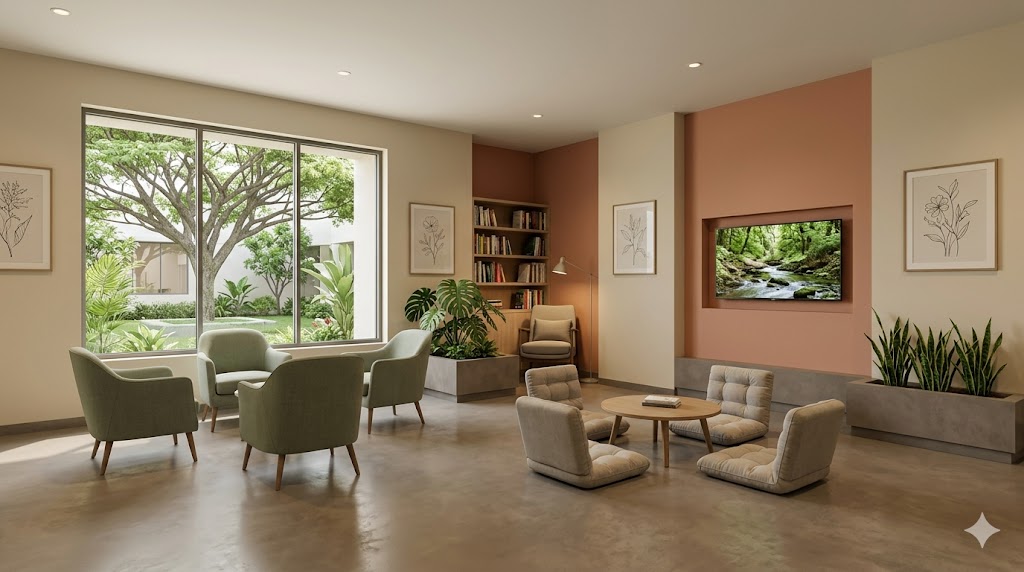
Day-room (within secure ward):
- 1.0–1.5 m² per ward bed (so a 30-bed ward needs 30–45 m² of day-room)
- Multi-zone: TV / reading / quiet seating / activity tables
- Mix of seating types — some upright, some recliner, some at table
- Daylight from external wall; view to garden if possible
- Domestic-scale finishes; no clinical aesthetic
- Adjacent to dining area (shared use possible)
Occupational Therapy (OT) hall:
- 30–60 m² typical for a 30-bed ward
- Can be in clinical-controlled zone (not necessarily within secure ward)
- Equipment storage for craft materials, art supplies, exercise equipment, music instruments
- Sink + work counter
- Daylight + view
- Acoustic separation (music therapy can be loud)
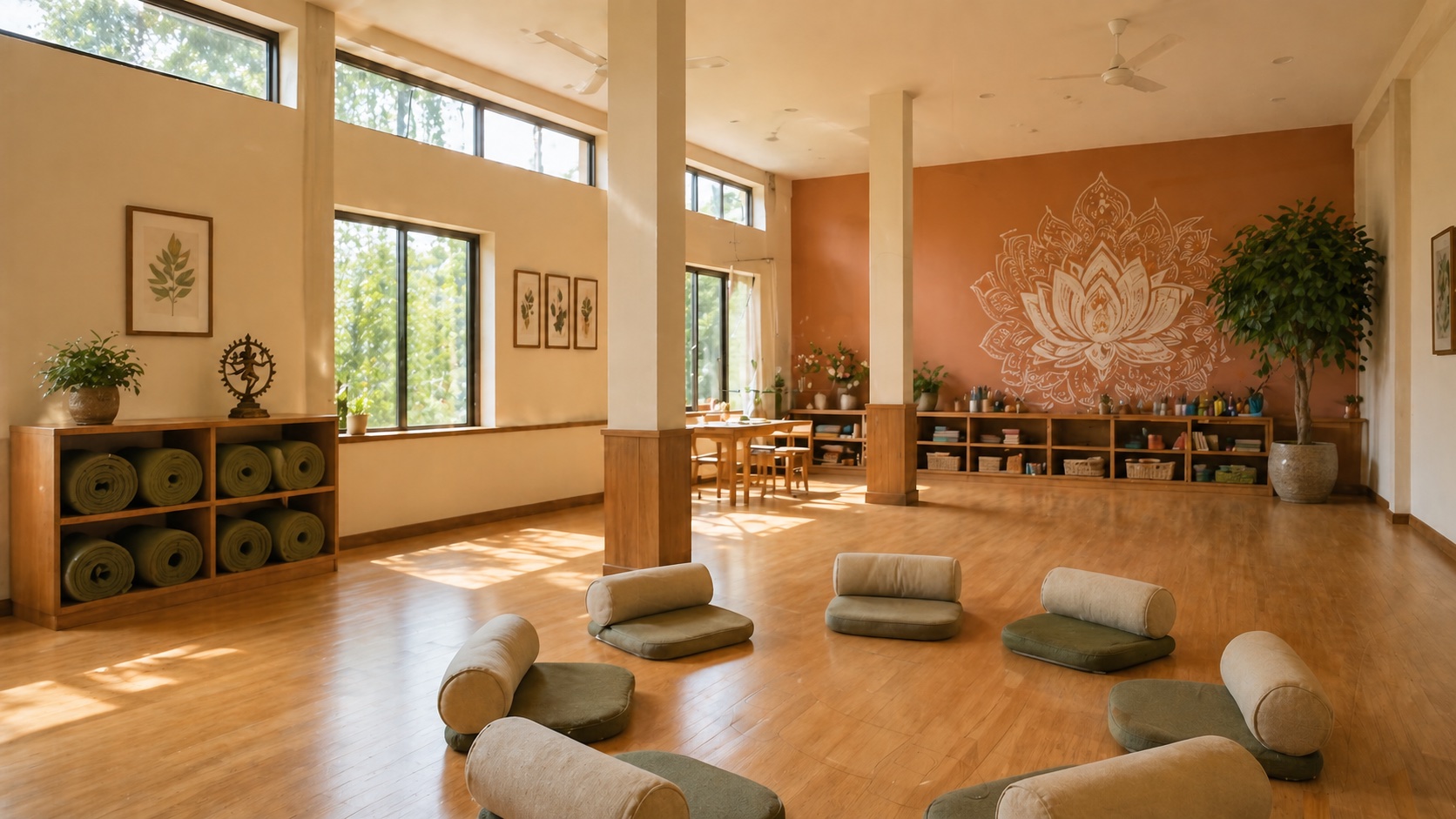
Art therapy / sensory room:
- 12–18 m²
- Adjustable lighting (dim possible)
- Sound-controlled
- Soft furnishings
- Removable equipment options (sand tray, weighted blanket, etc.)
Quiet room (within ward):
- 6–8 m²
- For solitary reading, prayer, meditation
- Calm finishes; minimal stimulus
- Optional: small library
Outdoor garden / courtyard:
- Statutory under MHCA in some states; clinically essential everywhere
- Min 1 m² per ward bed; 2 m² per bed preferred
- Secure perimeter (high fence or wall, but visually permeable where possible)
- Variety: lawn, paved walkway, planted areas, seating
- Safe planting (no toxic species, no thorny shrubs near pathway)
- Weather-protected pavilion or covered area for monsoon
- Lockable from secure side; gate to clinical-controlled if shared with day-care
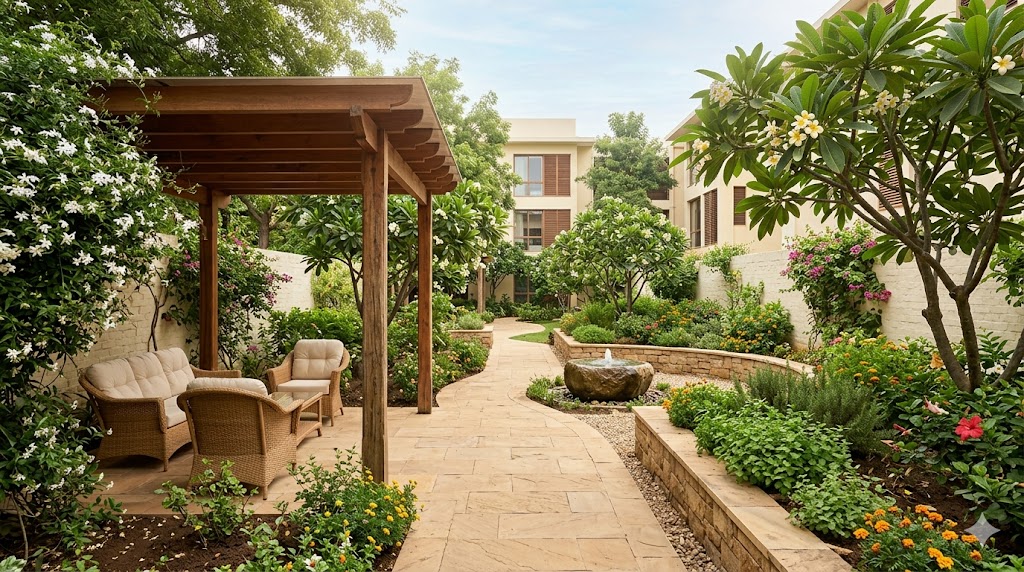
The Indian climate consideration. Indian patients spend more time outdoors than in many Western contexts. The garden / courtyard is therefore both clinically and culturally significant. A well-designed mental health garden in an Indian facility is one of the highest-value spaces in the project — it is the space the patient remembers, the space the family is invited to during visits, and the space that defines the institutional ethos. Examples worth studying: NIMHANS Bengaluru's older landscape (R.M. Varma's contribution), CIP Ranchi's heritage gardens, Iswar Sharan's contemporary work at Sweekaar Rehabilitation in Hyderabad.
11. De-Addiction and Forensic Overlays
Two specialty overlays change the architecture of a Level-3 or Level-4 facility: de-addiction and forensic.
11.1 De-Addiction (Level 5)
A de-addiction / rehabilitation unit is structurally distinct from a general psychiatric inpatient unit because the patient profile is different: typically 30–90 day stays, structured therapy programme, group-living model, residential atmosphere, often co-ed (separate gender wings). The architectural differences:
- Residential model — single rooms grouped into "households" of 6–10; shared dining; shared recreation; not "wards"
- No locked doors within the unit — the secure boundary is at the unit perimeter, not at every ward door (because patients are voluntary, often)
- Larger common areas — dining, group therapy, recreation, fitness
- Therapeutic kitchen / programme kitchen — patients participate in meal prep as part of recovery
- Vocational training space — basic carpentry, gardening, tailoring (model-dependent)
- Visitor accommodation — families visit weekly for structured programmes; visitor lodging on-site is common
- Outdoor space scaled for activity — sports court, walking path, gardening plot
- NDPS-compliant drug storage — Schedule X cupboard, double-key, restricted access
- No ECT — typically not part of de-addiction programmes
- Light medical infrastructure — basic emergency, no full OT
11.2 Forensic Psychiatric Unit (Level 6)
A forensic psychiatric unit admits patients who are involved with the criminal justice system: persons charged with crime but found unfit to stand trial, persons acquitted by reason of insanity, and persons whose mental illness has produced public-safety concerns requiring custodial-with-clinical care. The architectural overlay is heavy:
- Higher security perimeter — taller fence, fewer gates, prison-liaison access
- More controlled entry — typically a full vestibule with identification
- Dedicated transport bay — for prisoner-patient transfer from court / prison
- No shared space with non-forensic patients — physical separation throughout
- Court-link facilities — video-conferencing rooms for remote court hearings
- Higher staffing-to-patient ratio — sight-line-driven design
- Heavier door specifications — to hardware grade-1 standards
- No outdoor unsupervised access — courtyards must have full visual control
- Statutory observation — many jurisdictions require continuous CCTV recording with longer retention
- MHRB hearing room — forensic patients have particular use of MHRB; typically a dedicated hearing space within the unit
- Limited family contact zones — supervised visits in a dedicated room; no in-room visits
- Religious / ethnic provisions — many forensic patients are long-stay; chapel / prayer room provision is important
The forensic unit is the most demanding architectural brief in the typology and is typically only undertaken at tertiary facilities with state government commission. The civilian architect should engage the state department of prisons, the state mental health authority, and a forensic-psychiatry specialist consultant from concept stage. A unit designed without prison-liaison input will produce repeated operational compromises.
12. NIMHANS-Influenced Indian Design Tradition
India has a small but globally-significant body of mental health architecture, centred on three institutions: the National Institute of Mental Health and Neuro Sciences (NIMHANS) in Bengaluru, the Central Institute of Psychiatry (CIP) in Ranchi, and the Institute of Human Behaviour and Allied Sciences (IHBAS) in Delhi. Together they have shaped a distinctively Indian approach to mental health facility design.
Common features of the NIMHANS-CIP-IHBAS tradition:
- Pavilion planning — facilities are organised as pavilions (separate buildings) connected by covered walkways, rather than as monolithic blocks. This responds to climate, supports staged construction, and creates implicit zone separation.
- Generous landscape — heritage and contemporary gardens; trees; lawns; pavilions in landscape rather than landscape between buildings.
- Open ward tradition — voluntary patients housed in less-restrictive environments; locked-ward designation reserved for involuntary or high-acuity patients.
- Vocational and rehabilitation focus — substantial OT, tailoring, gardening, agricultural, and craft programmes built into the brief; corresponding spaces designed in.
- Day-care integration — outpatient day-care as a stepping-stone between OPD and inpatient is a long-established Indian innovation.
- Family-stay tradition — many tertiary mental health facilities provide family-attendant accommodation on-site (an Indian cultural adaptation rare in Western practice).
- AYUSH integration — yoga, naturopathy, and ayurvedic mental health interventions are part of treatment at several Indian institutions; corresponding spaces (yoga hall, panchakarma room, herbal pharmacy) are designed in.
The contemporary Indian shift. The last fifteen years have seen new mental health buildings move toward the international "household" / "domestic-scale" / "low-stim" specifications while retaining the pavilion-and-landscape tradition. The Department of Psychiatry's new ward at AIIMS Delhi (2022), the rehabilitation wing at NIMHANS Bengaluru (under construction 2024–2026), and the IHBAS de-addiction extension exemplify this hybrid. The architect designing a new Indian mental health facility today should reference both the international evidence-based-design literature (Ulrich, Chrysikou, Karlin, Zeisel) and the Indian institutional tradition (NIMHANS, CIP, IHBAS, AIIMS). The synthesis is what produces a building that is internationally rigorous and culturally appropriate.
"NIMHANS taught India that mental health architecture could be Indian — that the courtyard and the verandah and the tree and the long covered walk are not nostalgic but therapeutic. The contemporary Indian architect's task is to take this tradition forward without freezing it." — Ar. Anjali Mody (b. 1968), Bengaluru architect, paraphrased from a 2021 essay on healthcare landscape
13. State MHCA Notification Matrix
The MHCA 2017 is a Centre Act, but operational details — minimum-area schedules, staffing ratios, MHRB constitution, registration fees — are notified state-by-state under State Mental Health Rules. A representative matrix:
| State | State MHCA Rules Notified | MHE Registration Body | Key State-Specific Provisions |
|---|---|---|---|
| Karnataka | 2018 | State Mental Health Authority, Bengaluru | NIMHANS as implementing authority; KPME concurrence required |
| Tamil Nadu | 2019 | TN State MHA, Chennai | Larger MHRB representation; OT registration distinct |
| Maharashtra | 2018 | State MHA, Mumbai | Bombay NH Act overlay continues |
| Kerala | 2019 | Kerala State MHA, Thiruvananthapuram | Strong rehabilitation focus; AYUSH integration |
| Delhi | 2018 | Delhi State MHA, Delhi | IHBAS as flagship; DMHP integration |
| West Bengal | 2019 | WB State MHA, Kolkata | Transparency provisions; family rights emphasised |
| Telangana | 2018 | Telangana State MHA, Hyderabad | Quick adoption of Centre rules |
| Uttar Pradesh | 2020 | UP State MHA, Lucknow | Larger workforce-norms emphasis |
| Gujarat | 2020 | Gujarat State MHA, Gandhinagar | Ahmedabad Mental Hospital as flagship |
| Andhra Pradesh | 2018 | AP State MHA, Vijayawada | Telangana-influenced rules |
| Odisha | 2019 | Odisha State MHA, Bhubaneswar | DMHP-strong |
| Bihar, Rajasthan, Madhya Pradesh, Punjab, Haryana, Chhattisgarh, Jharkhand | Various 2018–2023 | State authorities | Individually consult; rules vary materially |
The architect's deliverable. For any psychiatric facility commission, the first deliverable is the state MHCA compliance map: a one-page summary of (a) the specific facility level being registered, (b) the relevant state rules, (c) the minimum-area schedule applicable, (d) the staffing-norm implications for design (e.g., nurse-station-per-N-bed ratios shape ward sizing), and (e) the MHRB and inspection schedule. Without this map, the architectural brief is incomplete.
14. Common Failure Modes — Mental Health Facility Specific
A pattern audit of stalled or non-registrable Indian psychiatric projects reveals the following recurring failures:
| # | Failure Mode | Root Cause | Consequence | Prevention |
|---|---|---|---|---|
| 1 | Non-ligature-resistant fittings in patient rooms | Standard fittings specified to save cost | Suicide risk; MHCA non-compliance; potential litigation | Ligature-resistant specification at preliminary design; audit at handover |
| 2 | Seclusion room without anteroom | Single-cell padded room provided | Cannot support continuous observation; MHCA §97 non-compliance | Two-cell configuration from concept |
| 3 | No de-escalation room | Brief omits it; only seclusion provided | Unnecessary seclusion use; MHCA §95 spirit failure | De-escalation room before seclusion room in brief |
| 4 | "Ward of thirty" cohort design | Cost-driven; outdated brief | MHCA §22 dignity failure; registration risk | Single rooms or twin maximum |
| 5 | No outdoor garden / courtyard access from secure ward | Vertical site; brief overlooks | Patient confined indoors throughout stay; clinical outcome failure | Garden / courtyard from concept; sky-garden if vertical |
| 6 | Family meeting room missing or in public corridor | Brief overlooks | Confidentiality breach (MHCA §23) | Family meeting room at boundary |
| 7 | MHRB hearing space missing in tertiary facility | Brief overlooks statutory tribunal | Cannot conduct on-site hearings; logistical / legal failure | MHRB room in brief at concept (tertiary) |
| 8 | ECT suite without separate PACU | Single procedure room with bay-curtain | Anaesthesia recovery cohort with active patients; safety failure | Five-station suite from concept |
| 9 | No advance directive consultation space | RPwD 2016 / MHCA §19 overlooked | Compliance failure | Counselling room provision noted |
| 10 | Internal-core wards (no daylight) | Massing-driven | Therapeutic environment failure | External-wall wards from concept |
| 11 | Pervasive CCTV in patient bedrooms | Security overplay | Privacy breach; clinical failure | CCTV restricted to seclusion + corridors |
| 12 | High walls and razor wire perimeter | Carceral aesthetic; "asylum" hangover | Stigma reinforced; patient distress; brand failure | Visual-permeable secure perimeter |
| 13 | Fluorescent-lit corridors | Cost-driven; standard healthcare spec | Sensory aggravation; therapeutic failure | LED 3000K throughout; no fluorescents |
| 14 | Dining cohort without choice | Cafeteria-only model | Loss of dignity / choice; therapeutic failure | Mixed dining: cafeteria + smaller unit dining |
| 15 | No vocational / OT space at scale | Brief under-sizes activity programme | Therapeutic programme deficient | OT hall sized at 1 m²/bed minimum |
| 16 | No family-attendant accommodation in tertiary | Indian context overlooked | Family separation; cultural failure | Attendant rooms / lodging provisioned |
| 17 | Stretcher / lift sizing for restraint transfer | Standard healthcare lift | Cannot transfer restrained patient with attendants safely | Cabin sized with restraint protocol in mind |
| 18 | Absent NDPS-compliant drug cupboard | De-addiction adopted late in design | NDPS license refusal | Schedule X cupboard from concept |
15. Pre-Design Audit Framework for Mental Health Briefs
A 14-question audit to run on every mental health facility brief at concept stage. Three or more "no" answers indicate the brief is not ready for design.
| # | Audit Question | Why It Matters | Required Output |
|---|---|---|---|
| 1 | Is the facility level fixed (1–6 of the typology decision tree)? | Drives scope, MHCA registration path, and footprint | Level declaration in brief |
| 2 | Is the secure-boundary location declared? | Single most consequential design move | Secure boundary diagram |
| 3 | Is the state MHCA Rules notification read? | State minimums are binding | State compliance map |
| 4 | Is the bed-mix declared (acute / rehab / de-addiction / forensic / specialty)? | Drives ward design | Bed-mix table |
| 5 | Is the involuntary-admission proportion estimated? | Drives secure-ward sizing | Ward typology mix |
| 6 | Is ligature-resistance scoping done (which spaces, what level)? | Drives detail spec and procurement lead time | Risk-zone classification |
| 7 | Is the seclusion-vs-de-escalation strategy declared? | MHCA §95/§97 implication | De-escalation + seclusion room schedule |
| 8 | Is ECT in scope (and at what frequency)? | Drives ECT suite area | ECT scope declaration |
| 9 | Is MHRB hearing on-site (tertiary)? | Statutory tribunal space | MHRB room declaration |
| 10 | Is family-attendant accommodation in scope (Indian context)? | Cultural realism | Attendant lodging note |
| 11 | Is the AYUSH overlay in scope (yoga, naturopathy, ayurveda)? | Indian tradition; MHCA §19 right to traditional medicine | AYUSH spaces note |
| 12 | Is the outdoor garden / courtyard sized at ≥ 1 m²/bed? | Therapeutic environment + MHCA §22 | Landscape sizing |
| 13 | Is the day-room sized at ≥ 1 m²/bed and OT hall ≥ 1 m²/bed? | Activity programme adequate | Activity-programme sizing |
| 14 | Is the architectural language deliberately non-carceral? | Stigma-management + MHCA §22 | Aesthetic strategy note |
"The pre-design audit for mental health is the document where the ethical brief and the architectural brief converge. The architect who skips it produces a building; the architect who completes it produces an institution." — Dr. Rangaswamy Srinivasa Murthy (b. 1947), former Director of NIMHANS, paraphrased from a 2015 conference
16. The Architect's Mental-Health-Specific Compliance Deliverables
Beyond the general healthcare deliverables (see pillar reference), the mental-health-specific deliverables are:
| # | Deliverable | Recipient | Stage |
|---|---|---|---|
| 1 | Facility-level declaration with state MHCA compliance map | Client / state MHA | Concept |
| 2 | Secure-boundary diagram showing all controlled crossings | Client / clinical lead | Concept |
| 3 | Risk-zone classification (very high / high / medium / low / standard) | Client / clinical lead | Preliminary |
| 4 | Ligature-resistant detail set with manufacturer specifications | Equipment specialist | Detailed |
| 5 | Seclusion / de-escalation room layout with anteroom and observation | Clinical lead / state MHA | Detailed |
| 6 | ECT suite layout (5-station flow) | Anaesthesia consultant / clinical lead | Detailed |
| 7 | MHRB hearing room layout (tertiary) | State MHA | Detailed |
| 8 | Family meeting / advance directive room layout | Client | Detailed |
| 9 | Therapeutic environment statement (Rule of 8 application) | Client / NABH | Preliminary |
| 10 | Outdoor garden / courtyard landscape brief | Client / landscape consultant | Preliminary |
| 11 | Day-room and OT hall sizing | Client | Preliminary |
| 12 | Acoustic specification (STC/NC targets) | Acoustic consultant | Detailed |
| 13 | Lighting specification (CCT, lux, scenes) | Lighting consultant | Detailed |
| 14 | Surface palette specification (no clinical white; warm-neutral) | Interior consultant | Detailed |
| 15 | NDPS-compliant drug storage layout (de-addiction) | State drug controller | Detailed |
| 16 | Forensic security overlay (Level 6) | State prison / mental health authority | Detailed |
| 17 | Family-attendant accommodation provision | Client | Detailed |
| 18 | AYUSH spaces (yoga hall, panchakarma, herbal pharmacy if scoped) | Client / state AYUSH | Detailed |
References
- Bharadwaj, V. (2010) 'Architecture of mental hospitals in India: from asylum to therapeutic community', Indian Journal of Psychiatry, 52(Suppl 1), pp. S122–S125.
- Bureau of Indian Standards (2016) National Building Code of India 2016, Part 4 — Fire and Life Safety; Part 8 — Building Services. New Delhi: BIS.
- Chrysikou, E. (2014) Architecture for Psychiatric Environments and Therapeutic Spaces. Amsterdam: IOS Press.
- Department of Empowerment of Persons with Disabilities (2021) Harmonised Guidelines and Standards for Universal Accessibility in India 2021. New Delhi: Ministry of Social Justice and Empowerment.
- Facility Guidelines Institute (2022) Guidelines for Design and Construction of Hospitals — Chapter 2.5 Behavioral and Mental Health Facilities. St. Louis: FGI.
- Gabb, B.S., Speicher, K. and Lodl, K. (1992) 'Environmental design for individuals with schizophrenia: an assessment tool', Journal of Architectural and Planning Research, 9(2), pp. 95–110.
- Government of India (1985, amended) The Narcotic Drugs and Psychotropic Substances Act 1985. New Delhi: Ministry of Social Justice and Empowerment.
- Government of India (2016) The Rights of Persons with Disabilities Act 2016. New Delhi: Ministry of Social Justice and Empowerment.
- Government of India (2017) The Mental Healthcare Act 2017. New Delhi: Ministry of Health and Family Welfare.
- Government of Karnataka (2018) Karnataka Mental Healthcare Rules 2018. Bengaluru.
- Government of Maharashtra (2018) Maharashtra Mental Healthcare Rules 2018. Mumbai.
- Government of Tamil Nadu (2019) Tamil Nadu Mental Healthcare Rules 2019. Chennai.
- Government of West Bengal (2019) West Bengal Mental Healthcare Rules 2019. Kolkata.
- Isaac, M. (2017) 'Designing for psychiatry in low- and middle-income countries', in Patel, V. (ed.) Mental Health in the Tropics. Oxford: Oxford University Press.
- Jenkins, R., Othieno, C., Okeyo, S., Aruwa, J., Kingora, J. and Jenkins, B. (2013) 'Health system challenges to integration of mental health delivery in primary care in Kenya — perspectives of primary care health workers', BMC Health Services Research, 13, p. 368.
- Karlin, B.E. and Zeiss, R.A. (2006) 'Best practices: environmental and therapeutic issues in psychiatric hospital design', Psychiatric Services, 57(10), pp. 1376–1378.
- Kapur, R.L. (1992) The Family and Schizophrenia: A Profile of NIMHANS Studies. Bengaluru: NIMHANS Publication.
- Kobus, R.L., Skaggs, R.L., Bobrow, M., Thomas, J. and Payette, T.M. (2008) Building Type Basics for Healthcare Facilities — Chapter on Behavioral Health. 2nd edn. Hoboken: Wiley.
- Math, S.B., Murthy, P., Parthasarathy, R., Naveen Kumar, C. and Madhusudhan, S. (2011) Mental Health Care for Persons in Custody. Bengaluru: NIMHANS Publication.
- Math, S.B., Gowda, G.S., Basavaraju, V., Manjunatha, N., Kumar, C.N., Enara, A., Gowda, M. and Thirthalli, J. (2019) 'The Mental Healthcare Act 2017: implementation challenges and ways forward', Indian Journal of Psychiatry, 61(Suppl 4), pp. S759–S764.
- Ministry of Health and Family Welfare (2014) National Mental Health Programme: Guidelines. New Delhi: MoHFW.
- Murthy, P. and Ramanathan, S. (eds.) (2015) Mental Health Legislation: An Indian Perspective. Bengaluru: NIMHANS.
- NABH (2020) Standards for Hospitals, 5th Edition — Chapter on Mental Health Establishments. New Delhi: National Accreditation Board for Hospitals & Healthcare Providers, Quality Council of India.
- Patel, V. (2014) Where There Is No Psychiatrist: A Mental Health Care Manual. 2nd edn. London: Royal College of Psychiatrists.
- Sharan, P. and Gulia, S. (2018) 'Designing inpatient mental health units in India', Journal of Postgraduate Medicine, Education and Research, 52(4), pp. 158–166.
- Shore, J.H., Goranson, A., Ward, M.F. et al. (2014) 'Telepsychiatry and the coronavirus disease 2019 pandemic — current and future outcomes of the rapid virtualization of psychiatric care', JAMA Psychiatry, 77(12), pp. 1211–1212.
- Stewart, D., Bowers, L., Simpson, A., Ryan, C. and Tziggili, M. (2009) 'Mechanical restraint of adult psychiatric inpatients: a literature review', Journal of Psychiatric and Mental Health Nursing, 16(8), pp. 749–757.
- Ulrich, R.S., Bogren, L., Gardiner, S.K. and Lundin, S. (2018) 'Psychiatric ward design can reduce aggressive behavior', Journal of Environmental Psychology, 57, pp. 53–66.
- van der Schaaf, P.S., Dusseldorp, E., Keuning, F.M., Janssen, W.A. and Noorthoorn, E.O. (2013) 'Impact of the physical environment of psychiatric wards on the use of seclusion', British Journal of Psychiatry, 202(2), pp. 142–149.
- World Health Organization (2009) Improving Health Systems and Services for Mental Health. Geneva: WHO.
- World Health Organization (2021) World Mental Health Report: Transforming Mental Health for All. Geneva: WHO.
Author's Note: Mental health is the typology in which Indian healthcare architecture has had the longest gap between evidence and practice. The asylum-era buildings still in use across the state mental hospital system, the still-prevalent "ward of thirty" in many private psychiatric units, the prison-like perimeters, the institutional finishes — these are architectural failures that produce clinical failures. The MHCA 2017 has set the legal direction; the architecture has to follow. This guide is the author's contribution to that catching-up. The intention is not to substitute for the clinical, ethical, and social work that mental health practice demands; it is to give the architect, who is one of several authors of the patient's experience, the working reference required to do the architectural part of the work well. Subsequent guides in the sub-series will deepen child & adolescent psychiatry units, geriatric psychiatry units, and the integration of mental health with general healthcare.
Disclaimer: This article is for informational and educational purposes only. It does not constitute legal, regulatory, clinical, or professional architectural advice. Mental health facility design depends on site, state, facility level, scope, bed strength, clinical model, equipment selection, and applicable amendments at the time of design — all of which must be confirmed with the relevant statutory authorities, qualified clinical consultants (psychiatrists, psychiatric nurses, clinical psychologists, and where relevant prison-liaison personnel), and qualified design consultants for the specific project. Statute references, area minimums, ligature-resistance specifications, and infrastructure norms cited are indicative and subject to change. The Mental Healthcare Act 2017 state rules, the NDPS Act and rules, the RPwD Act, the POCSO Act, the JJ Act, and the state Clinical Establishments Acts are periodically amended; practitioners must verify current notifications against the project state and city before any binding design or construction commitment. Studio Matrx, its authors, and its contributors accept no liability for decisions made on the basis of the information contained in this guide, and recommend independent verification with the state mental health authority, the state drug controller, the AERB, the state pollution control board, and qualified mental health and design consultants before any binding project decision.
Interactive · Mental-health facility design
Locked acute ward · 11 of 12 features · All required met
Involuntary admission under Mental Healthcare Act 2017 § 89; high suicide / self-harm risk.
Tension to manage
Safety + recovery are in tension. Maximum anti-ligature design feels carceral and harms recovery; pure-recovery design with no anti-ligature is unsafe for acute risk. Calibrate per ward type.
References: Mental Healthcare Act 2017, NHS Estates HBN 35 (UK), CMS Healthcare Design Guidelines. Final designs require consultation with consultant psychiatrist + risk-assessment officer.
Export this guide
Related Guides — Deep-dive reading
Nursing Home Design (10–30 beds) in India: A Compliance Guide
An Architect's Working Reference — State Nursing Homes Acts (Bombay, Delhi, WB), Centre & State CEA Application at Small-Hospital Scale, Scaled-Down Infrastructure, Fire Constraints on Residential Plots, Bungalow-to-Nursing-Home Conversions, and the Compliance Calendar
Healthcare ArchitectureClinical Establishments Act + State Variations: An Architect's Compliance Map for All States
The Centre Act 2010 and the Twelve States with Their Own Statutes — Karnataka, Maharashtra, Delhi, Tamil Nadu, West Bengal, Telangana, Kerala, UP, Rajasthan, Madhya Pradesh, Chhattisgarh, Gujarat — Side-by-Side Schedules of Minimum Areas, Equipment, Penalties, and Architectural Deliverables
Healthcare ArchitectureDesigning Adaptable & Universal-Design Homes
Accessibility, Aging-in-Place, and the Multi-Stage Family — Code, Anthropometrics, and Plan-Stage Discipline for Indian Residential Architects
Room PlanningRelated Tools — Try Free
Acoustic Privacy (STC) Visualizer
Indian healthcare acoustic visualizer — compare wall assemblies and noise sources, see received SPL after STC attenuation, and check FGI 2018 / IS 1950 / NABH speech-privacy compliance with live dual-canvas waveform.
Acoustic ToolCircadian Light Meter
Patient-centric circadian lighting visualizer for Indian healthcare design — time-of-day × intensity → CCT, melanopic lux (EML / mEDI), melatonin suppression, and an alertness curve. Calibrated against WELL v2 L03 Circadian Lighting Design, CIE S 026:2018, Brainard 2001, and Lucas et al. 2014.
Circadian ToolHealing View Impact Calculator
Evidence-Based Design dashboard quantifying the recovery impact of nature view + daylight factor on analgesic use, length of stay, and HCAHPS patient-experience uplift. Calibrated against Ulrich 1984 (Science), Park & Mattson 2008, and the CHD EBD evidence base.
EBD Calculator