
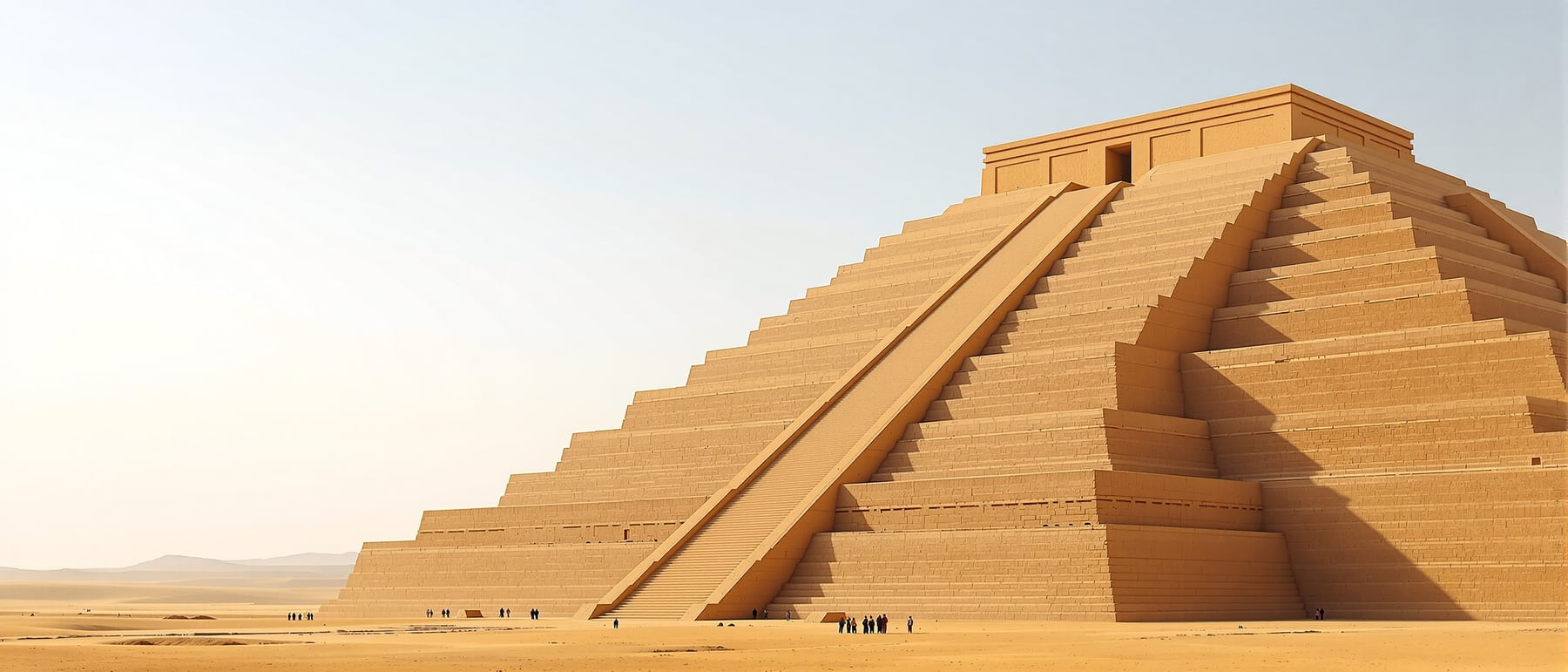
The Ziggurat of Ur: A Mountain of Brick for the Moon God
How the Sumerians of Mesopotamia — in a flat land with no stone and no mountains — raised an artificial sacred peak of mud brick and tar around 2100 BCE, not as a tomb like the pyramids but as a solid stairway to heaven with a temple at its summit, so their king could climb to meet the moon god Nanna, and left the best-preserved of all the world's ziggurats.
From the stone circles of prehistoric Europe we travel to the flat river-plain where cities, writing, and monumental architecture were arguably invented — Sumer, in southern Mesopotamia, the land between the Tigris and Euphrates that is now southern Iraq. Here there are no mountains and almost no stone. And yet here, around 2100 BCE, a Sumerian king built a mountain — a vast, stepped platform of brick called a ziggurat, raised so that a temple could stand at its summit, closer to the sky and to the god it was built to honour. The best-preserved of them all still stands on the plain near Nasiriyah: the Great Ziggurat of Ur.
This is the fiftieth article in our Architectural Wonders series, and the third in our chapter on the great temples and sacred places of the world.
Its Sumerian name was Etemenniguru — usually translated "the house whose foundation creates awe." It was begun by King Ur-Nammu, founder of the Third Dynasty of Ur, and finished by his son Shulgi, at the height of a late flowering of Sumerian civilisation. And it was dedicated to Nanna — also called Sîn — the moon god, patron deity of the city of Ur, whose earthly house this was. To understand it, we first have to clear away a very natural mistake: this is not a pyramid.
1. Not a pyramid — a stairway to heaven
From a photograph, a ziggurat and an Egyptian pyramid can look like cousins. In purpose they are almost opposites.
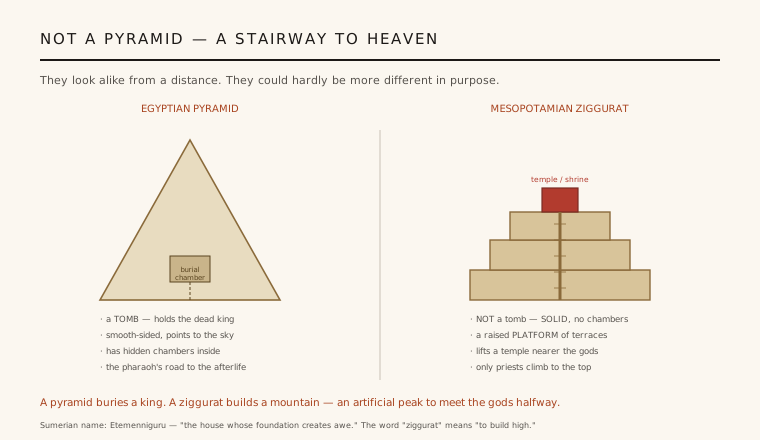
An Egyptian pyramid is a tomb: it holds the body of a dead king, sealed inside hidden chambers, and it was never meant to be entered again. A ziggurat is not a tomb and has no chambers at all — it is solid all the way through. It is a platform, and its entire reason for existing is to lift a temple up toward the heavens. The Sumerians thought of it as a kind of bond between earth and sky — an artificial sacred mountain that a god could descend to, and that a priest could climb to meet him. So where a pyramid points at the sky but faces inward and downward, toward death and the afterlife, a ziggurat is built outward and upward, a working stairway to the divine with a living shrine on top. Only priests, and the king in ritual, ascended; this was never a space for crowds. (The word "ziggurat" itself comes from an Akkadian verb meaning "to build high.") Keep that distinction in mind, and everything about the building's shape starts to make sense: the terraces are steps, and the whole mountain is a route.
2. A house for the moon god
Every detail of the ziggurat served one relationship — between a city and its god.
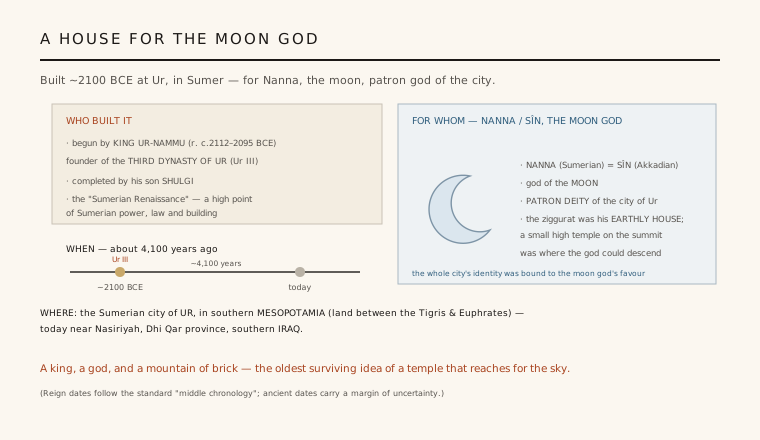
The ziggurat was raised around 2100 BCE, in the twenty-first century BCE, by Ur-Nammu — the founder of the Third Dynasty of Ur (often called the "Sumerian Renaissance," a last great flourish of Sumerian language, law and building) — and completed by his son Shulgi. We know their authorship with unusual certainty because thousands of the baked bricks are stamped with Ur-Nammu's name. The whole structure was the centrepiece of a walled sacred precinct, and it was the earthly house of Nanna (Akkadian Sîn), the moon god and divine patron of the city of Ur. In a Mesopotamian city, the fortunes of the people were believed to rest on keeping the patron god content and close; the ziggurat, with its high shrine where the god could dwell and be served, was the architectural expression of that bond — the single most important building in the city, dominating its skyline exactly as the god dominated its life. This was Ur, in the plain of Sumer near modern Nasiriyah: one of the very first great cities on Earth, built for the moon.
3. Built of mud, armoured in fire
Now the engineering problem — because a mountain of mud, in a land of floods and rain, should not survive four thousand years.
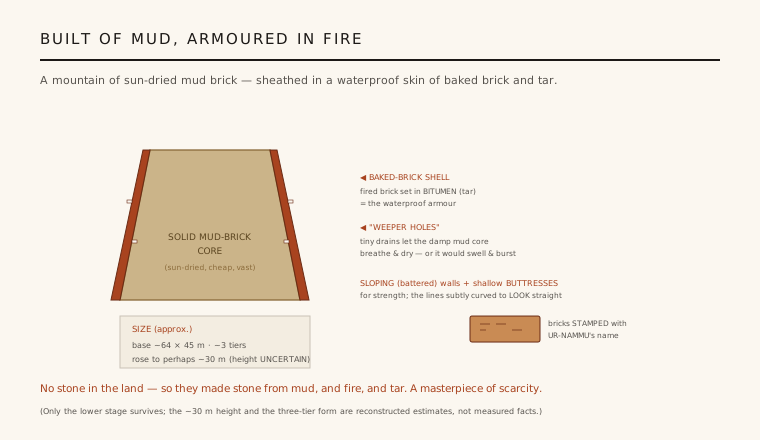
Sumer had no stone and no timber to speak of — only mud, reeds, and the sticky black bitumen (natural tar) that seeped from the ground. So the builders made a virtue of scarcity. The core of the ziggurat is a solid mass of cheap sun-dried mud brick, hundreds of thousands of them. Over that vulnerable core they laid a thick protective skin of fired (baked) brick set in bitumen — a waterproof armour — with layers of reed matting soaked in tar between courses for reinforcement. But a huge mud core, sealed in a waterproof shell, has a hidden danger: trapped damp makes mud swell and burst. The builders understood this, and pierced the baked-brick skin with countless small "weeper holes" — drains that let the core breathe and shed moisture. The base measures roughly 64 by 45 metres, and the monument rose in about three receding tiers. How high? Perhaps around thirty metres — but here honesty is essential: only the lowest stage survives, so the original height and the exact form of the upper terraces are reconstructions, not measurements. The walls lean subtly inward and are strengthened with shallow buttresses, and — a refinement that would not be out of place at the Parthenon fifteen centuries later — the excavator Leonard Woolley noticed that no line is truly straight: the surfaces are gently curved to correct the eye's tendency to see a long wall as sagging. Even at the very dawn of monumental building, these architects were thinking about how a building would be seen.
4. Three stairs, one gate, the summit
The ziggurat's most theatrical feature is the way you were meant to climb it.
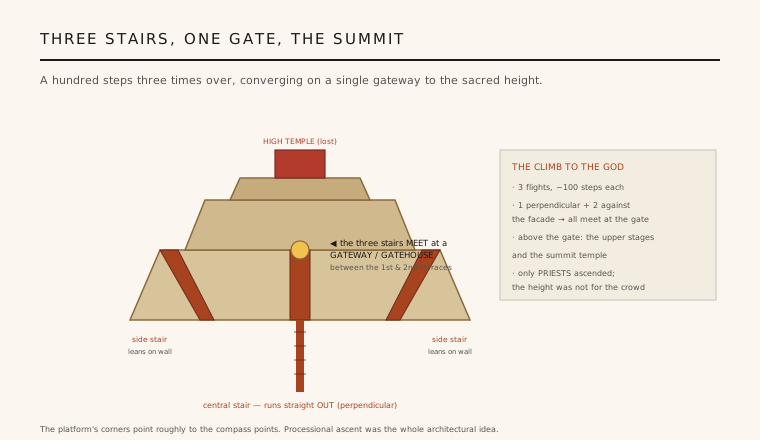
Against the front face of the ziggurat ran three monumental staircases, each of about a hundred steps: one projecting straight out from the centre, perpendicular to the wall, and two more leaning up against the facade from either side. All three converged at a gateway — a gatehouse — set between the first and second terraces. From that gate a single stair continued up to the higher stages and, at last, to the small high temple on the summit, the shrine of Nanna itself (now completely lost, its form unknown). It is a piece of pure processional architecture: the very shape of the building choreographs a ritual ascent, a slow climb from the ordinary ground of the city, up through gate and terrace, toward the house of the god — a route walked only by priests and the king. The platform is even set with its corners (not its sides) turned toward the points of the compass. Every ziggurat is, in the end, a route dressed as a mountain — and Ur's is the clearest surviving expression of that idea.
5. The city of Ur — and what you see today
The ziggurat is the great survivor of a city that was once among the most important on Earth — and that vanished almost completely.
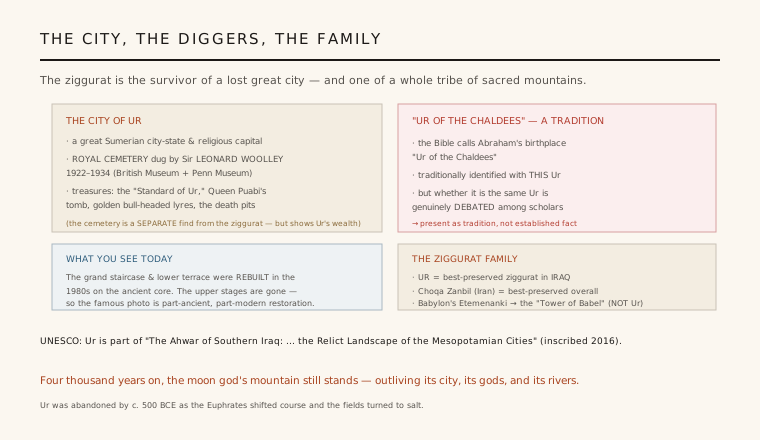
Ur was a Sumerian city-state and royal capital, and its wealth is staggeringly documented by a separate discovery: the Royal Cemetery, excavated by Sir Leonard Woolley between 1922 and 1934 for the British Museum and the University of Pennsylvania. From its "royal tombs" — older than the ziggurat — came the celebrated "Standard of Ur," the intact tomb of Queen Puabi with her golden headdress, the great bull-headed lyres, and the haunting "death pits" of attendants. (That cemetery is a separate thing from the ziggurat, but it tells you how rich and important this city was.) Ur is also woven into scripture as "Ur of the Chaldees," the traditional birthplace of Abraham — though it is fair to say plainly that this identification is a tradition, and genuinely debated (a rival tradition places Abraham's Ur in southern Turkey). Two more cautions in the same honest spirit. First, what you photograph today is partly modern: the grand staircase and the facade of the lowest terrace were rebuilt in the 1980s on the ancient core, while the upper stages and summit shrine remain lost. Second, the famous "Tower of Babel" was not Ur's ziggurat but Etemenanki, the ziggurat of Marduk at Babylon — a common confusion worth heading off. Ur's is simply the best-preserved ziggurat in Iraq (the largest surviving example is Choqa Zanbil, in Iran). The city itself was finally abandoned around 500 BCE, when the Euphrates shifted its course away and the fields turned to salt — but the moon god's mountain of brick outlived the river, the gods, and the city, and stands on the empty plain still.
6. What a modern architect can learn from the Ziggurat of Ur
- Build with what you have. No stone, no timber, no mountains — only mud, reeds and tar. The Sumerians did not wait for better materials; they mastered the humble ones and made them monumental. Constraint is not the enemy of great architecture; it is often its origin.
- Design for the failure mode, not just the form. The whole genius of the ziggurat's construction is the response to water — the baked skin, the bitumen, the reed layers, the weeper holes. The builders asked "how will this die?" and engineered against it. A building lasts because someone designed for what would destroy it.
- Let the form choreograph the ritual. The triple stair, the gate, the terraces, the summit shrine — the architecture is the procession. When a building's purpose is an experience, make the route and the sequence the design, not an afterthought.
- Small refinements carry the whole impression. The gently curved walls that only look straight are invisible to the casual eye and essential to the effect of solidity. Care at the level no one consciously notices is what separates the monumental from the merely large.
- Be honest about reconstruction. Much of what we "see" of Ur — the height, the upper stages, the restored staircase — is informed guesswork or modern rebuilding. A responsible account, like a responsible restoration, shows the seam between what survives and what has been supplied.
- A single building can outlast its entire world. The city died, the moon god is no longer worshipped, the river itself moved away — and still the ziggurat stands. What we build may be the one thing that speaks for us when everything else we knew is gone; that is reason enough to build it with care, and with meaning.
References & further reading
1. UNESCO World Heritage Centre — The Ahwar of Southern Iraq: Refuge of Biodiversity and the Relict Landscape of the Mesopotamian Cities (inscribed 2016; includes Ur). https://whc.unesco.org/en/list/1481/
2. Penn Museum — Ur excavations and the Woolley archive (Penn co-excavated Ur). https://www.penn.museum/sites/expedition/sir-leonard-woolley/
3. UrOnline — Woolley's Excavations at Ur (British Museum / Penn digital archive). http://www.ur-online.org/about/woolleys-excavations/
4. Smarthistory — Ziggurat of Ur. https://smarthistory.org/ziggurat-of-ur/
5. Encyclopaedia Britannica — Ziggurat at Ur and Ur. https://www.britannica.com/topic/ziggurat-at-Ur
6. World History Encyclopedia — Ur and Third Dynasty of Ur (Ur III). https://www.worldhistory.org/ur/
7. C. Leonard Woolley — Ur Excavations, Vol. V: The Ziggurat and Its Surroundings (1939), and Ur of the Chaldees (1929).
Last verified 2026-07-04. Figures follow UNESCO, Penn Museum, Smarthistory, Britannica and Woolley's excavation record, and are given as widely cited approximations that vary by source. The Great Ziggurat of Ur (Sumerian Etemenniguru, "house whose foundation creates awe") stood in the Sumerian city of Ur (Tell el-Muqayyar), near modern Nasiriyah, Dhi Qar, southern Iraq. It was begun by Ur-Nammu (r. c. 2112–2095 BCE, Third Dynasty of Ur) and completed by his son Shulgi, c. 2100 BCE (dates approximate; sources vary), dedicated to the moon god Nanna/Sîn. A ziggurat is a solid stepped temple-platform (NOT a tomb, NO internal chambers), of mud-brick core faced with baked brick set in bitumen, raising a summit shrine; access was by priests only. Base ~64 × 45 m; originally ~three tiers rising perhaps ~30 m — the height and upper stages are reconstructions, as only the lowest stage survives (a later Neo-Babylonian rebuild by Nabonidus may have raised it to seven stages). Features: three staircases (~100 steps each) meeting at a gatehouse, "weeper holes" for drainage, battered/buttressed walls subtly curved (Woolley's observation), corners to the compass points, bricks stamped with Ur-Nammu's name. The rooftop temple is entirely lost; the "planted terraces" idea is a contested hypothesis, not documented for Ur. The grand staircase and lowest terrace visible today were reconstructed in the 1980s on the ancient core. The Royal Cemetery of Ur (Woolley, 1922–34; Standard of Ur, Queen Puabi) is Early Dynastic and SEPARATE from and older than the ziggurat. "Ur of the Chaldees"/Abraham is a tradition, scholarly identification disputed. The "Tower of Babel" refers to Babylon's Etemenanki, NOT Ur. Ur's is the best-preserved ziggurat in Iraq; Choqa Zanbil (Iran) is the best-preserved/largest surviving overall. Ur was abandoned c. 500 BCE as the Euphrates shifted and soils salinised. Part of the UNESCO World Heritage Site inscribed 2016.
Export this guide
Related Guides — Deep-dive reading
The Pyramid of the Sun: A Mountain Raised Over a Cave by a People With No Name
In the Valley of Mexico, a civilisation we cannot name built one of the largest pyramids on Earth — a man-made mountain of a million cubic metres — and set it precisely over a sacred cave they believed was the womb of the world. They left no writing we can read; even the words 'Pyramid of the Sun' were given, a thousand years later, by the Aztecs, who found the city in ruins and called it the birthplace of the gods.
Architectural WondersChan Chan: The Vast City of Mud Where Every King Built His Own Palace
On the desert coast of Peru sprawl the ruins of the largest city ever built of mud — a thousand-year-old capital of adobe walls three storeys high, carved with fish and seabirds, that survived only because it almost never rains. It was a city of ten royal palaces, one for each king, driven by a strange rule of inheritance; and today, an earthen city in a warming world, it is racing the rain to survive. The ninth article in our chapter on the palaces and pleasures of worldly power.
Architectural WondersSomapura Mahavihara: The Buddhist University Hidden Inside a Hill
Twelve hundred years ago in Bengal, a Pala emperor built one of the largest monasteries the Buddhist world had ever seen — a walled quadrangle a fifth of a mile across, ringed by 177 monks' cells, with a great cross-shaped, terraced temple rising from its courtyard. For four centuries scholars came from as far as Tibet to study here; then it was abandoned, and slowly buried, until villagers knew it only as Paharpur — 'the hill-town.'
Architectural WondersRelated Tools — Try Free
AI Measurement Tool
Measure your room using voice, photos, or video sweep — no tape measure needed.
DesignAICircadian Light Meter
Patient-centric circadian lighting visualizer for Indian healthcare design — time-of-day × intensity → CCT, melanopic lux (EML / mEDI), melatonin suppression, and an alertness curve. Calibrated against WELL v2 L03 Circadian Lighting Design, CIE S 026:2018, Brainard 2001, and Lucas et al. 2014.
Circadian ToolHealing View Impact Calculator
Evidence-Based Design dashboard quantifying the recovery impact of nature view + daylight factor on analgesic use, length of stay, and HCAHPS patient-experience uplift. Calibrated against Ulrich 1984 (Science), Park & Mattson 2008, and the CHD EBD evidence base.
EBD Calculator