
The Statue of Belief and India's Colossus Movement: When the Monument Became a Building
India is raising the tallest figurative statues on Earth — a 112-metre Shiva at Nathdwara, a 182-metre Sardar Patel on the Narmada. Behind their bronze and copper skins are inhabited engineering towers with cores, dampers and lifts. This deep study reads the colossus as a building type, its structure, and the politics its scale cannot hide.
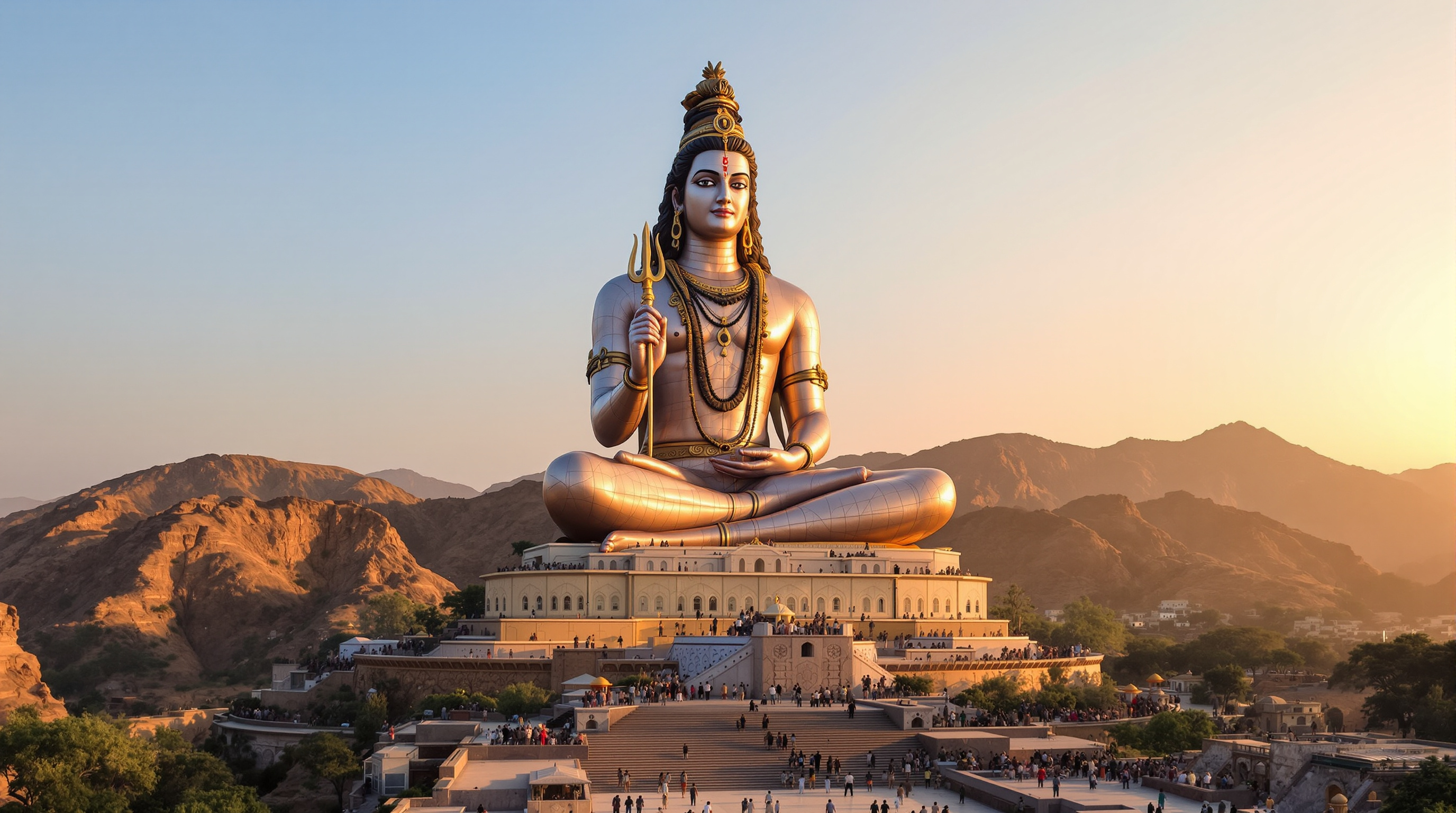
Stand at the foot of the Statue of Belief at Nathdwara and the ordinary vocabulary of architecture fails you. There is no façade, no entrance canopy, no cornice — only a seated Lord Shiva, 369 feet of copper-toned figure, gazing out over the Aravalli hills with a trident in his hand. And yet you can walk inside him. Lifts climb through the body to viewing galleries at his knee, his chest, and near his crown; an exhibition hall occupies the plinth; the whole colossus is wired, drained, air-conditioned and lit. The god is also a building.
That doubleness is why this project — and the wider Indian movement it belongs to — deserves a place in any honest account of where architecture is going. Across a single decade India has raised, or begun raising, the tallest figurative statues on the planet: the Statue of Unity (182 m, 2018) near Kevadia in Gujarat, the world's tallest; the Statue of Belief / Vishwas Swaroopam (112 m, 2022) at Nathdwara, the tallest Shiva in the world and among the four tallest statues anywhere; the 66-metre Statue of Equality (Ramanuja) at Hyderabad; the 34-metre Adiyogi bust in Coimbatore. This is not a series of one-off commissions. It is a movement — and it forces a question Marc Kushner's canon keeps asking: when a monument becomes an inhabited structure at the scale of a skyscraper, is it still sculpture, or has it become architecture?
A colossal statue is the rare structure that must lie about itself. Its whole purpose is to read as a single solid figure; its whole reality is a hollow, braced, serviced tower wearing a face. The art is in the deception — and the engineering is what makes the deception stand up.
The building type hiding inside a god
For most of history a "statue" and a "building" were different things: one solid and expressive, the other hollow and useful. The colossus collapses that distinction. Once a figure passes roughly forty or fifty metres it can no longer be cast or carved as a solid mass — it would be impossibly heavy, would crack under its own thermal movement, and could never resist wind. So the giant statue quietly becomes a building: a structural frame, a weatherproof envelope, and an inhabited interior, all shaped to the outline of a body.
The lineage is old. The Colossus of Rhodes and the Statue of Liberty were both hollow metal skins on internal frames — Liberty's, famously, engineered by Gustave Eiffel as an iron pylon with a flexible copper skin hung off it so the two could expand independently. What India's contemporary colossi add is scale, occupancy and services: these are not just hollow shells but destinations, with lifts, galleries, museums, restaurants and light shows folded into the anatomy. The statue has absorbed the programme of a tower.
The Statue of Belief makes the type unusually legible. Its 16-acre precinct near the Shrinathji temple town of Nathdwara wraps the figure in a full visitor economy — three herbal gardens, a food court, a musical fountain, handicraft shops and a mini-train — while the figure itself is threaded with three elevator-served viewing galleries at roughly 20, 110 and 270 feet. You buy a ticket, ride a lift up through a deity, and look out at Rajasthan from inside his chest. The devotional and the touristic have been engineered into one continuous section.
Two colossi, two arguments
The movement's two giants are worth reading against each other, because they make almost opposite arguments with a similar technology.
The Statue of Unity is a state project: a 182-metre bronze-clad figure of Sardar Vallabhbhai Patel, independent India's first home minister, master-planned by Michael Graves Architecture & Design, sculpted by Ram V. Sutar, and built by Larsen & Toubro at a reported cost of around ₹27 billion (roughly US$420 million). It is deliberately secular-national in address — the "Iron Man" as a symbol of a unified republic — and it anchors a resort-and-tourism masterplan on the Narmada.
The Statue of Belief is a private, devotional project: conceived by the industrialist Madan Paliwal of the Miraj Group, sculpted through the studio of Naresh Kumawat (Maturam Art), structurally engineered by Skeleton Consultants, and built by the Shapoorji Pallonji Group. Its address is faith and pilgrimage, not the state. Where Unity is bronze and civic, Belief is copper-toned ultra-high-performance concrete and religious. Between them they map the two engines driving the whole movement: nationalist memory on one side, devotional tourism on the other — both underwritten by private capital and both, tellingly, sold as experiences rather than mere images.
| Statue of Belief (Vishwas Swaroopam) | Statue of Unity | |
|---|---|---|
| Subject | Lord Shiva, seated | Sardar Vallabhbhai Patel |
| Location | Nathdwara, Rajasthan | Kevadia, Gujarat |
| Height | 112 m (369 ft) + 34 m pedestal | 182 m (597 ft) |
| Opened | 29 October 2022 | 31 October 2018 |
| Sculptor / studio | Naresh Kumawat (Maturam Art) | Ram V. Sutar |
| Structure / builder | Skeleton Consultants; Shapoorji Pallonji | L&T; Michael Graves (masterplan) |
| Skin | UHPC, zinc + copper coating | ~1,850 t bronze cladding |
| Register | Devotional / pilgrimage | National / civic |
The body is a disguised tower
Underneath the face, both statues are solved the same way: a stiff vertical spine of reinforced concrete does the real structural work, a steel frame reaches out from it to hold the figure's shape, and a thin engineered skin — bronze at Kevadia, copper-coated ultra-high-performance concrete at Nathdwara — is hung off the frame as cladding, not as structure. It is the Eiffel principle at monument scale: separate the thing that stands up from the thing you see.
At Kevadia this system had to survive a genuinely hostile site. High winds sweep off the adjacent Sardar Sarovar reservoir, so the Statue of Unity was engineered to withstand gusts of around 180 km/h and earthquakes up to magnitude 6.5, and — because a slender figure that tall will still sway — it carries two 250-tonne tuned mass dampers at chest height, pendulum masses that shift out of phase with the wind to cancel the motion. Visitors ride internal lifts to a viewing gallery at roughly 153 metres, inside Patel's chest, that can hold several hundred people at once. The statue is, structurally and experientially, a tower that happens to be shaped like a man.
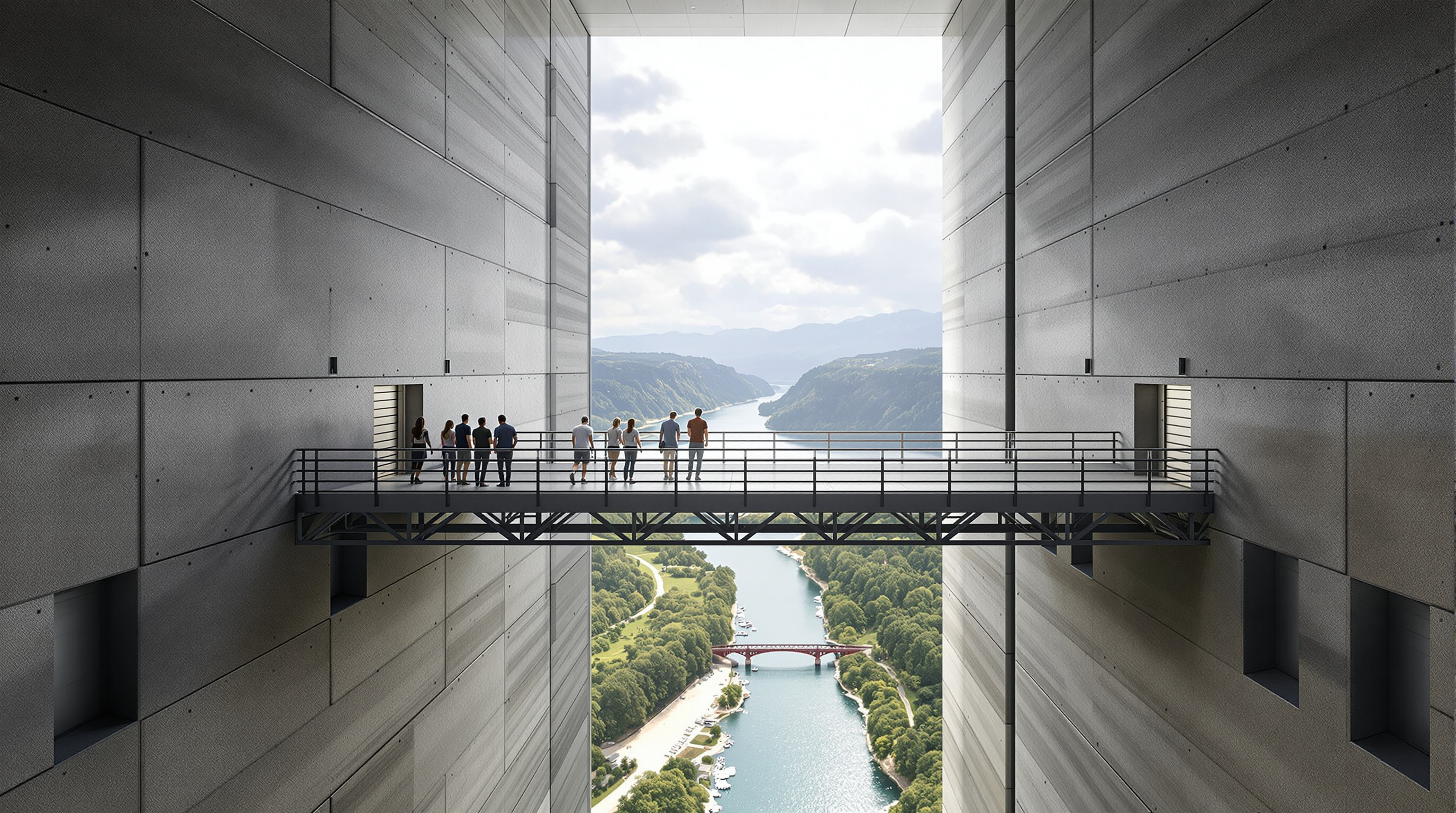
The Statue of Belief solves the same equations in a different material. Rather than bronze panels on steel, its outline is realised in ultra-high-performance concrete over a steel framework braced by inner reinforced-concrete walls, then finished with a liquefied-zinc undercoat and a copper coating that gives the figure its warm, weathered patina and long-term corrosion resistance. Dates here need a light hand: sources report design beginning around 2011 and the main build running roughly 2016–2020, with the public unveiling on 29 October 2022 — so treat "completed 2022" as the safe public date and the earlier figures as approximate.
A movement, not a monument
What makes this a subject for a canon of the future is that these are not isolated follies but a repeatable typology with an economic logic. Each colossus is the anchor of a masterplanned precinct engineered to convert reverence — national or religious — into footfall, tickets, hotels and helicopter tours. The statue is the loss-leader; the destination is the product. In that sense India's colossi are less the descendants of Rhodes than the cousins of the theme park and the super-tall observation deck: figurative monumentality fused with the mechanics of managed tourism.
They also mark a coming-of-age for Indian construction. Firms such as L&T and Shapoorji Pallonji, and specialist structural consultants, are now delivering globally unprecedented figurative structures — bespoke, doubly-curved, wind-and-seismic-critical — largely in-country. That capability is the quiet, genuinely forward-looking story beneath the spectacle: the ability to build almost any imaginable form at almost any scale has arrived, and India is using it to make gods and statesmen inhabitable.
The third position: what the scale cannot hide
Studio Matrx's house position is to admire the engineering and interrogate the argument. Colossal statues are never neutral; scale is rhetoric, and someone always pays for it.
The critique of the Statue of Unity is well documented in scholarship: the political scientist historian Dylan Davis, writing in the Australian Journal of Politics & History (2020), reads it as an effort to re-centre India's nationalist historiography on Patel — and, by implication, away from Nehru — projecting a masculine, majoritarian idea of "unity." The monument's own construction attracted protest from local Adivasi communities over land and displacement around Kevadia, and from activists who called its cost indefensible for a country with pressing development needs. None of that is a footnote; it is part of what the statue says.
The devotional colossi raise adjacent questions — of ecological load on sensitive sites, of the commercialisation of pilgrimage, and of a competitive "tallest-in-the-world" logic that can push scale past meaning. The honest verdict is a double one. India's colossus movement is a real feat of engineering and a genuinely new hybrid of sculpture, tower and destination — and it is a soft-power instrument, secular or sacred, whose height is doing political and commercial work that the serene face is designed not to show.
Why it belongs in the canon
Kushner's question is always "what does this building tell us about where architecture is going?" India's colossi answer with unusual clarity. They tell us that the boundary between sculpture and architecture has effectively dissolved at the top end of scale; that figurative monumentality — long dismissed by Modernism as kitsch — has returned, industrialised and inhabitable; and that the giant statue is now a building type with its own structural grammar of cores, dampers, hung skins and internal circulation. They also tell us, uncomfortably, that the most ambitious public structures of the moment are increasingly branding at civic scale, where the engineering is world-class and the meaning is contested. That is precisely why the movement belongs in the canon: it asks, at 182 metres, the question the canon exists to ask — what, and who, are our tallest buildings really for?
References
- Statue of Belief / Vishwas Swaroopam — project facts (height 112 m; UHPC over steel frame with RCC core; zinc + copper finish; three elevator viewing galleries; conceived by Madan Paliwal; sculptor Naresh Kumawat / Maturam Art; structural design Skeleton Consultants; built by Shapoorji Pallonji; opened 29 October 2022), Wikipedia, en.wikipedia.org (reference tertiary — cross-checked against builder/press reporting; treat pre-2022 dates as approximate)
- Statue of Unity — engineering and project data (182 m; bronze cladding on steel frame and RCC cores; two 250-tonne tuned mass dampers; ~153 m viewing gallery; wind to ~180 km/h, seismic to M6.5; L&T construction; Michael Graves masterplan; sculptor Ram V. Sutar), Wikipedia, en.wikipedia.org (reference tertiary — cross-checked against engineering press)
- Davis, D. (2020). "Constructing an 'Iron' Unity: The Statue of Unity and India's Nationalist Historiography." Australian Journal of Politics & History, 66(3). Wiley. DOI: 10.1111/ajph.12678. onlinelibrary.wiley.com (peer-reviewed — the critical/political reading)
- Michael Graves Architecture & Design — "Statue of Unity" masterplan and design role, as reported by The Architect's Newspaper (2018). archpaper.com (architectural press)
- Engineering News-Record (2019). "Award of Merit, Cultural: The Statue of Unity" — independent engineering account of the structure. enr.com (engineering press)
- Statue of Unity — official visitor site, height, gallery and by-the-numbers data. visitsou.com (primary — operator)
Part of The Future of Architecture in 300 Buildings — Studio Matrx's canon of the buildings asking where architecture goes next. Chapter 17: Extending Kushner — Post-2015 Landmarks.
Export this guide
Related Guides — Deep-dive reading
Statue of Unity: The Architecture of the Approach, the Museum, and the World's Tallest Figure
Michael Graves Architecture wrapped a 182-metre bronze colossus of Sardar Patel around two concrete cores, then choreographed a kilometres-long arrival sequence — road, bridge, visitor centre, museum, and a chest-height viewing gallery — into a single national monument on the Narmada. This is a deep study of the building behind the statue: its structure, its staged approach, and the contested ground it stands on.
The Future of ArchitectureStatue of Unity: How India Turned a Portrait into a 182-Metre Building
The world's tallest statue is not really a statue at all — it is a slender, wind-loaded tower wearing a bronze likeness of Sardar Vallabhbhai Patel. This deep study reads its twin-core structure, its tuned mass dampers, its 6,500-panel skin cast in China, and the politics a monument this large can never fully contain.
The Future of ArchitectureNaga Tower, GIFT City: The Skyscraper That Lives Only as a Render
A pair of serpent-shaped towers designed for India's first financial city was approved, published and never built. Read the Naga Tower as a case study in the 21st-century render — how the image of a building now does more cultural work than the building, how a globalised icon gets grafted onto a Hindu symbol to sell a place, and what the gap between a 230-metre vision and a 122-metre reality tells us about where architecture is going.
The Future of ArchitectureRelated Tools — Try Free
Home Building & Interior Cost Calculator — 20 Cities
Construction + interior costs for 20 Indian cities across kitchen, wardrobes, flooring, painting, ceiling.
Cost CalculatorHome Lift Size Planner
Which lift capacities fit the space you have — largest car for your shaft footprint.
Lift CalculatorBefore vs After — Cost Reality Check
Compare what you expected to pay vs what you actually paid, category by category.
Reality Check