
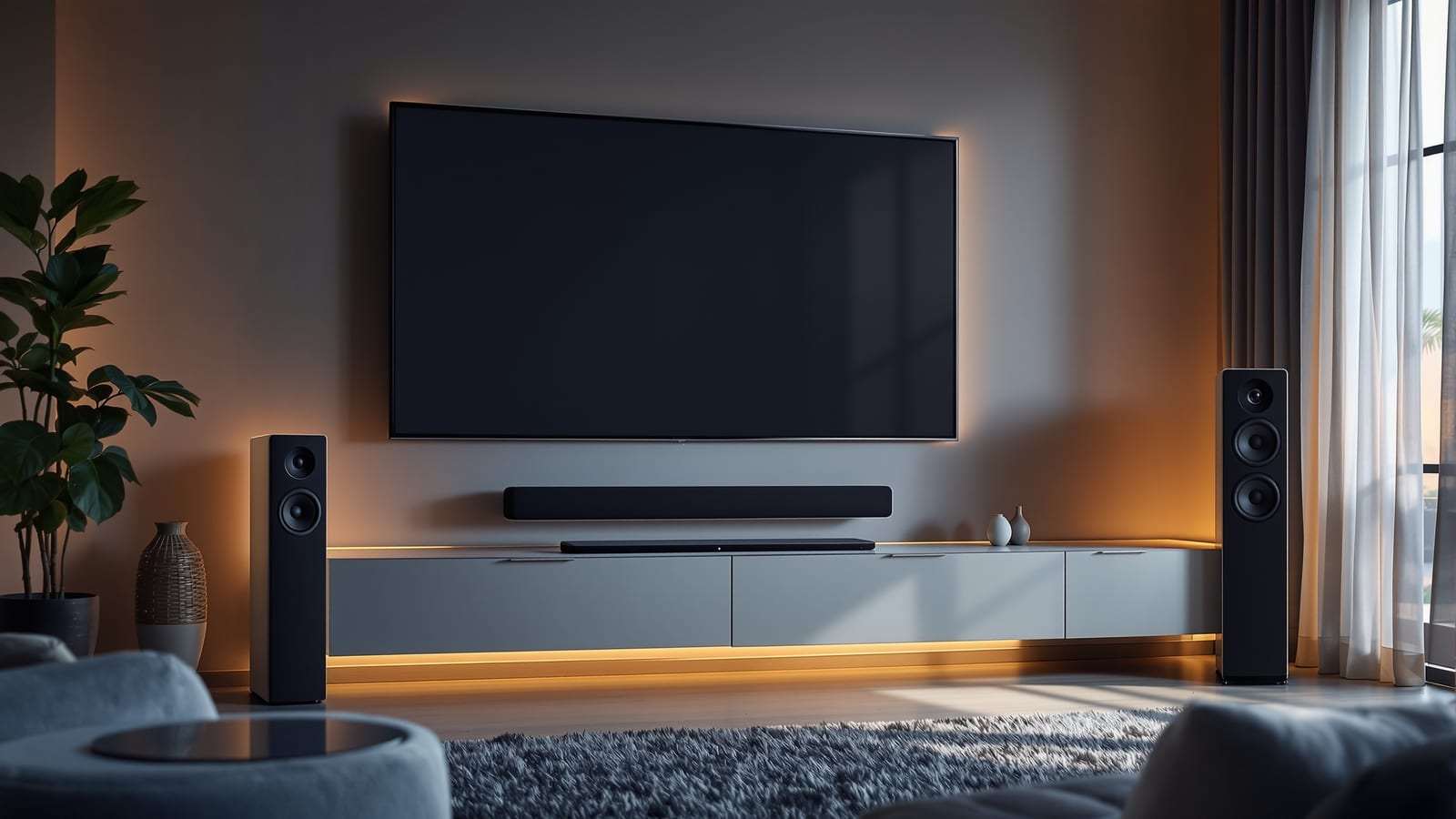
Soundbar vs AV Receiver: Which for Your Home Theatre? (India)
One is a single sleek bar you mount under the TV and forget; the other is a heavy box, a rack of speakers and a weekend of wiring that can shake the room. This guide settles soundbar vs AV receiver for the Indian living room — sound quality, cost, space and looks, complexity, room size, surround and Dolby Atmos, expandability, spouse-approval, HDMI eARC and CEC, and whether you mostly watch TV, movies or music — with a clear verdict by room, budget and ambition.
There is a moment every home-theatre journey reaches: the TV's own speakers sound thin, and you must decide how far to go to fix it. The easy answer is a soundbar — one bar, one cable, done in ten minutes, and instantly better than any flat-panel TV. The ambitious answer is a proper AV receiver driving a set of real speakers around the room, the kind of setup that makes a film's rain fall behind you and the bass thump in your chest. Both are legitimate; they simply sit at opposite ends of effort, cost and result. This guide compares them honestly for the Indian living room so you match the setup to your room, your budget and how much you actually care about sound — not to what looks impressive in a showroom.
A soundbar is a decision you make once and forget; an AV receiver is a hobby you invite into your home. One gives you eighty per cent of the magic with none of the mess. The other gives you the last twenty per cent — and asks for a rack, a subwoofer and a very understanding household in return.
For where audio fits the bigger picture, read this with smart home entertainment in India and the ultimate guide to smart homes in India. If you want the room to respond to voice and scenes as well, the home automation guide covers tying the TV, lights and audio together.
The quick verdict
One line: a soundbar is the right answer for most Indian living rooms — apartments, mixed TV-and-movie use, tight budgets and households that value clean looks over the last decibel. A full AV receiver plus speakers is the right answer for a dedicated or large room, a real movie enthusiast, and a budget that comfortably clears roughly ₹80,000 to ₹1,00,000 for audio alone. In between sits a Dolby Atmos soundbar with wireless rear speakers and a subwoofer, which borrows much of the AVR experience without the box and the wiring. Everything below is about which of those three your room and ambition point to.
What each setup actually is
The difference is one integrated box versus a system of separate boxes.
Soundbar. A single long enclosure sitting under or on the TV, with several drivers inside firing forward (and, on Atmos models, upward). It often ships with a wireless subwoofer and, on better models, two small wireless rear speakers. It connects to the TV with one HDMI eARC cable — that is the whole install. Sony, Samsung, JBL, LG and Bose dominate the Indian shelves from about ₹12,000 to ₹1,20,000.
AV receiver plus speakers. The AVR is the brain and muscle: a heavy box that decodes the soundtrack, switches your HDMI sources, and amplifies signal out to separate passive speakers you place around the room — a 5.1 setup means front left and right, a centre, two rears and a subwoofer. Denon, Marantz, Yamaha, Onkyo and Sony make the receivers; the speakers are a separate purchase and a separate decision. This is a system you assemble, wire and calibrate, typically ₹80,000 upward once speakers are counted.
Sound quality: the AVR's ceiling is higher
There is no honest way around it — a well-set-up AVR with real speakers beats a soundbar at the top end. Discrete speakers spread around the room create genuine directionality: a voice truly comes from the centre, an explosion truly comes from behind, and a subwoofer you can position properly delivers bass a slim bar cannot physically move. A soundbar simulates surround by bouncing sound off your walls and ceiling, which is clever and often convincing, but it is simulation — the effect depends on your room's shape and never fully matches sound arriving from a speaker actually placed there. That said, the gap has narrowed enormously: a good Atmos soundbar with wireless rears and a sub gets most listeners most of the way, and in a small or acoustically awkward room it can even sound better than a badly placed speaker system. The AVR's ceiling is higher; whether you will ever reach it depends on your room and how much you tune it.
The head-to-head comparison
| Dimension | Soundbar | AV Receiver + Speakers |
|---|---|---|
| Peak sound quality | Very good; simulated surround | Best; true discrete surround |
| Typical cost | ₹12,000 to ₹1,20,000 | ₹80,000 to ₹3,00,000+ |
| Space and looks | One slim bar, near-invisible | Rack, cables, 5 to 7 speakers |
| Setup complexity | One cable, ten minutes | Wiring, placement, calibration |
| Best room size | Small to medium (apartments) | Medium to large / dedicated |
| Surround / Dolby Atmos | Simulated + up-firing drivers | True, discrete, room-filling |
| Expandability | Limited (add sub / rears) | High (swap speakers, upgrade AVR) |
| Spouse-approval (WAF) | High — clean and hidden | Lower — visible boxes and wires |
| HDMI eARC / CEC | Yes, single connection | Full HDMI switching hub |
| Music listening | Good, convenient | Excellent with the right speakers |
| Wife/household disruption | Minimal | A visible, wired commitment |
Cost, space and the WAF question
Cost. A soundbar covers a huge range but delivers a big jump over TV speakers even at ₹15,000 to ₹30,000. An AVR system starts higher because you buy the receiver and the speakers separately — a decent 5.1 with a mid-range Denon or Yamaha and a speaker package realistically lands ₹80,000 to ₹1,50,000, and it climbs from there. Before you commit, weigh audio against the rest of the room and home budget with the smart home cost calculator.
Space and looks. This decides more Indian purchases than sound does. A soundbar is one discreet line under the TV; an AVR system is a visible rack, a subwoofer on the floor, five to seven speakers on stands or walls, and cable runs to each. In a shared apartment living room, that visual and wiring footprint is a genuine cost — the "spouse-approval factor" (WAF) is real, and it usually favours the bar. A dedicated media room removes the objection entirely, which is exactly why enthusiasts build one.
Complexity, HDMI eARC and CEC
A soundbar is close to plug-and-play: connect one HDMI eARC cable to the TV, and HDMI-CEC lets the TV remote control the bar's volume and power so you forget it is a separate device. An AVR is a control hub — every source (streaming box, console, Blu-ray) plugs into the receiver, which switches and passes 4K/8K video to the TV over one HDMI eARC link while decoding the audio. That is more capable but more to understand: input assignments, speaker calibration with the bundled mic, and occasional HDMI handshake quirks. If you want to plug in and never think again, the bar wins; if you enjoy the setup as part of the hobby, the AVR rewards it. For tying playback into scenes, voice and the wider room, see smart home entertainment in India.
Expandability, music and the long view
Ambition changes over time, and the two paths age differently. A soundbar is largely a sealed decision: you can usually add the maker's wireless subwoofer or matching rear speakers, but you cannot swap in a better centre channel or upgrade the amplifier — when you outgrow it, you replace the whole bar. An AVR system is modular and future-proof by design: keep the receiver and upgrade the speakers, or keep the speakers and step up the receiver; grow a 5.1 into a 7.1 or add Atmos height channels later; even repurpose the speakers for stereo music. For a listener who expects their taste and budget to climb, that upgrade path is real value, and it is a large part of why enthusiasts start with separates.
Music is the quiet tie-breaker many people forget. For songs, a stereo pair driven by an AVR is genuinely excellent and separates instruments in a way a bar cannot; but a good soundbar is more than adequate for casual listening, radio and news, and it wins on convenience for the daily TV-and-YouTube diet that fills most Indian living rooms. Be honest about your split: if it is ninety per cent TV and shows, the bar's convenience matters more than the AVR's musical ceiling. If serious two-channel music is part of the plan, that pushes you toward separates.
Match the setup to room, budget and ambition
The right answer is a three-way fit, not a single winner.
- Small-to-medium apartment room, budget under ₹50,000: a soundbar (add the wireless sub if it is not bundled). It transforms the TV, hides away, and keeps the peace.
- Same room but you want more cinema, budget stretching: a Dolby Atmos soundbar with wireless rears and a sub — most of the surround thrill without a rack of boxes or a WAF argument.
- Large living room or a dedicated media room, movie enthusiast, ₹80,000-plus: a full AV receiver with a 5.1 or 7.1 speaker set. You have the space to place speakers properly and the ambition to tune them, so you will actually reach the higher ceiling.
- Mostly music and casual TV: a good soundbar or a stereo pair covers it; you rarely need full surround for songs and news.
The frame to drop is "the receiver is the serious choice and the soundbar is the compromise." A soundbar in the room it suits beats an AVR crammed into a room that cannot host it. Buy for the room you have and the effort you will genuinely put in, not the setup that looks most serious in a shop. For pulling audio, TV, lighting and voice into one seamless experience, continue with smart home entertainment in India and the home automation guide.
References
- Dolby — What is Dolby Atmos — how object-based surround and height channels work in soundbars and receivers.
- HDMI Licensing — HDMI 2.1 and eARC — the eARC and CEC features that connect a TV to a soundbar or AVR over one cable.
- Bureau of Indian Standards (BIS) — safety and quality standards for audio equipment sold in India.
- Bureau of Energy Efficiency — power-consumption context for always-on AV receivers and audio gear.
- TRAI — Telecom Regulatory Authority of India — broadband context for streaming the 4K and Atmos content these systems play.
Export this guide
Related Guides — Deep-dive reading
Home Theatre Setup Guide for Indian Homes (Automated, 2026)
A practical, room-first walkthrough of building a home theatre in an Indian home and wiring it to run at one touch. Room and seating, TV versus projector and screen, 2.1 to 7.1.4 Atmos speaker layouts, the AV receiver and how everything connects over HDMI eARC and CEC, acoustic treatment and calibration, bias and star-ceiling lighting, cable management, budget tiers, and one-touch scenes that dim the lights, close the curtains, power everything on and pick the right input — with real brands and ₹ prices.
Smart HomePoE vs Wi-Fi CCTV: Which Home Security Cameras Are Better?
One camera type runs power and video down a single Cat6 cable to an NVR and almost never drops out; the other clips to a wall in minutes and streams over your home Wi-Fi. This guide settles PoE vs Wi-Fi CCTV for Indian homes — reliability, video quality and bandwidth, cabling and power, retrofit versus new-build effort, NVR versus SD and cloud storage, hacking risk, real rupee costs, scalability and outdoor use — and gives a clear verdict for each kind of home.
Smart HomeInfrared vs Colour Night Vision CCTV in India (2026): Which Sees Better in the Dark?
A homeowner's head-to-head between traditional infrared (IR) night vision, which lights the scene invisibly and shows a black-and-white image, and colour night vision, which keeps the picture in colour at night using a very sensitive sensor and a little white light — with an honest verdict on when each wins and why a hybrid camera is usually the smartest buy.
SecurityRelated Tools — Try Free
Acoustic Privacy (STC) Visualizer
Indian healthcare acoustic visualizer — compare wall assemblies and noise sources, see received SPL after STC attenuation, and check FGI 2018 / IS 1950 / NABH speech-privacy compliance with live dual-canvas waveform.
Acoustic ToolApartment Video Door System Planner
Enter flats, entrances, floors and guard desk for a first-pass building intercom plan — door stations, indoor monitors, guard station, the right architecture and an indicative cost band.
Building PlannerBefore vs After — Cost Reality Check
Compare what you expected to pay vs what you actually paid, category by category.
Reality Check