
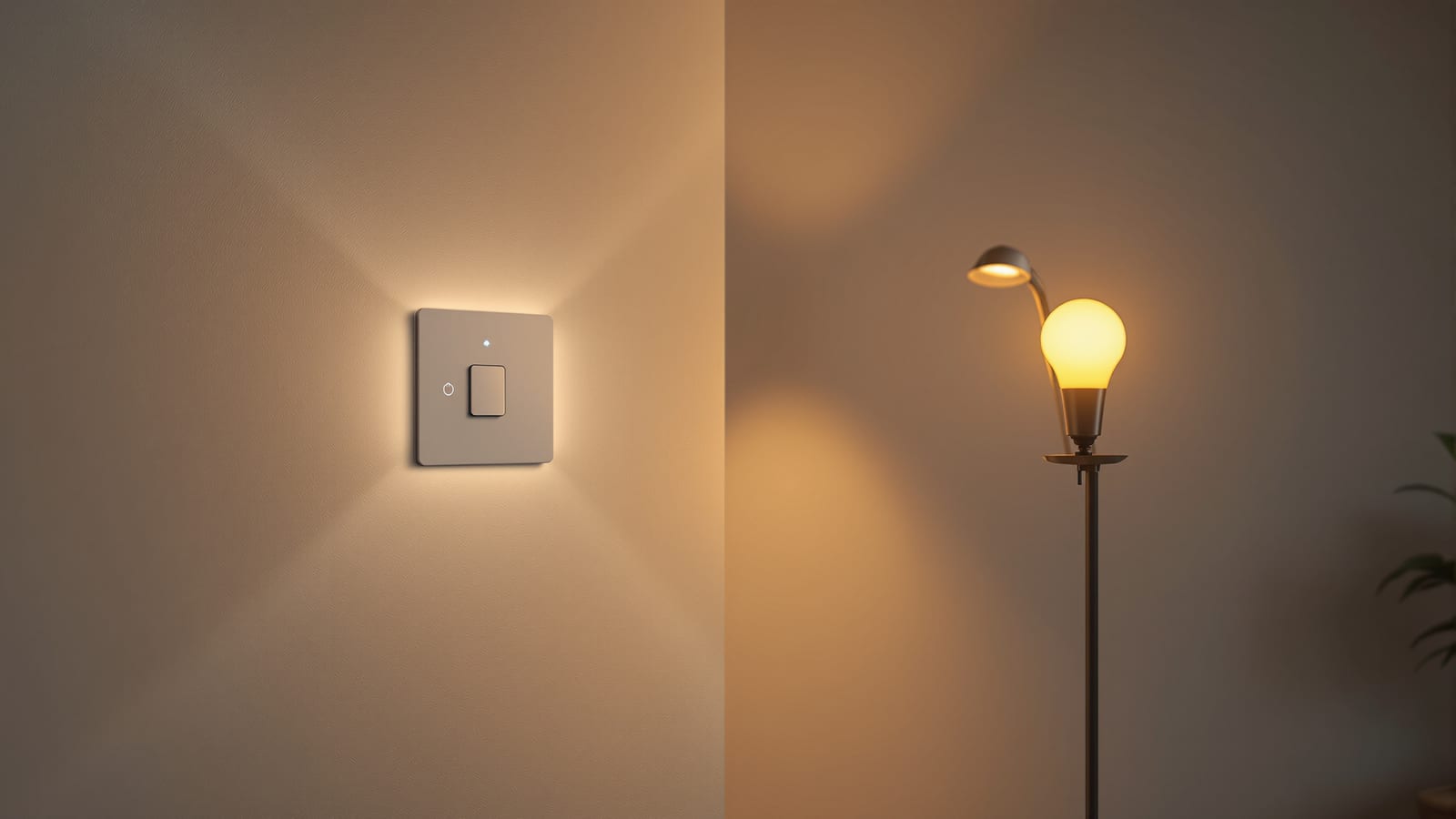
Smart Switches vs Smart Bulbs: Which Is Right for Your Indian Home?
The honest, room-by-room breakdown of the one lighting decision that shapes your whole system — how each works, the physical-switch problem, the neutral-wire catch in Indian wiring, per-fixture vs per-room cost, colour vs whole-circuit control, and exactly when to mix the two.
Nearly every Indian smart-home journey begins at a light. It is the cheapest thing to make "smart", the payoff is felt every single evening, and it is where the most money gets wasted. The single question underneath all of it — smart switch or smart bulb — sounds trivial but quietly decides whether your automation feels effortless or fights your family every day. Get it wrong and you end up with beautiful colour bulbs that go dead the moment your mother flips the wall switch out of a lifetime of habit. Get it right and the light is simply correct, all the time, without anyone touching an app.
A smart switch controls the circuit; a smart bulb controls the light. The whole decision comes down to whether you want to change what the light does, or change the colour of the light itself.
This guide is the deep companion to our smart lighting guide for India and the practical follow-up to choosing smart lighting in India. If you are planning a whole home, read it alongside the ultimate guide to smart homes in India and the broader home automation guide.
Quick verdict
If you only remember one line: use smart switches for the everyday ceiling lights and fans your family already flips at the wall, and smart bulbs for accent, mood and colour points where colour actually matters. Most Indian homes are best served by switches doing the heavy lifting and a handful of bulbs adding drama — not a house full of colour bulbs.
| If you mostly want... | Choose | Because |
|---|---|---|
| The wall switch to keep working for guests and elders | Smart switch | The physical press still controls the light |
| To turn a whole room, or a fan, on and off | Smart switch | It controls the entire circuit, fans included |
| Colour, RGB and tunable warm-to-cool white | Smart bulb | Only the bulb can change what colour it emits |
| A rented home you cannot rewire | Smart bulb | It screws in with zero wiring changes |
| The cheapest way to automate a full room | Smart switch | One switch beats five smart bulbs on cost |
| Per-lamp scenes on table and floor lamps | Smart bulb | Each lamp becomes independently controllable |
How each one actually works
Smart bulbs
A smart bulb — Philips Hue, Wipro Garnet, Syska, Havells Glamax, Halonix — is an ordinary-looking bulb with a small radio (Wi-Fi, Bluetooth or Zigbee) and a controller board built in. You screw it into a normal holder, pair it to an app, and from then on the app or your voice assistant tells it what to do: on, off, dim, warm, cool, or a colour. Because the intelligence lives in the bulb, it can do things a switch never can — a single bulb can glow candle-warm at night and desk-cool by morning, or shift to a festival colour for Diwali.
The catch is equally simple: a smart bulb only works while power is reaching it. The instant someone turns off the wall switch feeding it, the bulb is not "off" in the smart sense — it is disconnected, unreachable, and unable to hear a single command until power returns.
Smart switches
A smart switch — Wipro, Legrand, Schneider, GM, Anchor by Panasonic, Havells — replaces the physical switch on your wall. Behind it sits a radio and a relay (or dimmer) that opens and closes the circuit. It controls whatever is wired downstream: an ordinary tubelight, a cluster of downlights, an exhaust fan, even a ceiling fan on the right module. Crucially, the physical rocker or touch plate still works, so anyone can operate the light the old way while the app operates it the new way.
What a switch cannot do is change the light itself. It can cut power or, on a dimmer module, reduce it — but it has no idea whether it is feeding a warm bulb or a white one, and it certainly cannot turn a plain bulb into a colour one.
The physical-switch problem
This is the single most under-appreciated issue in Indian smart lighting, and it sinks more smart-bulb setups than anything else. In an Indian household, the wall switch is muscle memory. Guests reach for it. Grandparents reach for it. The house help reaches for it while cleaning. The child reaches for it at bedtime. Every one of those presses cuts power to a smart bulb, and from that moment the bulb is invisible — your automations cannot reach it, your voice command fails, and your schedule silently stops working until someone flips the switch back on.
There are only three ways around it, and none is perfect. You can remove or tape over the wall switch so nobody uses it, which is ugly and unsafe. You can add a smart-bulb-aware wireless button or a smart dimmer switch that talks to the bulbs instead of cutting their power, which adds cost and another device. Or you can simply not use smart bulbs on lights that people are used to switching at the wall — which is why smart switches win the everyday ceiling lights so decisively. A smart switch has no physical-switch problem at all, because it is the switch.
The neutral-wire problem in Indian homes
Here is the classic Indian catch. Most modern smart switches need a neutral wire at the switch box to power their radio continuously. The problem is that a great many older Indian homes — and plenty of newer ones wired the traditional way — ran only the live (phase) wire to the switch box, sending neutral straight to the light fitting. Open such a box and there is no neutral to connect.
| Situation | What you can install |
|---|---|
| Neutral present in the switch box | Any standard smart switch (Wipro, Legrand, Schneider, GM) |
| No neutral, but you can rewire | Run a neutral during renovation, then fit a standard smart switch |
| No neutral, cannot rewire | A "no-neutral" smart switch, or switch to smart bulbs for that room |
| Renting, cannot touch wiring at all | Smart bulbs only — no switch swap needed |
No-neutral smart switches exist and are sold in India, but they are fussier: they trickle a tiny current through the load to stay powered, which can make some LED bulbs faintly glow or flicker when "off". Before you buy any smart switch, physically open one switch box (power off, or have an electrician do it) and confirm whether a neutral is present. This one check saves the most common return-and-refund cycle in Indian smart lighting. For the wiring and earthing standards behind all this, see the BIS references at the end.
Cost: per fixture vs per room
This is where the maths quietly favours switches for whole rooms. A smart bulb is priced per light point. A smart switch is priced per gang (per circuit) and controls everything wired to that circuit — which might be four downlights at once.
| Item | Typical India price (2026) | Controls |
|---|---|---|
| Wi-Fi smart bulb (Wipro, Syska, Halonix) | ₹500–₹900 each | One bulb |
| Colour + tunable smart bulb (Wipro Garnet, Havells) | ₹900–₹1,500 each | One bulb |
| Philips Hue colour bulb | ₹2,500–₹4,000 each | One bulb |
| Wi-Fi smart switch module (single gang) | ₹1,200–₹2,200 | One whole circuit |
| Premium smart switch panel (Legrand, Schneider) | ₹2,500–₹5,000 per gang | One whole circuit + fan modules |
| Smart fan regulator module | ₹1,200–₹2,500 | Ceiling fan speed |
Do the sum for a bedroom with four ceiling downlights. Four colour smart bulbs at ₹1,200 is ₹4,800. One smart switch on that circuit is ₹1,500–₹2,200 and controls all four together. If you do not need each of those four points to be a different colour — and in a ceiling you almost never do — the switch is both cheaper and better behaved. Bulbs only pull ahead on cost when a room has just one or two light points and you genuinely want colour there. Our smart home cost calculator can total a whole-home plan across both approaches.
Colour and scenes vs whole-fixture control
The trade is clean once you name it. Bulbs win expressiveness; switches win coverage.
| Capability | Smart bulb | Smart switch |
|---|---|---|
| Change colour / RGB | Yes | No |
| Tunable warm-to-cool white | Yes | No |
| Per-lamp scenes (a lamp glows differently) | Yes | No, whole circuit only |
| Control a ceiling fan | No | Yes, with a fan module |
| Control a plain tubelight | Only if you replace it | Yes, as-is |
| Wall press still works | Only with extra hardware | Yes, always |
| Dim ordinary LED bulbs | The bulb dims itself | Yes, on a dimmer module |
If your dream is a festive colour wash across the living room for Diwali, or circadian tunable white in the bedroom that warms through the evening, that is a bulb job — a switch can never do it. If your dream is walking in and clapping the whole room and fan to life, or never worrying that a guest killed your automation at the wall, that is a switch job.
Retrofit ease and aesthetics
Smart bulbs are the easy retrofit: no electrician, no wiring, no landlord permission. Screw in, pair, done — ideal for renters and for testing the water. But they change how the fitting looks up close, they are limited to the holders you have, and a wall of bare app-only bulbs can feel gimmicky.
Smart switches need an electrician and a compatible switch box (Indian boxes vary; confirm module size and depth), but once fitted they are invisible. The wall looks like a normal, if slightly nicer, switch plate. Nothing about the room announces "smart home", which is exactly what most families want. For long-term, whole-home installs, switches almost always feel more finished.
Room-by-room recommendation
| Room | Recommendation | Reasoning |
|---|---|---|
| Living room | Mix | Smart switches on the main ceiling and fan; a couple of colour bulbs or an LED strip for TV-wall mood |
| Bedroom | Mix | Smart switch on the ceiling light and fan; a tunable-white smart bulb in the bedside lamp for circadian evenings |
| Kitchen | Smart switch | You want reliable, instant white light and to control it at the wall while cooking with wet hands |
| Bathroom | Smart switch | One switch can automate both the light and the exhaust fan; colour is pointless here |
| Pooja niche / accents | Smart bulb or strip | This is exactly where warm, dimmable, sometimes-coloured light earns its place |
| Balcony / outdoor | Smart switch | Weather and reach make a switch far more reliable than exposed smart bulbs |
When to mix
The honest answer for most Indian homes is: you will mix, and that is correct. Let smart switches carry the workhorse lights and fans — the ones your family flips at the wall by reflex — so nothing ever "goes dumb". Then sprinkle smart bulbs and LED strips exactly where colour, tunable white or per-lamp mood adds something real: a bedside lamp, a TV wall, a pooja niche, a reading corner. Buy the switches first for reliability and coverage, and add bulbs later for expression. A home built this way behaves predictably for elders and guests, yet still glows warm at night and festive on Diwali — which is the whole point.
References
- Bureau of Indian Standards — IS 732: Code of practice for electrical wiring installations — the wiring code that governs your switch boxes and neutrals.
- Bureau of Indian Standards — IS 3043: Code of practice for earthing — earthing requirements relevant to switch and fixture installation.
- Central Electricity Authority — Measures relating to Safety and Electric Supply Regulations — the national electrical safety framework for household wiring.
- Philips Hue India — official support and getting started — bulb-side setup, bridge and no-power-cut behaviour.
- Legrand India — connected wiring devices and smart switches — switch-side product range, neutral requirements and module sizing.
- Wipro Smart Lighting — smart bulbs and switches — mainstream Indian pricing reference for both approaches.
Export this guide
Related Guides — Deep-dive reading
Smart Lighting for Indian Homes: Switches, Scenes, Circadian & Sensors
The one honest decision that shapes your whole system (switch or bulb), plus dimming, tunable white, circadian light, motion sensors and the automations that actually earn their keep — with real Indian brands and rupee costs.
Smart HomeInstalling Smart Lighting in India: A Step-by-Step Guide (Bulbs & Switches)
The two ways to make your lights smart — screw-in smart bulbs you can fit in five minutes, and in-wall smart switches that need the MCB off, a neutral wire and a licensed electrician. Tools, wiring, pairing, dimmer compatibility, testing and the problems that trip up Indian homes.
Smart HomeRetrofit Smart Home India: Automate Without Rewiring
You do not need to break a single wall to make an existing Indian flat smart. Here is the honest, room-by-room retrofit playbook — the neutral-wire problem and its workarounds, wireless-first devices, rental-friendly options, and where retrofit genuinely hits its limits.
Smart HomeRelated Tools — Try Free
Electrical Safety & Load Audit
Home electrical audit — 10 categories, 65+ checkpoints across earthing, RCCB, MCB, wiring, switchboards, appliance circuits, DG/inverter backup.
Safety AuditSmart Home Cost Calculator
13 device categories across 5 ecosystems (Apple HomeKit, Alexa, Google Home, Mi, Wipro). Live floor-plan that lights up as you add devices, per-room and per-category breakdown.
Smart Home CalculatorFull-Room BOQ — Living, Bedroom, Kitchen, Bath
Room-wise BOQ across living, bedrooms, kitchen, utility, and bathrooms with line-item pricing.
Full-Room BOQ