
Sliding Door Roller Repair: DIY Fix Guide (India 2026)
Why your sliding door is hard to slide, jumps the track or sags — and how to replace the rollers, adjust their height and straighten the track.
When a sliding door starts to fight you — you have to shove it with two hands, it judders and jumps off the track, or the panel has dropped at one end and scrapes the frame — the cause is almost always down at the bottom edge. Sliding door roller repair is one of the most satisfying DIY jobs in the home: the parts are cheap, the panel usually lifts straight out, and a fresh set of rollers (plus a few minutes with a screwdriver) can make a tired wardrobe or patio door glide like new again. Before you call anyone, it is well worth diagnosing what has actually gone wrong, because a dirty track and a worn roller feel almost identical from the handle but need very different fixes.
This guide covers wardrobe sliders and the heavier aluminium/uPVC patio type, walks you through lifting the panel out safely, replacing the bottom wheels, dialling in the height-adjustment screws so the door sits level, and straightening a dented track — and where it stops being a DIY job.
Sliding door roller repair: find the fault first
Grip the handle and slide slowly. How it misbehaves points to the cause.
- Stiff and gritty along the whole run, gets stuck at certain points — usually a dirty or hard-water-crusted track, not the rollers. Clean it first (it is free).
- Rolls but with a flat-spotted thump-thump, or noticeably heavy — the roller wheels are worn, cracked or seized.
- One end of the panel has dropped, scrapes the floor or frame, leaves an uneven top gap — a roller has collapsed, or the height-adjustment screws need setting.
- Jumps or lifts out of the track at one point — a bent/dented bottom track, or rollers riding too high.
- Top of the panel rattles or tips inward — top guides loose, often alongside a low roller.
| Symptom | Likely cause | First fix to try |
|---|---|---|
| Gritty, sticks at spots | Dirty / crusted track | Clean & vacuum the track |
| Heavy, thumping roll | Worn or seized rollers | Replace bottom roller set |
| One corner dropped, uneven gap | Collapsed roller / misadjusted | Adjust height screw, then replace |
| Door jumps off the track | Bent track or rollers too high | Straighten track, lower rollers |
| Slides but rattles up top | Loose top guides | Tighten / replace top guide |
| Won't move at all | Seized roller or jammed track | Lift panel out, inspect both |
Not certain which it is? The door problem diagnoser narrows it down in a minute, and the door troubleshooting hub covers neighbouring faults. Since a clogged track masquerades as a roller fault, always read sliding door track cleaning and try a proper clean before you spend on parts.
Tools & materials you'll need
Difficulty: easy to moderate. Time: 30 minutes to 2 hours. Cost: ₹200–900 in parts DIY; ₹600–1,500 with a carpenter.
- Phillips and flat screwdrivers (a cordless screwdriver helps)
- Replacement roller / wheel set — buy to match your existing rollers (take the old one to the shop)
- A helper — patio panels are heavy and awkward
- An old toothbrush, vacuum with crevice nozzle, mild soapy water
- Silicone spray or dry PTFE lubricant (NOT oil or grease — they trap grit)
- A pencil and a small spirit level
- A block of wood and a rubber/plastic mallet (to tap a dented track straight)
- Pliers, masking tape, a torch
| Tool / part | Indicative ₹ (India 2026) | Needed for |
|---|---|---|
| Sliding-door roller / wheel set | ₹200–900 | Roller replacement |
| Screwdriver set | ₹150–600 | All fixes |
| Silicone / PTFE spray | ₹150–400 | Smooth running |
| Spirit level | ₹150–500 | Levelling the panel |
| Rubber mallet + wood block | ₹200–600 | Straightening track |
| Vacuum / toothbrush | already owned | Track cleaning |
GST of 18% applies to these goods. A carpenter or aluminium-fabricator visit runs ₹400–800 for a simple job, more for heavy patio panels or if the track itself must be replaced. Avoid oil and thick grease on tracks — in dusty Indian homes they turn into a sticky black paste within weeks; a dry silicone or PTFE spray is the right choice.
How a sliding door sits in its track
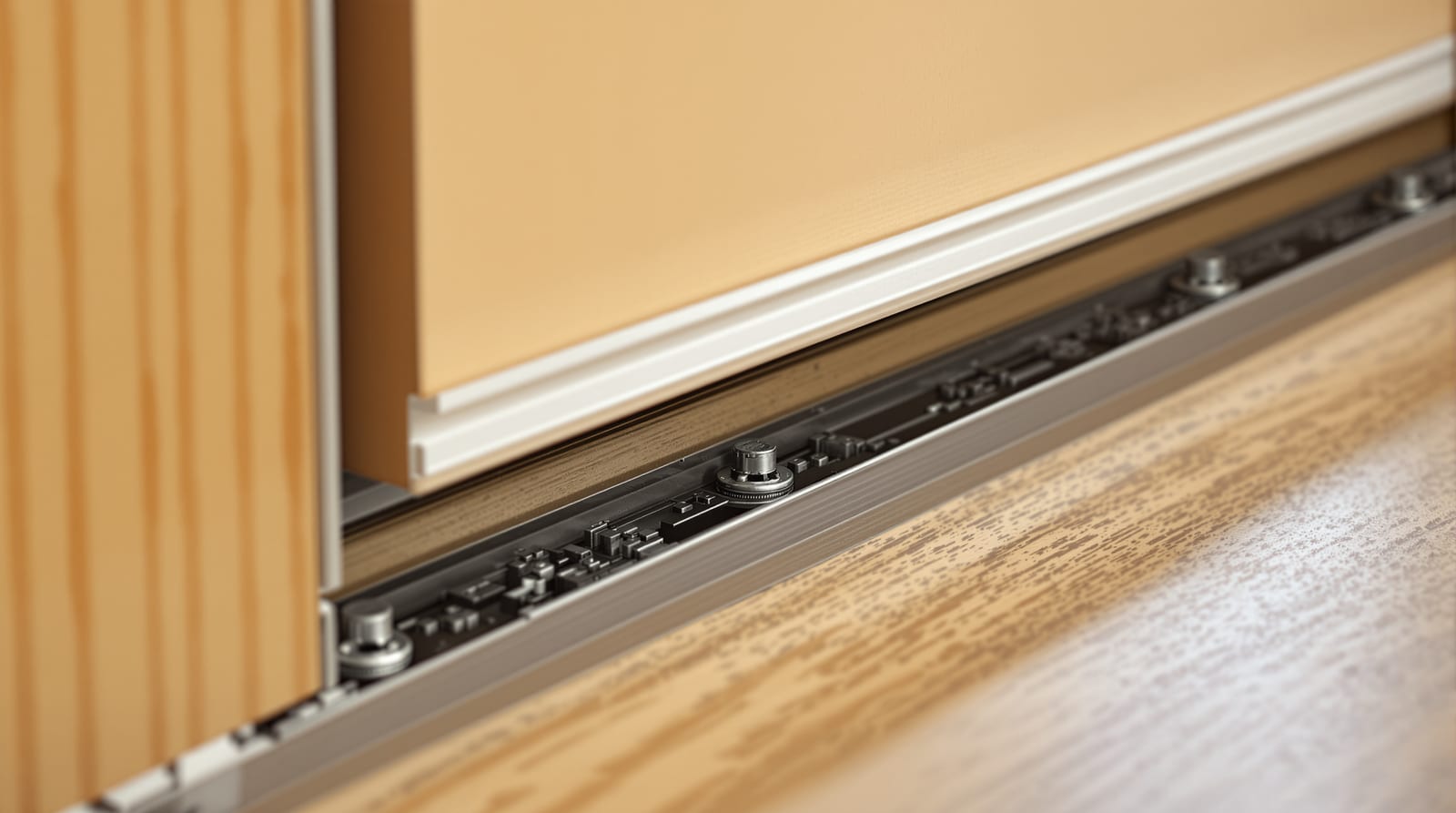
Most sliding panels carry two bottom rollers (one near each end) that run in the floor track, plus top guides that just steady the panel — the rollers do the work. Each roller usually has a small height-adjustment screw that raises or lowers that corner. That screw is your friend: it levels a sagging door and sets how firmly the rollers sit in the track.
Step-by-step: lift the panel out and replace the rollers
1. Clean and rule out the easy cause
Vacuum the bottom track, scrub it with an old toothbrush and mild soapy water (or a paste of bicarbonate for hard-water lime crust), dry it, and run a light film of silicone/PTFE spray. Try the door. If it now glides, you are done — no parts needed.
2. Locate the height-adjustment screws
At the bottom corners of the panel (sometimes behind small plastic caps) you will find a screw for each roller. Turning it adjusts that corner up or down. For a door that just sags slightly, turning the low corner's screw to raise it may fix things without removing the panel at all.
3. Lift the panel out
With a helper, lift the panel straight up into the deeper top channel, then swing the bottom out toward you and lower it clear of the floor track. Most panels are designed to come out this way. If it will not lift, look for anti-jump screws or stops in the top track and back them off first. For wardrobe doors, you may need to tilt and angle the panel out of the frame.
4. Inspect and remove the old rollers
Lay the panel on a soft surface. The rollers sit in housings at each bottom corner, held by one or two screws. Note exactly how the old roller is oriented, then unscrew and remove it. Take it to the hardware shop to match the new set — sliding rollers vary widely between brands.
5. Fit the new rollers
Set the new rollers in the same orientation and screw the housings back. Wind the height-adjustment screws to roughly mid-travel so you have room to fine-tune later.
6. Rehang and test
Lift the panel back in — top channel first, then drop the bottom rollers onto the track. Slide it gently to check it runs free and does not jump.
Step-by-step: adjust the rollers so the door sits level
1. Close the panel and look at the gap along the top and where it meets the frame. A wedge-shaped gap means one corner is too low.
2. Find the height screw on the low corner and turn it (usually clockwise raises) a little at a time, checking with a spirit level on the top edge.
3. Adjust until the top gap is even and the panel meets the frame squarely.
4. The rollers should sit firmly in the track but still spin freely — too high and the panel can jump the track; too low and it drags. Aim for the panel just clearing the track base.
5. Give the track a final mist of silicone/PTFE and test the full slide.
If one corner still will not level no matter how you adjust it, that roller is probably collapsed — replace the set (step 4–5 above).
Straighten a dented bottom track
A kicked or trolley-dinged aluminium track makes the door jump or catch at one spot. With the panel out:
1. Find the dent — run a finger along the rail; the high point is where the door snags.
2. Place a wood block against the bent section and tap gently with a rubber/plastic mallet to coax it back to shape. Work in small taps — over-bending splits aluminium.
3. For an inward-crushed track, you can sometimes pry it open with a flat screwdriver behind the block.
4. If the track is badly crushed, cracked or torn from its screws, stop — it needs replacing by a fabricator, and a new floor track section is not a beginner job.
Monsoon humidity and hard water are the two big enemies of Indian sliding doors: water dries to a gritty lime scale in the track, and steel rollers can rust and seize. A monthly wipe and a silicone film keep both at bay — see the maintenance cadence in sliding doors.
When to stop and call a professional
DIY covers cleaning, roller swaps, height adjustment and light track straightening. Call a carpenter or aluminium fabricator when:
- The track is crushed, cracked or pulling out of the floor — it needs replacing properly.
- It is a heavy glass patio panel — toughened glass is dangerous to manhandle; never risk dropping it. Get two pros and read glass doors.
- It is an automatic or sensor sliding door — isolate the power first and call the supplier; never poke inside the operator. See automatic door troubleshooting.
- The frame is out of square or the panel is warped — that is a bigger fix.
If the door and track are both worn out, weigh a repair against new — the repair vs replace door calculator helps, and the complete door guide covers replacement end to end. For the broader fault map, the door troubleshooting hub links every related repair.
Frequently asked questions
Why is my sliding door suddenly so hard to slide?
Nine times out of ten it is a dirty or hard-water-crusted track, not the rollers. Vacuum and scrub the track, dry it, and apply a dry silicone or PTFE spray. If it is still heavy and thumps as it rolls, the roller wheels are worn or seized and should be replaced. Full method in sliding door track cleaning.
How much does a sliding door roller set cost in India?
A replacement roller/wheel set typically costs ₹200–900 depending on the door type and brand, plus 18% GST. Doing it yourself, that is the whole bill. A carpenter or fabricator visit adds ₹400–800, more for heavy patio panels.
Can I fix a sagging sliding door without removing the panel?
Often yes. Most panels have a small height-adjustment screw at each bottom corner. Turning the low corner's screw to raise it can level the door and even the top gap without lifting the panel out. If adjusting does nothing, the roller has collapsed and needs replacing.
Should I oil my sliding door track?
No — never use oil or thick grease. In dusty Indian homes they turn into a sticky black paste that makes sliding worse. Use a dry silicone spray or PTFE lubricant on a clean, dry track instead.
My sliding door keeps jumping off the track — what's wrong?
Usually the bottom track is dented so the door rides up at one spot, or the rollers are adjusted too high. Lift the panel out, gently tap the dent straight with a wood block and mallet, and lower the roller height screws so the panel sits firmly but spins freely in the track.
Are wardrobe and patio sliding doors fixed the same way?
The principle is identical — clean track, replace bottom rollers, adjust height. But patio doors are far heavier (and often glass), so always use a helper, and never attempt a toughened-glass or automatic patio door yourself. Lightweight wardrobe sliders are the easiest beginner job.
Export this guide
Related Guides — Deep-dive reading
Sliding Door Track Cleaning: Easy DIY Fix (India 2026)
Why Indian sliding doors get stiff — dust, grime and hard-water scale in the track — and the step-by-step clean-dry-lubricate routine that fixes it.
Home Doors & EntrancesDoor Repair Guide India: Fix Holes, Dents, Swelling, Hinges & Locks (2026)
A fix-it reference for Indian homes: every common door problem with a quick fix, a proper repair, a replace verdict, the materials needed, and indicative rupee costs.
Home Doors & EntrancesDoor Troubleshooting Guide: Fix Any Door Fault (India 2026)
Symptom to cause to fix for every common door problem in Indian homes, with difficulty, time, cost and when to call a carpenter.
Home Doors & EntrancesRelated Tools — Try Free
Window Maintenance Cost Calculator
Estimate annual window upkeep by frame material — yearly, per-window and 5-year cost.
Window CalculatorDoor Material Comparison Tool
Compare 2–4 door materials on cost, durability, maintenance, security and moisture resistance.
Comparison ToolWindow Material Comparison Tool
Compare uPVC, aluminium, wood, steel and composite windows on cost, life, upkeep and insulation.
Compare