

Security Tender Template for India (2026): Inviting Bids Fairly
A ready-to-adapt security tender or invitation-to-bid template: what a tender package contains section by section, how it wraps the specification and BOQ, how to set evaluation criteria before bids open, and a blank structure you can copy for your own project.
You have a security design, a written specification and a priced-up bill of quantities. Now you need to get vendors to bid on it fairly, so you can compare their offers side by side and choose on merit rather than on who shouted loudest. That invitation is the security tender template — the package that wraps your technical documents in the rules of the bid and sends the same brief to every invited vendor.
This is the procurement step in the Studio Matrx security resources library. It sits after design and specification, and before install: the specification says what the system must be, the BOQ lists how much of it, and the tender says how the contest to supply it will be run. Handled well, a tender turns a pile of unequal quotes into a clean, comparable decision you can stand behind.
Scope & how to read this. This is a ready-to-adapt professional template for a private security tender, not authoritative or contractual wording. Every clause about payment, penalties, taxes, warranty or liability must be drafted and checked by your own legal and commercial advisers before you issue anything. Public-sector and large tenders carry their own procurement rules and formats that override a generic template. Nothing here is legal advice, and no figures, clause numbers or penalty amounts below are real, they are placeholders you replace.
What a tender is, and where it sits
A tender, sometimes called a request for proposal (RFP) or an invitation to bid, is simply the formal ask: here is the project, here are the rules, please quote by this date in this format, and here is how we will judge you. You issue it to a shortlist of vendors who have already cleared prequalification so that only capable firms are in the room.
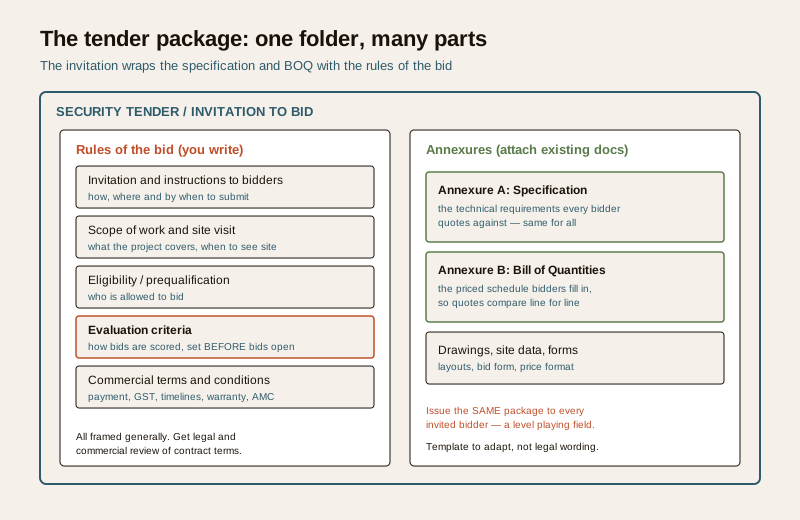
The tender does not replace the specification or the BOQ, it carries them. Think of it as a folder: the front matter is the instructions and rules, and the specification and BOQ ride inside as annexures. Every bidder receives the identical folder, quotes against the identical documents, and is scored on the identical criteria. That sameness is the whole point, it is what makes the bids comparable and the process defensible.
The structure of a tender package, section by section
A private security tender usually runs in this order. Adapt the headings to your project, but keep the logic: tell them the rules first, then the work, then how you will judge, then the commercial terms.
- Invitation and instructions to bidders. A short covering note naming the project and issuer, then the mechanics: where and by when to submit, in what format, in how many copies or which portal, what must be enclosed, and who to contact for questions. This is where you state the submission deadline and that late bids are not accepted.
- Scope of work. A plain-language summary of what the project covers, so a bidder grasps the whole before reading the detail. It points to the specification for the technical requirements.
- Specification (annexure). Your security specification, attached as-is. This is the technical yardstick every bid is measured against.
- Bill of quantities (annexure). Your security BOQ, attached as a blank priced schedule the bidder fills in, so quotes come back line for line and compare directly.
- Eligibility and prequalification criteria. Who is allowed to bid and what they must prove, drawn from your prequalification form. State it up front so unqualified firms self-select out.
- Site visit. Whether a site visit is offered or required, and when, so every bidder quotes against the real conditions.
- Submission format and deadline. How the bid must be packaged, commonly a technical envelope and a separate commercial envelope, so price does not colour the technical read.
- Evaluation criteria. How bids will be scored, the technical and commercial split and what each covers, published so bidders know the rules before they bid.
- Commercial terms. Payment stages, taxes and GST treatment, project timeline, any penalties for delay, warranty period and AMC expectations, all framed generally and all subject to your legal review.
- Contract conditions. The terms that will govern the eventual contract, again for your advisers to draft.
Setting evaluation criteria: technical and commercial
The single most important discipline in a fair tender is deciding how you will score before you open a single bid, and writing it into the tender so bidders can see it. Score on both technical merit and commercial offer, never on lowest price alone, a cheap bid against a poor specification is not a saving.
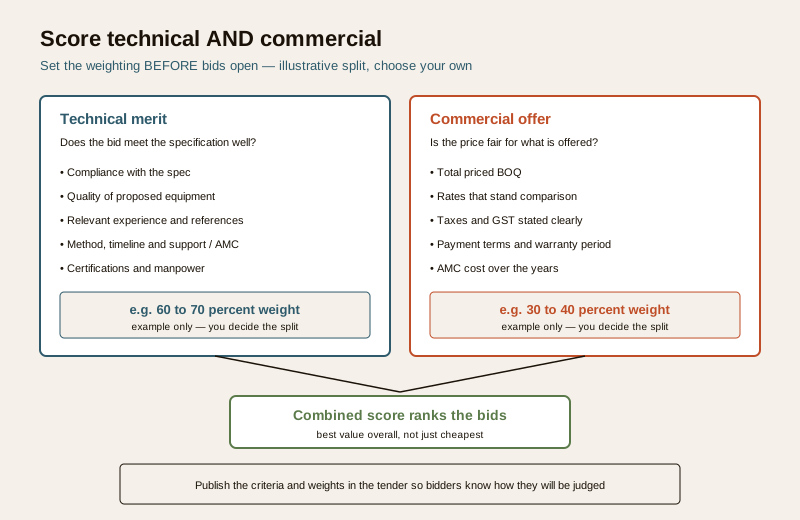
A common shape is to weight technical merit more heavily than price, for example a majority weight on technical and the remainder on commercial, then combine the two into one ranked score so the best overall value wins rather than the cheapest. The exact weights are yours to choose for the project, the figures in the figure and the table below are illustrative only.
Worked example: tender contents and evaluation (Example only, adapt to your project)
The table below shows an illustrative tender-contents checklist with an evaluation weighting described in words. The percentages are placeholders, choose your own split and have it reviewed.
| Section | What it contains (example) | Evaluation weight |
|---|---|---|
| Instructions to bidders | Submission portal, deadline, envelope format, contact | Not scored, mandatory to comply |
| Scope of work | Summary of the security project across the site | Not scored |
| Specification (Annexure A) | Technical requirements every bidder quotes against | Basis of technical scoring |
| BOQ (Annexure B) | Blank priced schedule the bidder fills in | Basis of commercial scoring |
| Eligibility | Prequalification thresholds, e.g. years in business, references | Pass or fail gate |
| Technical proposal | Compliance, equipment quality, experience, method, AMC | e.g. majority weight, specify |
| Commercial proposal | Total priced BOQ, taxes and GST, payment terms | e.g. minority weight, specify |
| Timeline and penalties | Delivery schedule, delay terms | Verify with legal, specify |
Example only, adapt to your project. The weights, thresholds and terms above are illustrative placeholders, not recommendations and not legal wording. Replace every "specify" and "e.g." with figures your team has decided and your advisers have checked.
Blank tender-structure template (copy-ready)
Copy this skeleton into your own document and fill each row. Keep the specification and BOQ as attached annexures rather than retyping them.
| Section | Include? | Your content / annexure reference |
|---|---|---|
| Invitation and issuer details | Yes / No | ... |
| Instructions to bidders (how, where, by when) | Yes / No | ... |
| Scope of work summary | Yes / No | ... |
| Specification | Annexure A | Attach spec document |
| Bill of quantities | Annexure B | Attach blank priced BOQ |
| Eligibility / prequalification criteria | Yes / No | ... |
| Site visit arrangements | Yes / No | ... |
| Submission format (technical + commercial) | Yes / No | ... |
| Deadline and late-bid rule | Yes / No | ... |
| Evaluation criteria and weights | Yes / No | ... |
| Commercial terms (payment, GST, warranty, AMC) | Yes / No | Draft with legal |
| Contract conditions | Yes / No | Draft with legal |
| Bid submission form / declaration | Yes / No | ... |
Field guide: how to fill it
- Invitation and instructions — be precise about the deadline, format and contact. Ambiguity here is what creates disputes later.
- Scope of work — enough for a bidder to grasp the whole; the detail lives in the specification, do not duplicate and risk contradicting it.
- Annexures — attach the specification and BOQ exactly as issued so every bidder works from the identical text and schedule.
- Eligibility — set thresholds you can justify and apply equally; use them as a pass-or-fail gate before scoring, not as hidden preferences.
- Evaluation criteria — decide the technical and commercial weights up front, write them in, and score every bid against them consistently.
- Commercial terms and contract conditions — placeholders only in your draft; these are the sections that most need legal and commercial review before issue.
The field guide: running a fair tender
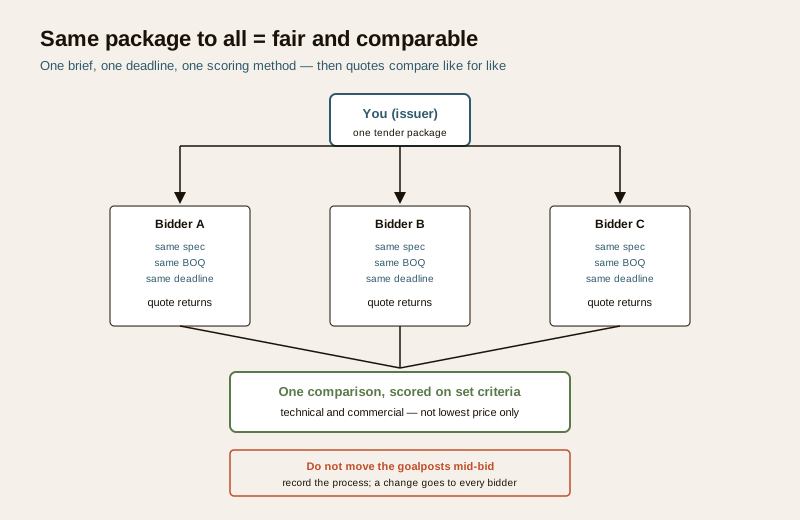
- Issue the same package to everyone. Same documents, same deadline, same information. If you answer one bidder's question in a way that changes the brief, send that clarification to all of them.
- Set the evaluation criteria before bids open. Decide and publish how you will score, then hold to it. Criteria invented after you have seen the prices are not credible.
- Prequalify first. Invite only vendors who have cleared your prequalification, so you are comparing capable firms, not filtering out unqualified bidders at the last minute.
- Score technical and commercial, not lowest price only. The cheapest bid against a good specification often hides thinner equipment or weaker support, weigh quality and price together.
- Keep a level playing field. No side conversations, no private previews, no moving the goalposts once bids are in.
- Record the process. Note who was invited, what was issued, questions and answers, scores and the reasoning for the award. A clean record is your protection if the decision is ever questioned.
Common mistakes to avoid
- Moving the goalposts — changing the scope, deadline or criteria after bids are in, which makes the earlier bids meaningless and the process unfair.
- Lowest-price-only awards — treating the cheapest number as the winner regardless of what it buys, then paying for it later in quality and support.
- Vague scope — a woolly scope of work invites wildly different quotes that cannot be compared, tie it to a clear specification.
- No evaluation method — collecting bids with no agreed way to score them, which turns the award into a subjective argument.
- Skipping prequalification — letting anyone bid, then wasting the evaluation on firms that were never capable.
How it connects to the neighbouring documents
The tender is the wrapper; the value is in what it carries and where it points.
- It attaches the security specification as the technical yardstick and the security BOQ as the priced schedule.
- It draws its eligibility rules from the vendor prequalification form.
- The bids that come back feed into vendor and installer evaluation, where you score them and check references.
- For the wider workflow of how these deliverables fit together, see the professional security resources guide.
Key takeaways
- A tender is the invitation that wraps your specification and BOQ in the rules of the bid and sends the identical package to every invited vendor.
- Structure it clearly: instructions, scope, annexed specification and BOQ, eligibility, site visit, submission format, evaluation criteria, and commercial terms for legal review.
- Set evaluation criteria before bids open, score technical and commercial together, and never award on lowest price alone.
- Prequalify bidders, keep a level playing field, do not move the goalposts, and record the whole process.
- This is a template to adapt, not legal or contractual wording. Get legal and commercial review, and remember public or large tenders have their own rules.
References
- Your own legal and commercial advisers — the authoritative source for every contractual, payment, tax, penalty and liability term in a tender; draft and review with them before issuing anything.
- Central and state public-procurement rules and portals — where a tender is public or above threshold, the applicable procurement framework and format governs and overrides any generic template; confirm the current rules that apply to you.
- Bureau of Indian Standards catalogue — verify the current edition of any standard your specification references at https://www.services.bis.gov.in/
This is an educational template, not legal advice. Every commercial and contractual term must be drafted and reviewed by qualified legal and commercial professionals, and public or large tenders follow their own binding procurement rules.
Export this guide
Related Guides — Deep-dive reading
How to Compare Security Quotations in India (2026): Read Three Quotes Like an Expert
Three quotes for the same home security job will name different amounts, different equipment and different scope. This homeowner guide shows how to make them truly like-for-like first, read every line item, spot what a cheap quote hides, and pick on total value rather than the lowest number.
SecuritySTP Vendor Evaluation Matrix: A Weighted Scoring System to Pick the Right Supplier
How to turn a pile of STP quotations into a defensible decision — the criteria that actually matter, how to weight them for your project, and how to score vendors on a single comparable scale instead of chasing the lowest price.
Sewage Treatment PlantsSecurity Bid Comparison Sheet for India (2026): Comparing Apples with Apples
A ready-to-adapt scoring matrix that lays received security bids side by side, evaluates them on the criteria and weights set in your tender, normalises everyone to a common scope, and produces a fair, documented award recommendation — not just the lowest price.
SecurityRelated Tools — Try Free
Interior Contract Clause Checklist
16 sections and 98 checkboxes covering scope, BOQ, milestones, penalties, warranty, and disputes.
Contract ChecklistSecurity Vendor Evaluation Scorecard
Rate a CCTV/security installer or guarding agency across eight weighted criteria for a hire / negotiate / walk-away verdict.
Vendor ScorecardInterior Red Flag Checklist — Before Signing
54 red flags across 8 categories with a live risk score and personalised PDF.
Red Flag Checklist