
Security Product Warranty Guide (2026): What It Covers and How to Protect It
A homeowner's buying guide to security-product warranties in India: what a warranty actually covers versus an AMC, what is excluded, why a grey-market unit may have no valid India warranty, and how to keep your cover alive.
A warranty is one of the least glamorous things about a security product and one of the most decision-useful. Two cameras can look identical on a shelf and carry very different promises behind them: one backed by a manufacturer who will replace it if it fails, bought through a channel that honours that promise, installed in a way that keeps it intact; the other a lookalike with a printed "1 year" card that no service centre in India will actually stand behind. The device is the easy part. The promise attached to it is what you are really buying, and it is where most buyers never look until the day something stops working.
This guide is about reading that promise before you pay, not after. A warranty is a selection criterion in its own right, a signal of how confident a maker is in the product, and a thing you can quietly void on day one with the wrong channel, the wrong installer, or a lost invoice. For a homeowner buying a camera, a smart lock, an alarm panel, a video doorbell or a sensor, understanding warranties turns a vague comfort ("it has a warranty, na") into a real, enforceable protection you actually chose.
Scope and how to use this. This is a buyer's selection guide, not an install manual and not a price list, and it is not legal advice. It explains what security-product warranties in India typically cover and exclude so you can compare products and protect your cover; it does not quote specific rupee figures or interpret any particular contract or law for your case. For what things cost and service-plan pricing, see the cost guides; for choosing the product itself, start from the pillar guide to choosing a home security system. On life-safety products (fire and smoke detection, egress-affecting locks), never let warranty convenience override certification and fitness-for-purpose. Read the actual warranty document for your product; when a dispute involves your legal rights, consult a qualified professional.
Warranty, AMC and certification are three different things
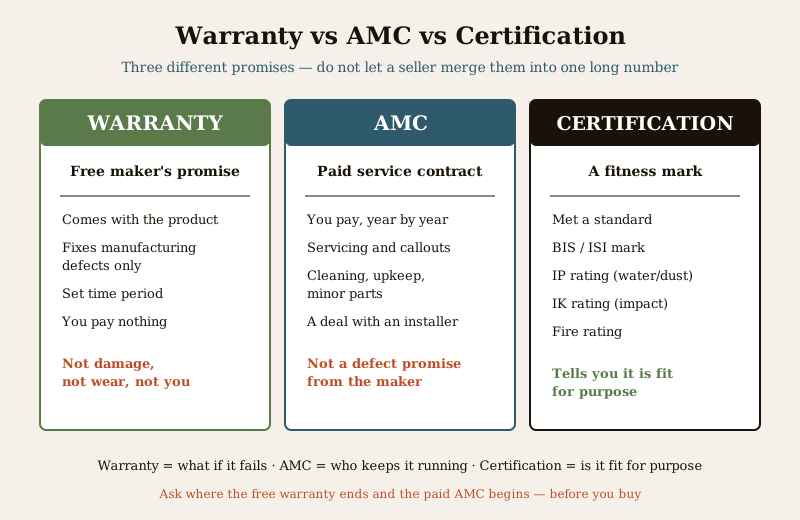
The single most common confusion is treating a warranty and an AMC as the same promise. They are not, and a good salesperson will sometimes blur them because the blur sells.
- A warranty is the manufacturer's promise to fix or replace the product if it fails from a manufacturing defect within a set period, at no cost to you. You do not pay extra for it; it comes with the product. It is about defects, not wear, and not accidents.
- An AMC (Annual Maintenance Contract) is an ongoing service you pay for, year by year, after or alongside the warranty. It typically covers periodic servicing, callouts, cleaning, minor part replacement and support, on whatever terms you agree. An AMC is a relationship with an installer or service provider, not a defect promise from the maker.
- Certification is a third thing again: a mark that the product met a standard (BIS/ISI, an IP ingress rating, an IK impact rating, a fire rating). Certification tells you the product is fit for purpose; warranty tells you what happens if it fails; an AMC tells you who keeps it running. See the security product certification guide for the certification half of this picture.
You want clarity on all three before you buy, and you especially want to know where the warranty ends and the paid AMC begins, so you are not sold a "5-year warranty" that is really one year of warranty plus four years of AMC you will be billed for.
Typical warranty periods, framed honestly
Warranty length varies by product type and by brand, and any specific number should come from the actual product's warranty card rather than a rule of thumb. Framed generally, and only as orientation:
- Cameras and recorders (CCTV, NVR/DVR, IP cameras) usually carry a warranty measured in a small number of years, with the recorder and its hard disk sometimes covered on different terms from the camera.
- Smart locks and video doorbells typically carry a shorter electronics warranty, with the mechanical parts, batteries and finish often on separate or shorter terms.
- Alarm panels, sensors and detectors vary widely; the panel and the sensors may be warranted differently.
- Batteries and other consumables are almost always warranted for a much shorter period than the device they sit in, or excluded as wear items entirely.
The point is not the exact figure. It is that a warranty noticeably shorter than the product should reasonably last is a red flag about how long the maker expects it to survive. If a lock the size of a family's front-door security carries only a token warranty, ask why.
What a warranty usually covers, and what it excludes
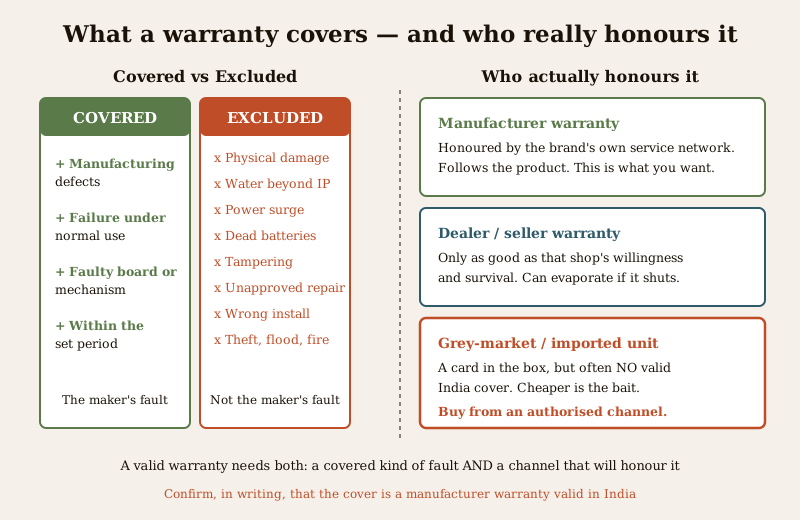
A warranty is narrower than most buyers assume. It covers the maker's fault, not yours, not the environment's, and not time's.
Usually covered:
- Manufacturing defects — a component that was faulty when made, a board that fails within the period without external cause, a mechanism that was never right.
- Failure under normal, intended use — the product used the way it was meant to be used, in the conditions it was rated for.
Usually excluded:
- Physical damage — drops, knocks, cracked housings, cut cables.
- Water and moisture damage beyond the product's rating — an indoor camera exposed to rain, a unit mounted outside its IP rating.
- Power surge and lightning damage — a very common real-world killer of electronics, and very commonly excluded unless you provided proper surge protection.
- Wear-and-tear items — batteries, seals, and other parts that are expected to degrade with use.
- Unauthorised repair or tampering — once an unapproved technician has opened the unit, the cover typically lapses.
- Wrong or unauthorised installation — a device installed against the maker's instructions, or by someone not qualified/authorised, often voids the cover (more on this below).
- Acts of nature, theft, and misuse — floods, fire, and using the product for something it was not designed for.
Read your specific exclusions before you buy, because two products at a similar price can exclude very different things. A camera that excludes surge damage in a location with unstable power is a different proposition from one that does not.
Manufacturer warranty vs dealer warranty, and the grey-market trap
This is the distinction that catches the most homeowners, and it is worth slowing down for.
- A manufacturer warranty is honoured by the brand's own service network anywhere its terms apply. It follows the product because the maker stands behind it.
- A dealer or seller warranty is a promise from the shop, not the maker. It can be perfectly good, but it is only as durable as that shop's willingness and existence. If the dealer shuts, moves, or simply refuses, a "dealer warranty" can evaporate.
The dangerous case is the grey-market or unofficially-imported unit. A product brought into India outside the brand's official distribution — a "parallel import", a unit meant for another country's market, or stock with no Indian importer behind it — may carry no valid India warranty at all, even if it came with a warranty card in the box. The brand's Indian service centres can and do refuse warranty service on units they did not officially bring into the country. The card looks real; the cover is not. This is a genuine trap, because grey-market units are often cheaper, which is exactly the bait.
The defence is simple and non-negotiable: buy from an authorised channel — the brand's official store, an authorised dealer or a reputable retailer selling India-warranted stock — and confirm, in writing, that the unit carries a manufacturer warranty valid in India. A price that looks too good is often too good because the promise behind it is missing.
Carry-in, onsite and replacement warranties
Even a valid warranty differs in how you actually claim it, and this matters more for a fixed installation than a gadget.
- Carry-in warranty — you must take the faulty unit to a service centre yourself. Manageable for a small camera; a real nuisance for a mounted lock, a wired panel or a device on the outside wall.
- Onsite warranty — a technician comes to you. More convenient and more valuable for anything installed into the fabric of the home, though it may be limited to certain locations or the first period.
- Replacement warranty — a defective unit is swapped for a new or equivalent one, sometimes only within an early window (for example the first few days or weeks), after which it reverts to repair.
For a security system that is fixed to your walls and wired through your home, an onsite or replacement term is worth real money compared with a carry-in one, because the cost and hassle of dismounting and transporting a fixed device is exactly what you do not want when it fails. Weigh this when you compare two otherwise-similar products.
How installation interacts with your warranty
Here is the trap that turns a good product into an uncovered one: a bad or unauthorised installation can void the warranty. Many manufacturers require, or strongly favour, installation by an authorised or qualified installer, and reserve the right to refuse a claim where damage or failure was caused by improper fitting — wrong wiring, no surge protection, a unit mounted outside its rated conditions, or a device opened and modified.
This is why warranty and installer choice are one decision, not two. A cut-price installer who saves you a little on fitting can cost you the entire warranty if their work is what fails the unit, or if using an unapproved fitter voids the cover by itself. Choosing a competent, ideally brand-authorised installer is partly a warranty-protection decision. See the security vendor and installer evaluation guide for how to vet one, and keep a record of who installed what and when.
Reading warranty terms before you buy
Treat the warranty document as part of the product comparison, not the paperwork you skim after. Before you pay, get clear answers on:
- How long, and on which parts? The headline period may not cover every component equally.
- Manufacturer-backed and valid in India? Not a dealer-only or grey-market promise.
- What is excluded? Especially surge, water and battery, which decide real-world outcomes.
- Carry-in, onsite or replacement, and for how long is each in force?
- Is there an AMC after it, and what does that cost and cover? So you know the true multi-year picture.
A product whose maker gives you clear, written, India-valid answers is telling you something good. One that cannot, or that hides warranty behind a paid AMC, is telling you something too. For choosing the device on its merits, this sits alongside the pillar buying guide and, for cameras specifically, how to choose a CCTV camera.
Your consumer rights, in general terms
In India, consumer protection law (the Consumer Protection Act framework) gives buyers general rights against defective goods and deficient service, and a route to complain when a legitimate warranty is not honoured. The practical takeaways are simple and do not require you to know the fine print: keep proof of your purchase, keep the warranty documentation, buy from a seller you can actually reach, and insist on written terms — because your ability to enforce any right depends on being able to show what you bought, from whom, and what was promised. This is general context, not legal advice; for a specific dispute, take the exact facts to a qualified professional.
Red flags to walk away from
Warning signs a warranty is weak or absent. Any one of these should make you pause; two together should make you walk.
- No written warranty at all — only a verbal "don't worry, it has guarantee".
- A grey-market or unofficially-imported unit — cheaper, with a card in the box but no confirmed India cover.
- A warranty noticeably shorter than the product should reasonably last — the maker is telling you how long they expect it to survive.
- "Warranty" that is really a paid AMC — a long number that turns out to be one year free plus years you pay for.
- A seller who will not put the terms, channel and India-validity in writing on the invoice.
- Pressure to use an unapproved installer to save a little, at the cost of your cover.
- No invoice, or an invoice that omits the model, serial or seller details you would need to make a claim.
Buying checklist — protect your warranty before you pay
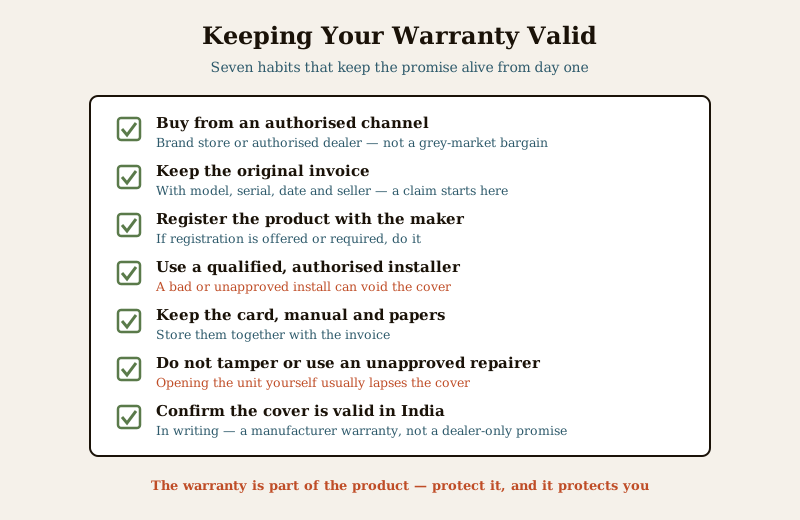
Before you commit to a security product, run this:
- [ ] Buy from an authorised channel — brand store, authorised dealer, or a retailer selling India-warranted stock. Avoid grey-market bargains.
- [ ] Confirm the warranty is a manufacturer warranty valid in India, in writing, not a dealer-only or imported-unit promise.
- [ ] Get and keep the original invoice — with model, serial number, date and seller clearly on it. This is the document a claim starts from.
- [ ] Read the exclusions — especially surge, water and battery — and match them to your conditions.
- [ ] Check the claim type — carry-in, onsite or replacement, and for how long. Prefer onsite/replacement for anything fixed to the home.
- [ ] Register the product with the manufacturer if registration is offered or required.
- [ ] Use a qualified, ideally brand-authorised installer — a bad install can void the cover.
- [ ] Keep the warranty card, manual and any registration confirmation together with the invoice.
- [ ] Do not tamper or use an unapproved repairer during the warranty period.
- [ ] Understand any AMC that follows — its cost, its cover, and where warranty ends and it begins.
Key takeaways
- A warranty is the maker's free promise to fix manufacturing defects; an AMC is a paid service contract; certification is a fitness mark. Do not let a seller merge them into one long number.
- Warranties cover defects, not damage. Physical, water, surge, battery, tampering and wrong-install failures are the usual exclusions — read yours before you buy.
- A grey-market or unofficially-imported unit may have no valid India warranty at all, even with a card in the box. Buy from an authorised channel and confirm India-validity in writing.
- How you claim matters — onsite or replacement cover is worth real money over carry-in for anything fixed to your home.
- A bad or unauthorised install can void the warranty — choosing a good installer is partly a warranty decision.
- Keep the invoice, register the product, and keep the papers. Your consumer rights depend on being able to show what you bought and what was promised.
Where to go next
- The pillar guide to choosing a home security system — the overall buying decision this warranty question sits inside.
- The security product certification guide — the certification half of "is this product any good".
- How to choose a CCTV camera — warranty terms as one criterion among many for cameras.
- The security vendor and installer evaluation guide — vetting the installer whose work can keep or void your cover.
- The buying and selection sub-hub and the main security hub — the rest of the how-to-choose library.
References
- Consumer Protection Act framework, Government of India — general rights of buyers against defective goods and deficient service, and the consumer-complaint route when a legitimate warranty is not honoured. This guide summarises the framework generically; verify current provisions and take any specific dispute to a qualified professional.
- Bureau of Indian Standards (BIS) — product certification marks (ISI), IP ingress-protection ratings, IK impact ratings and related standards that indicate a security product's fitness for purpose alongside its warranty. Verify a product's certification status via the BIS catalogue: https://www.services.bis.gov.in/
- Manufacturer warranty documentation — the authoritative source for any specific product's period, covered parts, exclusions, claim type and India-validity is the warranty card and terms supplied with that product. Read it before purchase.
This is an educational buyer's guide for homeowners, not legal advice, an installation manual or a price list. Warranty periods, terms and exclusions vary by product and brand and change over time; confirm the exact terms in the manufacturer's own warranty documentation, buy from an authorised channel, keep your invoice, and consult a qualified professional for any specific consumer dispute.
Export this guide
Related Guides — Deep-dive reading
Security Product Certification Guide (2026): Reading the Marks That Prove a Device Is Safe and Genuine
How a homeowner tells a genuinely certified, fit-for-purpose security product from an uncertified one, and why it matters most for life-safety and anything electrical or outdoor. A plain-language buyer's guide to the marks and standards you will actually meet in India, and how to verify one is real.
SecuritySecurity AMC Buying Guide (2026): How to Buy a Maintenance Contract That Keeps the System Working
A decision guide to buying an Annual Maintenance Contract for a home or building security system in India — the types of AMC and how to choose, what a good scope must include, the clauses that decide whether you are covered, how to compare quotes like-for-like, and the red flags that hide a dead camera you only discover the night you need it.
SecurityBIS Standards for Security Equipment in India (2026): The Marks That Matter
What the Bureau of Indian Standards actually certifies, the ISI mark and the CRS registration you will meet on cameras, alarms, cables and extinguishers, and how a homeowner checks a mark is real on the BIS portal, without memorising a single standard number.
SecurityRelated Tools — Try Free
Security Vendor Evaluation Scorecard
Rate a CCTV/security installer or guarding agency across eight weighted criteria for a hire / negotiate / walk-away verdict.
Vendor ScorecardSecurity System Cost Estimator
Estimate the all-in capex with GST, annual running cost and 5-year total cost of ownership of a home or building security system.
Cost EstimatorCCTV Camera Coverage & Count Calculator
Estimate how many CCTV cameras you need, the NVR channels, storage in TB for your retention period, and an indicative all-in cost with GST.
CCTV Calculator