
Robot Vacuums & Mops for Indian Homes: A Buyer's Guide
How robot vacuums actually work, what suction and battery numbers mean, mopping types, LiDAR vs gyro navigation, self-emptying docks, the Indian dust-and-threshold reality, honest value vs premium picks with real prices, and the maintenance nobody tells you about.
A robot vacuum is one of the few smart-home gadgets that earns its keep every single day. It does not just automate a task — it removes one entirely, quietly running while you work or sleep and handing you back floors that dust would otherwise reclaim within hours in most Indian cities. But it is also one of the most over-sold and most returned categories in the market, because a lot of homes buy on suction numbers and marketing, then discover that thresholds between rooms trap the machine, that mopping is not the same as scrubbing, and that the ₹18,000 unit needs its brushes cleaned every week.
This guide explains how these machines actually work, what the specifications mean in plain terms, and — most importantly — how they behave in the specific reality of an Indian home: fine construction and road dust, raised thresholds between rooms, floors that are equal parts vitrified tile, granite, marble and rug, and the cobweb-and-corner limits every robot shares. It fits alongside the best smart home devices guide and the ultimate guide to smart homes in India. If budget is your main constraint, read the smart home on a budget guide too.
A robot vacuum is a daily-maintenance machine, not a deep-cleaning one. It keeps already-clean floors clean brilliantly; it will not rescue a home that is deep-cleaned once a month. Buy it to hold the line, not to win the war.
How a robot vacuum actually works
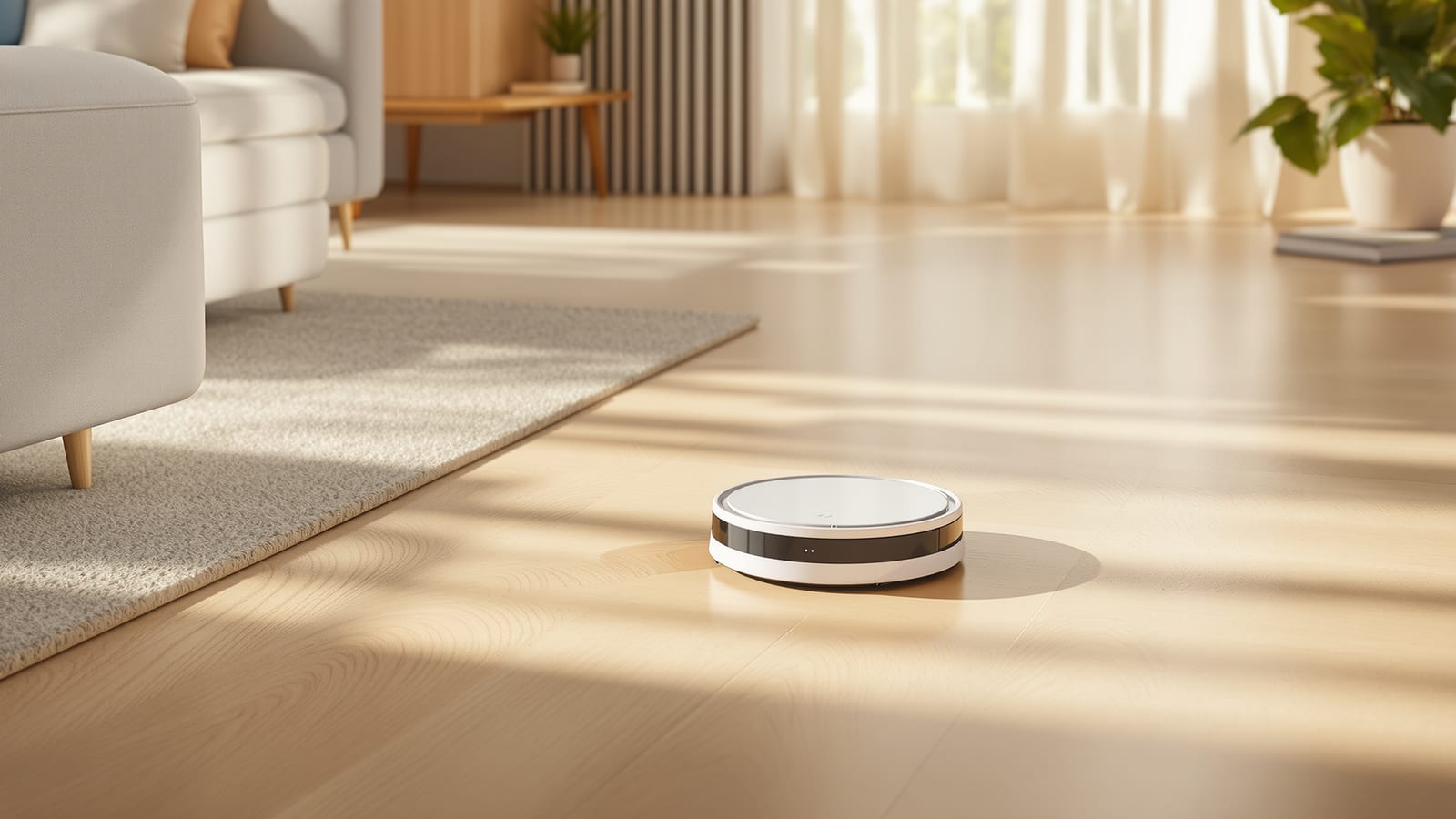
Underneath the disc is a spinning main brush (or twin rubber rollers) that agitates dust off the floor, side brushes that sweep debris from edges toward the centre, and a suction motor that pulls everything into an onboard dustbin through a filter. A set of sensors — cliff sensors to avoid stairs, bump sensors, and a navigation system on top — lets it move around the room and, on better models, build a map. It returns to a charging dock when the battery runs low or the job is done.
The two numbers marketing shouts loudest are suction and battery. Both matter, but not the way the box implies.
| Spec | What it means | What actually matters |
|---|---|---|
| Suction (Pa, pascals) | Vacuum pressure the motor generates | More helps on carpet and fine dust; beyond ~4,000 Pa gains shrink. 2,500 to 5,000 Pa is the useful band for hard floors |
| Battery (mAh / minutes) | Runtime per charge | 90 to 180 minutes covers a 2 to 3 BHK; models that recharge and resume matter more than raw runtime |
| Dustbin size (ml) | Onboard capacity | Bigger means fewer empties; Indian dust fills small bins fast |
| Filter (HEPA / washable) | Traps fine particles | A true HEPA-grade, washable filter matters in dusty cities |
| Height (mm) | Whether it fits under furniture | Under 100 mm clears most Indian sofas and beds |
Suction is measured in pascals (Pa). A budget robot at 2,000 Pa is fine for daily dust on tile; a premium unit at 6,000 to 10,000 Pa helps mostly on rugs and embedded pet hair. Chasing the highest Pa number is the classic first-time mistake — navigation and maintenance design affect the result far more.
Mopping: what it can and cannot do
Most robots sold in India today are "2-in-1" vacuum-and-mop units. It is essential to understand what mopping means here, because the word oversells the reality.
- Basic drag mop. A water tank drips onto a flat microfibre cloth that the robot drags behind it. This wipes up light dust and gives a "damp-wiped" finish. It does not scrub. It is a daily freshen-up, not a substitute for a pochha.
- Vibrating mop. The pad oscillates rapidly (sonic scrubbing), applying light pressure — noticeably better on dried spills than a drag mop.
- Rotating / spinning mop. Two round pads spin under pressure, the closest a robot gets to real scrubbing. Premium models lift the pads over carpet automatically and wash them at the dock.
For Indian homes where a proper wet mop is the norm, treat robot mopping as maintenance between real cleans. It keeps daily footprint dust and dryness at bay; it will not lift a week of kitchen grease or dried dal. Set expectations accordingly and you will be happy; expect it to replace your house help's mopping and you will be disappointed.
| Mop type | Cleaning quality | Found on | Notes |
|---|---|---|---|
| Drag pad | Light damp-wipe | Budget models | No scrubbing pressure |
| Vibrating pad | Better on dried spills | Mid-range | Sonic oscillation |
| Rotating pads | Closest to scrubbing | Premium | Auto-lift on carpet, self-wash docks |
Navigation: LiDAR vs gyroscope
How a robot finds its way is the single biggest quality divide, more than suction. There are two broad approaches.
LiDAR (laser) navigation puts a small spinning laser turret on top of the robot. It measures the distance to every wall many times a second, builds an accurate map, cleans in efficient straight rows, remembers the map across sessions, and lets you set no-go zones and room-by-room cleaning in the app. It also works in the dark, which matters for night runs. This is now available from around ₹18,000 and is worth prioritising.
Gyroscope (gyro) navigation uses internal motion sensors to estimate position, moving in a rough back-and-forth pattern without a true map. It is cheaper but bumps around more, misses patches, and cannot do smart room selection. Below roughly ₹15,000 you are usually buying gyro; treat those as basic daily sweepers.
Some premium units add cameras (vSLAM) or AI obstacle recognition to dodge wires and slippers — genuinely useful in cable-heavy Indian homes, but a premium-tier feature.
Self-emptying docks
The newest convenience is the auto-empty dock: when the robot returns, a dock sucks the onboard bin into a large dust bag, so you empty it once every few weeks instead of after every run. Premium docks also wash and dry the mop pads and refill the water tank.
They are a real quality-of-life upgrade, especially in dusty cities where a small bin fills daily — but they add ₹10,000 to ₹30,000 to the price, the dust bags are a recurring cost (₹800 to ₹1,500 for a pack), and the dock is bulky. Worth it for larger homes and hands-off owners; skippable for a compact flat where emptying a bin takes ten seconds.
The India reality check
This is where honest advice matters most, because a robot that thrives in a European apartment meets very different conditions here.
| Indian condition | What happens | How to handle it |
|---|---|---|
| Fine construction / road dust | Bins and filters fill fast; more frequent emptying | Bigger bin or a self-empty dock; washable HEPA filter |
| Raised thresholds between rooms | Robot gets stuck or cannot cross | Check climb spec (18 to 22 mm is good); add ramps or run room-by-room |
| Loose wires, phone chargers | Robot eats cables and tangles | AI obstacle avoidance, or tidy wires before runs |
| Mixed flooring (tile, marble, rug) | Mop must lift on carpet; some rugs snag | Auto mop-lift models; keep tasselled rugs out of the path |
| Cobwebs and high corners | Robots only clean the floor plane | Still a manual job — no robot reaches walls or ceilings |
| Deep corners under low furniture | Round robots miss 90° corners | Side brush helps; accept a manual touch-up |
| Power cuts | Interrupted cleans, dock reboots | Models that resume after charge; a small UPS on the dock helps |
The threshold problem is the one most people underestimate. Traditional Indian homes often have raised marble or granté dividers between rooms and at bathroom doors; if they exceed the robot's climb rating, the machine simply cannot pass, and you are back to running it one room at a time. Measure your highest threshold before you buy, and match it to the model's stated climbing ability.
Value vs premium: honest picks with prices
The market spans roughly ₹10,000 to ₹90,000. Here is how the tiers really differ, with brands widely available in India.
| Tier | Price band | Navigation | Mopping | Represents |
|---|---|---|---|---|
| Budget | ₹10,000 to ₹16,000 | Gyro (random) | Drag pad | Mi/Xiaomi entry, Eureka Forbes, ILIFE |
| Mid-range | ₹18,000 to ₹35,000 | LiDAR mapping | Vibrating pad | Eufy, ECOVACS Deebot, Xiaomi LiDAR |
| Premium | ₹35,000 to ₹60,000 | LiDAR + obstacle AI | Rotating, auto-lift | Roborock, higher ECOVACS |
| Flagship | ₹60,000 to ₹90,000+ | LiDAR + camera AI | Rotating + self-wash dock | Roborock top line, iRobot Roomba Combo |
The honest recommendation for most Indian homes is a LiDAR mid-range model around ₹18,000 to ₹25,000 — the jump from gyro to LiDAR mapping transforms daily reliability far more than a few thousand extra pascals of suction. Go budget only if you want a simple sweeper for one or two rooms of hard floor. Go premium if you have a large home, pets, or want the self-washing dock to make it truly hands-off. iRobot Roomba commands a brand premium; Roborock and ECOVACS often give more features per rupee, while Mi/Xiaomi and Eureka Forbes anchor the value end with easy service reach.
Maintenance nobody warns you about
A robot vacuum is a machine with consumables, and neglecting them is why so many end up in a cupboard.
- Filters clog with fine Indian dust; rinse washable HEPA filters weekly and replace every 2 to 4 months (₹400 to ₹900 each).
- Main brush and side brushes trap hair and thread — cut them free weekly and replace every 6 to 12 months.
- Mop pads must be washed after every mop run or they smear; buy spares.
- Wheels and sensors need a wipe so cliff sensors keep reading correctly.
- Hard water and mopping is a real Indian issue: hard water leaves mineral streaks on tile and scales the water tank and pump. Use filtered or soft water in the tank where you can, and descale the tank occasionally.
- Dust bags in self-empty docks are a recurring ₹800 to ₹1,500 cost every few weeks to months.
Budget roughly ₹1,500 to ₹4,000 a year in consumables. A robot maintained this way lasts years; a neglected one loses suction and starts smearing within months.
When a robot vacuum is worth it
It is worth it if you have mostly hard flooring, few high thresholds, a habit of keeping wires off the floor, and the discipline to do weekly upkeep — then it genuinely gives back time every day. It is not worth it if your home is mostly rugs and raised dividers, you expect it to replace real mopping, or you will not maintain it. For a compact flat, a mid-range LiDAR unit is a delight; for a rug-heavy or multi-level threshold-heavy home, a good cordless stick vacuum may serve you better. To see where it sits in a wider smart-home budget, use the smart home cost calculator, match it to your platform with the smart home ecosystem selector, and read the smart home cost guide for context. It also pairs naturally with the smart plugs guide if you want to schedule the dock — and if you are shopping for someone else, our smart home gift ideas guide covers it as a flagship present.
References
- Bureau of Energy Efficiency (BEE) — appliance energy standards and star labelling: beestarlabel.com
- Bureau of Indian Standards (BIS) — safety marks and standards for household electricals: bis.gov.in
- Roborock India — official range, specifications and navigation technology: roborock.com
- iRobot — how robot vacuum navigation and mapping works (technical explainers): irobot.in
- Rtings — independent robot vacuum test methodology and reviews: rtings.com/vacuum
- Wirecutter (NYT) — robot vacuum buying advice and long-term reliability notes: nytimes.com/wirecutter
Export this guide
Related Guides — Deep-dive reading
Smart Air Purifiers for Indian Homes: Beating PM2.5
Across Delhi-NCR winters and year-round urban haze, indoor air is often worse than the street. This guide explains what actually makes a purifier smart, how CADR and room sizing work, what HEPA and activated carbon really remove, honest running costs on filters and power, and which brands earn their price in Indian conditions.
Smart HomeHow to Choose a CCTV Camera (2026): The Homeowner's Decision Guide for India
Cut through the spec-sheet noise and choose the right CCTV camera for each spot around an Indian home. What actually matters — sensor and low-light performance, lens and field of view, form factor, IP and IK ratings, honest smart features — and the marketing claims to ignore.
SecurityHow to Choose a Toilet in India: A Buyer's Guide to WCs, Traps, Flush & Budget (2026)
The make-or-break trap and rough-in check, floor-mounted vs wall-hung, one-piece vs two-piece, flush type and water use, seat and rimless upgrades, good/better/best rupee tiers, what's actually in the box, and how to spot a fake before you pay.
BathroomsRelated Tools — Try Free
Before vs After — Cost Reality Check
Compare what you expected to pay vs what you actually paid, category by category.
Reality CheckFlooring Cost Calculator
Estimate the all-in cost of a floor — material, laying, wastage, skirting and GST — by area and material.
Flooring CalculatorHome Building & Interior Cost Calculator — 20 Cities
Construction + interior costs for 20 Indian cities across kitchen, wardrobes, flooring, painting, ceiling.
Cost Calculator