
Rainwater Recharge Well in India: Recharge Bores, Borewell Recharge, Construction, Filtration and Permissions
The deeper cousin of the recharge pit — a bored recharge well that pushes filtered rainwater past clayey topsoil into a deeper aquifer, used where percolation is poor or to revive a failing borewell. How it differs from a pit, how it is built with slotted casing and gravel pack, why filtration and desilting are non-negotiable, and the CGWA/CGWB permissions to know.
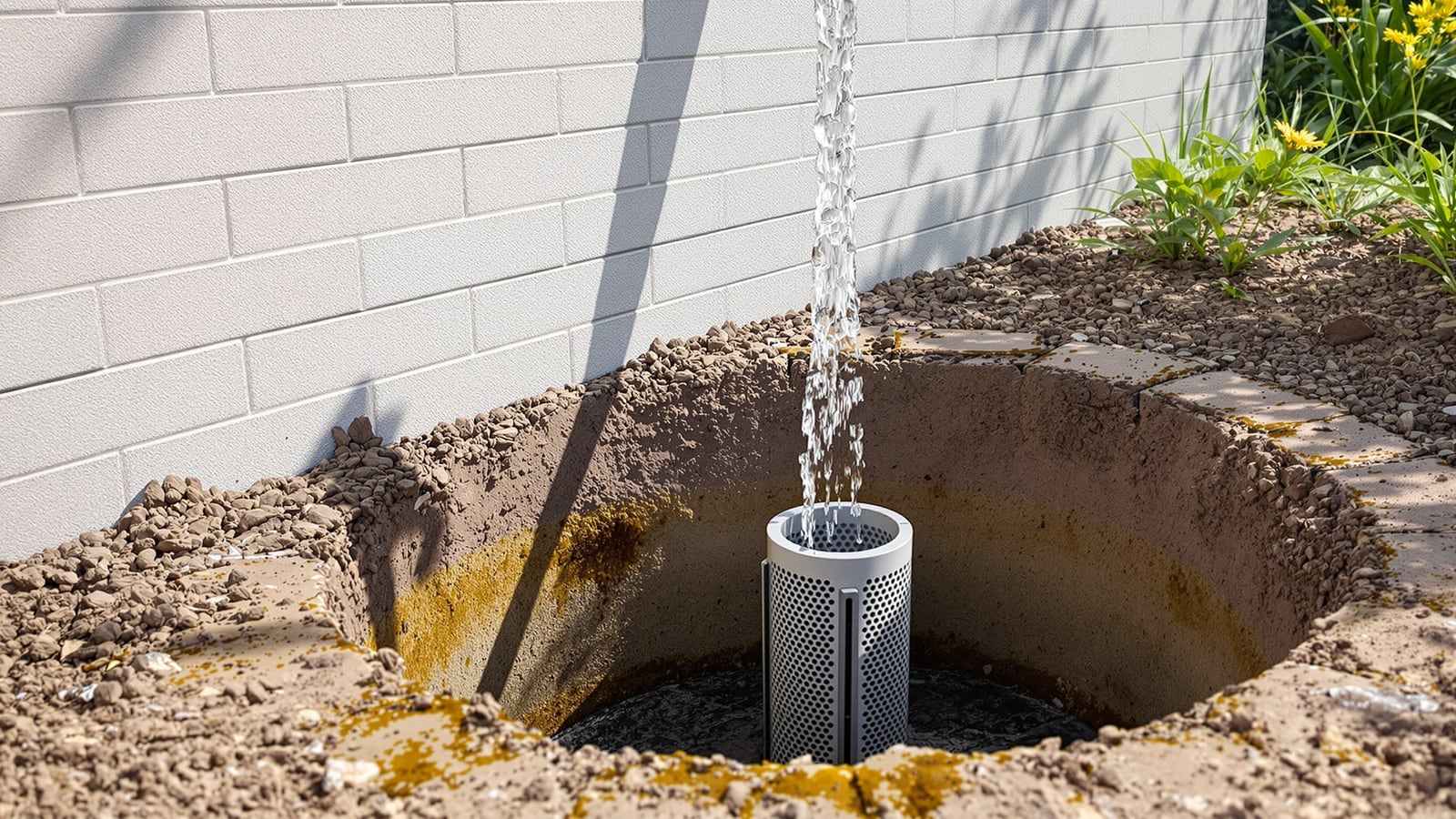
Where a shallow soakage pit stalls — thick clay, a high proportion of runoff, or a deep water table sitting far below a low-permeability layer — the answer is to go deeper and inject the rain past the obstruction. A rainwater recharge well (often called a recharge bore or recharge borewell) is a bored structure that carries filtered rooftop or surface runoff down through the impermeable zone and delivers it directly into a deeper, water-bearing aquifer. This is a professional's structure: get the filtration wrong and you contaminate the aquifer you were trying to help.
This guide sits inside the Studio Matrx Plumbing Knowledge Hub. It is the deeper counterpart to the shallow-percolation option — read it alongside the rainwater recharge pit guide, and start at the pillar rainwater harvesting guide for how storing versus recharging fit together.
A recharge well is a direct pipe into the aquifer. Unlike a pit, which lets soil do a final round of natural filtration, a well largely bypasses the soil column. That single fact is why upstream filtration and desilting are not optional here — they are the whole safety case.
Recharge well versus recharge pit — when to go deep
Both structures do the same job — return rain to the ground instead of the drain — but they suit different sites. A pit relies on water percolating sideways and down through the soil around it. A well relies on injecting water into a permeable stratum some depth below.
Choose a recharge well over a pit when:
- The topsoil is clayey or has a hardpan that throttles percolation, so a pit would simply pond and overflow.
- You want to recharge a deep aquifer — the water table sits well below a confining layer that a shallow pit cannot reach.
- Space is tight. A well has a small footprint at the surface but reaches deep, useful on constrained urban plots.
- You are trying to revive a failing borewell by putting water back near the same stratum it draws from.
Choose a pit when the soil is sandy or loamy and percolates freely, and the aquifer is shallow — the pit is cheaper, needs no drilling rig, and the soil gives you a forgiving natural filter.
| Factor | Recharge pit | Recharge well (recharge bore) |
|---|---|---|
| Best soil | Sandy, loamy, free-draining | Clayey topsoil over a deeper permeable layer |
| Target aquifer | Shallow / phreatic | Deeper, often confined |
| Typical depth | 1.5 m to 3 m | 20 m to 60 m (site-dependent, indicative) |
| Surface footprint | Larger (pit + bed) | Small (bore + collection chamber) |
| Natural soil filtration | Yes — soil polishes the water | No — largely bypassed, so filter upstream |
| Equipment | Manual / small excavator | Drilling rig |
| Contamination risk | Lower | Higher — treat filtration as mandatory |
Borewell recharge — reviving a failing yield
A specific and very common use of the recharge well is putting water back into or beside an existing borewell whose yield has dropped. Years of pumping draw the local water table down; directing monsoon runoff back toward the same aquifer can slow or partly reverse that decline. See the borewell water system guide for how the borehole, casing and water table actually behave.
There are two approaches:
- Recharge near the borewell (recommended). Build a separate recharge well or a recharge pit-plus-bore a few metres from the production borewell, so filtered water enters the aquifer close by. The soil and gravel still give some buffering, and if filtration ever fails, the damage is not injected straight down your drinking-water column.
- Recharge directly into the borewell casing (use with great caution). Filtered water is fed into the existing bore. It is the most direct revival method, but any silt, debris or contamination goes straight into the water you pump and drink. Only do this with a robust multi-stage filter and desilting chamber, and never with unfiltered or first-flush water.
Direct-into-borewell recharge concentrates every risk. If the site allows it, always prefer a dedicated recharge well set a few metres away from the production borewell.
How a recharge well is built
A recharge well is essentially a purpose-drilled bore fitted to accept water rather than yield it. A typical construction sequence:
1. Collection and conveyance. Rooftop and paved runoff is guttered to a down-conveyance pipe leading to the recharge point. First-flush is diverted (see below).
2. Desilting / settlement chamber. A masonry or precast chamber ahead of the bore where suspended silt settles out. This is the single most important maintenance-friendly component — it protects everything downstream and is easy to clean.
3. Filter media bed. Layered coarse-to-fine media — typically boulders / coarse aggregate at the bottom, then graded gravel, coarse sand and a top screening layer — through which water passes before entering the bore.
4. The bore with slotted casing. A bore is drilled to the target permeable stratum. A slotted (perforated) PVC or MS casing is lowered in; the slots let water pass out into the aquifer while keeping the bore wall from collapsing.
5. Gravel pack (shrouding). The annular gap between the slotted casing and the bore wall is packed with graded gravel. This gravel pack keeps fines out of the slots and spreads the flow, so the well accepts water without clogging.
6. Sealed top and cover. The collar is sealed and given a removable cover so silt can be cleared and the media serviced.
Filtration and desilting come first — the contamination case
This is the heading that matters most. Because a recharge well delivers water almost directly into the aquifer, whatever is in the water goes into the groundwater — silt that clogs the bore, and worse, oil, sewage cross-connections, pesticide, or road grime that can pollute a shared drinking-water source. A poorly filtered recharge well does not just fail; it can quietly contaminate the water of an entire neighbourhood.
Non-negotiables, in order:
- First-flush diverter. The first few millimetres of every rain event carry the accumulated dust, bird droppings and debris off the roof. Divert it away from the well entirely.
- Desilting / settlement chamber. Give suspended solids time and space to drop out before the water reaches the filter and bore.
- Graded filter media. Coarse-to-fine layers to trap what settlement missed. See the rainwater filtration guide for media selection, sequencing and sizing.
- Only clean catchment. Recharge rooftop and clean paved runoff — never runoff that has passed over areas exposed to sewage, chemicals or vehicle washing.
Rule of thumb: never let any water reach the slotted casing that you would not be broadly comfortable seeing near your own drinking source. The aquifer has no second filter after the bore.
Depth to aquifer and sizing at a glance
The well must reach a genuinely permeable, water-accepting stratum — drilling deep into more clay achieves nothing. Getting the target depth right needs local hydrogeology (a driller's strata log or CGWB data), not a rule copied from another town.
Recharge volume follows the catchment, not the well: yield is roughly catchment area × rainfall × runoff coefficient (indicative — roof runoff coefficient about 0.8 to 0.9). Do not size storage or recharge by guesswork — use the rainwater tank sizer for the numbers and keep this guide to the structure.
| Component | Indicative guidance | Notes |
|---|---|---|
| Bore diameter | 150 mm to 300 mm | Depends on rig and expected recharge rate |
| Depth to permeable stratum | 20 m to 60 m (site-specific) | Confirm from strata log / CGWB, never assume |
| Slotted casing | Slots across the water-accepting zone | PVC for shallow, MS for deep / unstable ground |
| Gravel pack | Graded 2 mm to 8 mm shroud | Keeps fines off the slots |
| Desilting chamber | Sized for the peak catchment flow | The serviceable heart of the system |
Maintenance
A recharge well clogs from the top down, so maintenance is mostly about keeping silt out and clearing what gets through:
- Before every monsoon: desilt the settlement chamber, wash or replace the top filter media, and confirm the first-flush diverter is clear and working.
- After the first heavy rains: check that water is being accepted, not ponding — ponding signals a clogged filter or a silted bore.
- Annually: inspect the media bed for biological fouling and the collar seal for cracks.
- If acceptance drops sharply: the slots or gravel pack may be silting up. This is far cheaper to prevent (good filtration) than to cure (re-development of the bore).
The permission reality — CGWA and CGWB
Rainwater harvesting and artificial recharge are encouraged, but injecting water into an aquifer is still a groundwater intervention, and in many areas so is the drilling itself.
- The Central Ground Water Authority (CGWA) regulates groundwater abstraction and, in notified areas, related activity; recharge is generally promoted, but where you also draw groundwater or drill, the applicable No-Objection and registration requirements can apply.
- The Central Ground Water Board (CGWB) publishes the technical guidance and manuals on artificial recharge and is the reference for aquifer data and recommended designs.
- State ground water authorities and municipal bye-laws frequently mandate rainwater harvesting on plots above a threshold size, and specify what counts as an acceptable recharge structure.
Because the exact thresholds, forms and clause numbers vary by state, notified block and year, verify the current requirement with your local ground water authority and municipal body before construction — do not rely on a figure carried over from another project.
References
- Central Ground Water Board (CGWB) — Manual on Artificial Recharge of Ground Water.
- Central Ground Water Authority (CGWA) — groundwater abstraction and NOC framework (verify current notified-area rules locally).
- CPHEEO Manual on Water Supply and Treatment — rainwater harvesting and recharge guidance.
- Local state ground water authority and municipal rainwater-harvesting bye-laws (site-specific).
Export this guide
Related Guides — Deep-dive reading
Percolation Tanks & Ponds in India: Recharging Groundwater at Plot, Farm and Watershed Scale
A professional guide to percolation tanks — impounding monsoon runoff in a shallow surface basin so it slowly infiltrates and recharges the aquifer. How they work, where they suit, siting, indicative sizing, silt management and how they relate to check dams.
PlumbingRainwater Harvesting Guide for India: Catchment, Storage, Recharge & Bye-laws
The section pillar for rainwater harvesting — why it matters for water security and groundwater, the full catchment-to-store-or-recharge chain, the two paths of using rain versus recharging aquifers, indicative yield and sizing, first-flush and filtration, maintenance, and the mandatory-RWH reality in Indian cities.
PlumbingRainwater Recharge Pit for Indian Homes: How It Works, Sizing, Filter Media, Distances and Maintenance
The soak-pit that puts rain back into the ground — how a rainwater recharge pit works, how to size it against your roof area and soil percolation, the boulder-gravel-sand filter media, the desilting chamber ahead of it, safe distances from foundation, borewell and septic, why it fails in clay, and how to keep it from choking.
PlumbingRelated Tools — Try Free
Rainwater Tank Sizer
How big should your rainwater tank be? Computes annual harvest, recommended tank capacity in litres, water-bill savings, and payback — for 10 Indian cities.
RWH CalculatorRecharge Pit Size Calculator
Size a rainwater recharge pit from catchment area, rainfall intensity and detention time, with a suggested footprint.
Plumbing CalculatorBefore & After Studio
Generate AI before-and-after renders to preview how your redesign could look.
DesignAI