
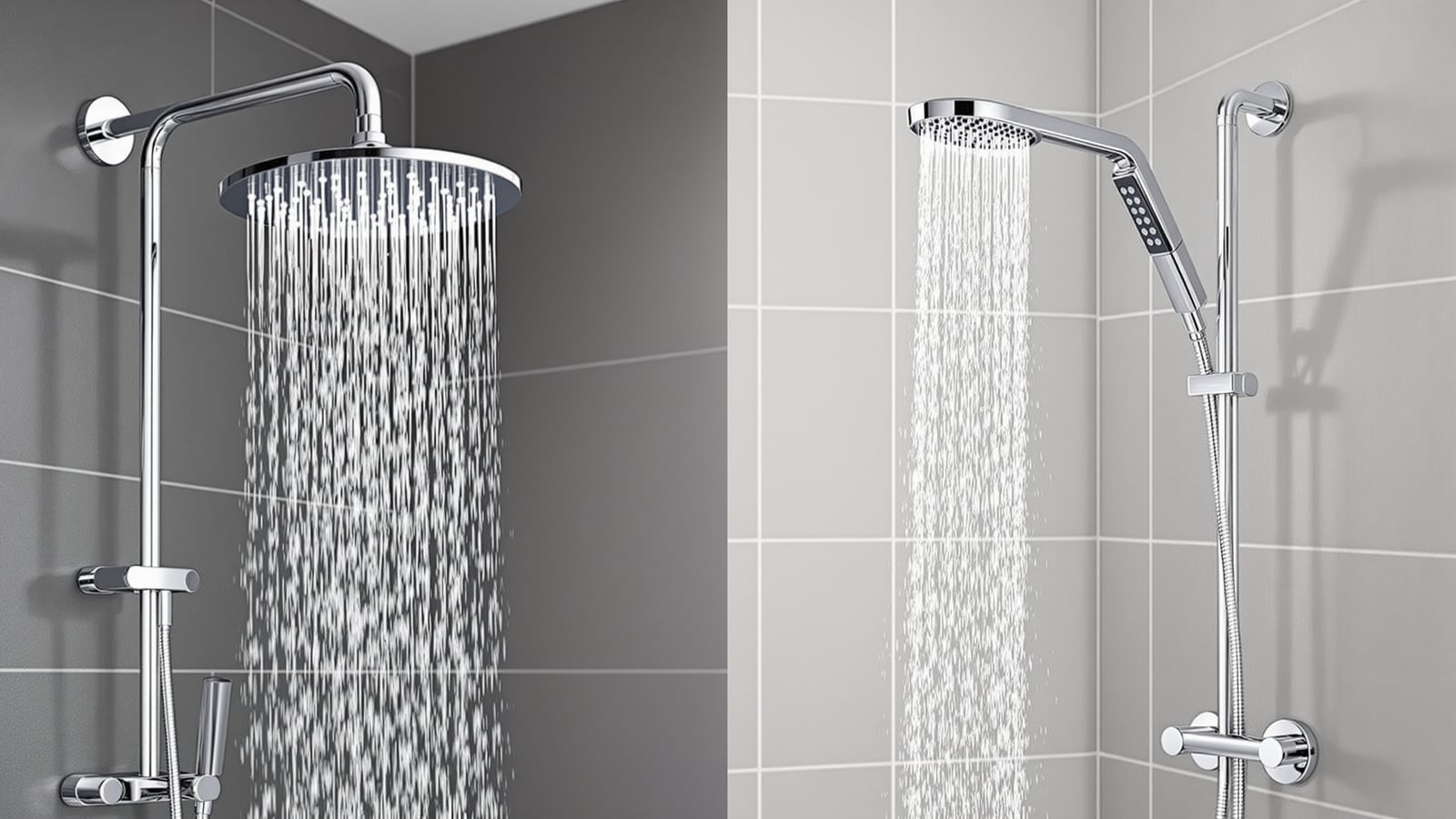
Rain Shower vs Hand Shower: Which Is Better for India? (2026)
A fixed overhead rain head feels like a spa but lives or dies on water pressure; a handheld hand shower just works on gravity and does every practical job. Here is the honest India-first head-to-head — pressure, water use, versatility, cost — and why the real answer is usually both together.
Two showers, two completely different philosophies. A rain shower is a wide, fixed head — usually overhead — that drops water straight down over you like warm monsoon rain. A hand shower is a handheld spray on a flexible hose that you hold, hang on a rail, or point wherever you need it. One is about a fixed, hands-free experience; the other is about control and practicality. In an Indian home the choice is decided less by looks and more by one unglamorous fact: water pressure. This guide sets them head-to-head, fairly, and ends with the answer most Indian bathrooms actually need.
For the deep dives, read the rain shower guide for India and the hand shower guide for India alongside this comparison, and see the shower systems guide for India for how they combine into one kit.
Bottom line up front: on a gravity-fed Indian overhead tank, a hand shower simply works and a rain shower usually disappoints without a pump. Choose a hand shower if you must pick one. But the correct answer for most homes is both, on a diverter — the rain head for pleasure, the hand shower for everything else.
The one factor that decides it: water pressure
This is where the comparison is won or lost in India, so it goes first.
A hand shower has a small spray plate with angled nozzles close to your body. Even weak pressure produces a satisfying jet, because the water only has to travel through a few dozen tightly grouped holes. It runs happily on 0.2–0.5 bar — exactly the pressure a first-floor bathroom gets from an overhead tank three to five metres up. This is why the humble hand shower is the workhorse of Indian bathrooms: it never lets you down, even during low-pressure afternoon hours.
A rain shower spreads the same water over a disc 200–300 mm across with dozens or hundreds of straight-down nozzles. To feel like rain rather than a leaking ceiling, every nozzle needs water pushed through it at once. Makers quote a minimum working pressure of typically 1.0–1.5 bar and a flow of 12–20+ LPM. A typical overhead-tank supply gives only 0.3–0.5 bar — a third of what the head wants. The result is the single most common shower disappointment in India: a ₹15,000 rain head that dribbles.
The fix for a rain shower is almost always a pressure booster pump (₹6,000–15,000 for a single bathroom, plus fitting), or a whole-house hydro-pneumatic system. A hand shower needs no such thing. That asymmetry is the heart of this comparison.
Water use
- A rain shower can be a water hog. A full 300 mm head at 20 LPM uses about 200 litres in a 10-minute shower — as much as several bucket baths. Air-injection heads cut this to 8–10 LPM while keeping the feel, but a plain large head on a strong pump uses a lot.
- A hand shower typically flows 6–10 LPM, and because you hold it close and point it only where needed, real-world use is lower still. You can wet, turn off, soap, and rinse — the "bucket-bath discipline" many Indian households already practise. For a water-conscious home the hand shower is the greener default.
Winner: hand shower, comfortably — unless you fit an air-injection rain head.
Versatility — cleaning, kids and elderly
This is the hand shower's home ground, and it is a big deal in Indian bathrooms.
- Cleaning. A hand shower rinses the WC, the floor, the shower walls and the glass. A fixed rain head can only wet the patch of floor directly beneath it — useless for cleaning.
- Kids. You can wash a child sitting down without soaking their hair or their eyes, and rinse shampoo in seconds. A rain head soaks everything from above.
- Elderly and seated users. Anyone using a shower stool, or with limited mobility, needs a handheld spray they can direct while seated — a core part of choosing a shower for India and any accessible bathroom.
- Buckets and low-pressure hours. During weak-supply afternoons, a hand shower still fills a bucket. A pressure-hungry rain head simply stops performing.
Winner: hand shower, decisively.
Experience and look
Here the rain shower earns its keep. Standing hands-free under a wide, even drench is a genuinely different, indulgent sensation that a handheld spray cannot replicate — it is the reason people want a spa bathroom in the first place. A large slim head, round or square, is also a strong visual centrepiece. A hand shower on a rail looks tidy and modern but is a supporting actor, not the star.
Winner: rain shower, for pure pleasure and visual impact.
Installation and cost
| Attribute | Rain shower (fixed) | Hand shower (handheld) | India winner |
|---|---|---|---|
| Minimum working pressure | ~1.0–1.5 bar (often needs pump) | ~0.2–0.5 bar (gravity fine) | Hand shower |
| Typical flow | 12–20+ LPM | 6–10 LPM | Hand shower |
| Water use (10 min) | Up to ~200 L | ~60–100 L | Hand shower |
| Versatility (clean/kids/elderly) | Low — fixed, overhead only | High — point anywhere | Hand shower |
| Experience / spa feel | Excellent hands-free drench | Practical, directed | Rain shower |
| Installation | Wall-arm or concealed ceiling pipe | Wall outlet + hose, easy retrofit | Hand shower |
| Hard-water cleaning of nozzles | Ceiling head, awkward to reach | In hand, wipe silicone nozzles easily | Hand shower |
| Fitting cost | ₹1,500–40,000+ (head), + pump | ₹400–8,000 | Hand shower |
| The "wow" factor | High | Low | Rain shower |
- Rain head fitting: ₹1,500–4,000 budget, ₹5,000–12,000 mid, ₹15,000–40,000+ premium — plus a booster pump (₹6,000–15,000) on most gravity supplies, plus concealed pipe labour if ceiling-mounted.
- Hand shower fitting: ₹400–2,000 budget, ₹2,500–8,000 premium, including hose, wall bracket or slide rail. Almost always a simple retrofit onto an existing bath spout or diverter.
Why "both together" is usually the answer
For most Indian bathrooms this is not really an either/or. The standard, correct setup is a rain head plus a hand shower on a diverter — and it fixes every weakness above:
- The rain head gives the hands-free spa experience when pressure allows (or when the pump is on).
- The hand shower covers cleaning, kids, the elderly, bucket-filling and low-pressure days.
- A 2-way or 3-way diverter switches flow between them, so one supply feeds both.
- Buying them as a matched shower system kit guarantees the finishes and threads line up. See the shower systems guide for India for kit options.
The only time you skip the rain head is a tight budget or a genuinely un-pumpable supply — then a good hand shower on a slide rail, height-adjustable, does 90% of the job for a fraction of the cost.
Which should you choose?
| Pick a hand shower (only) if… | Pick a rain shower (add hand shower) if… |
|---|---|
| Supply is gravity-fed and you won't add a pump | You have 1+ bar or will fit a booster pump |
| Budget is tight — under ₹5,000 for the fitting | You want the spa/hotel experience daily |
| Cleaning, kids and elderly use dominate | You are doing a new build or full renovation |
| It's a utility, guest or servant bathroom | It's a master or luxury bathroom |
| You want the lowest water bill | You can conceal ceiling pipes before tiling |
- Choose a hand shower alone for utility bathrooms, tight budgets, and any home on weak gravity supply that won't run a pump. It never disappoints.
- Choose a rain shower — but always paired with a hand shower — for master and luxury bathrooms where you can guarantee pressure, ideally planned into a new build.
- The honest common case: most Indian homes should install both on a diverter. It is a genuine best-of-both, not a toss-up: the hand shower guarantees function on any pressure, the rain head adds the experience when you want it.
If you can only afford one, buy the hand shower — it works everywhere and does everything. If you can afford the pressure, add the rain head for the joy of it. The mistake is a rain head alone, on weak pressure, with no way to rinse the floor.
References
- National Building Code of India (NBC) 2016, Part 9 (Plumbing Services) — water supply, minimum service pressures and fixture flow rates.
- IS 1701 — specification for mixing and shower fittings for sanitary appliances.
- IS 1172 — code of basic requirements for water supply, drainage and sanitation (per-capita water and fixture demand).
- CPHEEO Manual on Water Supply and Treatment, Ministry of Housing and Urban Affairs — service pressure and demand guidance.
- BIS product standards for sanitary fittings, and IGBC/GRIHA water-efficiency credits for low-flow shower fittings.
Export this guide
Related Guides — Deep-dive reading
Rain Shower India: Overhead Drench Heads, the Pressure Truth & What They Cost (2026)
The big flat rainfall head looks like a hotel dream — but on a gravity-fed Indian tank it can dribble. This guide is honest about pressure and flow, ceiling vs wall-arm mounting, head sizes, LED and rainfall modes, water use, pairing with a hand shower and real rupee ranges.
BathroomsWater Pressure Booster Pump India: Fix Weak Shower Flow Before You Buy a Rain Head (2026)
Gravity from an overhead tank cannot run a rain shower or body jets — especially on the top floor. This is the honest India-first guide to pressure booster pumps: pressure-switch vs flow-switch, single-fixture vs whole-house sizing by head and LPM, dry-run protection, noise, mounting, electricals and real rupee ranges.
BathroomsHand Shower India: Handheld Shower Sets, Spray Modes & Riser Rails (2026)
Why a handheld hand shower is the most practical fixture in an Indian bathroom — spray modes, flow rates, wall bracket vs sliding riser rail, working at low pressure and off a geyser, pairing with an overhead, and honest rupee costs.
BathroomsRelated Tools — Try Free
Shower Pump Calculator
Check whether your shower needs a pressure-boost pump and what size — available vs required pressure from your tank height or supply.
Bathroom CalculatorShower Water Flow Calculator
Shower water use per shower, day and month by head type, plus a pressure-adequacy check for your tank height or pump and low-flow savings.
Bathroom CalculatorMonsoon-Readiness Checklist
Pre-rain home audit across 9 categories — terrace, drains, waterproofing, electrical, HVAC, pest, vehicles, documents.
Seasonal Audit