
PVC vs Gypsum False Ceiling for Bathrooms: Which Is Better? (India)
PVC panels are fully waterproof and cheap; gypsum looks seamless but must stay in the dry zone with moisture-resistant board. A fair, zone-by-zone verdict on cost, finish, install, lifespan and access for Indian bathrooms.
Two materials dominate the false ceiling in an Indian bathroom, and they could not be more different in temperament. PVC panels are cheap plastic planks that clip up in an afternoon and simply ignore water. Gypsum board is a paper-faced sheet that paints out dead-flat and seamless — the designer's choice — but drinks water and sags if you put it in the wrong place. Pick wrong and you either live with a plasticky-looking ceiling you didn't want, or watch a beautiful painted soffit grow brown tide-marks and black mould after the first monsoon.
This is a fair, head-to-head comparison for the Studio Matrx bathroom hub. The single most important idea up front: PVC is fully waterproof and safe anywhere, including directly over a shower; ordinary gypsum fails in any wet area, and even moisture-resistant "green" gypsum is only acceptable if it is kept to the dry zone. Everything below fills in cost, finish, installation, lifespan and access — and ends with a verdict by zone, because in many Indian bathrooms the honest answer is not "one or the other" but "both, in the right places."
For the deep dives, read the component guides this article compares: the PVC bathroom ceiling guide and the gypsum bathroom ceiling guide. For the wider menu of systems see the bathroom false ceiling pillar, and for the board-science of wet-area boards, the moisture-resistant ceiling guide.
The verdict in one line: over the wet shower zone, PVC wins outright because gypsum cannot go there at all. Over the dry vanity and WC, moisture-resistant gypsum wins on looks. Most well-designed Indian bathrooms use both, split at the shower glass.
The one difference that decides everything: water
A bathroom ceiling's first job is to survive steam, splash and the occasional drip from the flat above. This is where the two materials part ways completely.
PVC is unplasticised polyvinyl chloride — the same rigid, non-absorbent plastic as your uPVC pipes and window frames. It does not soak up water, does not corrode, and gives mould nothing to feed on. You can mount it directly over an open shower and it will shrug off years of steam.
Gypsum is calcium sulphate board with a paper facing. Left standard, it wicks moisture through the paper, loses core strength and sags, and grows mould on the paper itself — the classic grey-black bloom spreading from bathroom ceiling corners. Moisture-resistant (MR / green) board fixes the first two problems with a water-repellent silicone-treated core and a fungicidal facing, but it is still not waterproof. It handles ambient humidity and the occasional splash of a ventilated dry zone; it will not survive standing shower steam and direct spray day after day.
So the water rule is absolute: PVC anywhere, gypsum only in the dry zone, and only in MR grade. Standard white gypsum has no place in a bathroom at all.
Look and finish
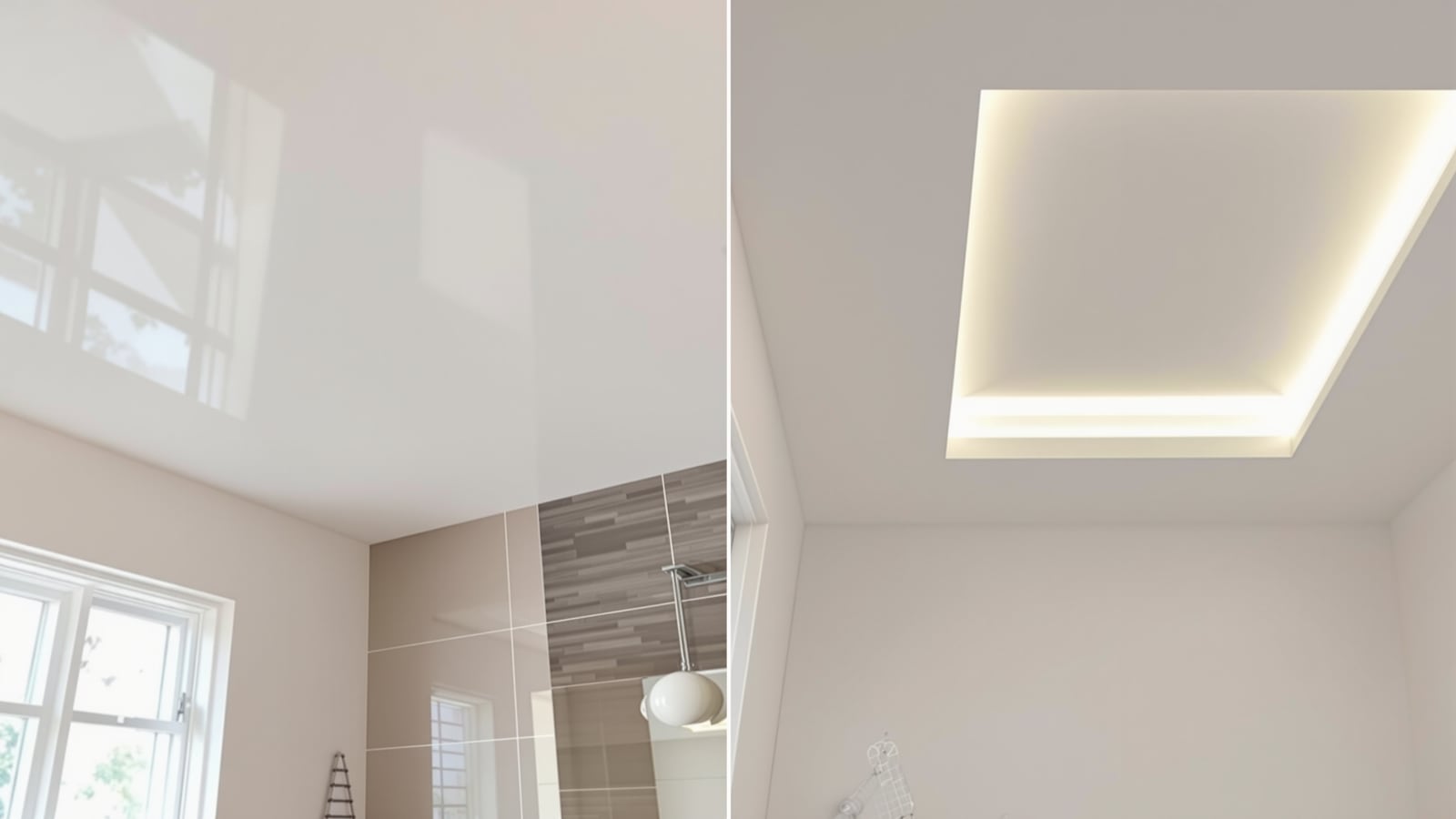
This is where gypsum earns its premium. A jointed, taped and painted gypsum ceiling reads as a single monolithic plane — no lines, no seams — and you can drop a peripheral pelmet to form a cove for concealed LED lighting, plus set recessed downlights flush into it. It looks built-in and architectural.
PVC always reads as planks. Even good matte, marble-look or wood-grain panels show their tongue-and-groove joint lines when you look up, and high-gloss white — still the cheapest grade — looks plasticky and reflects every LED as a hard hotspot. You can recess a panel light or two, but coves and seamless washes are effectively off the table.
For a luxury dry-zone vanity ceiling with cove lighting, gypsum wins clearly. For a purely functional utility bathroom, PVC's look is perfectly acceptable and nobody spends time staring up.
Cost
PVC is the cheapest false-ceiling route in India, which is exactly why it dominates the budget and mid market. Gypsum costs more in both material and labour because of the framing, jointing and painting.
| Cost item (2026, installed) | PVC panels | Gypsum (MR board) |
|---|---|---|
| Material grade | ₹40–150 / sq ft panels | MR/green board + GI + jointing |
| Installation labour | ₹25–50 / sq ft | Higher (frame, joint, sand, paint) |
| All-in installed | ₹90–200 / sq ft | ₹120–250 / sq ft |
| A 40 sq ft bathroom ceiling | ~₹4,000–8,000 | ~₹5,000–10,000 |
| Ongoing | Wipe clean, no repaint | Repaint every few years |
The gap is real but not huge on a single small bathroom. Where it widens is the hidden cost of getting gypsum wrong — a standard-board ceiling that fails in two years and has to be torn down and rebuilt costs far more than the MR premium you should have paid up front. PVC wins on cost, especially where budget is tight.
Installation and speed
PVC is a dry, one-day job: fix a GI or aluminium framework and perimeter trim, then clip the interlocking panels in. No plaster, no curing, minimal mess — ideal for a quick refresh or an occupied home.
Gypsum is a wet, multi-day trade: hang the GI channels, screw the board, tape and joint the seams, sand, prime, then paint — often 3–5 days with curing and drying between steps, and dust from sanding. It needs a skilled drywall team; a botched jointing job telegraphs cracks along every seam.
For speed and simplicity, PVC wins.
Lifespan, maintenance and access
Both last a genuine 10–15 years when done right — PVC anywhere, gypsum only in a ventilated dry zone. Their weak points differ:
- PVC can sag between supports if battens are too far apart, yellow under UV, or crack on a hard knock. But it never rots, and repair is trivial: unclip one damaged plank and slot in a new one for a few hundred rupees, no dust.
- Gypsum fails by sagging, staining or mould if it meets water it shouldn't, and needs repainting every few years to stay fresh. Repair means cutting out a patch, re-jointing, sanding and repainting — a messier job that rarely matches the surrounding paint perfectly.
Access to the plenum — for a leaking pipe, the exhaust duct or wiring — is far easier with PVC: pull a plank or leave a removable one near the fan. A sealed gypsum ceiling has to be cut open and made good. For anyone who values easy servicing, PVC wins on access and repair; gypsum needs a touch more upkeep for its looks.
The verdict, by zone
| Attribute | PVC panels | Gypsum (MR board) | Winner |
|---|---|---|---|
| Waterproofing (wet zone) | Fully waterproof | Not suitable — dry zone only | PVC |
| Ambient humidity (dry zone) | Handles it | Fine in MR grade, ventilated | Tie |
| Look / finish | Visible plank joints | Seamless, paintable, cove-ready | Gypsum |
| Cove & recessed lighting | Limited | Excellent | Gypsum |
| Installed cost | ₹90–200 / sq ft | ₹120–250 / sq ft | PVC |
| Install speed / mess | 1 day, dry | 3–5 days, wet, dusty | PVC |
| Lifespan | 10–15 yrs anywhere | 10–15 yrs, dry + ventilated | Tie |
| Maintenance | Wipe clean | Repaint periodically | PVC |
| Access & repair | Swap a plank | Cut, joint, repaint | PVC |
Read row by row and PVC takes the practical categories while gypsum takes the aesthetic ones — which is exactly why the smart answer follows the room, not a single product.
| Pick PVC if… | Pick gypsum (MR) if… |
|---|---|
| The ceiling is over or near the shower | It is strictly a dry-zone ceiling |
| Budget is tight | You want a seamless, premium finish |
| You want a fast, one-day job | You want cove or recessed lighting |
| Easy future access matters | You will ventilate and repaint as needed |
| It is a utility / rental bathroom | It is a master or feature bathroom |
For most Indian bathrooms, do not choose one — split at the shower glass. Run fully waterproof PVC (or aluminium) over the wet shower zone, and moisture-resistant green gypsum across the dry vanity and WC for the seamless, cove-lit look. It is the same material boundary the shower enclosure already draws, and it plays to each material's strength.
If the whole bathroom is a single small wet room, or the budget is firm, PVC alone is the sensible default — it is the one material that is safe everywhere. If it is a large, well-ventilated bathroom with a clearly separated dry zone and you want it to look designed rather than assembled, spend on MR gypsum there and keep PVC or aluminium over the shower. Whichever you choose, the two non-negotiables are the same: a galvanised-steel (GI) framework so nothing rusts in the humidity, and an exhaust fan ducted fully to outside so steam never lingers against the ceiling.
References
- NBC 2016 (National Building Code of India), Parts 4 & 8 — false ceilings, internal finishes and building-services ventilation.
- IS 2095 — Gypsum plaster boards, including the moisture-resistant classification.
- IS 14862 — PVC (vinyl) ceiling tiles / panels specification, BIS.
- IS 875 (Part 1): Dead Loads — accounting for the self-weight of a suspended false ceiling.
- IS 3813 / GI framing practice — galvanised steel sections for suspended ceilings.
- CPWD General Specifications for Works — false-ceiling framework, suspension and workmanship norms.
- IGBC / GRIHA — low-VOC interior material and ventilation guidance for healthy wet-area finishes.
Export this guide
Related Guides — Deep-dive reading
Gypsum False Ceiling Bathroom India: Moisture-Resistant Board, GI Framing & Cove Lighting
How to build a gypsum board false ceiling in an Indian bathroom the right way — only moisture-resistant (green) board, only in the dry zone, on a GI framework, with a seamless painted finish for cove lighting. Board specs, rupee costs vs PVC, and why ordinary gypsum fails in wet areas.
BathroomsBathroom False Ceiling India: PVC, Gypsum, Aluminium Panels, Cost & the #1 Moisture Rule
A complete guide to bathroom false ceilings for Indian homes — why you fit one, the material choices (PVC, moisture-resistant gypsum, aluminium and metal panels, ACP), access panels, integrating the exhaust fan and lights, and a rupee cost comparison — with the one rule that keeps a wet-zone ceiling from sagging.
BathroomsConcealed vs Exposed Plumbing India: Which Bathroom Fittings Are Better?
A fair head-to-head on concealed (in-wall) versus exposed bathroom plumbing and fittings for Indian homes — how each looks, what each costs to fit, and the one trade-off that decides it: a hidden concealed leak means breaking tiles, while exposed stays reachable.
BathroomsRelated Tools — Try Free
False Ceiling Cost Estimator
Live ₹/sqft across 8 ceiling types — POP, gypsum, designer, metal, PVC, wooden — with cove and spot lighting for 20 Indian cities.
Cost CalculatorWindow Material Comparison Tool
Compare uPVC, aluminium, wood, steel and composite windows on cost, life, upkeep and insulation.
CompareWindow Maintenance Cost Calculator
Estimate annual window upkeep by frame material — yearly, per-window and 5-year cost.
Window Calculator