
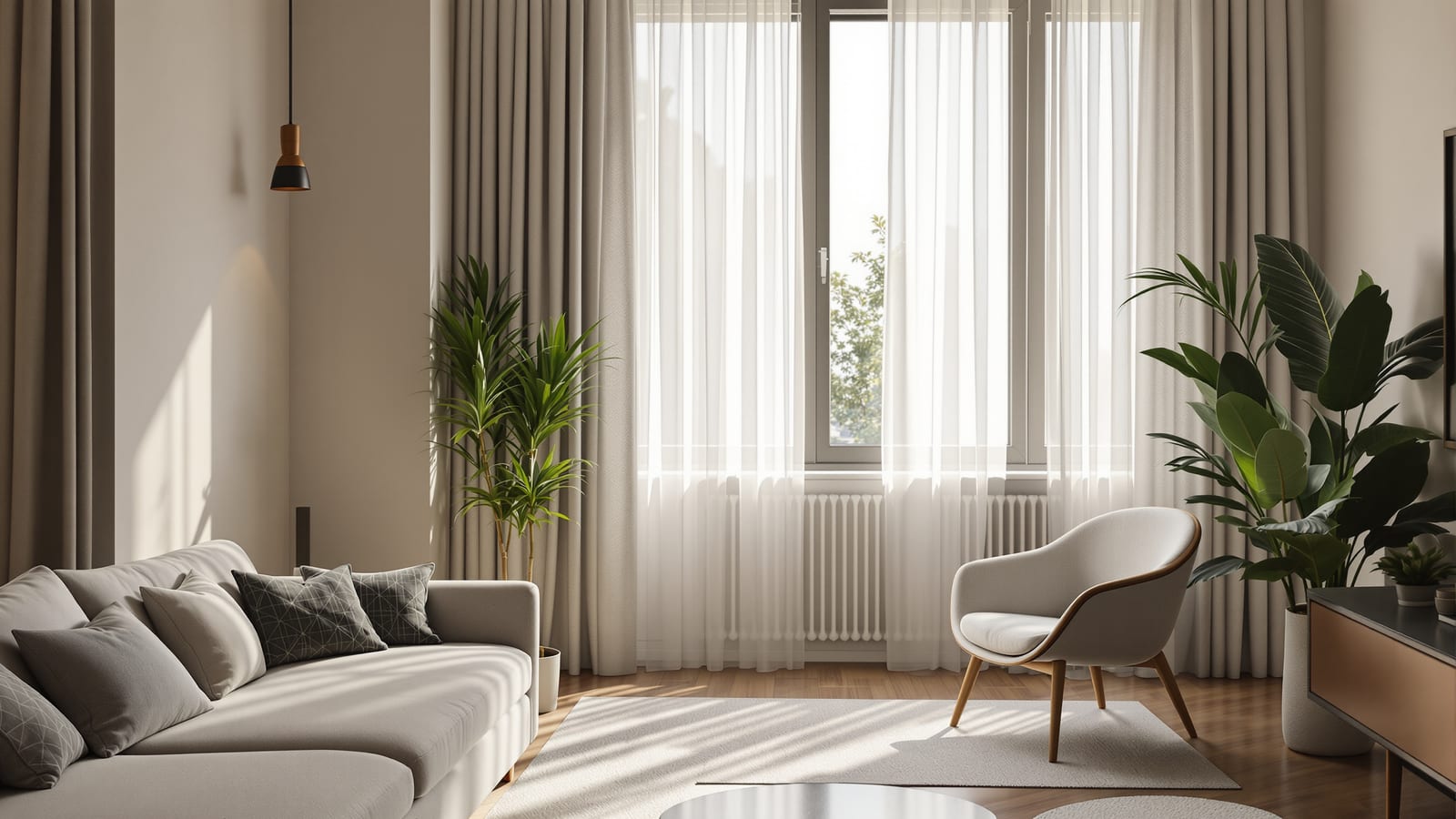
Privacy Curtains: Solving Day and Night Privacy (India 2026)
Why a daytime sheer becomes a night-time stage, and how to fix it — the layered sheer-plus-opaque setup, top-down shades and zebra blinds, frosted film, ground-floor and overlooked-flat tactics, and bathroom privacy, for dense Indian homes.
Privacy sounds like a single thing you either have or do not. It is actually two completely different problems wearing the same word, and most curtain disasters come from solving one and forgetting the other. By day, a thin sheer hides you beautifully — the bright outside and dim inside mean people on the street see only a pale panel. The moment you switch on a light at night, the physics flip: now your room is the bright side, the street is dark, and that same sheer turns into a glowing screen that broadcasts your silhouette to everyone outside. In a dense Indian society where the opposite tower is fifteen feet away, that is not a minor flaw. This guide is about getting both halves of privacy right.
A sheer that hides you at noon becomes a stage at night. Privacy is two problems, not one — and you have to dress for the dark, not just the day.
This is the privacy-specific companion to our complete curtain guide. That pillar teaches the universal decisions; here we focus only on keeping the inside of your home yours, day and night, in the kind of close-packed housing most Indians actually live in.
Why the same curtain behaves differently at noon and at night
Privacy through fabric is really about which side is brighter. People can see through a translucent material toward the darker side. In daylight, the outdoors is far brighter than your room, so the view runs inward-to-out is blocked and the outside-to-in view is foiled — a sheer reads as opaque from the street. After dark, your lamps make the room the bright side, the relationship reverses, and the sheer becomes near-transparent from outside while you cannot see out at all.
This is why so many homes feel exposed exactly when they are most private-feeling — relaxing in the evening, getting changed, watching TV. The fix is never a better sheer. It is a second layer that becomes opaque on demand after dark.
The core fix: layer a sheer with an opaque
The single most reliable privacy solution in India is two layers on one window:
- A sheer (the front layer) for daytime — soft light, daytime privacy, a finished look.
- An opaque back layer — a dim-out or true blackout curtain, a roller blind, or a Roman shade — that you pull across at night.
By day you run only the sheer and enjoy the light. At night you draw the opaque layer and the room seals shut to outside eyes. This is the whole game. Our curtain layering guide covers the track and stacking detail, and the sheer curtains guide explains how to pick a sheer that performs by day without you over-trusting it by night.
For rooms where the opaque layer needs to deliver real darkness as well as privacy — bedrooms, especially — go to a genuine blackout curtain with a centre overlap, so there is no glowing vertical gap down the middle when it is shut. A blackout that does not overlap leaks both light and a clear sightline.
Privacy by treatment: a day-and-night comparison
No single treatment wins on every axis. This is the honest matrix — read the day and night columns together, because most failures are a treatment that is fine by day and useless at night.
| Treatment | Daytime privacy | Night-time privacy | Lets light in | Best for |
|---|---|---|---|---|
| Sheer alone | Good | Poor (becomes a stage) | Excellent | Day-only rooms, upper floors |
| Sheer + dim-out/blackout | Excellent | Excellent | Excellent (sheer only by day) | Bedrooms, living rooms |
| Zebra (day-night) blind | Good | Good when banded shut | Adjustable | Studies, kitchens, flats |
| Top-down / bottom-up shade | Excellent | Excellent | Good (light over the top) | Ground floor, baths, street-facing |
| Roller blind (opaque) | Excellent | Excellent | None when down | Privacy-first windows |
| Frosted window film | Excellent | Excellent | Diffused, all day | Bathrooms, fixed glazing, stairwells |
The takeaway repeats the pillar's most useful idea: for any room you occupy after dark, plan two layers, or pick a treatment whose night column is not "poor".
Top-down/bottom-up shades: light high, privacy low
One clever option deserves its own mention because it solves a very Indian problem. A top-down/bottom-up shade can be lowered from the top as well as raised from the bottom. You drop it from the top to let daylight pour in over the upper half of the window while the lower half stays covered — so passers-by at street level see nothing, but the room stays bright.
This is ideal for ground-floor and street-facing windows, where people walk right past your glass, and for bathrooms. You get sky and daylight without putting yourself on display at eye level. Honeycomb (cellular) shades commonly offer this mechanism and add insulation; it is one of the few setups that delivers privacy and light at the same time without two separate layers.
Zebra blinds: privacy you dial in
Zebra blinds — alternating sheer and opaque horizontal bands on a roller — let you tune privacy continuously. Align the bands and they read as a sheer (light, soft daytime privacy); offset them so the opaque stripes overlap and they go nearly solid for night-time privacy. One blind, two modes, no second layer.
The honest caveat: even fully banded, a zebra blind is not as light-tight or as private as a true opaque roller or a blackout curtain, because the fabric is still partly translucent. For a bedroom you want truly dark and private, a zebra is a daytime convenience, not the night solution. For a study, kitchen or living room where you mainly want adjustable daytime privacy with the option to close up, it is excellent.
Frosted film: permanent privacy for the windows you never dress
Some windows should never carry cloth — a bathroom, a stairwell, a fixed pane beside the front door, the small high window over a kitchen counter. For these, frosted or etched window film applied to the glass gives permanent, all-day, all-night privacy while still passing diffused daylight. It is cheap, removable on rental-friendly versions, and needs no track or maintenance.
Film is also the right answer for overlooked fixed glazing where a curtain would be fussy and pointless. Combine it with a sheer if you want softness, or leave it bare. The one limit: solid frost blocks the view permanently, so do not film a window you actually want to look out of — there, use a treatment you can open.
Ground-floor and overlooked-flat tactics
Dense Indian housing creates two sharp privacy situations:
Ground-floor windows sit at the eye level of everyone walking past. Tactics that work: top-down/bottom-up shades (light high, cover low); frosted film on the lower half of the glass; a permanent sheer plus a pull-across opaque for night; or planting and grilles outside to add a soft buffer. Never rely on a sheer alone here — at night it is a full-length window onto your living room from the footpath.
Overlooked flats — your bedroom facing the opposite tower across a narrow gap, your balcony onto the internal courtyard everyone crosses — need the two-layer setup as close to mandatory. Make the bedroom back layer a true blackout with a centre overlap. For the balcony slider and the whole-flat privacy plan, our apartment curtains guide maps it room by room.
Bathroom privacy: a special case
Bathrooms demand total privacy with zero compromise, plus they are damp, so cloth curtains often rot or grow mould. Better answers:
- Frosted film on the glass — permanent, moisture-proof, no maintenance. The default.
- An opaque roller blind in a moisture-tolerant fabric, mounted clear of splash zones.
- A top-down/bottom-up shade, dropped from the top for ventilation light while staying covered at eye level.
Avoid long fabric curtains in a wet bathroom. If you do use cloth, keep it short, washable and well clear of the shower, and accept you will replace it more often.
Balancing privacy with light — the real trade-off
The mistake people make in the panic for privacy is to seal the room and lose all their daylight. You do not have to. The whole point of the two-layer system is that you run the bright, private sheer by day and only deploy the opaque layer when you need it — at night, or while changing. Top-down shades and zebra blinds exist precisely to give you privacy and light together rather than forcing a choice.
So the rule is: never solve night privacy by leaving a dark, heavy curtain shut all day. Plan the layers, and you keep your light and your privacy both.
Honest caveats
A few things worth stating plainly:
- Test at night, from outside. The only real privacy test is to switch on your lights, step outside after dark and look back. Do this before you trust any single layer.
- Sheers vary. A very fine, pale sheer is more see-through at night than a tightly woven one — but no sheer alone fixes night privacy. Do not let a salesperson tell you otherwise.
- Light gaps betray you. A blackout that does not overlap at the centre, or sits short of the frame, leaks both light and a sightline. Overlap and oversize.
- Costs are indicative. Price your own fabrics, films and blinds locally; a frosted-film fix can cost a fraction of a layered curtain set for a window you never need to open.
Solve your privacy windows with Studio Matrx. Not sure whether a window needs layered curtains, a zebra blind, a top-down shade or frosted film? The window treatment selector narrows it to the right fix for each room. Then size the fabric and price the two-layer setup with the Curtain Cost Calculator, and read the complete curtain guide for the type, pleat and track decisions behind it. The full Window Treatments cluster covers every room and option in depth.
Export this guide
Related Guides — Deep-dive reading
Curtains vs Blinds: The Complete Comparison for Indian Homes (2026)
Light, privacy, heat, noise, cleaning, cost and looks — a head-to-head verdict on curtains and blinds, plus the under-rated answer most good designers actually use: both.
Window TreatmentsBathroom Window Treatments: Privacy & Moisture (India 2026)
Why fabric curtains fail in the bathroom, the moisture-proof covers that actually last, how to get privacy without killing daylight, and how to keep mould and rust away — for the humid, hard-water Indian bathroom.
Window TreatmentsBlackout Curtains: The Complete Guide for Indian Homes (2026)
What “blackout” really means, how dark you actually get, the light-gap problem nobody warns you about, and how to choose, seal and care for them in Indian conditions.
Window TreatmentsRelated Tools — Try Free
Window Treatment Selector
Curtains, blinds or a layered system? Answer five questions about your room and get a specific recommendation.
SelectorCross-Ventilation Analyzer
Estimate airflow and air changes per hour (ACH) from room size, window areas, layout, and local wind — with NBC 2016 Part 8 compliance check.
Ventilation CalculatorCurtain Cost Calculator
Get the fabric metres you need plus the total curtain cost by window size, fabric, pleat, lining and hardware.
Curtain Calculator