
Non-Toxic Door Adhesives: Low-Emission Glues (India 2026)
The resins that bond flush doors, ply and frames — UF, PF, PVAc, PUR and soy — and how to specify low-emission, formaldehyde-free door adhesives in India.
Every door in your home is held together by glue you cannot see — and on the cheap end of the market, that glue can quietly off-gas formaldehyde into the rooms you breathe in for the next ten years. Non-toxic door adhesives are the specification lever that fixes this at source: choose the right bonding resin and emission grade and you cut indoor formaldehyde and VOCs without changing the look of the leaf at all. This Studio Matrx guide is the spec-sheet deep dive into the adhesives inside Indian doors — the urea-formaldehyde, phenol-formaldehyde, PVAc, polyurethane and soy resins that bond face veneers, plywood lamellas and frame joints — what off-gasses and what does not, the E1/E0/CARB/NAF grades that actually mean something, and the exact questions to put to a manufacturer. It sits alongside our low-VOC doors and formaldehyde-free doors guides, which cover the finished-door and health picture; here we go one layer deeper, into the glue line itself.
Why the glue, not the wood, is the problem
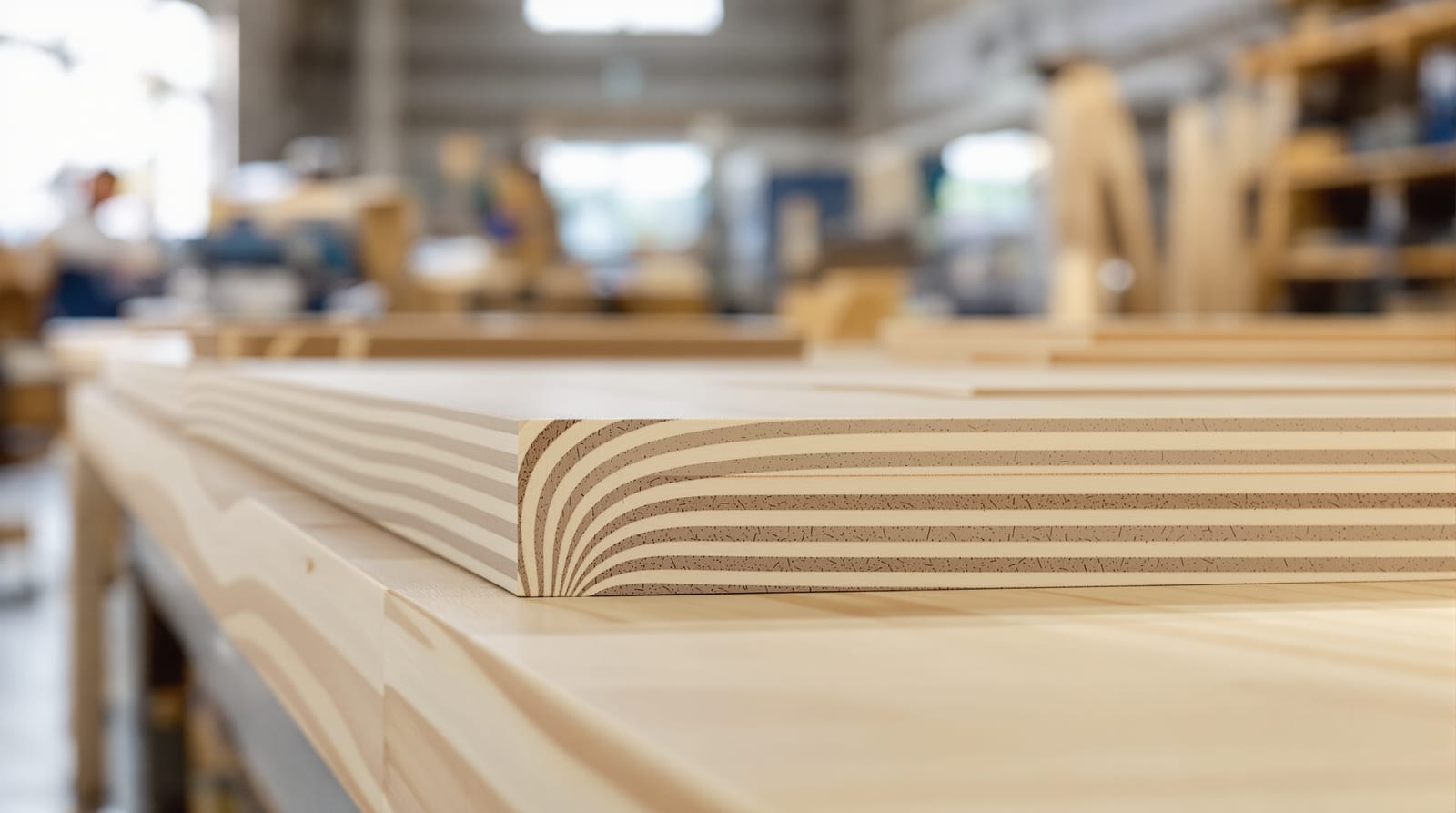
Solid timber off-gasses almost nothing once seasoned. The emissions in a modern door come overwhelmingly from the adhesive in engineered components — the plywood, MDF, particleboard and block-board that make up flush-door cores and faces, plus the glue at frame and lamination joints. A flush door is a sandwich of glue lines, and the resin chemistry of those lines decides whether the finished leaf is a benign object or a slow source of indoor air pollution. That is why two doors that look identical can perform very differently on air quality: the difference is invisible, sitting in the bond. Understanding the resin families below lets you specify the healthy version of the same product.
The resin families used in Indian doors
| Adhesive | Where it is used | Formaldehyde risk | Notes for a specifier |
|---|---|---|---|
| Urea-formaldehyde (UF) | Interior plywood, MDF, particleboard, flush-door cores | High — main source of off-gassing | Cheapest, not water-resistant; insist on E1/E0/NAF grade |
| Melamine-urea-formaldehyde (MUF) | MR/BWR ply, laminate bonding | Moderate | Lower emission than plain UF, more water-resistant |
| Phenol-formaldehyde (PF) | BWP/marine ply (IS 710), exterior doors | Low after cure — very stable bond | Dark glue line; the classic durable choice |
| PVAc (white wood glue) | Frame joints, edge lipping, assembly | Negligible / formaldehyde-free | Water-based, low-VOC; interior strength only |
| Polyurethane (PUR) | Engineered timber, structural laminating | Formaldehyde-free | Strong, gap-filling, moisture-cure; pricier |
| Soy / bio-based (e.g. PVAc-soy) | NAF engineered panels | None added | Genuinely low-emission; limited Indian supply |
| Isocyanate / pMDI | Some NAF MDF and OSB | None added | No formaldehyde but handle uncured resin with care |
The single most important line in that table: IS 710 (BWP) and IS 303 grade the bonding quality and water resistance of plywood — they do NOT certify emissions. A BWP door can still be high-emission if it uses a high-formaldehyde resin. Bond grade and emission grade are two separate questions, and you must ask both.
Where formaldehyde comes from — and the grades that limit it
Urea-formaldehyde resin is made with an excess of formaldehyde for a fast, cheap cure; the unreacted formaldehyde and that released as the bond slowly hydrolyses in warm, humid air is what you smell and breathe. India's warm-humid and composite climate zones accelerate this. The internationally recognised emission grades — referenced by Indian green-building schemes even where they are not Indian law — are the language you specify in.
| Grade | Formaldehyde limit (indicative) | What it means in practice |
|---|---|---|
| E2 | > 0.124 mg/m³ | High emission — avoid; being phased out |
| E1 | ≤ 0.124 mg/m³ | The baseline acceptable grade (EU/India reference) |
| E0 | ≤ 0.07 mg/m³ | Low emission — a meaningful step up |
| CARB Phase 2 | Strict US limits | Widely cited benchmark for imported panels |
| NAF / no-added-formaldehyde | No UF/PF resin added | Soy, PUR, pMDI bonded — the healthiest tier |
| Japanese F★★★★ | Lowest Japanese class | Equivalent to top low-emission spec |
As a rule of thumb, E1 is the floor you should accept and E0 or NAF is what to specify for bedrooms, children's rooms and air-conditioned (low-ventilation) homes. Treat any unlabelled commodity flush door as E2-or-unknown until proven otherwise.
The low-emission and bio-based alternatives
The good news is that healthier door adhesives are real products, not aspiration. PVAc (ordinary white wood glue, IS 851 family) is water-based, low-VOC and formaldehyde-free, and already does most frame-joint, edge-lipping and assembly bonding on Indian doors — so the assembly stage is rarely the problem; the panel resin is. Polyurethane (PUR) adhesives are formaldehyde-free, strong, gap-filling and moisture-curing, used for engineered timber and structural laminating where you want both health and durability. Soy-based and soy-PVAc hybrid resins, pioneered abroad, bond genuinely no-added-formaldehyde panels; Indian supply is still limited but growing through green-building demand. Isocyanate / pMDI binders make NAF MDF and OSB with no formaldehyde at all (uncured resin needs careful factory handling, but the finished board is inert).
Where phenol-formaldehyde (PF) appears — in BWP/marine ply for exterior and wet-area doors — note that PF is far more stable than UF and emits very little after cure; it is the durability workhorse, and durability is itself sustainability. The hierarchy to remember: NAF/soy/pMDI > PUR > PVAc (assembly) > E0 panels > E1 panels > PF for wet areas > avoid plain high-UF E2.
Certifications and labels to look for
Because an "eco" or "non-toxic" claim on a brochure is worthless without third-party backing, ask for one of these. GreenPro (CII-IGBC) is India's product eco-label and is the most relevant local certification; ECOMARK (BIS) is the Indian government scheme; GREENGUard Gold and CARB Phase 2 are widely cited international benchmarks for low-emission panels. For green-building projects, low-emission adhesives also earn material credits under IGBC and GRIHA doors and contribute to healthier indoor air, which our doors and indoor air quality guide explains in full. The companion low-VOC door finishes guide covers the paint and stain layer that sits on top of the glue.
What to ask a door manufacturer
Specifying healthy adhesives is mostly about asking the right questions and getting them in writing — not on a brochure, but on the purchase order and the test certificate.
- "What emission grade is the panel resin — E1, E0, or NAF?" Get the grade, not just "BWP". Remember IS 710 rates the bond, not the off-gassing.
- "Can you provide a formaldehyde-emission test certificate?" A third-party report (EN 717 / ASTM E1333 method) for the actual board, not a generic letter.
- "Is the panel GreenPro, ECOMARK, GREENGUARD or CARB2 certified?" Ask for the certificate number you can verify.
- "What adhesive bonds the frame joints and lippings?" PVAc or PUR is the healthy answer at assembly.
- "For wet-area doors, is the BWP ply PF-bonded?" PF gives both water resistance and low post-cure emission.
- "Will you supply a product datasheet or EPD?" Serious manufacturers can; see our door EPD guide.
If a vendor cannot answer the grade question or produce a test certificate, treat the door as unknown-emission and price the risk accordingly. For the broader sustainable-sourcing picture, the sustainable doors guide is the Act pillar that ties materials, adhesives and certification together. To sanity-check a specific door against these criteria, run the low-VOC door checker; the eco door material selector helps match resin choice to room and climate. For the full cluster picture, the complete door guide is the pillar.
The health and indoor-air-quality link
Formaldehyde is classified as a known human carcinogen by the WHO/IARC, and at lower concentrations it irritates eyes, nose and throat and can trigger respiratory symptoms — most affecting children, the elderly and asthma-sensitive occupants. The risk is highest in new, air-conditioned, poorly ventilated rooms in warm-humid weather, exactly the conditions of much of urban India for months at a time. Because a flush door is a large surface area of bonded panel, the resin you specify is not a trivial detail — it is a measurable contributor to the air a family breathes for a decade. Specifying E0/NAF adhesives, ventilating new installations for the first weeks, and choosing PVAc/PUR at assembly are low-cost moves that pay back in health rather than rupees. Honest caveat: every "non-toxic" claim must be backed by a third-party test certificate or eco-label — without that paperwork, it is greenwashing, not specification.
Frequently asked questions
Are all flush doors high in formaldehyde?
No. Commodity flush doors built on plain urea-formaldehyde plywood (E2 or unlabelled) are the high-emission risk. Doors built on E1, E0 or no-added-formaldehyde panels, with PVAc or PUR at the joints, can be very low-emission. The leaf looks identical — the difference is the resin grade, which you must specify and verify with a test certificate.
Does an IS 710 (BWP) marine-grade door mean it is low-emission?
No, and this is the most common misunderstanding. IS 710 grades the bond quality and water resistance of the plywood, not its formaldehyde emission. A BWP door is durable, and if it is phenol-formaldehyde bonded it emits little after cure, but you still need a separate E1/E0/NAF emission grade and a test certificate to confirm the air-quality performance.
Which adhesive is the most non-toxic for door making?
For assembly and joinery, PVAc (white wood glue) and polyurethane (PUR) are formaldehyde-free and low-VOC. For the panels themselves, no-added-formaldehyde resins — soy-based, soy-PVAc hybrids and pMDI/isocyanate binders — are the healthiest tier. As a rule of thumb, specify NAF or E0 panels with PVAc/PUR assembly for the lowest indoor emissions.
What certification should I ask for in India?
Ask for GreenPro (CII-IGBC) or ECOMARK (BIS) as the Indian eco-labels, and treat GREENGUARD Gold and CARB Phase 2 as international low-emission benchmarks. Crucially, ask for a third-party formaldehyde-emission test certificate for the actual board (EN 717 / ASTM E1333), with a verifiable number — a brochure claim alone is not evidence.
Do low-emission door adhesives cost much more?
The price premium is modest at the door level — typically a small percentage uplift, mostly on the panel rather than the assembly glue, since PVAc is already standard. Certified E0/NAF panels and PUR cost more than commodity UF, but the payback is in health and indoor air quality rather than rupees, and it supports green-building credits under IGBC and GRIHA.
How long do new doors off-gas formaldehyde?
UF emissions are highest when new and decline over months to a few years as the resin fully cures, accelerated by warm, humid air. Ventilating a newly installed door's room well for the first few weeks meaningfully reduces exposure. Choosing E0/NAF panels removes most of the source from the start, which is why specification beats ventilation as the primary control.
Export this guide
Related Guides — Deep-dive reading
Low-VOC Doors in India: Healthier Indoor Air (India 2026)
What VOCs are, where they hide in a door, why low-VOC matters for your family's indoor air — and how to choose certified low-emission doors and finishes.
Home Doors & EntrancesFormaldehyde-Free Doors: E1, E0 & NAF Guide India 2026
How ply, MDF and particleboard doors off-gas formaldehyde, what E1/E0/CARB2/NAF grades mean, and how to choose low-emission doors for healthier Indian homes.
Home Doors & EntrancesEco Door Certifications & Green Labels Guide (India 2026)
How to read, verify and trust green door labels in India — FSC, PEFC, GreenPro, ECOMARK, GREENGUARD and E0/E1/CARB emission grades — and spot greenwashing.
Home Doors & EntrancesRelated Tools — Try Free
Material Decision Framework (M-Score)
Score 30+ Indian construction materials across cost, durability, climate fit, maintenance, and sustainability.
MaterialsCross-Ventilation Analyzer
Estimate airflow and air changes per hour (ACH) from room size, window areas, layout, and local wind — with NBC 2016 Part 8 compliance check.
Ventilation CalculatorMaterial Comparison Sheet
India's interior material cheatsheet — plywood, finishes, hardware, countertops, paints, waterproofing.
Reference Guide