
Formaldehyde-Free Doors: E1, E0 & NAF Guide India 2026
How ply, MDF and particleboard doors off-gas formaldehyde, what E1/E0/CARB2/NAF grades mean, and how to choose low-emission doors for healthier Indian homes.
Most "wooden" doors sold in India are not solid wood at all — they are flush or moulded leaves built from plywood, MDF or particleboard, glued together with urea-formaldehyde resin. That resin slowly releases formaldehyde gas into your home for months, sometimes years, after the door is hung. Formaldehyde-free doors — or, more accurately, low-emission and no-added-formaldehyde (NAF) doors — cut that off-gassing to a level that protects indoor air, especially in closed, air-conditioned Indian bedrooms where the gas concentrates. This guide explains the emission grades (E2, E1, E0, CARB2, NAF and the Japanese F-star system), why the familiar IS 710 "BWP" stamp tells you nothing about emissions, the real health effects, and how to specify a healthier door without overpaying for greenwash.
Where the formaldehyde comes from
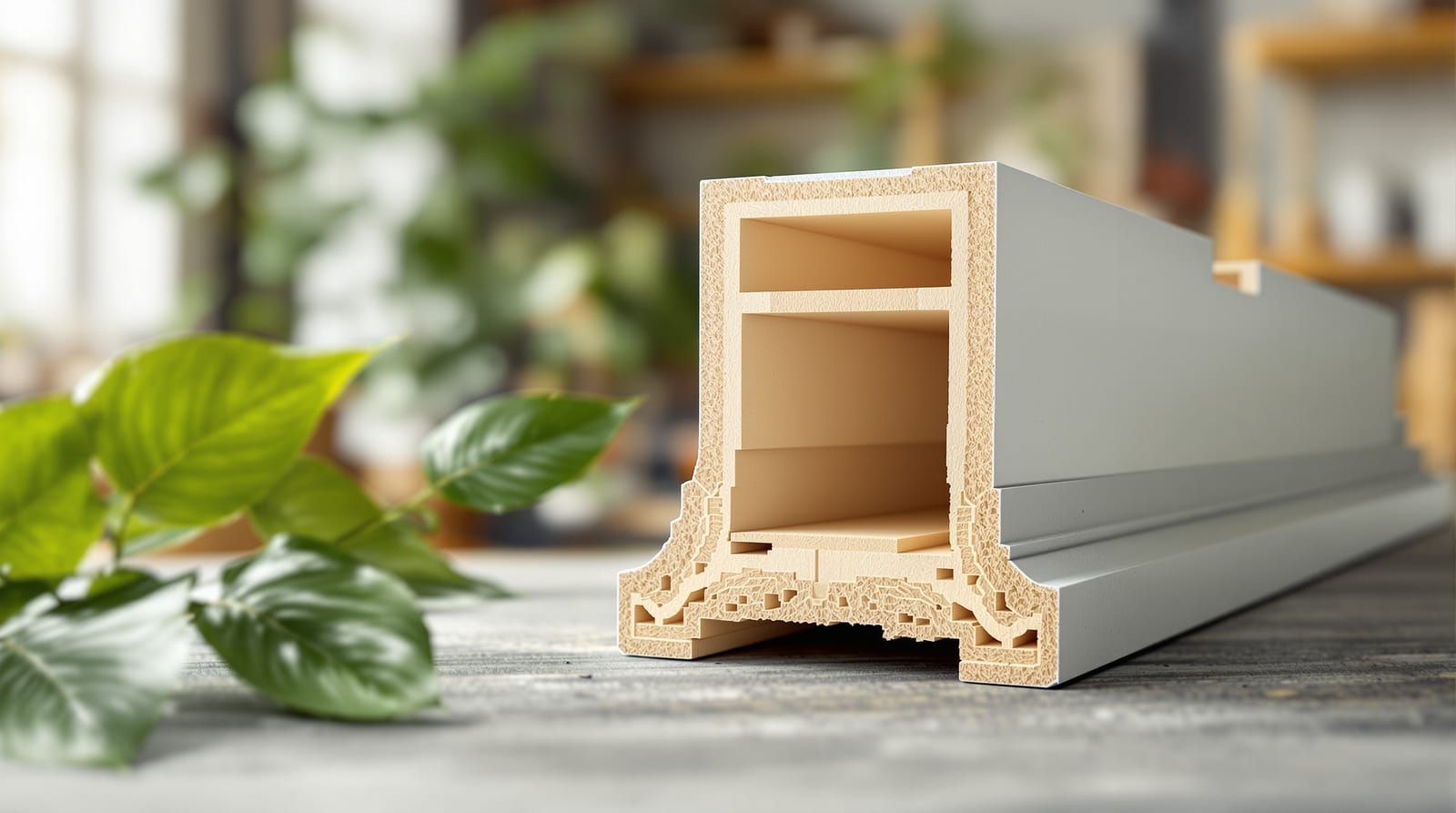
Formaldehyde (HCHO) is the cheapest, fastest-curing adhesive chemistry in the engineered-wood industry. Urea-formaldehyde (UF) resin binds the wood fibres in MDF and particleboard and the veneers in interior plywood; melamine- and phenol-formaldehyde resins (used in moisture-resistant and exterior boards) are more stable and emit far less. A finished flush door can contain several layers of UF-bonded board — face skins, internal stiles, the core grid or filler — so the emitting surface area is large. The gas escapes fastest when the board is freshly made and warm, which is why a brand-new door has that sharp "new furniture" smell. India's hot, humid climate accelerates the release: heat and moisture both drive UF resin to break down and off-gas faster, so the same door emits more in Chennai or Mumbai than in a cool hill station.
Solid timber and solvent-free solid-wood doors have effectively no added formaldehyde — wood naturally contains a trace, but it is negligible. The problem is specifically the glued engineered cores that make up the bulk of affordable doors.
The emission grades — what E1, E0, CARB2 and NAF mean
Formaldehyde emission is graded by how much gas a board releases under a standard test (usually the EN 717-1 chamber or a perforator test). Lower is better. These grades are the single most useful thing to look for on a spec sheet — not the brand, not the "premium" label.
| Grade | Indicative emission limit | What it means | Where you see it |
|---|---|---|---|
| E2 | > 0.124 mg/m³ (high) | Cheapest UF board; avoid indoors | Unbranded budget ply/MDF |
| E1 | ≤ 0.124 mg/m³ | EU/Indian baseline for indoor use | Branded interior ply, BWR boards |
| E0 | ≤ 0.07 mg/m³ | Low-emission, premium | "E0" or "super E0" marketed ply |
| CARB2 / TSCA Title VI | ≤ 0.05 ppm (board-type specific) | Strict US standard | Export-grade, IGBC-credit boards |
| NAF / no-added-formaldehyde | Effectively nil | Soy, PVAc or pMDI glue, no UF | Premium engineered + agri-fibre |
| Japanese F★★★★ (F-four-star) | ≤ 0.3 mg/L (lowest JIS band) | Cleanest Japanese rating | Imported Japanese-spec board |
In plain terms: E1 is the floor you should accept for any board inside the home; E0 is meaningfully cleaner; CARB2 and NAF/F-four-star are the gold standard, worth the premium for bedrooms, children's rooms and tightly sealed AC homes. "NAF" is the strongest honest claim because it removes the chemistry entirely rather than just limiting it.
Why IS 710 (BWP) does NOT mean low formaldehyde
This is the most common confusion in the Indian market. IS 710 is the standard for marine / Boiling Water Proof (BWP) plywood; IS 303 covers BWR and MR grades. These standards rate the strength of the glue bond — how well the plywood survives boiling water and damp — not how much formaldehyde it emits. A door can carry a genuine IS 710 BWP stamp and still off-gas heavily, because phenolic exterior glue happens to emit less, but the standard itself says nothing about emissions. Do not read "BWP" or "marine ply" as "healthy." To know the emission level you must look for a separate E1/E0/CARB/NAF declaration or a third-party indoor-air label.
The health effects — honestly stated
Formaldehyde is classified by the WHO/IARC as a known human carcinogen (Group 1). At the low chronic levels found in homes, the everyday effects most people notice are irritation of the eyes, nose and throat, headaches, a scratchy cough and worsened symptoms in people with asthma or allergies. The risk is dose- and time-dependent: a single E2 cupboard in a ventilated hall is a minor concern; multiple fresh UF doors, wardrobes and panelling in a small, sealed, air-conditioned bedroom — occupied eight hours a night by a child — is a real indoor-air-quality issue worth designing out. Emissions decay over time (often falling sharply over the first few months), but heat and humidity slow that decay and can re-mobilise the gas. The sensible Indian approach is to specify low-emission boards and ventilate well, especially for new fit-outs — see doors and indoor air quality and the broader low-VOC doors picture, since finishes and adhesives add their own emissions on top.
How to choose a low-formaldehyde door in India
You rarely get to test a door in a lab, so you buy on evidence and material logic. Use this hierarchy.
| Choice | Formaldehyde risk | Trade-off | Best for |
|---|---|---|---|
| Solid seasoned timber (teak, sal) | Negligible (NAF by nature) | Higher cost, weight | Main doors, premium bedrooms |
| Agri-fibre / NAF MDF doors | Very low | Limited availability | Health-priority interiors |
| E0 / CARB2 branded engineered | Low | Modest premium | Most internal flush doors |
| E1 branded ply / BWR flush | Moderate (acceptable) | Standard cost | General interior use |
| Unbranded "economy" flush / MDF | High (often E2) | Cheapest upfront | Avoid in bedrooms |
Practical rules of thumb:
- Ask for the emission grade in writing, not just "branded ply." A reputable manufacturer will state E1, E0 or CARB2; if no one can produce a figure, assume it is E2.
- Look for a third-party label. In India, GreenPro (CII-IGBC) and ECOMARK (BIS) signal independently verified low-emission products; internationally, GREENGUARD Gold and CARB2/TSCA Title VI compliance are strong markers. These labels also earn material credits under doors for green buildings, IGBC Green Homes and GRIHA.
- Prefer NAF where it exists — doors built with soy, PVAc or pMDI adhesive and agri-fibre cores remove the chemistry rather than capping it.
- Seal and finish well. A fully edge-banded, primed and sealed leaf traps far more of the residual gas than a raw or partly finished one; pair with low-VOC door finishes and non-toxic door adhesives so the finish does not undo the gain.
- Air it out. Even a good door benefits from ventilation — unwrap it, let it off-gas in an airy space for a few days before installing in a bedroom, and keep new fit-outs ventilated for the first weeks.
For a quick screen of a product or quotation, the low-VOC door checker and eco door material selector translate the grade and label evidence into a simple risk read. To weigh emissions against the door's wider footprint, see eco-friendly door materials and the sustainable doors pillar; the complete door guide ties material choice to everything else.
Cost, certification and the India reality
A low-emission upgrade is usually a modest premium, not a luxury: moving from unbranded economy board to E1 branded ply costs little; E0/CARB2 typically adds a single-digit to low-double-digit percentage; NAF agri-fibre and solid-timber doors cost more but buy durability and clean air together. GST on doors and boards is generally 18%. Be sceptical of unverified "eco" or "zero formaldehyde" claims printed on packaging — in a market with patchy enforcement, only a third-party certificate or a stated, testable grade is trustworthy. Two honest caveats for Indian buyers: NAF and CARB2 supply is still thin outside metros, so you may need to specify ahead and accept lead time; and because heat and humidity raise real-world emissions, ventilation and good sealing matter as much as the grade on the invoice. Treated as a system — right grade, verified label, sealed finish, ventilated install — a healthier door is well within reach for most Indian homes.
Frequently asked questions
Are all plywood and MDF doors bad for indoor air?
No — it depends on the resin and grade. Unbranded economy ply and MDF (often E2) can off-gas heavily, but E1, E0, CARB2 and NAF boards emit far less, and NAF doors use formaldehyde-free glue. The chemistry, not the category, decides the risk. Always ask for the emission grade in writing rather than assuming "branded" means "clean."
Does an IS 710 BWP or "marine ply" door mean low formaldehyde?
No. IS 710 (BWP) and IS 303 (BWR/MR) rate the glue's water resistance and bond strength, not formaldehyde emissions. A genuine marine-ply door can still off-gas. To judge health you need a separate E1/E0/CARB/NAF declaration or a third-party indoor-air label like GreenPro, ECOMARK or GREENGUARD.
How long does a new door off-gas formaldehyde?
Emissions are highest when the board is fresh and fall over time — often dropping sharply over the first weeks to months — but India's heat and humidity slow that decay and can temporarily raise levels. Unwrapping the door and airing it before installing in a sealed bedroom, plus ongoing ventilation, meaningfully reduces what you breathe.
What is the difference between E1, E0 and NAF?
E1 (≤ 0.124 mg/m³) is the indoor baseline; E0 (≤ 0.07 mg/m³) is a low-emission premium grade; NAF (no added formaldehyde) goes further by replacing urea-formaldehyde with soy, PVAc or pMDI glue, so there is effectively no formaldehyde to release. CARB2 and Japanese F-four-star are strict comparable benchmarks.
Which doors are genuinely formaldehyde-free?
Solid seasoned timber (teak, sal) and true NAF / agri-fibre doors are the closest to formaldehyde-free, since they either contain no glued UF core or use formaldehyde-free adhesives. For engineered flush doors, an E0 or CARB2 grade with a third-party label is the realistic healthy choice. See eco-friendly door materials for the wider comparison.
Export this guide
Related Guides — Deep-dive reading
Low VOC Bathroom Materials India: Healthy Paints, Sealants & Boards for Better Indoor Air
An India-first guide to low-VOC and formaldehyde-free bathroom materials — paints, sealants and adhesives whose fumes matter in a small unventilated room, E1/E0 boards for vanities, recycled and natural finishes, and the GreenPro, IGBC and GRIHA certifications worth checking before you buy.
BathroomsNon-Toxic Door Adhesives: Low-Emission Glues (India 2026)
The resins that bond flush doors, ply and frames — UF, PF, PVAc, PUR and soy — and how to specify low-emission, formaldehyde-free door adhesives in India.
Home Doors & EntrancesLow-VOC Doors in India: Healthier Indoor Air (India 2026)
What VOCs are, where they hide in a door, why low-VOC matters for your family's indoor air — and how to choose certified low-emission doors and finishes.
Home Doors & EntrancesRelated Tools — Try Free
Cross-Ventilation Analyzer
Estimate airflow and air changes per hour (ACH) from room size, window areas, layout, and local wind — with NBC 2016 Part 8 compliance check.
Ventilation CalculatorBefore vs After — Cost Reality Check
Compare what you expected to pay vs what you actually paid, category by category.
Reality CheckDoor Cost Calculator
Estimate the all-in cost of a door — leaf, frame, hardware, fitting and GST — by type, material and size.
Door Calculator