
Merdeka 118: How Kuala Lumpur Built the World's Second-Tallest Argument
Fender Katsalidis's 678.9-metre megatall in Kuala Lumpur turns a raised hand into a 118-storey silhouette — a case study in outrigger-braced supertall engineering, record-breaking high-performance concrete, an 18,144-panel Songket-patterned skin, and the harder question of what a nation is buying when it builds the tallest thing in Southeast Asia.
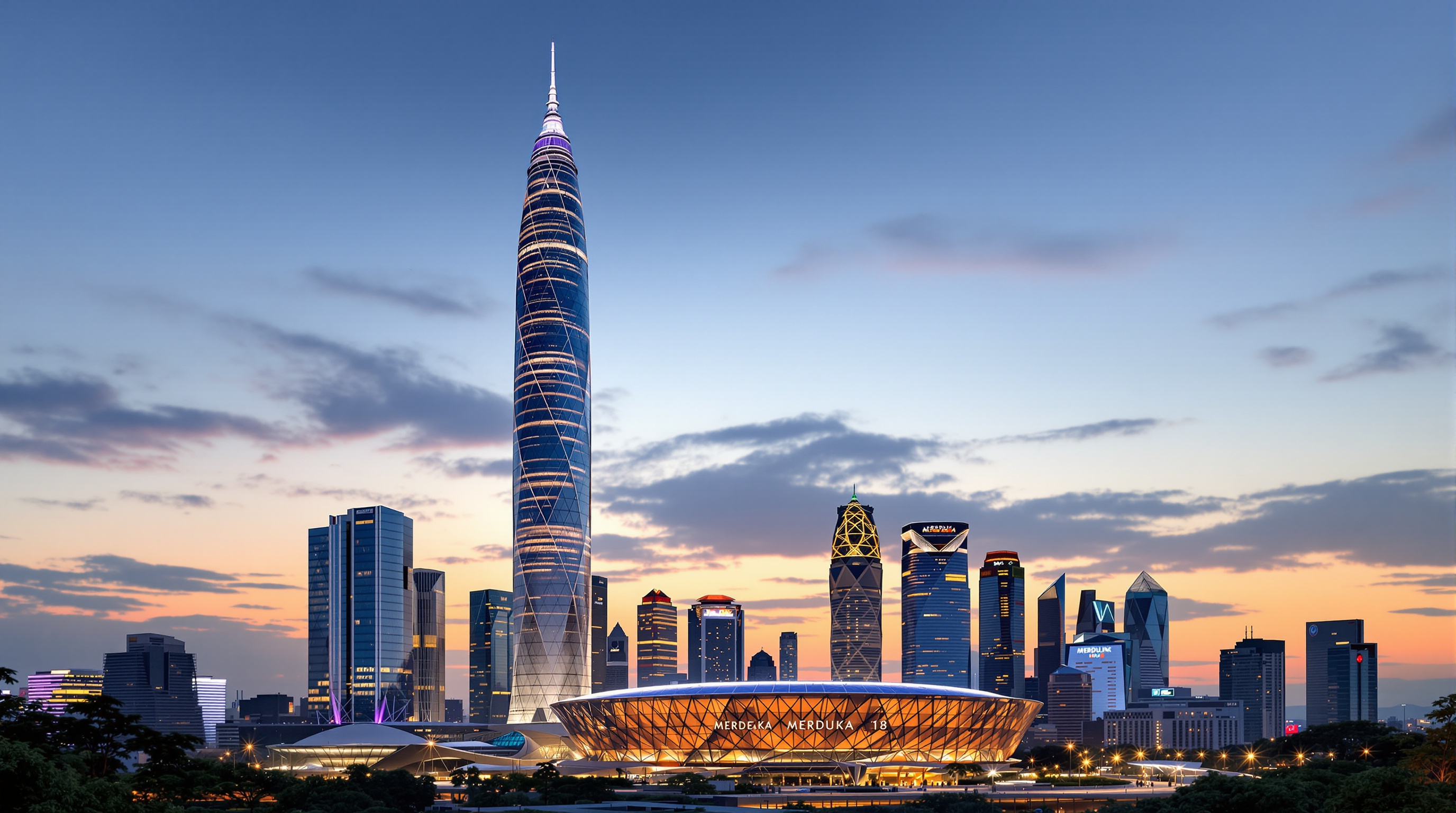
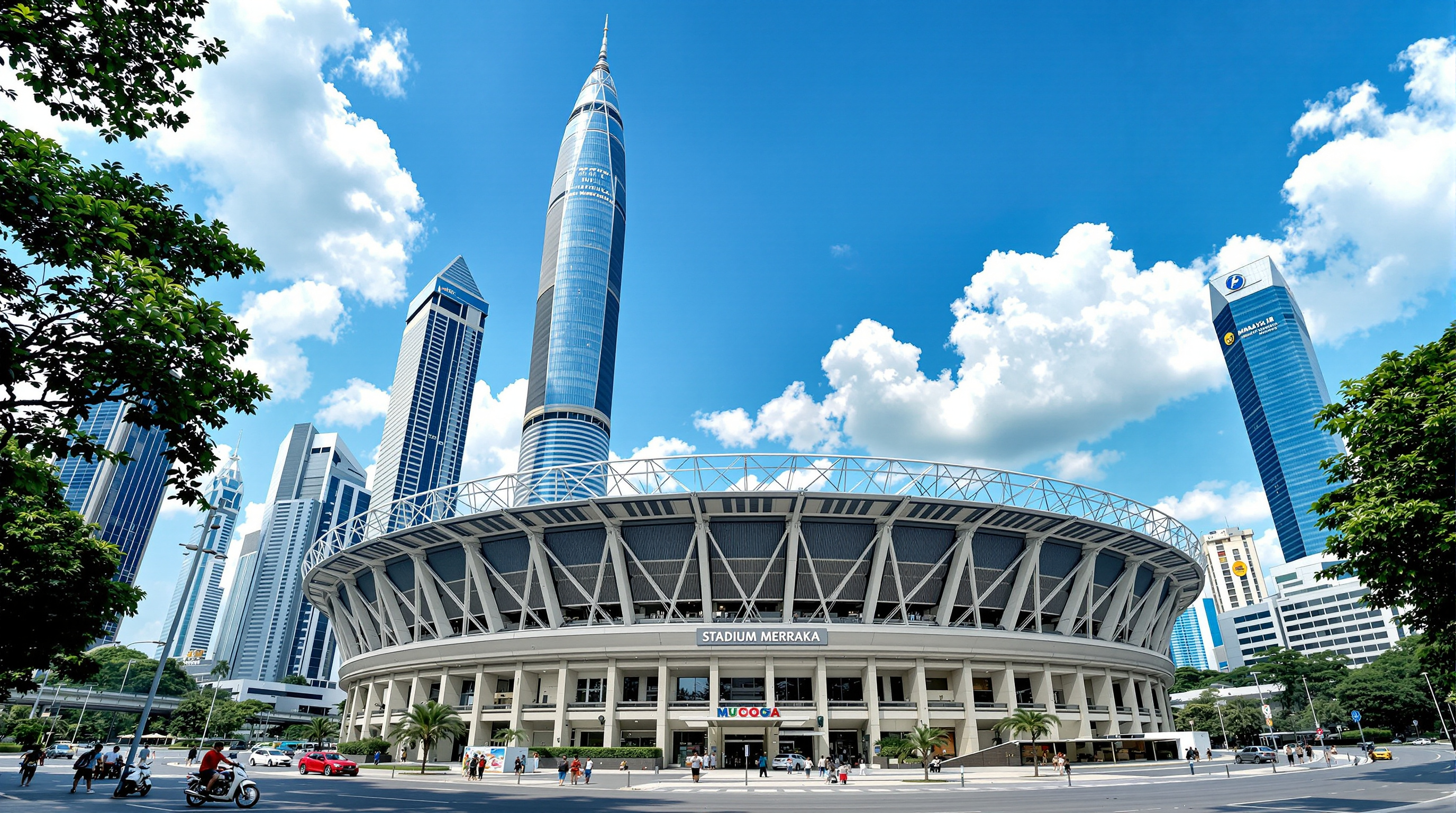
On 31 August 1957, on the field of a modest new stadium in Kuala Lumpur, Malaysia's first prime minister Tunku Abdul Rahman raised his hand and led a crowd in seven cries of Merdeka — independence. Sixty-six years later, a tower rose directly beside that stadium and claimed, in glass and concrete, to be the built shape of that raised hand. Merdeka 118 tops out at 678.9 metres across 118 storeys, making it the tallest building in Southeast Asia and, at completion, the second-tallest building and structure in the world, behind only Dubai's Burj Khalifa.
That claim — that a megatall skyscraper can carry the memory of a single historic gesture — is exactly why the building belongs in any honest account of where architecture is going. It is at once a triumph of supertall engineering and a test case for the harder question that shadows every record-breaker: when a nation builds the tallest thing for a thousand miles, what is it actually buying?
The form takes its cue from Tunku Abdul Rahman's outstretched hand as he proclaimed independence — a gesture of aspiration translated, at the scale of infrastructure, into a faceted vertical silhouette rising from the ground of the nation's founding.
The question it poses
The tower was commissioned by PNB Merdeka Ventures, a subsidiary of Permodalan Nasional Berhad (PNB) — Malaysia's state-owned fund manager, custodian of millions of ordinary Malaysians' savings. The design, by the Melbourne firm Fender Katsalidis (led by Karl Fender) in association with RSP Architects of Kuala Lumpur, had to do something that supertall towers rarely manage: mean something locally rather than simply signalling globalisation with a generic glass shard.
Fender Katsalidis's central move was to root the tower in its site's extraordinary history. Merdeka 118 does not stand in an anonymous business district; it rises from Warisan Merdeka, the precinct containing Stadium Merdeka (where independence was declared) and Stadium Negara. The building's tapering, faceted profile is read as that raised hand — narrowing as it climbs, then splitting into a slender 160-metre spire. Where Burj Khalifa abstracts a desert flower and Shanghai Tower twists to shed wind, Merdeka 118 argues that the supertall can be a monument to a founding moment rather than merely to capital. That is the future-facing provocation here: the skyscraper, so often accused of placelessness, made to carry a specific national narrative.
Making a raised hand stand up: the structure
A slender, tapering tower nearly seven hundred metres tall is, first and last, a wind problem. Above roughly five hundred metres, gravity is almost the easy part; the real adversary is lateral load — the wind trying to push the tower sideways and, worse, set it oscillating. The structural engineers of record, Arup, working with LERA Consulting Structural Engineers (the successor to Leslie E. Robertson Associates, engineers of the original World Trade Center) and Robert Bird Group, answered with a classic but ruthlessly optimised supertall system.
At the heart of the tower is a reinforced-concrete core — the vertical spine housing lifts and services and doing most of the work of resisting overturning. Around the perimeter stand a ring of mega-columns, each a massive composite element reported at roughly 4.5 by 5 metres in section. On their own, core and columns are two separate stiff elements swaying at different rates. What welds them into a single, far stiffer structure is the third component: three sets of three-storey-deep outriggers, arms of steel and concrete belt-truss that reach out from the core to grab the mega-columns at intervals up the height. When wind pushes the tower, the outriggers force the perimeter columns to act with the core, so the whole cross-section resists as one — dramatically reducing sway. It is the same family of logic Robertson's own firm helped pioneer, tuned here for the twenty-first century. The whole assembly bears on a deep piled raft below five basement levels, transferring the tower's colossal weight into the Kuala Lumpur bedrock; the perimeter mega-columns rake slightly inward as the plan tapers, so the geometry that makes the silhouette read as a narrowing hand is also, conveniently, the geometry that keeps the structure efficient. Form and force, for once, pull in the same direction.
Pushing concrete to its limit
The most quietly radical thing about Merdeka 118 is not visible at all. To make the core and mega-columns slender enough to preserve premium leasable floor area, the team specified high-performance concrete (HPC) up to grade C105 — an exceptionally strong, dense mix — for the core walls and columns. Getting concrete of that strength to pump hundreds of metres into the sky, and to cure without cracking under its own heat, is a genuine materials-science challenge; the project's engineers describe developing bespoke mixes to push those boundaries, work now documented in the peer-reviewed literature (Ng et al., 2025). The payoff is direct: stronger concrete means thinner columns, which means more rentable space and less steel — hundreds of tonnes saved.
The spire deserves its own note. At 160.7 metres, it accounts for nearly a quarter of the tower's height and is intrinsically slender and flexible — a tuning-fork waiting to vibrate. Rather than a solid mast, the engineers adopted a three-dimensional steel space truss, its behaviour under wind validated by aeroelastic wind-tunnel testing and fatigue assessment, so that a decorative-seeming crown is in fact a carefully engineered aerodynamic structure.
| System | What it does | Material / spec |
|---|---|---|
| Core | Resists overturning, houses services | High-performance concrete, up to C105 |
| Mega-columns | Carry gravity, anchor the outriggers | Composite, ~4.5 × 5 m sections |
| Outriggers + belt truss | Tie columns to core, cut wind sway | Steel + concrete, 3 sets × 3 storeys |
| Spire | Crown and height, tuned against vibration | 3D steel space truss, 160.7 m |
| Skin | Faceted enclosure, cultural pattern | 18,144 glass panels, ~114,000 m² |
The skin: a nation woven in glass

If the structure is the argument's grammar, the façade is its voice. The tower is wrapped in 18,144 diamond-shaped glass panels — around 114,000 square metres of glass — set at subtly shifting angles so that the surface reads as faceted and crystalline rather than smoothly curtain-walled. The pattern is not arbitrary: it is drawn from Songket, the traditional Malay hand-woven brocade in which metallic threads are floated across silk to catch the light. The building, in effect, is clad in a digital reinterpretation of a national craft, so that a global typology — the corporate megatall — is inflected by something unmistakably Malaysian. In daylight the facets scatter reflections; at night the geometry becomes a lantern.
This is where Merdeka 118 makes its most interesting contribution to the theme of Superstructures. The supertall has long been criticised as culturally empty — a competition over metres. Here the ambition is to make the very skin an instrument of place, an answer to the charge that towers are the same everywhere.
Sustainability, cost, and the third position
An honest account cannot stop at the engineering. Merdeka 118 was pursued as a green flagship: it targets triple-platinum environmental ratings (GBI, LEED and GreenRE) and was financed in part through green sukuk — Sharia-compliant Islamic bonds tied to sustainability criteria, a notable innovation in project finance. It is a serious attempt to reconcile the enormous embodied carbon of a megatall with contemporary environmental accounting.
And yet the tower arrived heavy with questions. Reported at a budget of around RM5 billion, built with money ultimately connected to a state fund holding ordinary Malaysians' savings, and constructed through the political turbulence and economic strain of the pandemic, it drew persistent criticism that the funds might have served housing, wages or infrastructure. The project's long timeline — groundbreaking in 2014, topping out in late 2021, structural completion usually given as November 2023, and a grand opening on 10 January 2024 with fit-out continuing well beyond — became a lightning rod for that debate. (Dates and figures for a project of this scale are frequently restated across sources; we hedge accordingly.)
Studio Matrx's editorial position is to hold both truths at once. Merdeka 118 is a genuine achievement in supertall engineering and a sincere effort to root a global typology in local memory and craft — and it is a reminder that the tallest building in a region is always also a political statement about priorities. The raised hand is a beautiful idea. Whether a nation's savings are best spent reaching that high is a question the building poses but cannot answer.
Why it belongs in the canon
Strip away the record and the controversy, and a real contribution remains. Merdeka 118 shows that the megatall need not be culturally weightless: its structure is a masterclass in outrigger-braced efficiency, its concrete pushed the material to new limits, and its skin is a deliberate act of cultural translation. It asks the future of the tall building a pointed question — not how high can we go? but can height mean something local? On the ground where a country was born, it answers: yes, if you are willing to weave the meaning in. For the next generation of supertall towers — most of them destined for Asia and the Gulf — that is the more demanding brief. Height alone is now cheap; anyone with enough concrete and capital can buy it. What Merdeka 118 gambles is that the buildings which endure in memory will be the ones that make their height say something particular about the place beneath them.
References
- PNB Merdeka Ventures / Merdeka 118 — official project descriptions, height, façade panel count, Park Hyatt and observation-deck data. merdeka118.com (primary source)
- Arup — "Merdeka 118," project page describing the outrigger structure, high-performance concrete core, mega-columns and wind engineering. arup.com (primary source — engineer of record)
- Robert Bird Group — "Merdeka 118," structural-engineering project description. robertbird.com (primary source)
- Ng, P. L. et al. (2025). "Design and construction of Merdeka 118 tower using high performance concrete: pushing the boundaries of concrete technology for a megatall building." Revista ALCONPAT. revistaalconpat.org (peer-reviewed; documents the C105 HPC mix design and outrigger system)
- Council on Tall Buildings and Urban Habitat (CTBUH) — Merdeka 118 building data, height verification (second-tallest, October 2023). skyscrapercenter.com (primary data / industry authority)
- "Merdeka 118, soon to be world's second tallest tower, tops out in Malaysia." Designboom (2021). designboom.com (architectural press)
- "Merdeka 118." Wikipedia. en.wikipedia.org (tertiary; cross-checked for dates, cost and controversy)
Part of The Future of Architecture in 300 Buildings — Studio Matrx's canon of the buildings asking where architecture goes next. Chapter 9: Superstructures.
Export this guide
Related Guides — Deep-dive reading
Burj Khalifa: How the Buttressed Core Made Height a Solved Problem
SOM's 828-metre tower in Dubai is not just the tallest building in the world — it is the moment structural height stopped being an engineering frontier and became a question of economics. This deep study reads its buttressed-core system, its wind-confusing setbacks, its record-breaking concrete, and the migrant labour the spire cannot rise above.
The Future of ArchitectureThe 42, Kolkata: How a 1:10 Sliver of Concrete Rewrote an Indian Skyline
Hafeez Contractor's residential tower on Chowringhee is a perfect square in plan pushed to roughly 249 metres — a slenderness ratio of about 1 to 10 that turns a colonial-era plot in the heart of Kolkata into India's tallest completed building outside Mumbai. A case study in slender-tower engineering, the water damper that keeps it still, and what vertical luxury says about the Indian metropolis.
The Future of ArchitectureShanghai Tower: How Gensler Turned a Skyscraper into a Vertical City
At 632 metres, Gensler's twisting supertall in Lujiazui wraps nine stacked 'neighbourhoods' inside a transparent double skin. This deep study reads its 120-degree twist as an aerodynamic argument, its sky gardens as public space in the sky, and its record-breaking eddy-current damper — and asks what a green megatall really costs.
The Future of ArchitectureRelated Tools — Try Free
Brise-Soleil Visualizer
Interactive horizontal-louvre cut-off angle calculator — sun altitude, louvre depth, and spacing inputs with a live shadow preview. Computes θ = arctan(spacing/depth) for façade shading, ECBC envelope compliance, hospital daylight design, and tropical sun-control detailing.
Sun Shading ToolClient Brief Generator
8-section questionnaire that produces a professional design brief PDF with signature lines.
Brief GeneratorCross-Ventilation Analyzer
Estimate airflow and air changes per hour (ACH) from room size, window areas, layout, and local wind — with NBC 2016 Part 8 compliance check.
Ventilation Calculator