
Jewellery and Valuables Safes in India (2026): Rating, Fitting and Placing a Safe for Gold, Watches and Heirlooms
How to choose, rate, fit and place a home safe for jewellery, gold, watches and high-value valuables in India — matching the burglary grade to the value your insurer will cover, adding fire protection for heirlooms and papers, keeping metal dry, and knowing when a bank locker is the better answer.
Jewellery is the most concentrated value most Indian households own — a small tray of gold, a few watches and a set of heirlooms can be worth more than everything else in the home combined, and it is exactly what a burglar comes for. That changes how you shop for a safe. A cheap "locker" that keeps papers tidy and children out is not the same thing as a safe rated to resist an attack for the value you are asking it to hold. The single most important idea on this page is that a jewellery and valuables safes decision is really a match between three numbers: the value at risk, the burglary grade of the safe, and the amount your insurer will actually cover inside a home safe. Get those three lined up and the safe does its job; ignore them and you have a heavy box that gives false comfort.
This guide is for the homeowner buying once and wanting to get it right. It sits beside the broader complete guide to home safes in India and the practical how to choose a home safe; where you also want to protect heirloom documents from fire, read fire-rated vs burglary-rated safes; and for very high value that you rarely touch, weigh the bank locker vs home safe trade-off before you buy anything. We stay strictly on the owner's side of the problem: how to choose, size, fit and place a safe, and how to keep it working in Indian humidity.
Scope & how to read this. This is educational guidance for choosing and using a home safe, not a security assessment of your home; it is strictly about buying, fitting and placing a safe — it never explains how to open or defeat one. Rating figures, prices and insurer limits are indicative — verify the certificate and confirm cover with your own insurer.
Why jewellery needs a burglary rating, not just a lock
A lockable steel cabinet resists curiosity, not a determined thief. Jewellery is small, portable and quickly resold, so it attracts exactly the kind of attack a burglary rating is designed to withstand: prying, drilling and hitting with hand tools in the minutes a burglar is willing to spend. Burglary resistance is graded by independent testing — you will see cash or valuables rating grades (for example the UL "residential security container" mark, or European EN 1143-1 grades expressed as a cash rating) — and the grade is what a home insurer reads to decide how much cover they will extend to contents inside the safe.
That last point is the one homeowners miss. Many household policies cap the jewellery they will pay out for unless it is kept in a safe of a stated rating, and the higher the value you want covered, the higher the grade they require. So the rating is not vanity — it is the number that turns "I have a safe" into "my insurer will pay if it is defeated". Before you buy, ask your insurer two things: what safe rating they require for the sum you want covered, and whether the safe must be anchored and installed to a particular standard. Buy to that answer, not above or below it.
Fire protection for heirlooms and papers
Burglary and fire are different threats and, largely, different safes. A pure burglary safe can transmit enough heat in a house fire to destroy paper and char jewellery boxes; a pure fire safe keeps the inside cool but is often easy to force open. For a household that keeps gold and irreplaceable papers — property documents, wills, heirloom certificates — a composite (fire-and-burglary) safe is usually the honest answer, or two safes for two jobs. Fire ratings are quoted as a protection time at a contents temperature: paper survives to roughly 177 degrees C, but photographs, media and data need to stay near 52 degrees C, so a "paper-rated" fire safe does not protect a hard drive. Read the certificate for the time and the internal temperature, and match it to what you are storing. The fire-rated vs burglary-rated safes guide unpacks the two systems in detail.
Interior fittings: what actually protects the pieces
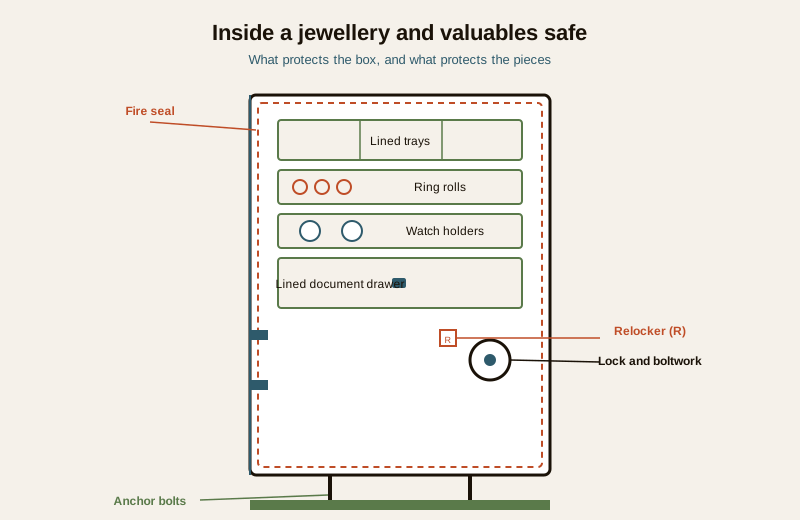
The rating protects the box; the fittings protect the pieces inside it from each other and from being missed in a hurry. For jewellery this matters more than raw size. A safe that is mostly empty air is harder to organise and tempts you to over-buy; a smaller safe with the right interior holds more of what you own, safely.
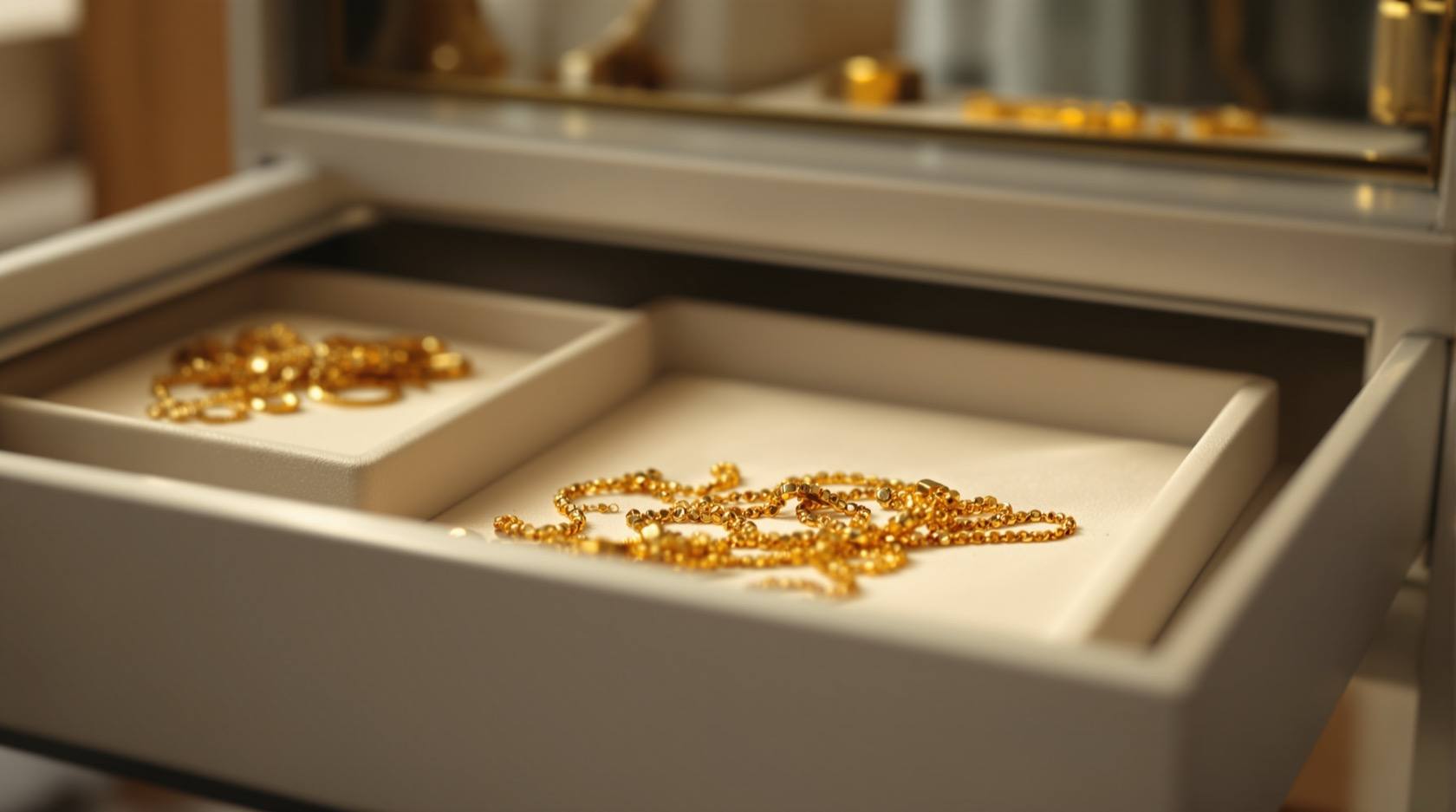
- Lined trays — felt or velvet trays keep rings, chains and bangles separated so they do not scratch, tangle or abrade. Removable trays let you lift a set out to a table rather than rummaging inside.
- Ring rolls and slots — padded rolls hold rings and studs in order; a glance tells you if a piece is missing.
- Watch holders — watches dislike being stacked; individual pads or a watch drawer prevent case scratches and crystal contact.
- A lined drawer or document slot — for heirloom papers, certificates and small boxes, kept flat and dry.
- Interior light and a soft mat — a small light helps you check contents; a mat stops a dropped piece bouncing.
Choose the interior for what you own, not for the showroom display. If most of your value is a few high pieces you wear on occasions, a compact safe with good trays beats a tall cabinet you will never fill.
A discreet, well-anchored safe beats a big one
Two features do more for real-world security than volume: the safe is hard to find and impossible to carry away. A burglar who cannot locate the safe in the few minutes they will spend cannot attack it; a safe they find but cannot move goes with them to a workshop where time and tools are unlimited — which is exactly the situation no home safe is built to survive.
- Anchor it. A home jewellery safe must be bolted down — through the floor slab for a floor safe, or floor-and-wall for a cabinet safe — using the anchor points the maker provides. An un-anchored safe under a certain weight is simply luggage. Heavy anchoring, floor loading and any masonry or floor-safe work should be done by a professional installer; it is not a job to improvise.
- Hide it. Fit it out of the obvious places (the master bedroom wardrobe is the first place searched). A discreet location inside built-in joinery, low and anchored, is worth more than a larger safe on display.
- Keep it quiet. The fewer people who know it exists and where it is, the better. Do not photograph it or its contents on a phone that backs up to the cloud with location on.
For the placement decision in full — which room, which level, how to anchor into an Indian RCC slab — this guide's siblings on choosing and placing a safe go deeper; anchoring is a professional install, not a DIY afternoon.
Match the rating to the value at risk
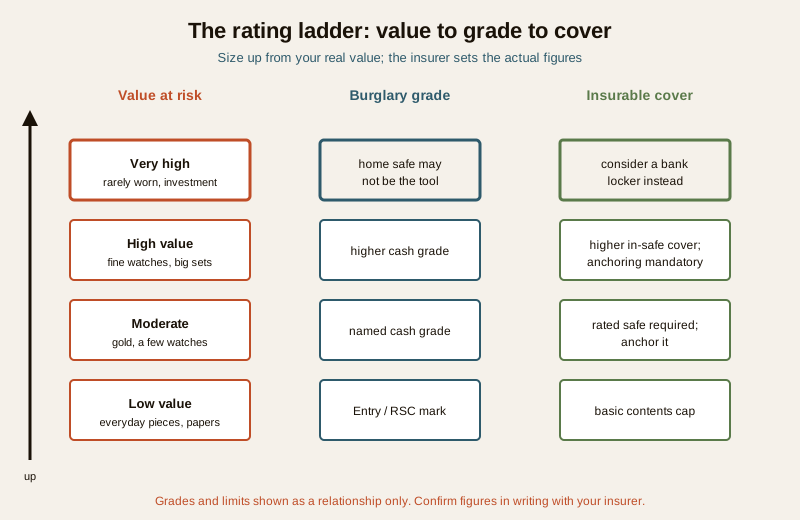
This is the heart of the buying decision, and it is a ladder, not a guess. Work upward: total the value you actually keep at home, find the burglary grade your insurer ties to that value, and buy at least that grade. Never size down from the safe you like to the value you wish you had; size up from the honest value to the grade that covers it.
| Value at risk (indicative) | What that usually means | Burglary protection to look for | Insurance angle |
|---|---|---|---|
| Low | Everyday pieces, a little cash, documents | Entry burglary rating / residential security container | Often covered under general contents; confirm the cap |
| Moderate | Regular gold, a few watches, some heirlooms | A certified cash-rated grade your insurer names | Insurer likely requires a rated, anchored safe |
| High | Substantial gold, fine watches, high-value sets | A higher certified cash-rating grade | Higher grade unlocks higher in-safe cover; anchoring often mandatory |
| Very high, rarely worn | Investment gold, inherited high-value sets | Home safe may not be the right tool at all | Consider a bank locker; home cover may be capped regardless |
The numbers are your insurer's, not ours. The grades and cover limits above are shown as a relationship, not as figures. Get the specific rating requirement and the in-safe cover limit in writing from your own insurer, and buy to it.
Humidity in India: keep gold and silver dry
India's monsoon and coastal air are hard on stored metal. Silver tarnishes, costume and plated pieces corrode, and a closed steel safe can trap damp and actually hold humidity against your jewellery. Fire safes are the worst offenders here, because many use a moisture-bearing insulation that keeps the inside humid by design — good for paper in a fire, bad for silver over years.
- Silica gel. Keep rechargeable silica-gel packs (the colour-indicating kind) inside the safe and recharge or replace them on a schedule. This is the single cheapest thing you can do for stored jewellery.
- Store metal dry and clean. Put pieces away clean and fully dry; moisture and skin residue accelerate tarnish.
- Anti-tarnish measures. Anti-tarnish strips or cloth pouches for silver; keep pieces in their soft pouches inside the trays.
- Ventilate a fire safe periodically. Open a fire safe now and then in dry weather to let trapped humidity escape, then reseat the silica gel.
- Watch the coast. Coastal and high-humidity homes should check silica gel more often and consider a small safe-heater or dehumidifier sachet system.
| What to store | Main risk in India | Simple control |
|---|---|---|
| Gold jewellery | Mostly fine; skin residue dulls it | Store clean and dry; soft pouch |
| Silver items | Tarnish from humidity and sulphur in air | Anti-tarnish strips, silica gel, sealed pouch |
| Watches | Case corrosion, crystal fog, band mould | Individual holders, silica gel, avoid stacking |
| Heirloom papers | Damp, foxing, mould | Fire/document slot kept dry; flat storage |
| Media / data | Heat and humidity | Data-rated fire safe (52 degrees C class), not a paper safe |
The bank locker alternative for very high value
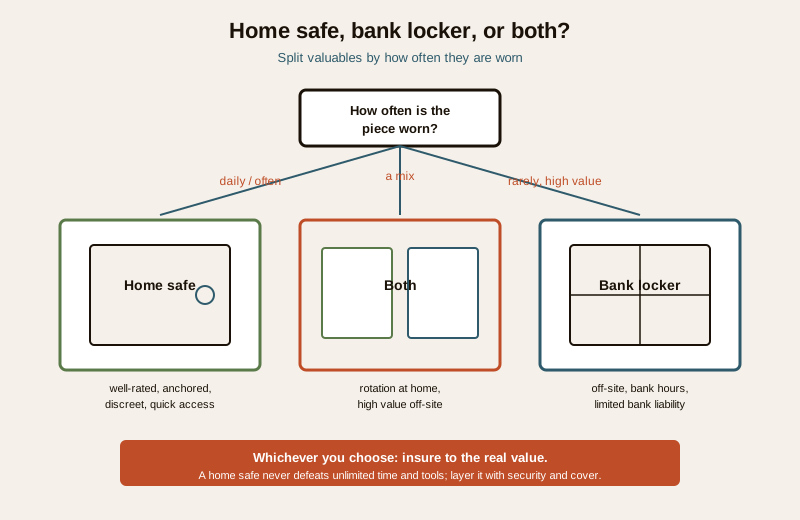
For value you rarely touch — investment gold, an inherited high-value set worn once a year — a bank locker is often the more honest choice than an ever-larger home safe. It removes the highest-value target from the home entirely, which is worth more than any grade of steel in your bedroom. The trade-offs are real: access is limited to bank hours, the bank's liability for locker contents is limited (read the locker agreement and the current banking-regulator norms, and insure separately), and you cannot get to the pieces at short notice. Many households run both — a modest, well-rated home safe for the jewellery in regular rotation, and a bank locker for the high-value pieces that live out of sight. The bank lockers vs home safes guide sets out the full comparison.
The honest limit: layer, don't rely
No home safe defeats unlimited time and tools. Every rating is a time rating — it buys minutes against a defined attack, on the assumption that the safe cannot be removed and that help, or the burglar's own caution, arrives before those minutes run out. That is why the safe is one layer, not the whole answer.
- Make the home hard to enter and quick to detect an intrusion, so the burglar's available minutes are few.
- Anchor the safe so it cannot be carried to where minutes are unlimited.
- Keep the highest value off-site in a locker so the worst case is capped.
- Insure to the real value, with the safe rating your insurer requires, so a defeat is a claim rather than a total loss.
Treat the safe as the last line behind a layered home, not as a substitute for one. And if you are ever locked out of your own safe — a lost key, a forgotten code, a jammed lock — do not try to drill or force it, and do not follow online methods to open it. Contact the safe's manufacturer or a licensed locksmith or safe technician and be ready to show proof of ownership; that is the only correct and safe route, and it protects your warranty and your valuables.
How it connects
This guide is the jewellery-specific view within the Safes & Vaults library. Start with the complete guide to home safes in India for the full landscape, use how to choose a home safe to work through the buying steps, read fire-rated vs burglary-rated safes when you also need to protect papers and heirlooms from fire, and weigh bank lockers vs home safes for the high-value pieces you rarely wear.
Key takeaways
- Buy the burglary grade your insurer ties to your value at risk — the rating is what turns "I own a safe" into "my insurer will pay".
- For gold plus irreplaceable papers, prefer a composite fire-and-burglary safe, and read the fire certificate's time and internal temperature (177 degrees C paper vs 52 degrees C media).
- Interior fittings — lined trays, ring rolls, watch holders, a document slot — protect the pieces and let a small safe hold more of what you own.
- A discreet, well-anchored safe beats a bigger one; anchoring and any floor-safe work is a professional install.
- In India, keep metal dry — silica gel, anti-tarnish measures, and periodic ventilation of fire safes.
- For very high value rarely worn, a bank locker (or a locker plus a modest home safe) is often the honest choice.
- No home safe defeats unlimited time and tools — layer it with home security and insurance, and route any lockout to the manufacturer or a licensed technician with proof of ownership.
References
- Underwriters Laboratories (UL) — residential security container and safe attack-test marks; read the label for the rating and what it certifies.
- EN 1143-1 (European standard for secure storage units) — burglary resistance expressed as cash-rating grades; verify the grade on the certificate.
- Your household insurer's policy and jewellery endorsement — the authoritative source for the safe rating required, anchoring requirements, and the in-safe cover limit for jewellery.
- Safe manufacturers' fitting and specification guidance — for fire time-and-temperature ratings, anchoring instructions and interior options; follow the maker's install instructions.
- Reserve Bank of India / your bank's locker agreement — for bank-locker access terms, the bank's limited liability for contents, and current safe-deposit-locker norms.
- Bureau of Indian Standards catalogue — verify the current edition of any Indian standard referenced, at https://www.services.bis.gov.in/
This is indicative educational guidance, not a security assessment or insurance advice; verify your value at risk, the safe's certificate and your insurer's requirement before you buy, have a professional install and anchor the safe, and treat this content as strictly defensive — a lockout goes to the manufacturer or a licensed technician with proof of ownership.
Export this guide
Related Guides — Deep-dive reading
Fire-Rated vs Burglary-Rated Safes in India (2026)
The ratings explainer that clears up the single biggest safe-buying mistake — a fire safe is not a burglary safe and a burglary safe is not a fire safe — with how to read a certificate and match it to what your home actually needs.
SecurityThe Complete Guide to Home Safes in India (2026)
The definitive homeowner overview of home safes for Indian houses and flats: why you might want one, what a safe protects and what it does not, the main types and ratings, how to size and weigh one, why anchoring is non-negotiable, and how to buy honestly and layer it into your wider home security.
SecurityBank Lockers vs Home Safes in India (2026): An Honest Comparison
A side-by-side look at bank lockers and home safes for Indian households — access, cost, real security level and, most misunderstood of all, the liability and insurance reality — so you can decide what belongs where, and why many homes sensibly use both.
SecurityRelated Tools — Try Free
Access-Control Schedule Generator
Build the time schedules that decide when each access group can enter — an editable list for your integrator.
Time SchedulesBefore vs After — Cost Reality Check
Compare what you expected to pay vs what you actually paid, category by category.
Reality CheckCCTV Cloud vs Local Cost Calculator
Compare cloud CCTV subscription against a local NVR + HDD — upfront, 5-year total, monthly fee and break-even.
Cloud vs Local