
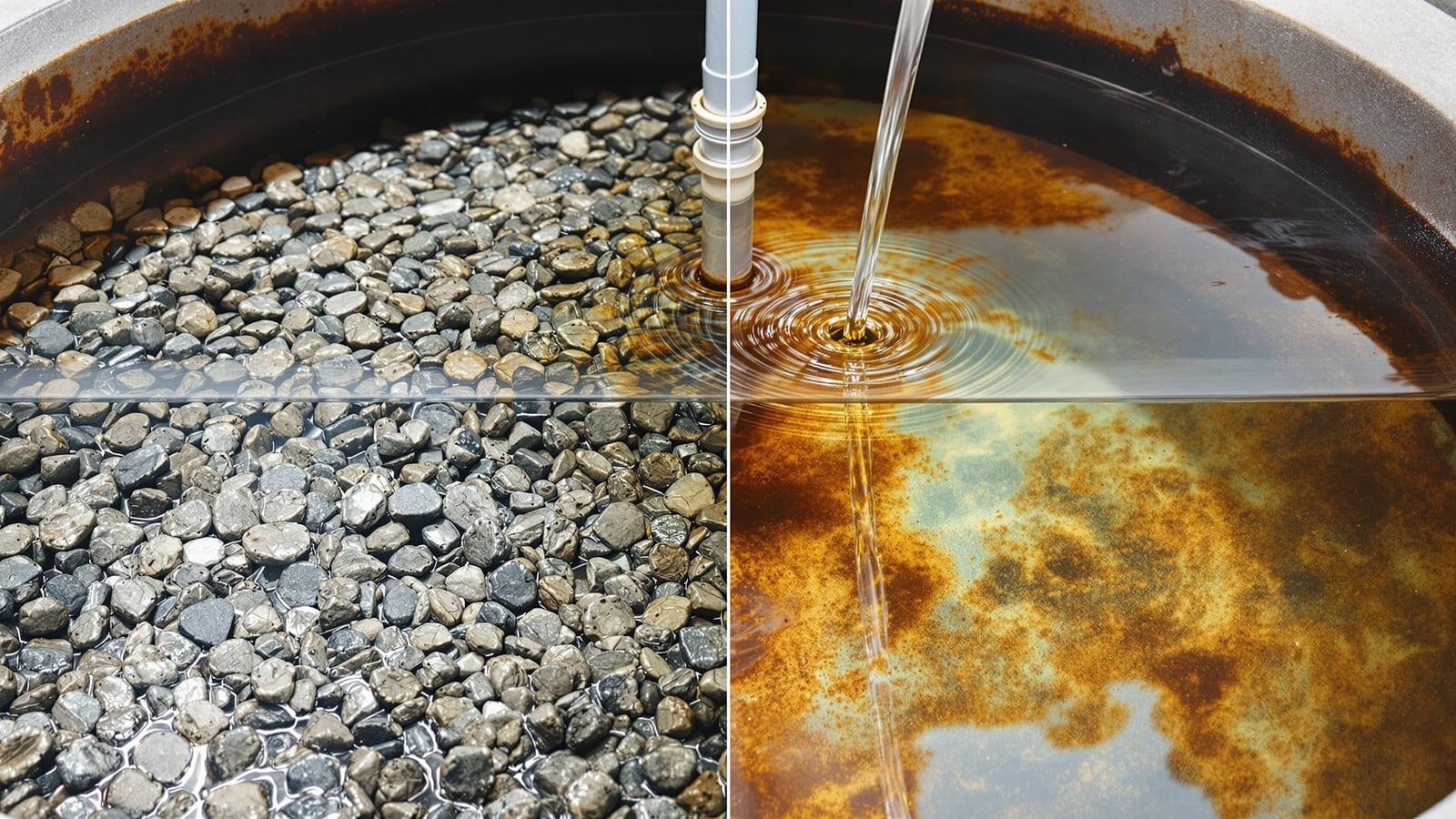
Iron Removal from Water in India: Fixing Red-Brown Borewell Water That Stains and Smells
A homeowner's guide to treating iron- and manganese-heavy water — the borewell supply that stains fixtures and clothes rust-red, tastes metallic and chokes your RO membrane. How oxidation-plus-filtration works, where to fit it, and what it costs.
If your borewell water runs clear from the tap but turns rusty red-brown in the bucket a few minutes later, stains the wash basin and toilet with orange streaks, leaves brown marks on white clothes, and tastes faintly of metal — you have an iron problem. It is one of the most common groundwater complaints across India, and this Studio Matrx guide, written for homeowners, walks through why it happens and how to fix it for the whole house.
Iron removal sits inside the wider water treatment guide. Because iron is almost always a groundwater problem, start by understanding your source in the borewell water system guide — and before you buy anything, get the water tested (see water quality testing). You cannot size an iron filter without a number.
The signs — and the IS 10500 limit
Iron rarely arrives alone or silently. The tell-tale signs are hard to miss:
- Clear water that turns brown on standing. Fresh from the tap it looks fine; leave it in a glass or bucket and it develops a yellow-brown tinge, then a rusty sediment at the bottom.
- Orange-brown staining on taps, sinks, WC pans, tiles and the inside of the overhead tank.
- Rust-coloured marks on laundry, which ordinary detergent will not shift and bleach makes worse.
- A metallic or bitter taste and sometimes a musty smell (manganese and iron bacteria add to this).
- Choked RO membranes and clogged aerators — iron fouls RO membrane and cartridge filters fast, cutting their life to a fraction.
The Bureau of Indian Standards drinking-water specification, IS 10500, sets the acceptable limit for iron at 0.3 mg/L (0.3 ppm). There is no separate "permissible in the absence of an alternate source" relaxation for iron in the current standard — 0.3 mg/L is the number to beat. The related nuisance metal, manganese, has an acceptable limit of 0.1 mg/L. Above these you get the staining, taste and appearance problems above; iron is an aesthetic and operational nuisance rather than an acute health hazard at typical borewell levels, but it will wreck fittings, laundry and downstream equipment.
Ferrous vs ferric: why the "form" decides the fix
The single most important thing to understand is that iron in water exists in two forms, and your treatment depends on which you have.
- Ferrous iron (dissolved, Fe2+). This is "clear-water iron." It is fully dissolved, so water from the tap looks perfectly clear. Only when it meets air (oxygen) does it oxidise, turn to rust and drop out as visible particles — which is why the bucket turns brown after a few minutes. Most fresh borewell water is ferrous.
- Ferric iron (oxidised, Fe3+). This is "red-water iron" — already oxidised into reddish particles you can see immediately, sometimes present because the water has already picked up air or because iron bacteria are at work.
Ferric iron is a suspended particle, so a good sediment filter can catch a lot of it. Ferrous iron is invisible and dissolved — a plain filter passes it straight through. To remove ferrous iron you must first turn it into ferric (oxidise it), then filter out the particles. That two-step logic — oxidation then filtration — is the backbone of nearly every iron removal system.
The oxidation-plus-filtration methods
Different systems oxidise the iron in different ways. The right one depends on how much iron you have, whether manganese is present, and your budget.
- Aeration + filtration. Spray or cascade the water through air (or bubble air in) so oxygen oxidises the ferrous iron; the rust then settles or is caught by a filter. Chemical-free and cheap to run, ideal for moderate iron, but needs a tank, a small pump and space.
- Chlorination + filtration. Dose a little chlorine (bleaching/liquid chlorine) to oxidise iron — and, usefully, manganese and iron bacteria — then filter. Effective and strong, but you must control the dose and often remove the excess chlorine afterwards with a carbon filter.
- Potassium permanganate + manganese greensand. The classic combined iron-and-manganese solution. Greensand media is coated so it oxidises iron and manganese on contact and traps the particles; it is periodically regenerated with a potassium permanganate (KMnO4) solution. Reliable for tricky manganese, but needs the KMnO4 top-up and careful dosing.
- Catalytic / oxidising media (Birm, Pyrolox, and similar). These media speed up oxidation as the water passes through and then hold the rust. Birm is light, low-cost and works where there is enough dissolved oxygen and reasonable pH. Pyrolox (and similar manganese-dioxide media) are heavier, handle higher iron and manganese, and need a strong backwash. Both are popular "no-chemical" whole-house choices in India.
| Contaminant / metric | IS 10500 acceptable limit | Typical Indian borewell range | What it causes |
|---|---|---|---|
| Iron (Fe) | 0.3 mg/L | 0.3 – 15 mg/L | Red-brown stains, metallic taste, RO fouling |
| Manganese (Mn) | 0.1 mg/L | 0.05 – 2 mg/L | Black/brown stains, bitter taste |
| Turbidity | 1 NTU | varies | Cloudiness, carries oxidised iron |
| pH | 6.5 – 8.5 | 6.5 – 8.5 | Low pH slows oxidation |
These ranges are indicative — borewells vary hugely even within one locality. Only a lab report gives you real iron and manganese numbers, and those numbers decide the media, the vessel size and whether you need aeration or a chemical dose. Never size an iron filter off staining alone.
Where it fits: whole-house (POE) is the right call
Iron is a whole-house problem. It stains every basin, every WC, the washing machine, the geyser and the overhead tank — not just the kitchen tap. So iron removal almost always belongs at the point of entry (POE): a single filter on the incoming line (or on the borewell-to-tank line) that treats all the water before it reaches the house.
Fitting it point-of-use (POU), at just the drinking tap, would leave every other fixture and appliance to keep staining. A POE iron filter also protects your downstream equipment — the water softener and, crucially, the RO/UV unit under the kitchen sink. Iron is brutal on RO membranes and on softener resin; removing it upstream extends their life dramatically. The correct treatment order for a borewell home is usually: iron removal -> softener (if hard) -> RO/UV at the drinking tap.
Backwashing keeps a media filter alive
Every media iron filter (greensand, Birm, Pyrolox) traps rust in its bed, and that bed slowly clogs. The cure is backwashing: periodically reversing the flow so a strong upward surge lifts and re-fluffs the media, carries the trapped rust to drain, and resets the filter. Manual valves exist, but most whole-house units use an automatic backwash valve on a timer or a meter.
Two practical points: backwashing needs a good flow and pressure (heavier media like Pyrolox especially), and it sends water to drain — a modest but real weekly water cost you should account for, similar in spirit to a softener's regeneration or an RO reject stream. Undersized backwash is the commonest reason an iron filter fails early.
Combined iron and manganese
Manganese very often rides along with iron and behaves the same way — dissolved and invisible until it oxidises, then dropping out as black or brown stains and a bitter taste. But manganese is harder to oxidise than iron: it needs a higher pH and a stronger oxidiser. This is exactly where KMnO4-regenerated greensand or a strong catalytic media like Pyrolox earns its place — a plain aeration-plus-sand setup that clears the iron may leave the manganese behind. If your lab report shows manganese above 0.1 mg/L, tell your supplier so the media and dosing are chosen for both metals.
Maintenance and running cost
- Media top-up/replacement. Catalytic media gradually loses activity; budget to replenish or replace the bed every few years, depending on iron load.
- Chemical dosing. KMnO4 (for greensand) or chlorine (for chlorination) needs regular refilling and dose checks.
- Backwash water. A weekly-to-daily flush to drain, depending on iron load and vessel size.
- Pre/post filters. A sediment cartridge before, and a carbon cartridge after chlorination, need periodic changes.
- Downstream RO/softener. With iron removed upstream, these last far longer — the whole point of fitting the POE unit.
| Approach | What it suits | Indicative installed cost | Running notes |
|---|---|---|---|
| Aeration + sand/media filter | Moderate iron, no/low manganese | ₹15,000 – ₹45,000 | Chemical-free, needs space + pump |
| Birm catalytic media (POE) | Iron with enough oxygen, ok pH | ₹18,000 – ₹50,000 | Backwash, occasional media top-up |
| Manganese greensand + KMnO4 | Combined iron + manganese | ₹35,000 – ₹90,000 | KMnO4 refills, dosing control |
| Pyrolox / high-capacity media | High iron and manganese | ₹40,000 – ₹1,20,000 | Strong backwash, heavier media |
Costs are indicative for typical Indian home vessels and vary with flow rate, media, automation and city. Always price against a real lab report — over-buying a huge vessel for mild iron wastes money, and under-buying for high iron means brown water within months.
Pros and cons at a glance
- Pros. Ends the staining and metallic taste across the whole house; protects laundry, fittings, geyser, softener and RO; largely automatic once set up; chemical-free options exist.
- Cons. Upfront cost and floor space; needs a drain and good backwash flow; media/chemicals need periodic attention; manganese and iron bacteria complicate things; must be sized off a real test.
The bottom line: iron is a solvable, whole-house problem, but only if you measure first. Get iron and manganese numbers from a lab, match the oxidation method to those numbers, fit the filter at the point of entry, and keep the backwash healthy.
References
- IS 10500 — Bureau of Indian Standards, Drinking Water Specification (acceptable limits: iron 0.3 mg/L, manganese 0.1 mg/L).
- World Health Organization — Guidelines for Drinking-water Quality (iron and manganese as aesthetic/nuisance parameters).
- Related Studio Matrx guides: water treatment guide, borewell water system, domestic water filtration, and water quality testing.
Export this guide
Related Guides — Deep-dive reading
Domestic Water Filtration in India: Sediment & Carbon Filters for a Home
The first stage of almost every home water-treatment train — how sediment and activated-carbon filters strip out sand, silt, rust, chlorine, taste and odour, where to fit them (whole-house vs under-sink), how to pick a micron rating, when to replace a cartridge, and what filtration cannot remove.
PlumbingDomestic Water Treatment Guide for Indian Homes: Test First, Then Treat Right
A master overview of treating the water coming into an Indian home — how to test first, match each contaminant to the right treatment, choose point-of-use versus point-of-entry, build a treatment train in the correct order, avoid over-treating, and budget for maintenance and running cost.
PlumbingRO vs UV Water Purifier: Which One Does Your Home Need? (India)
A fair, India-first head-to-head decided by one number — your feed-water TDS. RO strips dissolved salts and heavy metals for hard borewell water; UV only kills microbes and suits already-clear, low-TDS municipal supply. What each removes, water wastage, running cost, and a verdict by measured TDS.
PlumbingRelated Tools — Try Free
Water Softener Size Calculator
Size a water softener from your hardness, daily water use and days between regeneration, with the grain capacity needed.
Plumbing CalculatorWater Tank Chlorination Calculator
Work out how much household bleach to disinfect a water storage tank from tank volume, target chlorine dose and bleach strength.
Plumbing CalculatorBefore & After Studio
Generate AI before-and-after renders to preview how your redesign could look.
DesignAI