
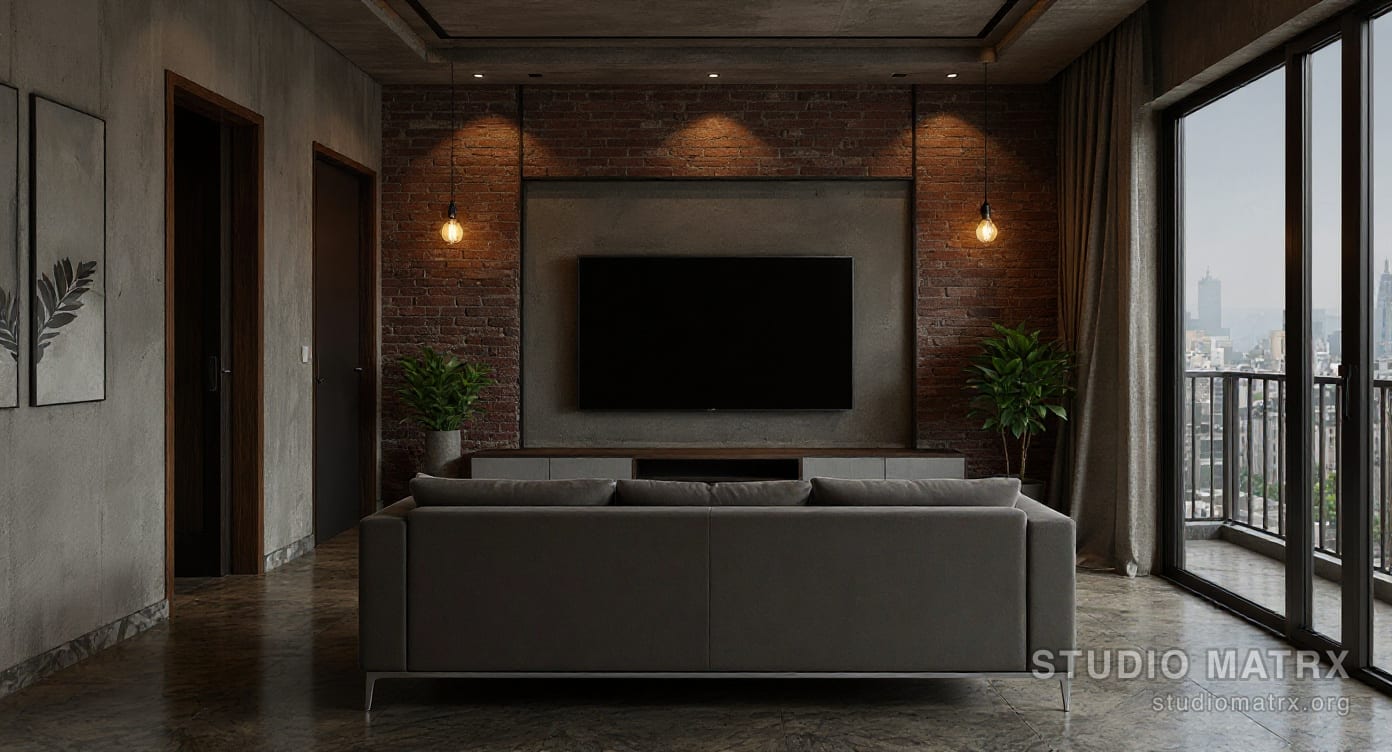
Industrial Interiors — A 2026 Style Guide for Indian Homes
Raw, honest, warm · Concrete, black metal, reclaimed wood · Loft character, liveable
Industrial interiors take the bones of a building — concrete, steel, brick, bulbs — and make them the finish, not the thing you hide behind plaster. Born in the converted factories of New York and London, the look has landed squarely in Indian homes in 2026: in compact city apartments that want loft character, in studio flats where a bachelor or young couple wants attitude, and in the growing wave of "café-at-home" living rooms where an exposed-brick wall and Edison bulbs do the heavy lifting. It suits the Indian reality well — our buildings are already concrete-and-brick under the paint — but needs careful handling so it reads as a warm urban loft, not a half-finished site. This guide is about styling the interior: palette, materials, room-by-room moves, and crucially, how to keep it warm and liveable in Indian heat, humidity and family life.
What Industrial Style Is (and Isn't)
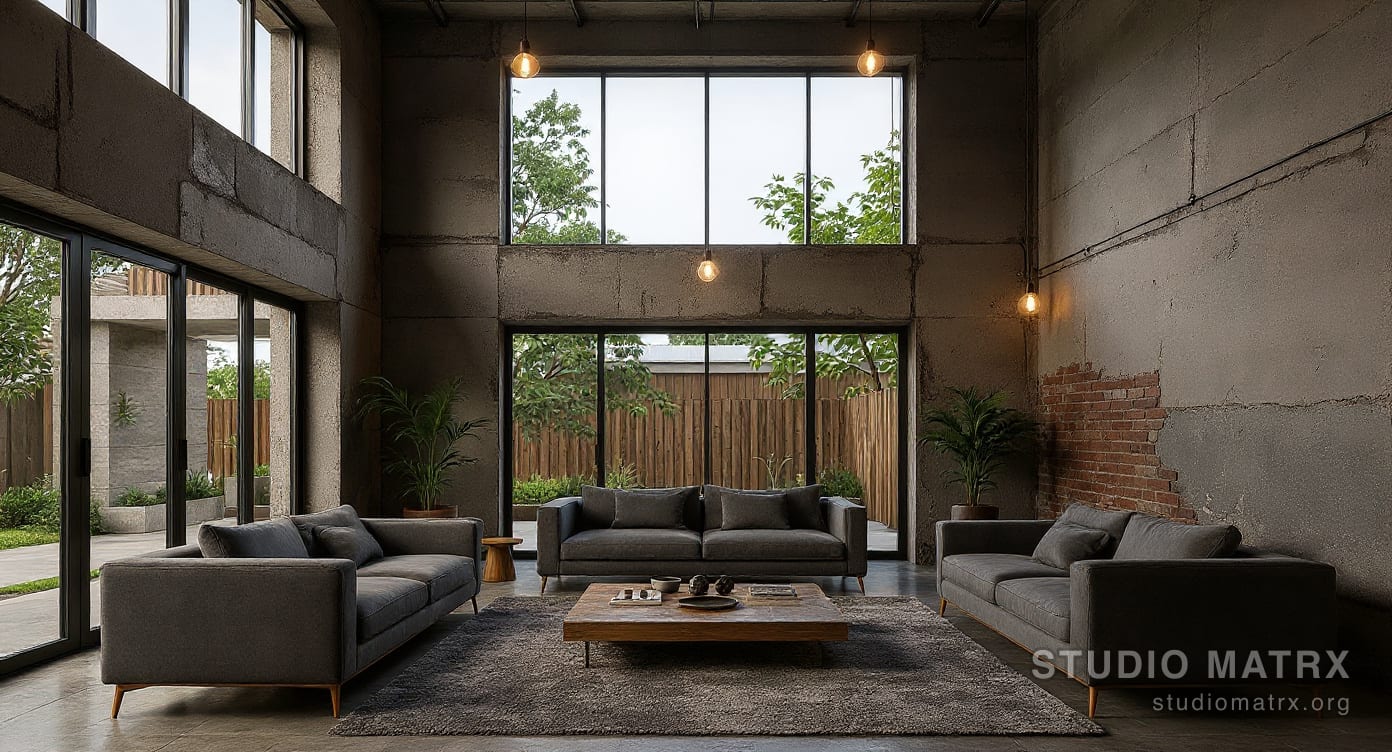
Industrial style celebrates honest materials. Instead of hiding the structure, it shows it: the concrete slab becomes the ceiling, the brick the wall, the steel the furniture frame. Nothing pretends to be something it isn't — no faux-marble laminate, no carved cornices, no gloss for its own sake.
What it is not is cold, unfinished or grungy by accident. The common misread in India is to leave a room genuinely raw — bare cement floor, no soft furnishing, a single tube light — and call it industrial. That is just incomplete. The difference between a loft and a building site is intention: every rough surface is balanced by something warm, soft or precise.
This is where the split between warm industrial and stark industrial matters. Stark industrial leans hard into grey, black, concrete and metal — striking in photos, punishing to live in, especially in a hot climate. Warm industrial keeps the same honest materials but layers in tan leather, reclaimed teak, warm bulb light and textiles. For an Indian home you almost always want the warm version. The raw shell is the canvas; the warmth is what makes it home.
Five Principles
1. Expose honestly — but only what looks good exposed
Strip back to reveal real structure: a concrete ceiling, a brick wall, a steel column. But not every Indian flat has a beautiful slab or clean brickwork under the plaster — much is uneven, patchy or run through with conduits and cracks. Be selective. Expose one strong feature wall or the ceiling, and use a microcement or IPS finish elsewhere to fake the honesty cleanly. Honesty of look matters more than literal demolition.
2. Draw the room with black metal lines
Black mild-steel (MS) framing is the signature stroke: black-framed glass partitions, slim metal shelving, pipe-leg tables, a black staircase rail. These thin dark lines give the room a graphic, drawn quality. They are also one of the cheapest big-impact moves in India, because MS fabrication is in every city. Keep the lines slim — chunky welded steel reads as machinery, not design.
3. Bring in reclaimed wood for warmth
Wood is the antidote to all that grey and black. Reclaimed or old teak — railway sleepers, old door planks, salvaged beams — adds grain, colour and history that new laminate can never fake. A reclaimed-wood dining top, a sleeper-wood shelf, an old-wood console: these stop the room feeling like a parking garage. Even one generous wood surface changes the whole temperature of a space.
4. Make lighting a statement
Industrial lighting is meant to be seen: exposed Edison-filament bulbs, black metal cage pendants, track spots, a cluster of bare bulbs over the dining table. Warm-white (2700K), never cool daylight — colour temperature is the single biggest lever between cosy loft and cold office. Layer a statement pendant with task lights and a floor lamp; avoid relying on a single ceiling fixture.
5. Edit the rawness
The discipline of industrial style is restraint. Pick two or three raw materials and repeat them; do not throw concrete, brick, corrugated metal, pipe, mesh and rust all into one room. Then soften with deliberate "non-industrial" elements — a rug, leather, plants, books. The polish is in the editing.
The Industrial Palette
| Tone | Hex | Where to use | Indian reference |
|---|---|---|---|
| Mid grey | #5a5a5a | Concrete walls, microcement floors, large surfaces | The natural shade of bare RCC / cement plaster |
| Near-black | #262626 | Black metal frames, window grilles, fittings, accents | Powder-coated MS sections, black hardware |
| Warm tan / leather | #a98c6b | Sofas, chairs, cushions, leather straps, accents | Tan leather upholstery, old teak, jute |
| Light grey | #8a8a8a | Soft furnishings, secondary walls, ceilings to lift dark rooms | Lighter cement wash, grey linen, raw plaster |
The rule of thumb: greys and black are the backdrop (roughly 70–80% of the room) and warm tan the accent that does the emotional work (20–30%). If a room feels cold, the fix is almost always more tan and warm light, not more grey.
Materials & Finishes
| Material | Role | India note |
|---|---|---|
| Microcement / IPS | Concrete-look walls and floors without exposing the slab | Microcement is a thin troweled finish; traditional IPS (Indian Patent Stone) gives a seamless cement floor at lower cost — both avoid the cracks of bare concrete |
| Black mild steel (MS) | Frames, partitions, shelving, table legs, railings | Fabricated locally everywhere; insist on anti-rust primer + matte-black powder coat or PU, especially in coastal cities |
| Reclaimed / old teak | Tabletops, shelves, consoles, wall cladding | From old-wood and demolition dealers; old teak and sleeper wood are dense and stable — borer-treat before installing |
| Leather (tan) | Sofas, chairs, straps, accents | Genuine or good faux in warm tan; in humid cities choose treated leather or quality leatherette to resist mould |
| Brick / brick-look | Feature walls | Real exposed brick if the wall allows; otherwise brick-tile cladding or limewashed brick — keep to one wall |
| Edison-bulb / cage lighting | Statement and ambient light | Use LED-filament Edison bulbs (warm, low-heat, long life) rather than true incandescent; pair with black cages and pendants |
| Glass + black frame | Partitions, doors, shower screens | Toughened glass in slim black MS frames — the "Crittall" look — divides space without blocking light, ideal for small flats |
A specific India warning: humidity and rust. In Mumbai, Chennai, Kochi, Goa and the coastal belt, untreated mild steel will weep orange rust within a season. This is non-negotiable: every MS element must be de-scaled, primed with anti-rust primer, and finished with powder coat or PU. Avoid the romanticised "raw rusted metal" look in humid homes — it never stays charmingly weathered; it stains walls and clothes and keeps spreading.
Room by Room
Living Room
This is where industrial shines. Anchor with a tan leather sofa against a microcement or brick feature wall. A reclaimed-wood coffee table on a flat-weave rug grounds it. Black metal open shelving holds books and a few objects — edited, not cluttered. A statement Edison-bulb pendant or floor lamp does the lighting. Add two or three plants (rubber plant, money plant, fiddle-leaf) to bring life against the grey. The rug is essential — bare concrete underfoot is what makes Indian living rooms feel unfinished.
Kitchen
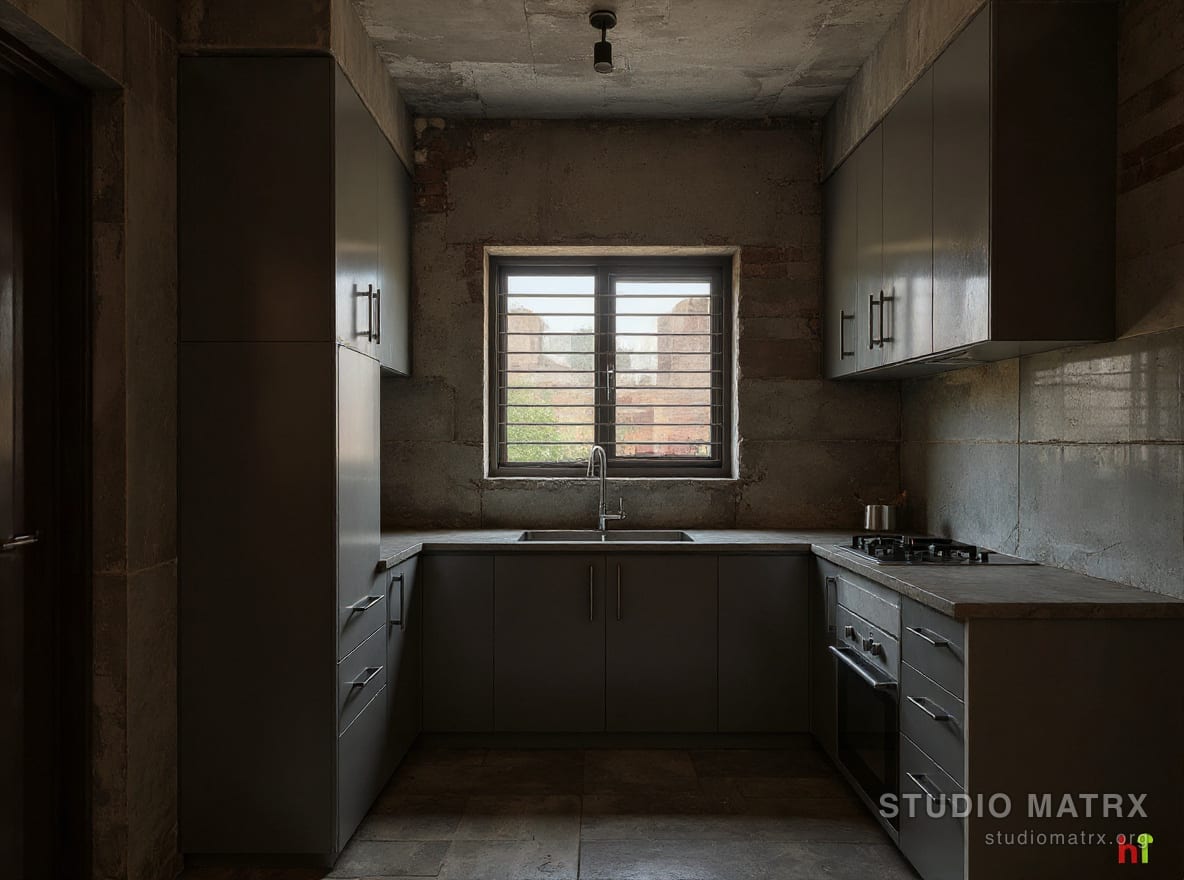
Industrial kitchens love stainless steel and black. Matte-black or steel cabinet fronts, open black metal shelving for everyday vessels, a concrete-look or dark stone countertop, and subway or brick-look backsplash tiles. Track or cage pendants over the counter. In Indian kitchens, plan for masala heat and oil splatter — keep open shelving away from the cooktop, and choose a wipeable backsplash (glazed tile, not raw brick) behind the burners. Stainless steel here is both authentic and genuinely practical.
Master Bedroom
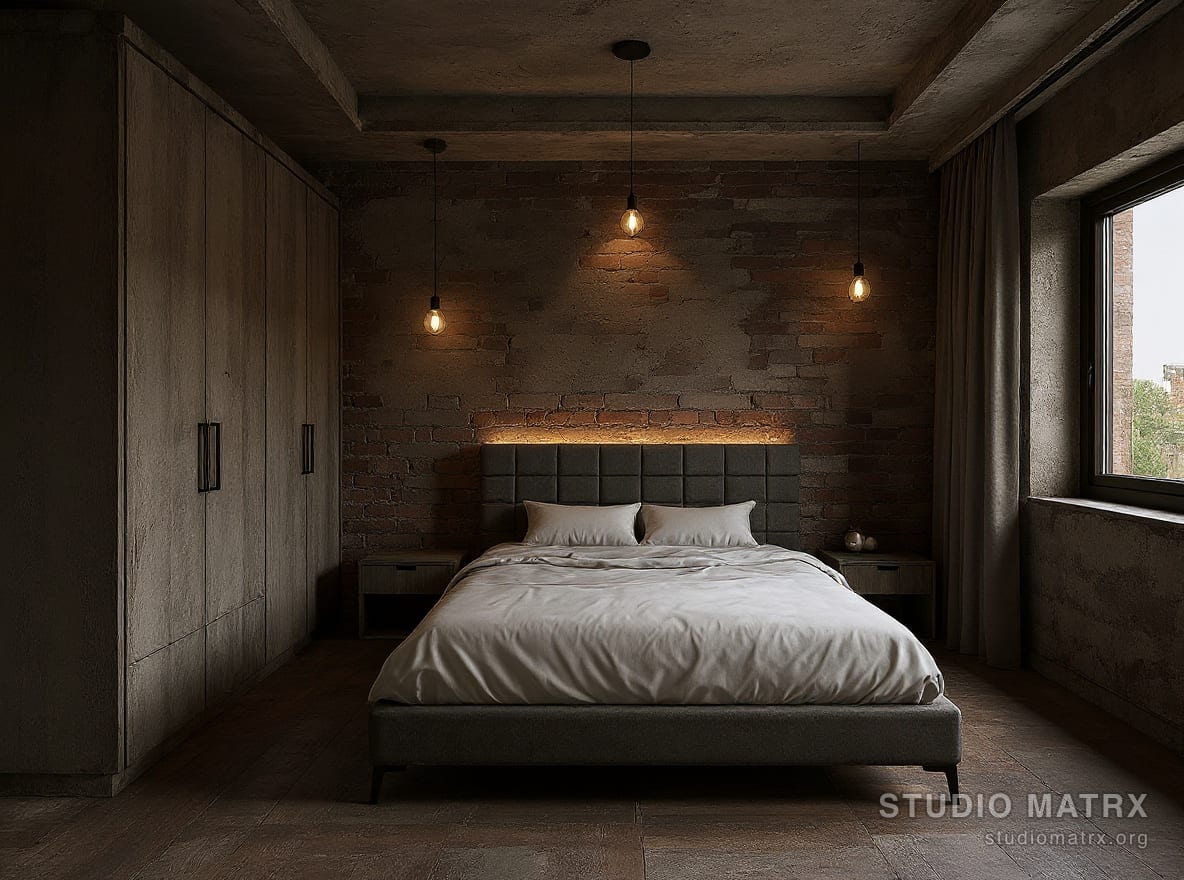
The bedroom is where stark industrial fails most often — nobody wants to sleep in a concrete box. Soften it deliberately. Keep one industrial gesture: a black metal bed frame, a single concrete-look or brick wall behind the headboard, or a black pipe clothes rail. Then warm everything else — a reclaimed-wood headboard or bench, linen or cotton bedding in warm neutrals and tan, a soft rug, layered cushions, and bedside Edison lamps on dimmers. Heavy warm curtains both soften the room and tame harsh light. The goal: industrial character, hotel-loft comfort.
Bathroom
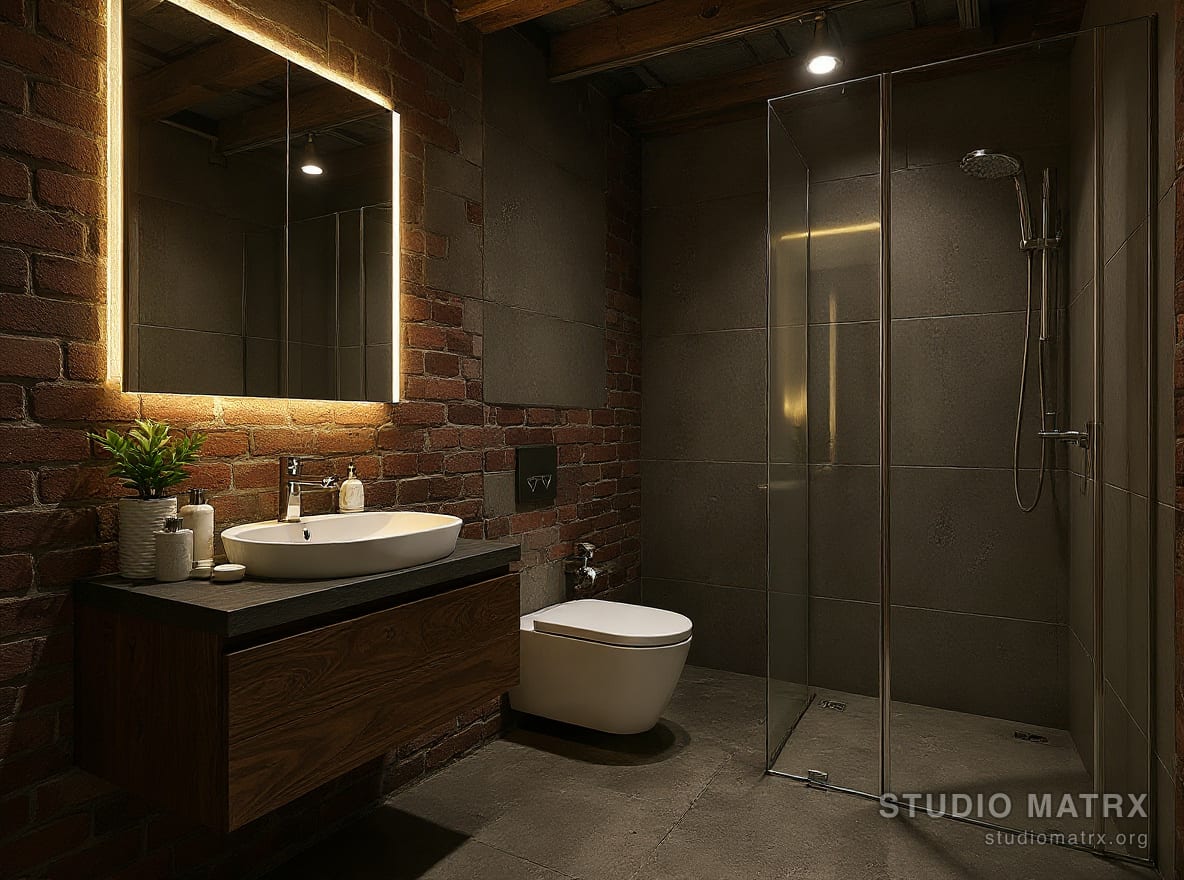
Microcement is brilliant here — seamless, waterproof when sealed, and exactly the right concrete look without grout lines. Pair it with black fittings: a black-framed glass shower screen, black tapware, black towel rails. Exposed (but anti-rust-treated) black pipework can be a feature. Add a reclaimed-wood shelf or vanity top for warmth and an Edison-style sconce. In humid bathrooms, ventilation is everything — ensure a good exhaust so the cement finish and metal stay dry.
Dining
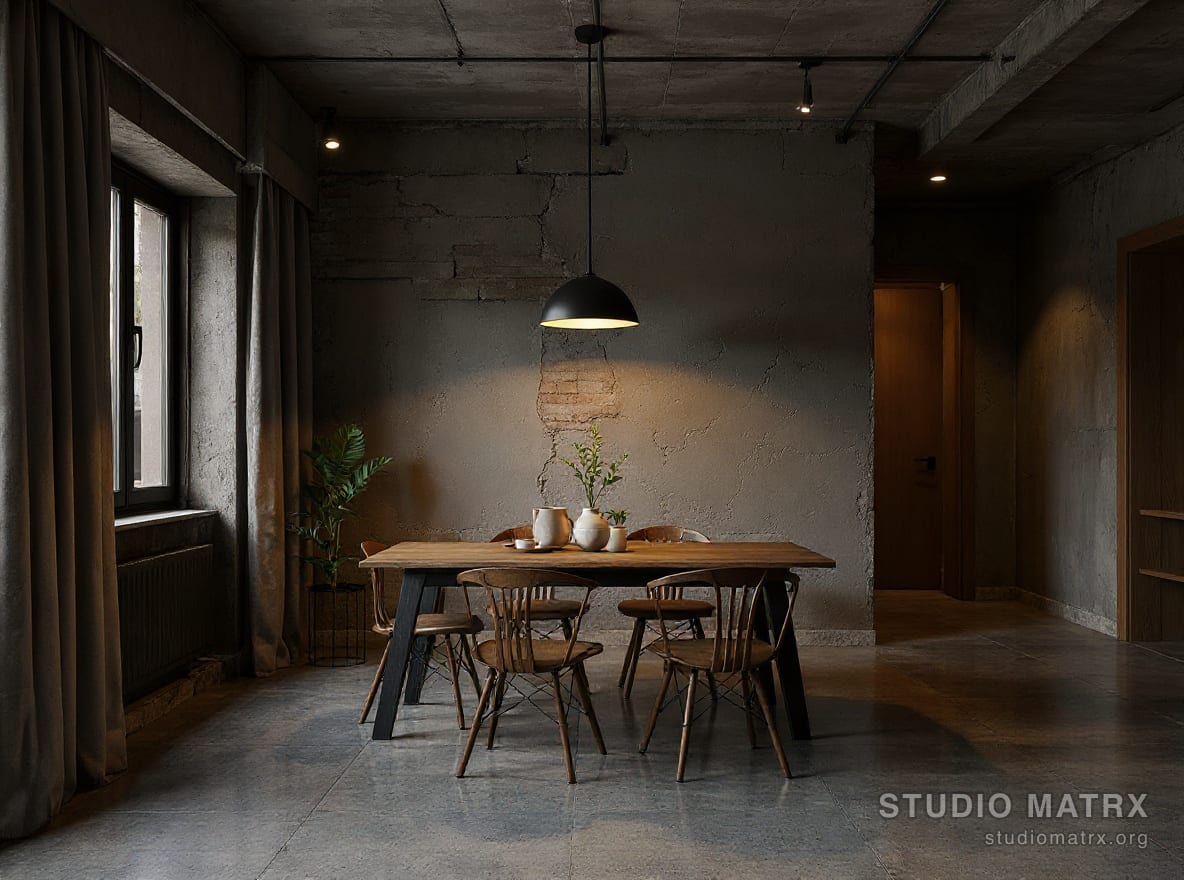
The dining area is the natural home of the "café-at-home" feeling. A reclaimed-wood table on black metal legs, ringed by metal or leather-and-metal chairs, under a cluster of Edison-bulb pendants — that is the whole look in one image. A bench on one side seats more in a small flat. Keep the pendants on a dimmer and warm-white so dinners feel intimate.
Pooja
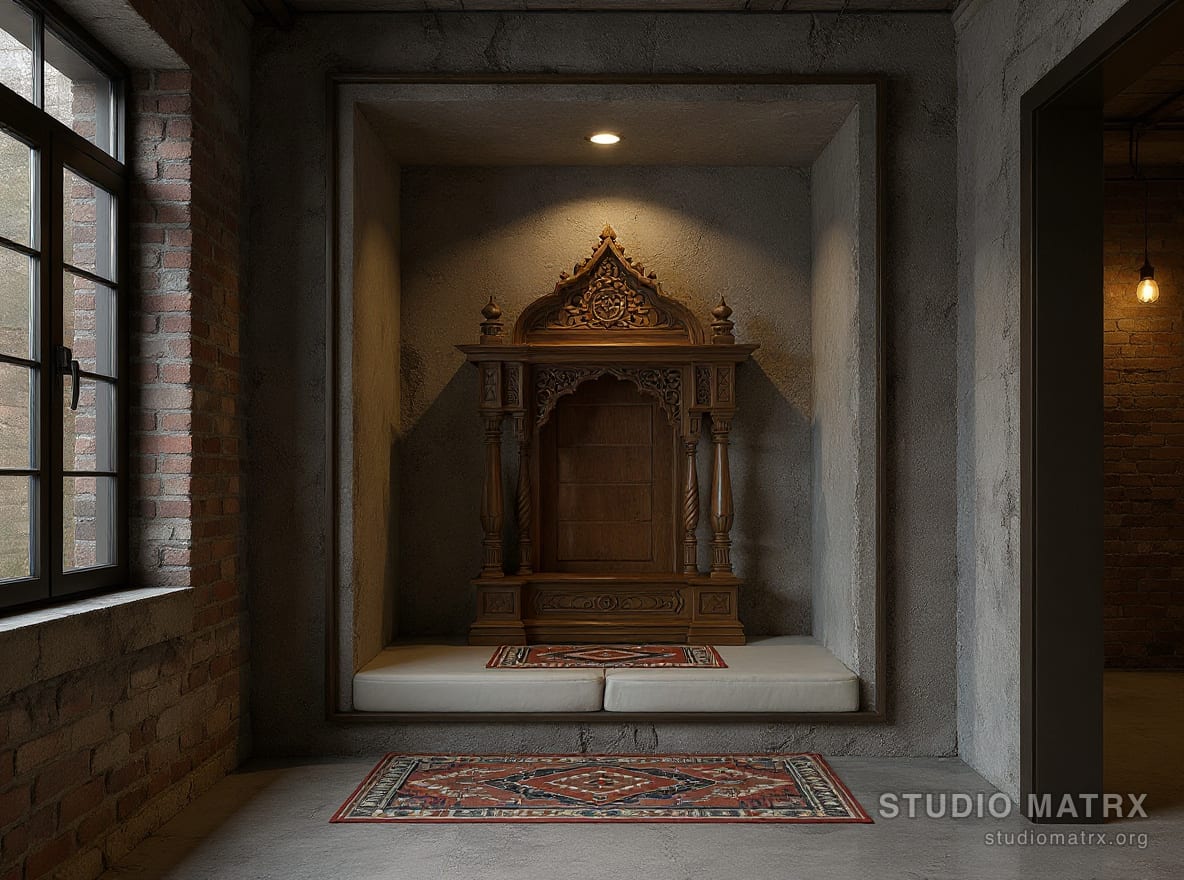
A pooja space belongs in an industrial Indian home — it just needs to be styled into the scheme rather than bolted on. A reclaimed-wood ledge or a clean teak unit set into a microcement niche reads beautifully: warm wood against grey, lit by a small warm Edison or brass lamp. Use brass diyas and a brass bell — brass is a natural friend of tan and dark metal and adds the only "ornament" the room needs. Keep the surround simple so the deity and the warm wood are the focus, and a black metal frame around the niche ties it to the home. The contrast of sacred warmth against the raw shell is part of what makes the space feel considered.
Budget — What It Costs in India
Industrial can be the cheapest style or one of the most expensive, depending on how much you fabricate. Leaving an existing slab or wall exposed and adding a few bulbs costs almost nothing; full bespoke MS fabrication, microcement across a flat, and reclaimed-teak furniture adds up fast. Figures below are indicative styling ranges for a typical urban home, excluding civil work — always get local quotes.
| Tier | Approx. spend | What you get |
|---|---|---|
| Essential | ₹1.5–4 lakh | Expose/limewash one wall, IPS or microcement on a feature surface, ready-made industrial furniture, Edison bulbs, a rug, tan cushions, a few black metal shelves |
| Mid-range | ₹4–9 lakh | Microcement on key walls/floor, custom black MS shelving and a partition, reclaimed-wood dining table, tan leather sofa, layered lighting on dimmers |
| Premium | ₹9–20 lakh+ | Full microcement scheme, bespoke black-framed glass partitions, custom MS-and-teak joinery, genuine reclaimed-teak pieces, designer lighting, integrated pooja and storage |
The smartest spend: put money into one or two showpiece elements (a black-framed glass partition, a real reclaimed-wood table) and save by leaving honest surfaces honest. Build a Moodboard of finishes before you commit, so the greys, the tan and the black add up to one coherent room.
Where to Source in India
- Black metal fabrication — local MS fabricators in every city handle frames, shelving, partitions and railings; brief them on slim sections, anti-rust primer and matte-black powder coat.
- Reclaimed and old wood — old-wood and demolition-timber dealers (look for "old teak", "purana lakdi", railway-sleeper and salvage yards) supply sleepers, beams and planks; get borer treatment before installation.
- Industrial furniture — Urban Ladder and Pepperfry both carry industrial ranges (metal-and-wood shelving, leather sofas, pipe-leg tables); Gulmohar Lane and local studios stock higher-end pieces.
- Edison bulbs and cage lighting — Bombay Electric and similar lighting houses, plus the lighting markets of most metros, stock LED-filament Edison bulbs, cage pendants and track systems; specify warm-white 2700K.
- Microcement and IPS — specialist microcement applicators now operate in all major cities; for traditional IPS flooring, local contractors are widely available and cheaper.
- Leather and textiles — tan leather upholstery from established furniture brands; warm-neutral linen, jute rugs and cushions from Fabindia, Jaypore and local home stores.
Ten Common Mistakes
1. Too cold — all grey, black and concrete with nothing warm; fix with tan leather, reclaimed wood, plants and warm light.
2. Rust in humid cities — untreated MS weeps orange within a season; always prime and powder-coat metal, and skip the "raw rusted" look on the coast.
3. Poor lighting — a single cool-white tube light kills the mood; use layered, warm-white (2700K) lighting on dimmers.
4. All-grey monotony — no accent; introduce warm wood tones and one or two tan accents to break it up.
5. Uncomfortable seating — hard metal chairs chosen for looks; pad them, add leather and cushions, keep one genuinely soft sofa.
6. Bare floors — exposed concrete with no rug reads as unfinished; ground every room with a rug.
7. Overdoing the raw — concrete plus brick plus pipe plus mesh plus rust in one room; pick two or three materials and stop.
8. Forgetting acoustics — hard surfaces everywhere make rooms echo; soft furnishings, rugs and curtains absorb sound.
9. Faking it badly — cheap grey-streaked laminate pretending to be concrete; use real microcement/IPS, or commit to one honest wall.
10. Cold bedroom — a concrete box you cannot relax in; soften with textiles, wood and dimmable warm light.
FAQ
What is industrial interior style?
Industrial interior style takes the structural materials of a building — concrete, brick, steel and exposed bulbs — and uses them as the finish rather than hiding them. It grew out of converted factories and reads as a raw, honest, urban-loft look defined by greys, black metal lines, reclaimed wood and statement lighting.
How do you warm up industrial style?
Layer in warmth against the grey shell: tan leather seating, reclaimed teak surfaces, warm-white (2700K) Edison lighting on dimmers, rugs, linen and cotton textiles, and a few plants. The concrete and metal stay as backdrop while warm materials and light do the emotional work — this "warm industrial" approach is far more liveable in Indian homes than the stark version.
Can you do industrial style on a budget in India?
Yes — industrial can be one of the cheapest looks. Leave an existing slab or wall exposed (or limewash it), use affordable IPS flooring, buy ready-made metal-and-wood furniture, add a few Edison bulbs and a rug. Local MS fabricators make black metal shelving cheaply. An essential industrial styling can start around ₹1.5–4 lakh, excluding civil work; costs rise only with full microcement schemes and bespoke fabrication.
Is exposed concrete good for Indian homes?
It can be, with care. A true microcement or IPS finish is durable, low-maintenance and well-suited to Indian conditions when properly sealed. Raw, unsealed concrete can be dusty, prone to cracking and cold underfoot, so most homes use a controlled cement-look finish on a feature wall or floor rather than bare slab everywhere. Always seal it and balance it with warm materials.
Does industrial style work in humid coastal cities?
It can, but rust is the main risk. In Mumbai, Chennai, Kochi, Goa and the coastal belt, every metal element must be de-scaled, anti-rust primed and powder-coated or PU-finished; avoid raw-rust looks. Choose treated leather or quality leatherette over untreated hide, ensure good ventilation in bathrooms and kitchens, and the style holds up well.
Industrial done right is not cold — it is honest, warm and full of character, a loft attitude tuned for the way Indian homes actually live. Explore more looks in our Interior Styles guides, or let DesignAI generate an industrial scheme for your room.
Last verified: June 2026 · Next verify: June 2027.
Export this guide
Related Guides — Deep-dive reading
Warm Minimal Interiors — A 2026 Style Guide for Indian Homes
Restraint with warmth · Oat & oak & linen · Curated negative space
Design StylesCompact Luxury Apartment — A 2026 Working Reference for Premium 1-2 BHK Indian Homes
Four-pillar discipline · Ten signature moves · Three budget tiers ₹22-90L
Room PlanningBohemian Interiors — A 2026 Eclectic Style Guide for Indian Homes
Collected, layered, alive · Rust and jewel tones · Curated eclecticism, never clutter
Design StylesRelated Tools — Try Free
Cross-Ventilation Analyzer
Estimate airflow and air changes per hour (ACH) from room size, window areas, layout, and local wind — with NBC 2016 Part 8 compliance check.
Ventilation CalculatorWindow Grill Design Selector
Pick a window grille style and material by priority — security, looks, budget, view — and estimate cost.
Window ToolFull-Room BOQ — Living, Bedroom, Kitchen, Bath
Room-wise BOQ across living, bedrooms, kitchen, utility, and bathrooms with line-item pricing.
Full-Room BOQ