
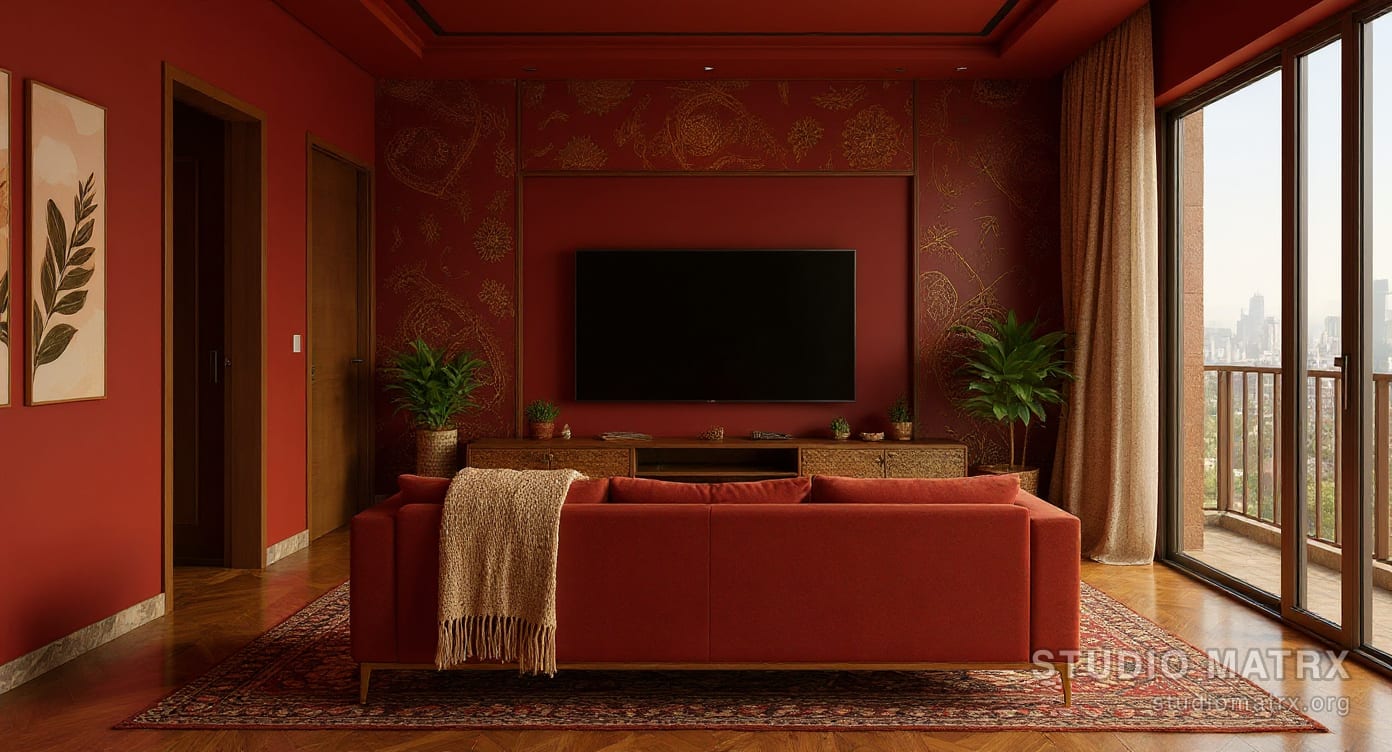
Bohemian Interiors — A 2026 Eclectic Style Guide for Indian Homes
Collected, layered, alive · Rust and jewel tones · Curated eclecticism, never clutter
Bohemian interiors are what happens when a home becomes a story instead of a showroom. Where minimalism subtracts and traditional homes inherit, boho collects — a Kutch mirror-work cushion next to a Moroccan pouffe, a grandmother's brass urli beside a thrifted cane chair, a wall of plants that earns its keep as architecture. For India in 2026, this is one of the most natural styles imaginable: Indian homes have always been layered, colourful, and full of objects that carry meaning. The difference is that good boho is edited layering — curated eclecticism, never clutter.
This guide is built around a clear style DNA — rust (#b5532e), jewel teal-green (#2f6f5e), ochre gold (#caa24a), and earthy brown (#7a4636), carried on rattan, jute, mixed handloom, and a forest of plants. Use it to build a home that feels collected over years, even if you start this weekend.
It is also gloriously renter-friendly: most of boho's impact comes from textiles, plants, and movable objects, not from anything you drill into a wall.
What Bohemian Is (and Isn't)
Bohemian style is the deliberate mixing of patterns, eras, crafts, and cultures, held together by a warm earthy-jewel palette and a high tolerance for texture. It celebrates the handmade, the well-travelled, and the personal — relaxed and abundant, never sterile.
The biggest misunderstanding is that boho means more of everything. It does not. Curated boho and a cluttered room are opposites that happen to share a high object count. The difference is intent: every piece in a curated room either repeats a colour from your palette, repeats a material (more rattan, brass, handloom), or earns its place through a personal story. Clutter is what you get when objects share nothing but the same shelf.
It also helps to know what boho is not:
- It is not earthy-minimal. Earthy-minimal whispers — one jute rug, neutral walls, restraint as the goal. Boho layers many traditions on the same earthy base and treats restraint only as the final edit, not the starting brief. If earthy-minimal is a single raga, boho is a jugalbandi.
- It is not traditional Indian. A traditional home is coherent within one lineage — Chettinad, Rajasthani haveli, or Kerala wood. Boho borrows from those lineages but mixes them with global craft (Moroccan, Turkish, mid-century) on purpose. Coherence comes from palette and texture, not from one regional language.
- It is not hippie chaos. The 2026 version is grown-up: fewer dreamcatchers, more considered colour, real craft over fast-fashion décor.
Five Principles of Bohemian Design
1. Layer relentlessly — then edit
Layering is the engine of boho: rugs over rugs, a throw over a sofa, cushions in three sizes, framed prints at varying heights. Build the layers up generously, live with them for a week, then remove ten to fifteen percent. The room you keep after that edit is the curated one; the room before it is cluttered. The act of taking away is what separates a designer's boho from a junk drawer.
2. Mix patterns — with one common thread
Boho loves pattern collisions: ikat against block-print against a Persian-style rug against a striped dhurrie. This works only when one element is shared across them all — usually a colour. If rust (#b5532e) and ochre (#caa24a) appear in every textile, you can mix five wildly different prints and the eye still reads the room as calm. Vary the scale too: one large, one medium, one small. Three bold prints fighting at the same scale read as noise.
3. Plants as architecture, not decoration
In boho, greenery is structural, not an afterthought. A tall fiddle-leaf fig or areca palm anchors a corner the way a column would; trailing money plant softens a hard shelf edge. Treat plants as furniture — give the big ones a defined spot, repeat the greens at three heights (floor, table, hanging), and the room gains depth no amount of cushions can buy. India's climate is a gift here: most boho-favourite plants thrive on a Mumbai balcony or a Bengaluru windowsill.
4. Handmade over factory
Wherever there is a choice, choose the made-by-hand version: a hand-knotted dhurrie over a machine rug, a thrown ceramic pot over moulded plastic, a cane chair from a karigar over flat-pack particleboard. Handmade objects carry tiny irregularities that catch light and feel alive — exactly the quality factory goods are engineered to remove. India's craft economy makes this affordable: handloom and cane here cost a fraction of what the same object fetches abroad.
5. Let it tell your story
This is the principle that makes a room yours and not a Pinterest clone. Build in objects with provenance — a brass diya from your hometown, a textile from a trip, your grandfather's old radio, framed children's art. These personal anchors give a layered room emotional gravity. A boho room full of newly-bought "boho-look" objects feels hollow; the same room with three things that mean something feels collected over a lifetime.
The Bohemian Palette
The boho palette is warm and saturated — earthy bases lit by jewel tones. Anchor the room in browns and rust, then let teal-green and ochre sing.
| Tone | Hex | Where to use | Indian reference |
|---|---|---|---|
| Rust | #b5532e | Feature cushions, a statement rug, an accent wall, terracotta pots | The warm clay of unglazed terracotta and Bishnupur pottery |
| Jewel teal-green | #2f6f5e | Velvet upholstery, a painted cabinet, glazed ceramics, plant foliage | Peacock-blue-green of Pichwai paintings and temple murals |
| Ochre gold | #caa24a | Brass accents, mustard throws, lampshades, woven jute | Turmeric and marigold; the brass of traditional urli and diyas |
| Earthy brown | #7a4636 | Wood furniture, rattan, leather pouffes, framed wood | Rosewood and teak (sheesham/sagwan) of classic Indian joinery |
Rule of thumb: roughly 60% earthy neutrals (browns, jute, off-white walls), 30% your two anchors (rust + ochre), and 10% the jewel pop (teal-green). Keep walls light — a warm off-white or pale terracotta lets the textiles do the talking. Saturated walls plus saturated everything-else is the fastest route to a heavy room.
Materials, Textiles & Plants
Boho is a material-first style. Get the textures right and the palette almost follows.
| Element | Role | Indian sourcing note |
|---|---|---|
| Rattan & cane | Furniture, lampshades, planters, headboards | Cane karigars across Kerala, Assam, and Kolkata; specialist cane studios in metros |
| Jute | Rugs, planters, wall hangings, baskets | Bengal is the global jute heartland; affordable handwoven jute rugs widely available |
| Handloom textiles | Cushions, throws, dhurries, bedspreads | Block-print from Bagru/Sanganer (Jaipur), ikat from Pochampally, mirror-work from Kutch |
| Macramé | Wall hangings, plant hangers, curtain ties | Easy DIY with cotton cord; local craft fairs and Etsy India sellers |
| Vintage / mixed wood | Tables, cabinets, stools, frames | Kabari (scrap) markets and antique dealers; mango and reclaimed sheesham |
| Brass & terracotta | Diyas, urlis, vases, planters | Moradabad brass; terracotta from Bishnupur, Pondicherry, and local potters |
| Plants | Architectural greenery at three heights | Local nurseries; areca palm, fiddle-leaf fig, money plant, snake plant all thrive in Indian homes |
A quick texture checklist: at least one woven natural fibre (jute/cane), two different handloom prints, one piece of brass or terracotta, and live plants. Hit those four and the room reads boho before you have spent on a single big-ticket item.
Room by Room
Living Room
The living room is where boho earns its reputation. Start with a low sofa in neutral linen or earthy brown, then layer: a patterned dhurrie or Persian-style rug as the base, a smaller rug overlapped at an angle, cushions in rust and ochre with mixed block-prints, and a teal-green throw. Anchor one corner with a tall plant and a cane floor lamp; add a vintage wooden trunk as a coffee table and a gallery wall of mismatched frames. Keep the large furniture calm and let the small, swappable layers carry the colour and pattern.
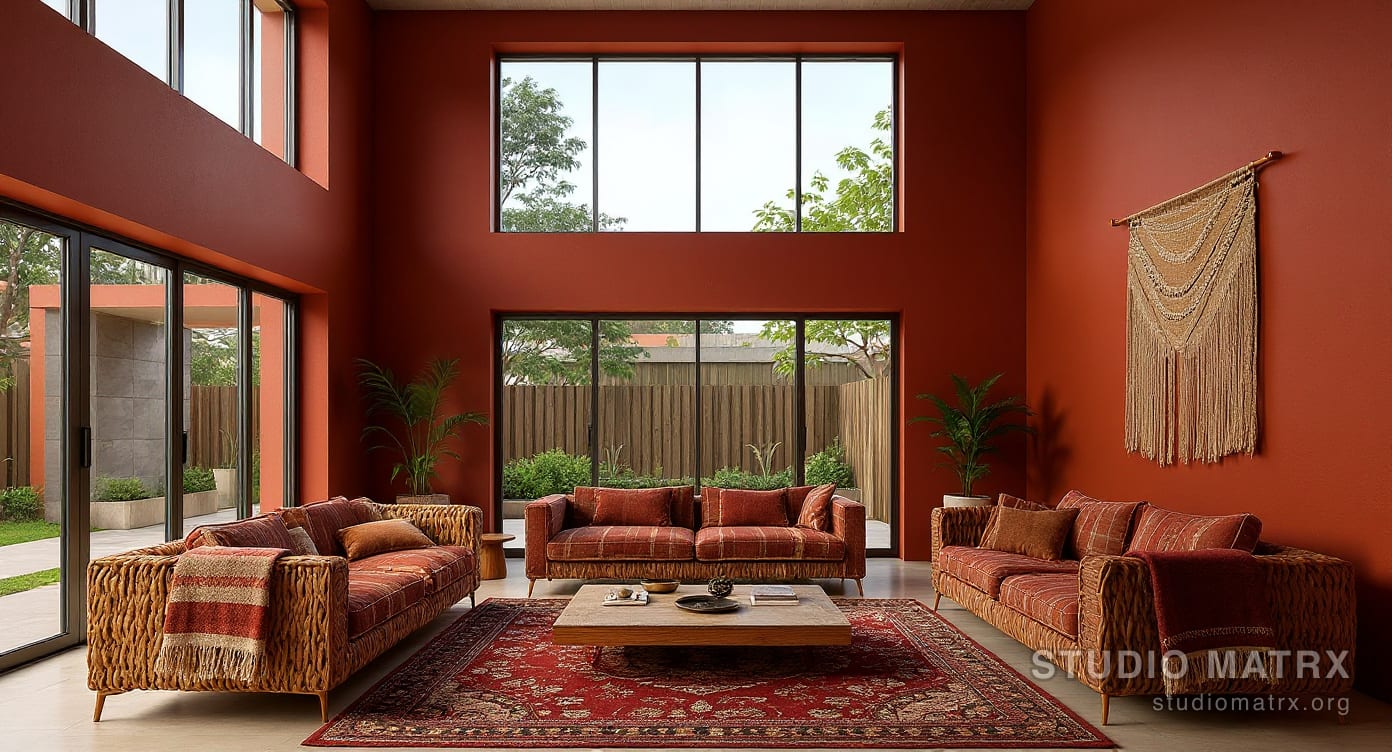
In a larger villa living room, give boho room to breathe: a daybed piled with cushions in a bay window, a macramé hanging on a tall wall, three planters at different heights, and an open shelf styled with brass, ceramics, and books in loose, asymmetric groupings.
Kitchen
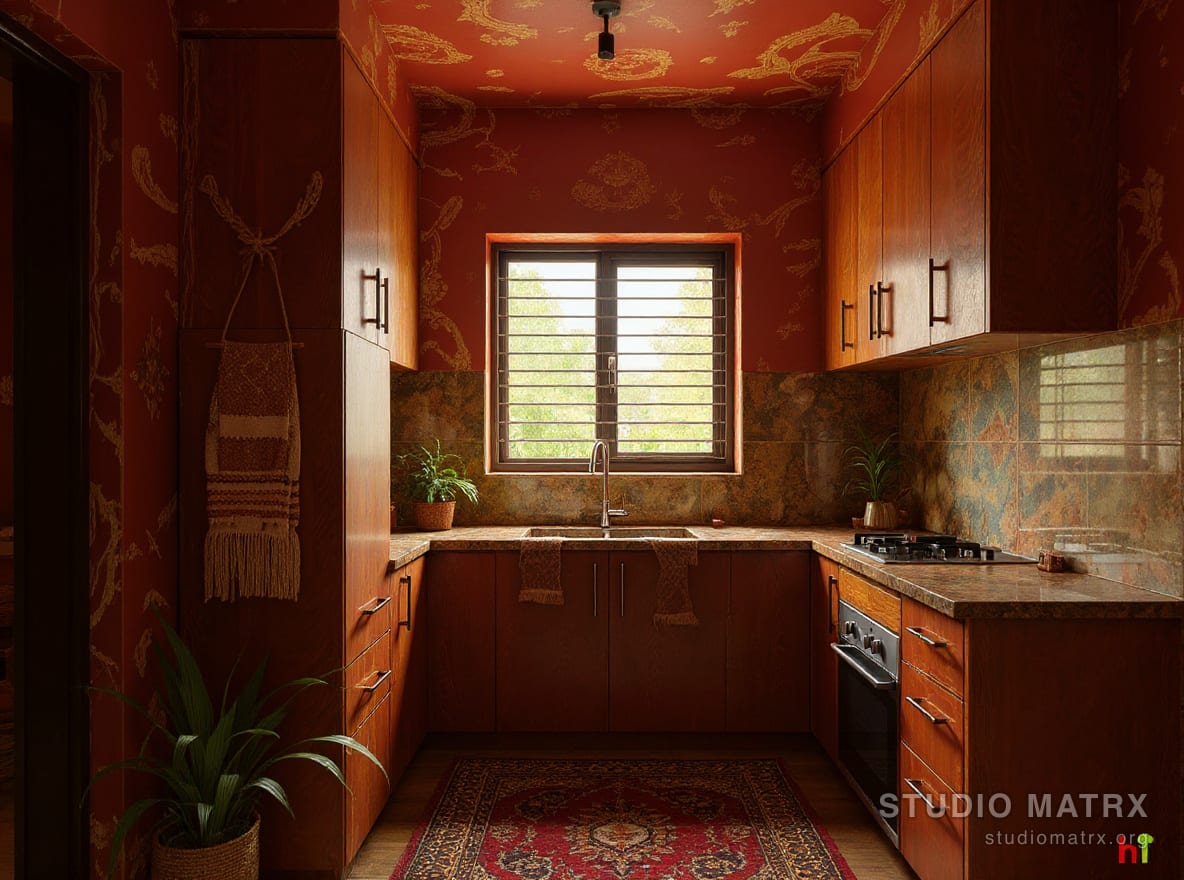
Boho kitchens lean warm and lived-in. Open shelving displays mismatched ceramics, brass storage tins, and clay pots. Add a patterned runner on the floor, hang a few copper or brass utensils, and keep a herb plant on the windowsill. Patterned cement or terracotta-look tiles make a perfect backsplash. For renters, the same effect comes from a hanging rail, a textile runner, and a row of terracotta jars — no renovation needed.
Master Bedroom
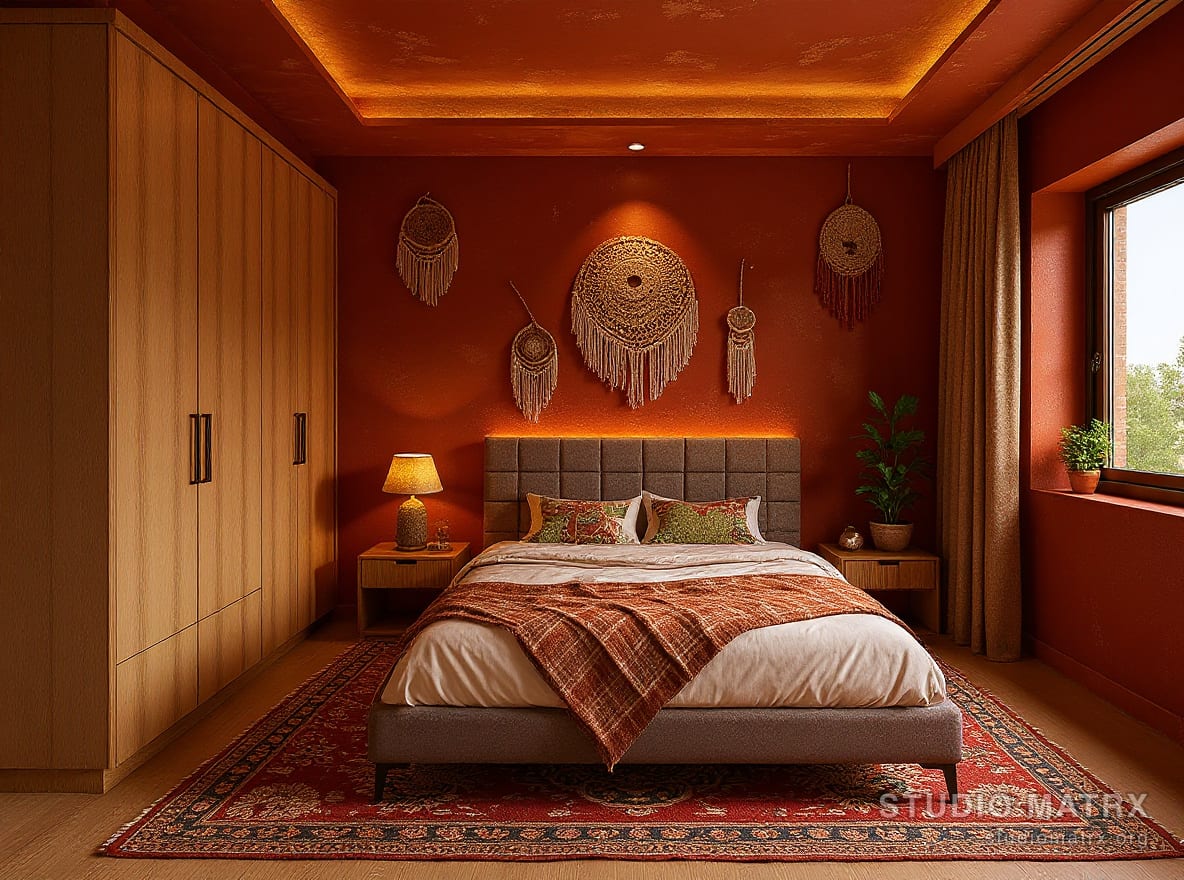
The bedroom is boho's most forgiving room. A cane or rattan headboard sets the tone; layer the bed with a block-print bedspread, mixed cushions, and a Kutch mirror-work throw at the foot. Hang a large macramé piece above the headboard, drape fairy lights along a wall, and place a trailing plant in the corner. Bedside tables can be deliberately mismatched — a vintage stool on one side, a small cane drawer on the other. Soft, warm table-lamp light completes the relaxed feel.
Bathroom
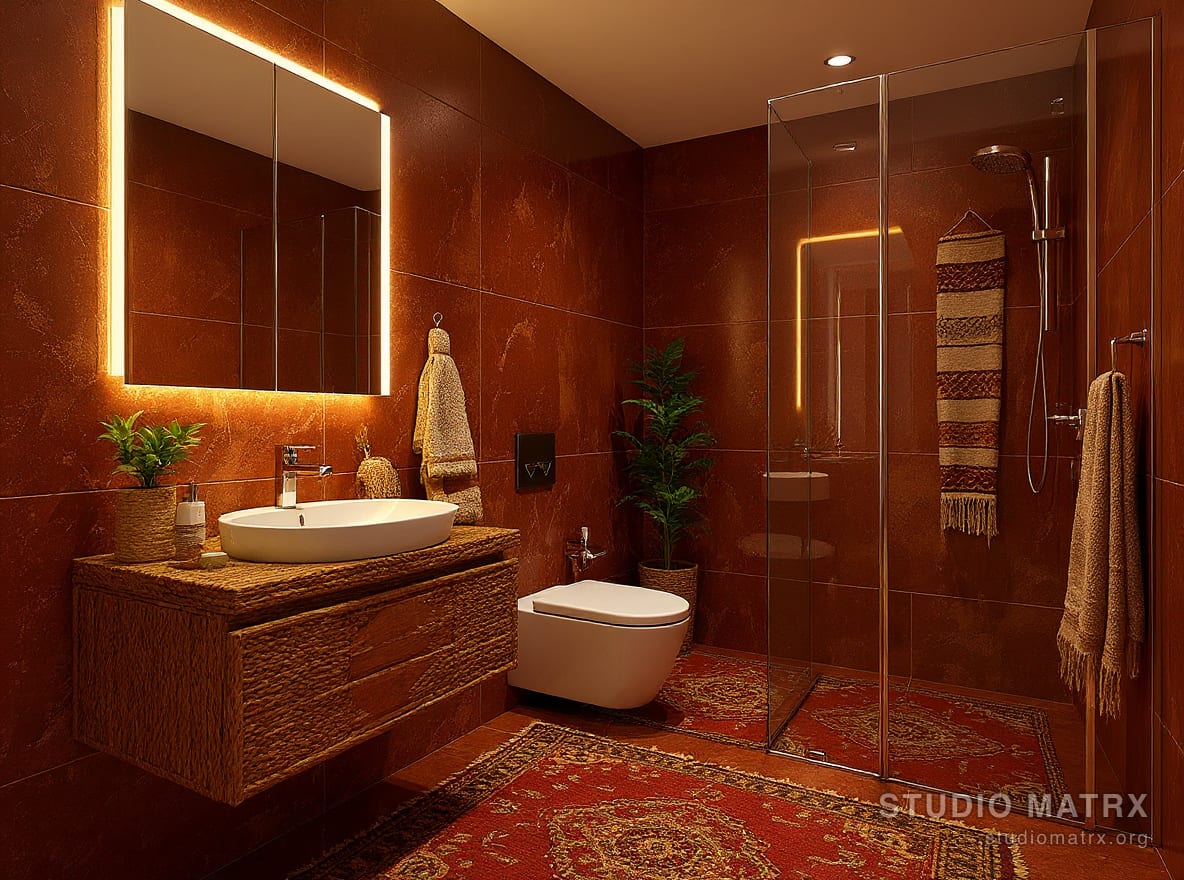
Even a compact Indian bathroom can go boho with movable pieces: a small jute mat, a cane laundry basket, terracotta or brass pots holding ferns, and a wooden stool for towels. A patterned hand-towel and a framed print pull the palette in. Plants love bathroom humidity, so this is the easiest room for greenery. Keep wet-zone materials practical — bring the boho in through accessories outside the splash zone.
Dining
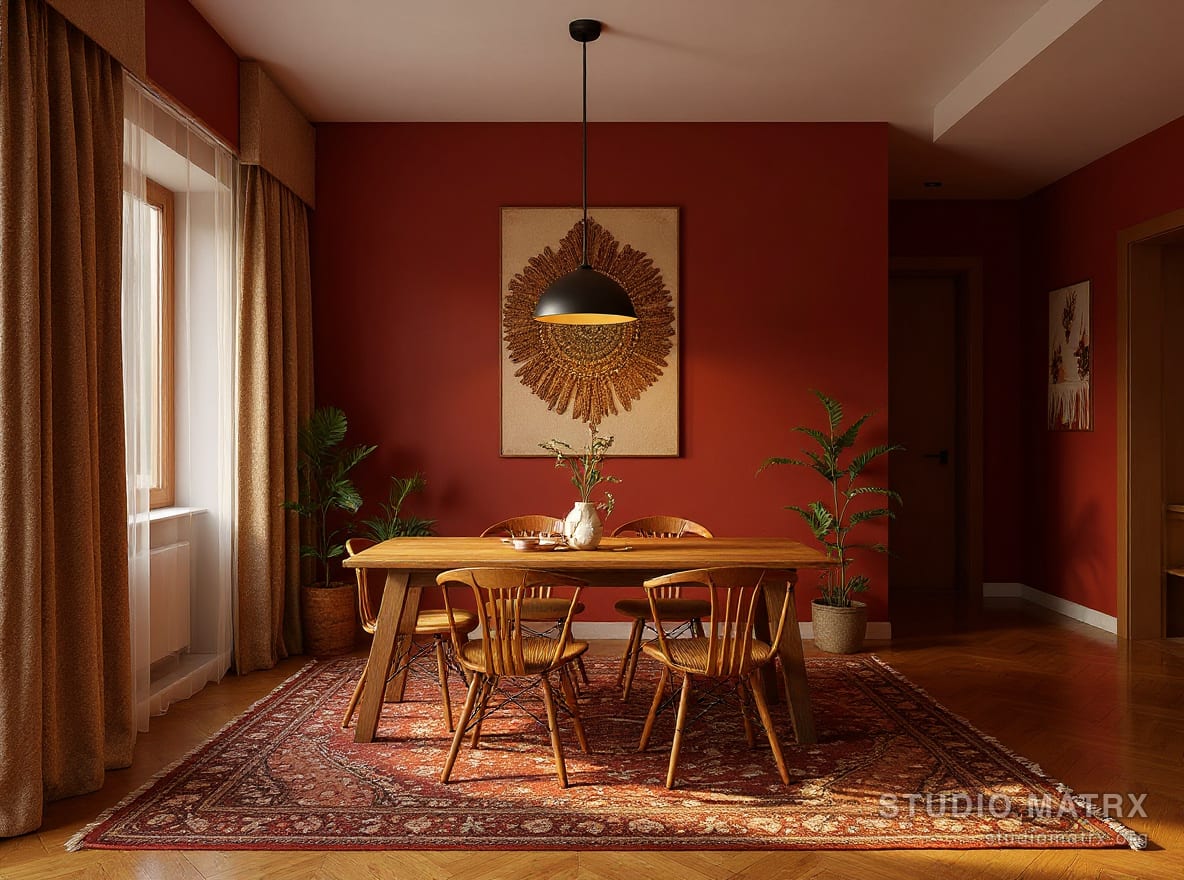
Mismatched chairs are the signature boho dining move — a few cane chairs, a bench, a vintage wooden chair, all unified by the earthy palette. Centre the table with a brass urli or terracotta bowl, a block-print runner, and a low cluster of candles or a small plant. A statement rattan pendant or cluster of brass lamps anchors the zone. Keep the tabletop styling low so conversation flows across it.
Pooja
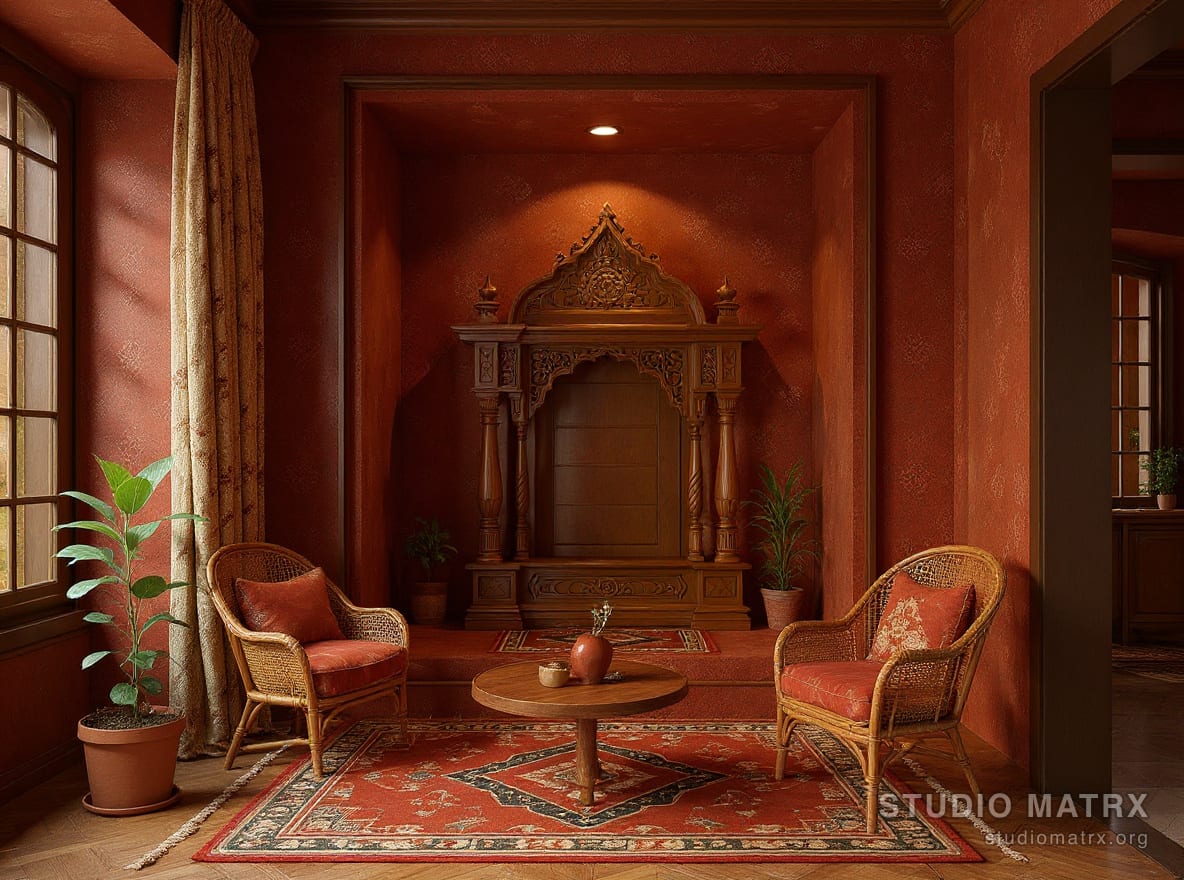
A boho pooja corner blends devotion with the collected aesthetic beautifully. Use a vintage or carved wooden ledge, layer brass diyas and idols, hang a marigold string or fabric toran, and place a jute mat below. Warm ochre and rust tones, a trailing plant, and soft diya light keep it sacred yet of-a-piece with the rest of the home. Keep the surface around the deities uncluttered — the layering should frame the space, not crowd it.
Budget — What It Costs in India
Boho's great advantage is that it scales down beautifully. Thrift, DIY, and craft-market sourcing deliver a genuinely layered look for very little, while premium handloom and designer cane take the same style upmarket. The figures below are indicative ranges for furnishing a 2–3 BHK in a boho direction — not a renovation budget.
| Tier | Approach | Indicative spend (2–3 BHK) |
|---|---|---|
| Starter | Thrift + DIY: kabari-market wood, DIY macramé, jute rugs, plant cuttings, mixed cushions stitched at home | ₹40,000 – ₹90,000 |
| Mid | Mix of high-street craft (Fabindia, Chumbak) plus a few thrift finds and one statement cane piece | ₹1,50,000 – ₹3,50,000 |
| Premium | Designer handloom, hand-knotted Jaipur rugs, bespoke cane furniture, curated antiques and art | ₹5,00,000 and above |
The biggest budget lever is where you spend the big money. Put it into one or two hero pieces — a genuine hand-knotted rug, a beautiful cane daybed — and let everything around them be thrifted and DIY. Because the style celebrates the mismatched and the well-worn, second-hand pieces actively help the look rather than cheapening it.
Where to Source in India
- Fabindia — handloom cushions, block-print bedspreads, dhurries, brass and terracotta.
- Jaypore — curated craft, textiles, ceramics, and statement décor.
- Nicobar — calmer, modern-Indian textiles and tableware that ground a busy scheme.
- Chumbak — affordable, playful patterned cushions and rugs for starter budgets.
- Bombay Trooper — quirky prints and accent pieces for personality.
- Jaipur Rugs — hand-knotted and flat-weave rugs across price points; the hero-piece source.
- Cane Boutique — rattan and cane furniture for headboards, chairs, and planters.
- Local kabari / flea markets — Chor Bazaar (Mumbai), Sunday markets, and antique dealers for vintage wood and brass at thrift prices.
- Plant nurseries — local nurseries for areca palm, fiddle-leaf fig, money plant, and snake plant; cuttings cost nothing.
Build a Moodboard before you buy so purchases share a palette, browse our Interior Styles library to see how boho sits beside its cousins, and preview your own room with DesignAI.
Ten Common Mistakes
1. Clutter mistaken for boho. Layering without an edit; always remove the last ten to fifteen percent.
2. No unifying thread. Patterns with no shared colour read as chaos. Repeat your palette across every textile.
3. Too many themes. Moroccan plus coastal plus industrial plus tribal in one room. Pick two or three influences, no more.
4. Dusty, dying plants. Greenery is architecture here — neglected plants read as a neglected room. Choose hardy species and dust the leaves.
5. Everything the same scale. Bold prints fighting at one size. Vary pattern scale: one large, one medium, one small.
6. All factory-bought "boho-look" décor. A room with no handmade or personal pieces feels hollow and themed.
7. Saturated walls plus saturated everything. Keep walls light so the layers can sing.
8. Symmetry everywhere. Boho thrives on asymmetry; perfectly matched pairs flatten the collected feel.
9. Cold overhead lighting. Boho needs warm, layered light — lamps, fairy lights, candles.
10. Buying it all in one weekend. The point is collected-over-time. Leave gaps to fill slowly with meaningful finds.
FAQ
What is boho style?
Bohemian (boho) style is a relaxed, layered interior look that mixes patterns, eras, crafts, and cultures, held together by a warm earthy-jewel palette. It celebrates handmade objects, abundant plants, natural materials like rattan and jute, and personal pieces collected over time — curated eclecticism, not a single matching set.
Is bohemian out of style in 2026?
No. The 2026 version has matured rather than disappeared — fewer clichés, more considered colour, real craft over fast décor. Its emphasis on the handmade, the personal, and the plant-filled aligns with current interest in sustainability and individuality, so it remains very much in demand, especially in Indian homes.
How do I do boho on a budget in India?
Lean on thrift and DIY. Source vintage wood and brass from kabari and flea markets, stitch your own macramé and cushions, grow plants from cuttings, and buy affordable handloom from high-street brands. Spend your limited budget on one hero piece — a good rug or cane daybed — and let everything else be inexpensive and mismatched, which actually helps the look.
What is the difference between boho and eclectic?
Eclectic simply means mixing styles and eras with no single rule. Boho is a specific flavour of eclectic — it adds a defined warm earthy-jewel palette, natural materials and global craft, abundant plants, and a relaxed mood. All boho is eclectic, but not all eclectic is boho; a cool-toned mid-century-plus-industrial mix is eclectic without being bohemian.
How is boho different from earthy-minimal?
Both share an earthy base, but earthy-minimal subtracts to a calm, restrained few pieces, while boho layers many traditions and patterns on that base and edits only at the end. Earthy-minimal celebrates emptiness and one beautiful object; boho celebrates abundance, colour, and the mix — held together by palette and texture.
Boho rewards living slowly: every trip, gift, and market find becomes part of the room. Start with the palette, layer with intent, edit at the end — and let the home grow into a story only you could tell.
Last verified: June 2026 · Next verify: June 2027.
Export this guide
Related Guides — Deep-dive reading
Earthy Interior Palette — A 2026 Style Guide for Indian Homes
Rooted · Regional · Biophilic · Indian craft-anchored
Design StylesTraditional Indian Interiors — A 2026 Style Guide for Homes
Living heritage, not a museum · Carved wood, brass, jewel tones · The pooja room as heart
Design StylesJapandi Apartment — A 2026 Style Guide for Compact Indian Homes
Japanese restraint × Scandinavian function · Low furniture · Two-wood discipline
Design StylesRelated Tools — Try Free
Cross-Ventilation Analyzer
Estimate airflow and air changes per hour (ACH) from room size, window areas, layout, and local wind — with NBC 2016 Part 8 compliance check.
Ventilation CalculatorApartment Furniture Size Chart
Standard furniture dimensions for Indian apartments — sofas, beds, tables, dining, storage.
Reference ChartApartment Interior Planning Checklist
51-item checklist across structural, ceiling, lighting, furniture, storage, electrical, kitchen, bathroom.
Checklist