
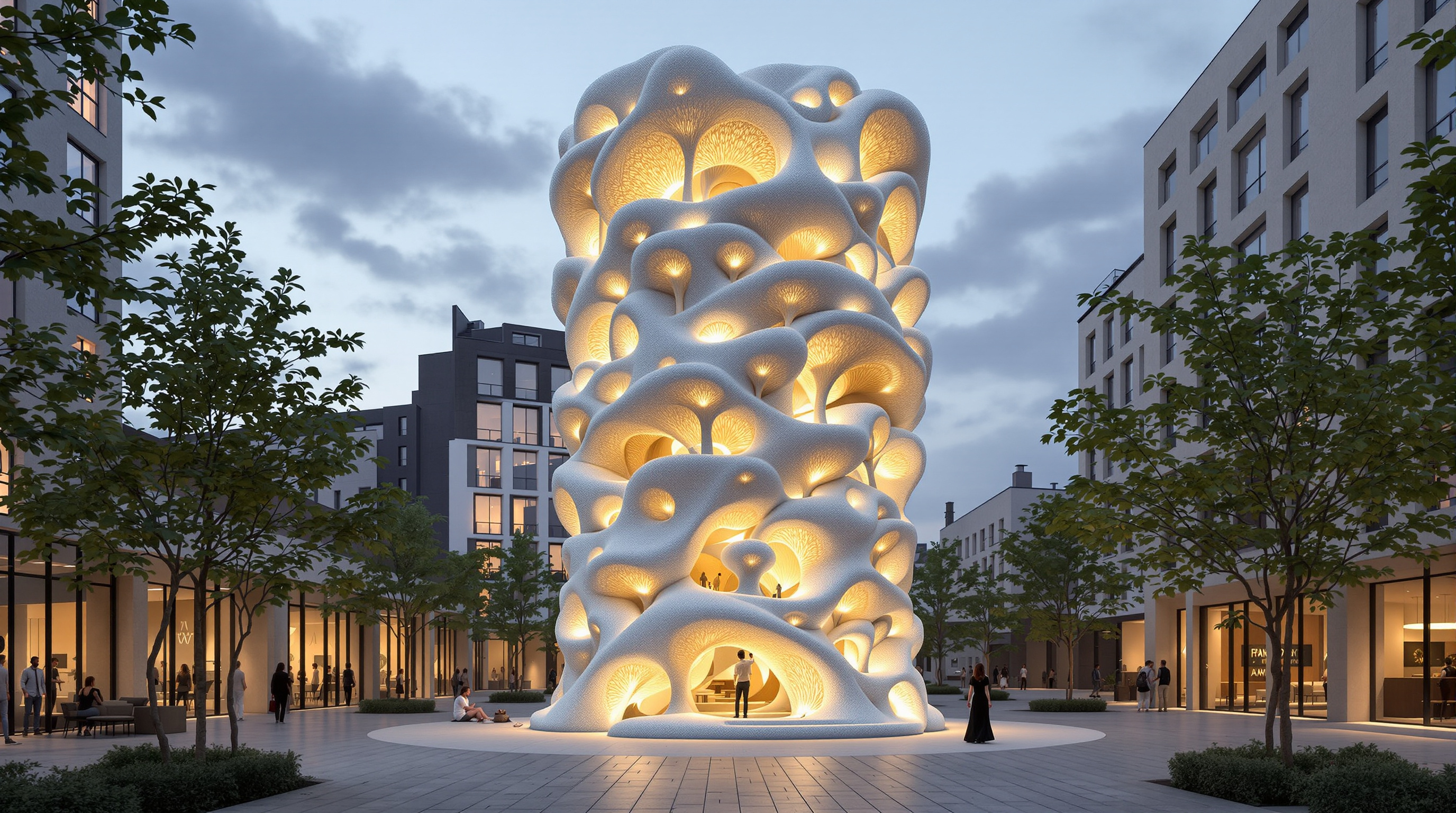
In-Vitro and Grown-Material Habitats: The Building That Is Cultivated, Not Constructed
From mushroom-brick towers to bacteria-cemented blocks and speculative dwellings grown from living cells, a cluster of experiments asks a genuinely new question: what if we stopped mining and manufacturing our buildings and started farming them instead? A deep study of grown architecture — its biology, its structural limits, and the honest gap between the manifesto and the load path.
Almost every building ever made begins with an act of extraction. We quarry limestone and burn it into cement, we smelt ore into steel, we fell forests into timber, we dig clay and fire it into brick. The building is assembled from materials that were taken from the earth's crust and processed with heat and energy. A small, stubborn group of architects, biologists and engineers has spent the last two decades asking whether there is another way — whether a building could instead be grown: cultivated from living organisms, in a mould or a Petri dish, and then coaxed into a structure. This is the idea behind grown-material and in-vitro habitats, and it is one of the most radical provocations in the whole of contemporary architecture precisely because it attacks the discipline at its root — not the shape of the building, but the origin of its matter.
Because conf on this entry is uncertain and there is no single canonical "building" here, this chapter treats the idea as a family of real experiments rather than one finished landmark. The honest position is that these are prototypes, pavilions and speculations. None is yet a house you could get a mortgage on. But together they sketch a coherent and testable future.
The vision is a shift from an architecture that mines its materials from the crust of the earth to one that cultivates them — where the raw material of a wall is not quarried but farmed, and where a structure at the end of its life is not demolished into landfill but composted back into soil.
The question it poses
Marc Kushner's framing for this canon is always the same: what does this tell us about where architecture is going? Grown-material habitats give an unusually sharp answer. They propose that the deepest problem in construction is not aesthetic or even structural but metabolic — that the built environment is responsible for a huge share of global carbon emissions largely because of how its materials are made. Cement manufacture alone is often cited at roughly 7–8% of global CO2 emissions. If the matter of buildings could be biologically grown at ambient temperature, absorbing carbon as it forms rather than releasing it, the entire carbon arithmetic of construction would change.
So the provocation is this: stop treating a building as a manufactured object and start treating it as a cultivated organism — or at least as the dried remains of one. It is a move from the factory to the farm, from the kiln to the incubator.
Three ways to grow a building
"Grown material" is not one technology but at least three distinct biological strategies, each with a different organism doing the work. Understanding the differences is the difference between hype and engineering.
The first and most developed is mycelium — the root-like thread network of fungi. Loose agricultural waste (corn stalks, sawdust, hemp, coir) is packed into a mould and inoculated with fungal spores. Over days to weeks the mycelium digests the substrate and knits it into a solid, foam-like composite. The organism is then killed by heat-drying, leaving an inert, lightweight, compostable block. This is the technology behind the two most famous built demonstrations.
The second is microbial biocement — using bacteria to precipitate calcium carbonate (the mineral of seashells and limestone) around grains of sand, cementing loose sand into solid stone at room temperature. The company bioMASON, founded in 2012 by Ginger Krieg Dosier, uses the soil microbe Sporosarcina pasteurii to grow masonry units in a few days with no kiln.
The third, and by far the most speculative, is genuinely in-vitro tissue — culturing living animal or plant cells outside a body to form building matter. This is where the "in-vitro" in the chapter title literally applies, and where architecture crosses fully into synthetic biology.
The two buildings that made it real
Two projects moved grown material from the laboratory into the public realm and the architectural press, and both are worth knowing precisely.
Hy-Fi, by David Benjamin's studio The Living, was the winner of MoMA PS1's 2014 Young Architects Program. It was a cluster of three tapering towers, reported at around 12–13 metres tall, built from roughly 10,000 bricks grown from shredded corn stalks and mushroom mycelium in trays — a collaboration with the biomaterials company Ecovative and structural engineers Arup. The name puns on hypha, the fungal filament that does the binding. At the end of the summer the bricks were composted. Hy-Fi was significant less as a permanent building than as proof that a grown material could be organised into a self-supporting structure at architectural scale, engineered to resist real wind loads.
MycoTree, three years later, went further structurally. Designed by Dirk Hebel's Sustainable Construction chair (KIT) with Philippe Block's Block Research Group at ETH Zürich, and shown at the 2017 Seoul Biennale of Architecture and Urbanism, it was a branching spatial structure of load-bearing mycelium nodes tied together with bamboo. Its intelligence lay in the engineering: because mycelium composite is weak in tension but tolerable in compression, the geometry was designed using 3D graphic statics so that the whole form stayed in pure compression — the material was only ever asked to do the one thing it can do. It was a small structure that made a large argument: that with the right structural logic, a weak grown material can still stand up.
The honest numbers
This is where an honest account must slow down. Grown materials are not a like-for-like replacement for concrete or fired brick, and the gap is not small.
| Property | Mycelium composite | Microbial biocement | Fired clay brick |
|---|---|---|---|
| How it is made | Fungus binds waste in a mould | Bacteria precipitate calcium carbonate | Clay fired in a kiln |
| Temperature | Ambient (then dried) | Ambient | ~900–1,100°C |
| Compressive strength | Low — often well under ~2 MPa | Moderate, approaching some masonry | High (~10–30+ MPa) |
| Best role today | Insulation, panels, non-structural infill | Blocks, pavers, sand consolidation | Structural loadbearing |
| End of life | Compostable | Inert, mineral | Landfill / rubble |
Peer-reviewed reviews of mycelium composites report compressive strengths that are highly variable and generally low — figures commonly fall in the range of a fraction of a megapascal up to roughly 1–2 MPa depending on fungal species and substrate (Alaneme et al., 2023). For comparison, a structural clay brick is an order of magnitude stronger. As one review bluntly concludes, load-bearing mycelium blocks cannot yet compete with concrete or brick masonry for primary structure. Grown material today is, realistically, an excellent insulation and cladding material and a poor column.
That is not a reason to dismiss it. It is a reason to be precise about where it belongs — and it is exactly why MycoTree's compression-only geometry matters: good engineering can widen the envelope of a weak material.
The strangest branch: in-vitro flesh
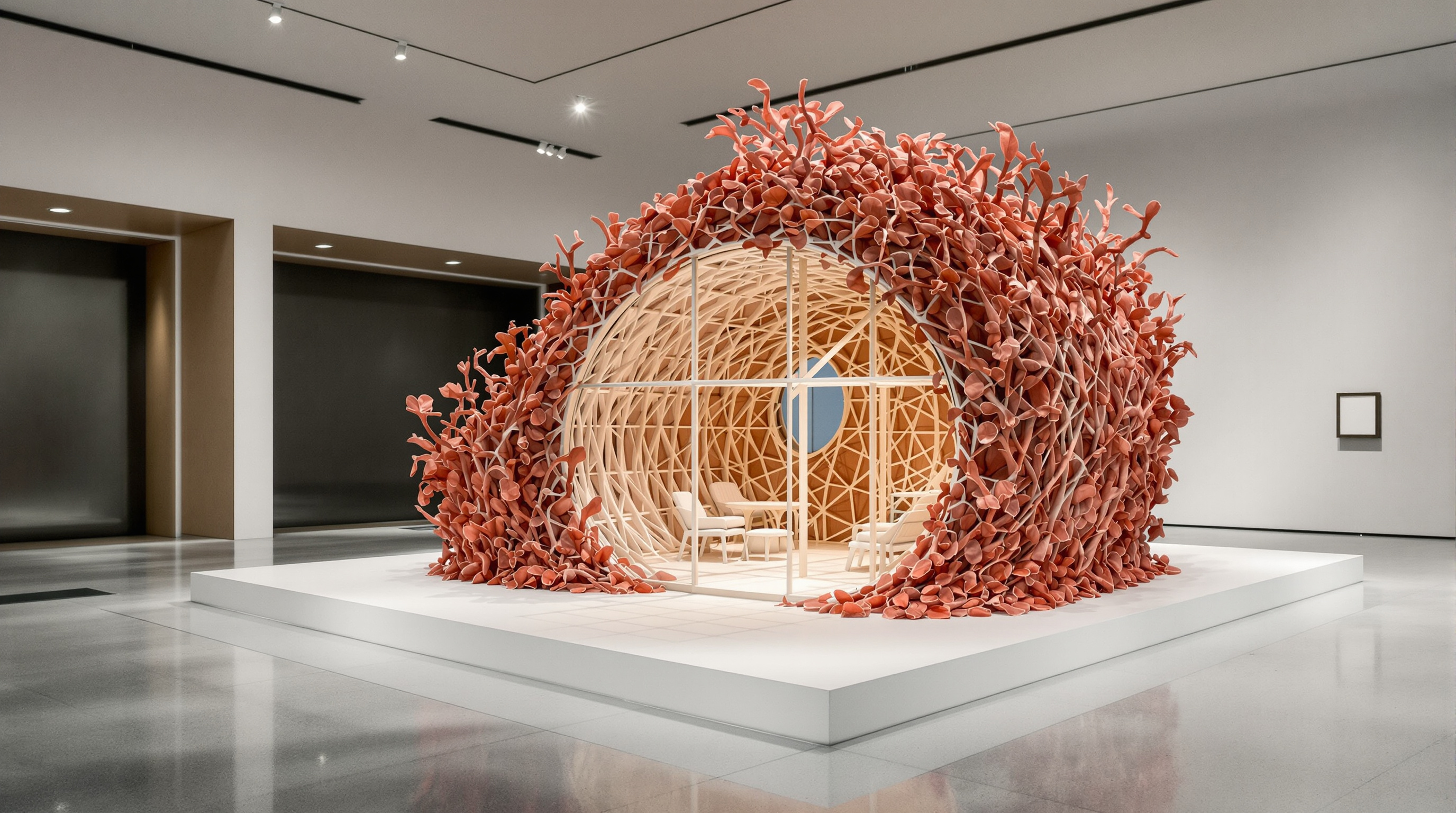
The chapter's title says in-vitro, and the most literal reading of that belongs to Terreform ONE, the New York non-profit led by Mitchell Joachim. Its In Vitro Meat Habitat (a concept from around 2008) proposed a dwelling whose walls would be grown from cultured animal cells — lab-produced tissue extruded over a scaffold to form what Joachim provocatively called a "victimless" organic shelter, a house grown without slaughtering an animal. It is deliberately unsettling, and it was never meant to be inhabited. Its job is philosophical: to push the logic of grown material to its most extreme conclusion and force the question of whether we are willing to live inside biology, not merely beside it.
Studio Matrx's editorial view is that this speculative branch should be read as provocation, not prediction. Its value is that it clarifies the stakes of the more sober mycelium and biocement work. When the shock wears off, the underlying question — can shelter be cultivated rather than killed and quarried for? — is a serious one.
Where it points, including for India
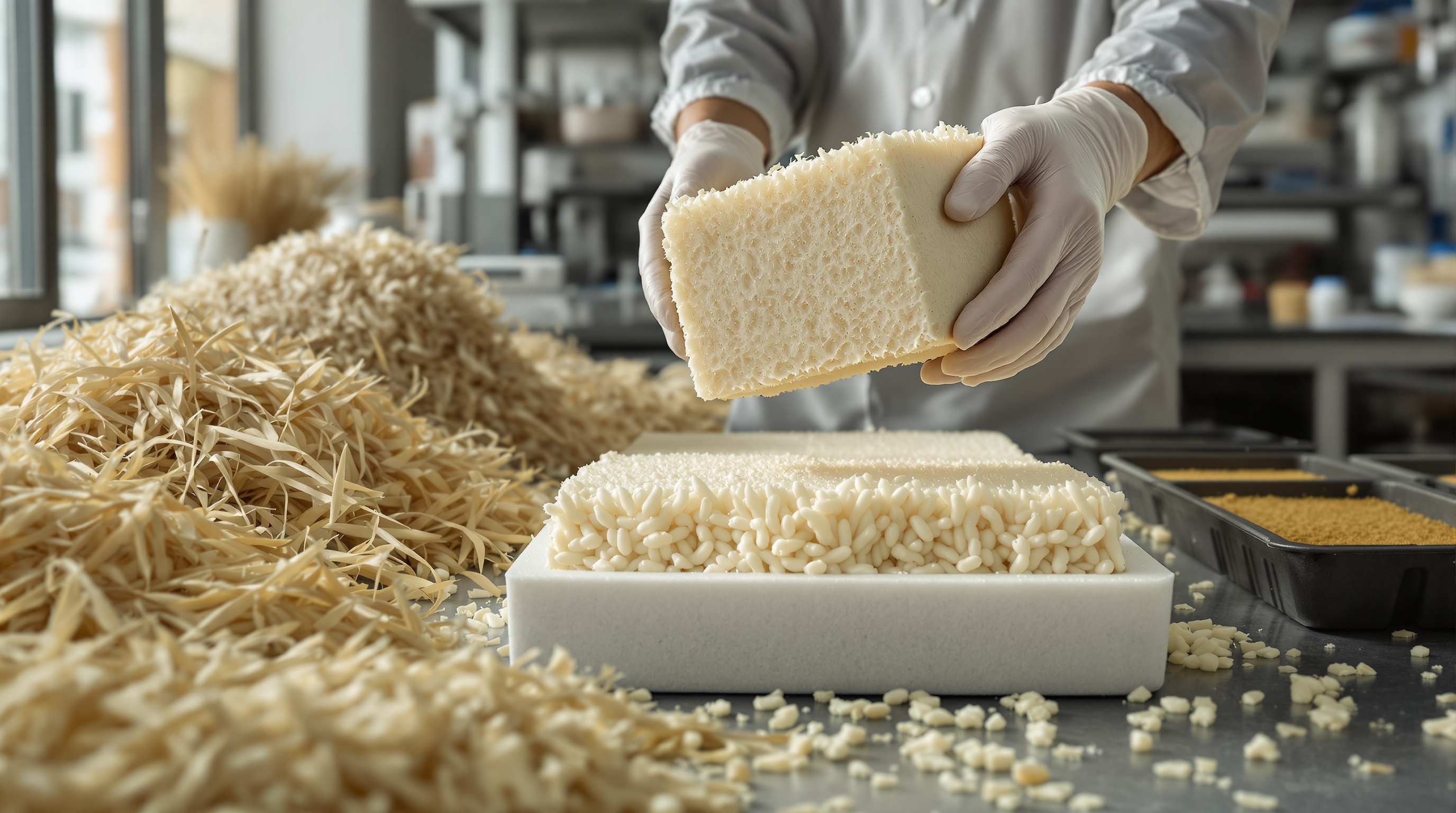
Although this entry is not tied to an Indian site, the grown-material idea has an obvious and pressing Indian relevance. India generates vast quantities of agricultural residue, and the annual burning of crop stubble across the northern plains is a major public-health and air-quality crisis. A material system whose feedstock is agricultural waste turns that liability into a resource: the same straw that is currently burned could instead be inoculated and grown into insulation panels or non-structural blocks. Indian research groups have begun publishing on mycelium biocomposites made from local agricultural and paper waste, and the country's deep tradition of bamboo construction pairs naturally with MycoTree's mycelium-and-bamboo logic. If grown materials find a serious market anywhere, a waste-rich, construction-hungry economy like India's is a plausible place.
The broader trajectory is clear even if the timeline is not. Grown-material habitats will almost certainly arrive first as components — insulation, acoustic panels, temporary pavilions, packaging that crosses into building — long before anyone grows a whole load-bearing house. The revolution, if it comes, will be quiet and incremental, wall by wall, rather than a single cultivated cathedral.
Why it belongs in the canon
Grown-material and in-vitro habitats earn their place in this canon not because any one of them is a finished masterpiece — none is — but because they change the question architecture is allowed to ask. For the whole history of the discipline, "what is this building made of?" has had answers drawn from geology and industry: stone, metal, fired earth. These experiments propose a third category of answer, drawn from biology: the building is made of something that was recently alive, that grew at room temperature, that ate our waste, and that will return to soil when we are done with it. Even if the load paths are not yet there, that reframing is the most future-facing move in the chapter — a genuine provocation about not-yet-built architecture.
The mushroom brick will not replace the steel beam soon. But it has already done something harder: it has made the steel beam look like a choice rather than a given.
References
- Terreform ONE / Joachim, M. "In Vitro Meat Habitat" — project description and concept (c. 2008). terreform.org (primary source; speculative concept)
- Heisel, F., Schlesier, K., Lee, J., Rippmann, M., Saeidi, N., Javadian, A., Nugroho, A. R., Hebel, D. E., & Block, P. (2017). "Design of a load-bearing mycelium structure through informed structural engineering: The MycoTree at the 2017 Seoul Biennale of Architecture and Urbanism." Proceedings of the World Congress on Sustainable Technologies (WCST) / International Journal of Sustainable Energy Development. block.arch.ethz.ch (peer-reviewed; the MycoTree structure)
- Alaneme, K. K., Anaele, J. U., Oke, T. M., Kareem, S. A., Adediran, M., Ajibuwa, O. A., & Anabaranze, Y. O. (2023). "Mycelium based composites: A review of their bio-fabrication procedures, material properties and potential for green building and construction applications." Alexandria Engineering Journal, 83, 234–250. DOI: 10.1016/j.aej.2023.10.012 (peer-reviewed; material properties and structural limits)
- Arup. "Hy-Fi reinvents the brick" — structural engineering account of The Living's mycelium tower (2014). arup.com (primary-ish; the engineer's own record)
- "Tower of 'grown' bio-bricks by The Living opens at MoMA PS1." Dezeen (2014). dezeen.com (architectural press; Hy-Fi facts and images)
- "Hy-Fi, The Organic Mushroom-Brick Tower Opens at MoMA's PS1 Courtyard." ArchDaily (2014). archdaily.com (architectural press)
- bioMASON (Krieg Dosier, G.) — company technology on microbial biocement grown with Sporosarcina pasteurii. biomason.com (primary source; biocement)
Part of The Future of Architecture in 300 Buildings — Studio Matrx's canon of the buildings asking where architecture goes next. Chapter 16: Concepts & Provocations.
Export this guide
Related Guides — Deep-dive reading
Hy-Fi: The Tower That Was Grown, Not Built — and Then Composted
The Living's 2014 MoMA PS1 tower stacked roughly 10,000 bricks grown from corn stalks and mushroom mycelium, stood for one summer, and returned to the soil — the clearest built argument yet that architecture's next material might be alive, carbon-negative, and designed to disappear.
The Future of ArchitectureBioMILA and the Bio-Based Facade: When the Wall Becomes Alive
Across a scatter of European prototypes in the 2010s and 2020s — Hamburg's algae-powered SolarLeaf, Stuttgart's compostable ArboSkin, mycelium panels grown from farm waste — architecture began treating the facade not as inert cladding but as a biological system. This is a survey of that shift, its verifiable exemplars, and the hard questions a living skin still cannot answer.
The Future of ArchitectureCompressed Stabilised Earth Blocks (CSEB): A Specify-and-Select Guide for India (2026)
What CSEB is - local soil plus a small percentage of cement or lime, compressed in a press and cured, never kiln-fired - its low-carbon and thermal-mass strengths, its real limits around soil, quality control and water, and how it compares with fired clay brick and fly-ash brick. A specify-and-select guide.
Building MaterialsRelated Tools — Try Free
Concept Generator
Get 3 AI-generated design concepts for any room with style, materials, and cost estimate.
DesignAIWindow Material Comparison Tool
Compare uPVC, aluminium, wood, steel and composite windows on cost, life, upkeep and insulation.
CompareCross-Ventilation Analyzer
Estimate airflow and air changes per hour (ACH) from room size, window areas, layout, and local wind — with NBC 2016 Part 8 compliance check.
Ventilation Calculator