
Humboldt Forum: The Copied Palace and the Return of Reconstruction
Franco Stella's Humboldt Forum rebuilds a Baroque palace the GDR blew up in 1950 — three facsimile stone facades wrapped around a modern museum of non-European art. It is the twenty-first century's most argued-over building, and a test of a question architecture keeps re-asking: can you honestly reconstruct a lost past, and what does the copy conceal?
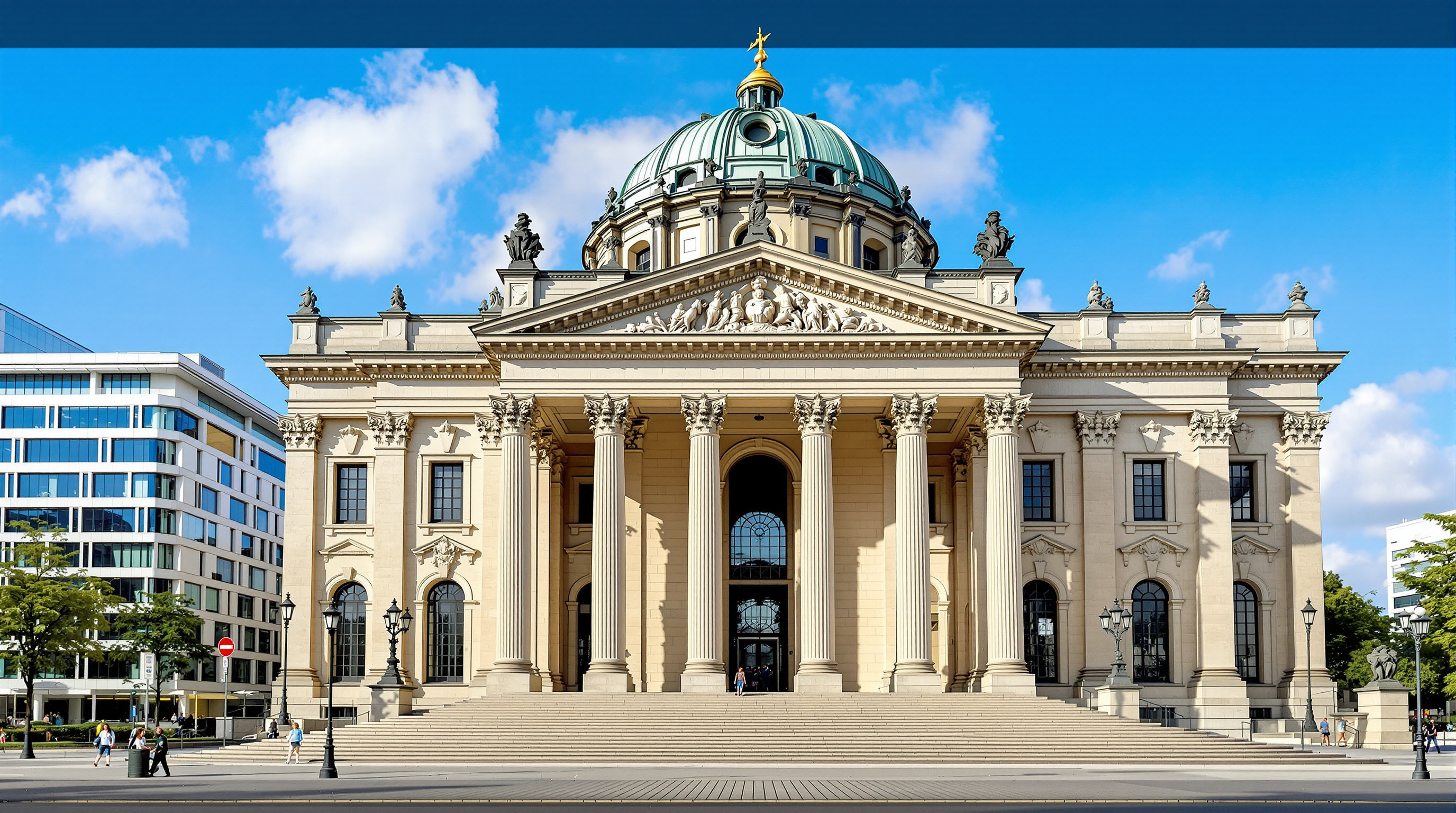
Stand on the Schlossplatz in central Berlin and you are looking at a building that did not exist for seventy years. From three sides, the Humboldt Forum presents the massive Baroque facades of the Berlin Palace — the Berliner Stadtschloss — the seat of Prussian kings and German emperors that stood here for centuries. Its columns, its window frames, its balustrades and its crowning dome all read as the eighteenth century. And all of them are new. The stone was carved after 2013. The palace they belong to was blown up by the East German state in 1950, and the ground beneath your feet was, until recently, occupied by an entirely different building — the GDR's own Palace of the Republic, itself demolished between 2006 and 2008.
The Humboldt Forum, completed in 2020, is therefore not a restoration and not quite a new building. It is a reconstruction: a full-scale replica of a demolished monument, built from photographs, drawings and salvaged fragments, and filled with a completely modern program. That is precisely why it belongs in any honest account of where architecture is going. For most of the twentieth century, the reconstruction of a lost building was something close to a professional taboo — a betrayal of modernism's demand that every era build in its own language. The Humboldt Forum is the largest and most expensive sign that the taboo has broken.
The reconstruction of a palace raises the question of whether a nation can rebuild its history like a stage set — and what it chooses to leave out when it does.
The question it poses
Marc Kushner's framing for The Future of Architecture asks what a building tells us about the direction of the discipline. Most of the buildings in this canon answer with something new: a new material, a new form, a new structural trick. The Humboldt Forum answers by looking backward, and that is what makes it unusual and important. It asks whether the copy — long dismissed as kitsch, as Disneyfication, as false — can carry real cultural meaning; and whether a society can reassemble a demolished symbol without also reassembling the politics that symbol once served.
Italian architect Franco Stella won the international competition for the project in 2008, following a 2002 decision by the German Bundestag to reconstruct the palace's exterior. The brief was unusually prescriptive: three of the four exterior facades, and the great courtyard elevations of the Schlüterhof, were to be rebuilt as faithful replicas of the Baroque palace designed around 1700 by Andreas Schlüter and Johann Eosander, complete with the nineteenth-century dome added by Friedrich August Stüler. The building's central idea was, in a sense, dictated before Stella arrived. His task was to be the architect of a copy.
Stella's move: a modern building wearing a historical face
What Stella actually contributed is subtler than the "fake palace" caricature suggests, and it is the reason the building is worth studying rather than merely arguing about. He treated the reconstruction as a hybrid. Three sides — west, north and south — are the historicist replica the Bundestag demanded. The fourth side, the east facade facing the Spree river, is Stella's own: a stripped, rational, contemporary elevation of large windows and plain stone piers that makes no attempt to imitate the Baroque. Where the old palace met the river with ornament, the Humboldt Forum meets it with a modern, almost austere face.
Stella described the building as a city in miniature — "a palace with its six portals representing city gates, and its three inner courtyards serving as city squares." Inside the historicist shell sits an entirely modern museum: reinforced-concrete floor plates, wide column-free galleries, climate control, loading docks and the full technical apparatus of a twenty-first-century cultural institution. The Baroque, in other words, is a mask roughly one facade thick. Behind it is a contemporary building doing contemporary work.
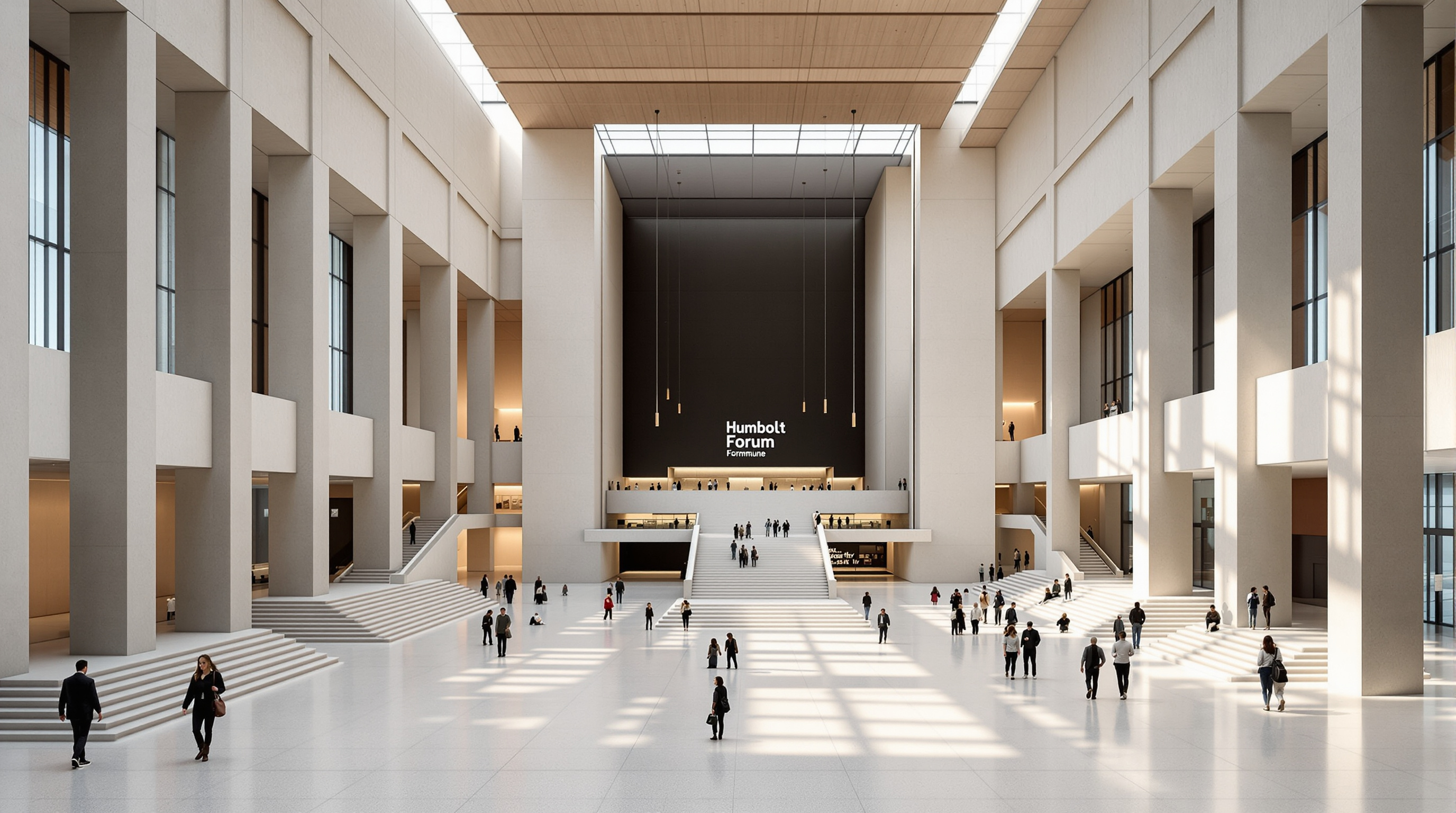
This split personality is the honest core of the design. The east facade is a quiet argument that reconstruction and contemporary architecture can share one body — that the copy need not be total. Critics have called the result an "uncomfortable hybrid of styles," and they are right that it is uncomfortable. But the discomfort is the point: the building refuses to fully pretend.
How you rebuild a Baroque palace: the Schlossbauhütte
The technical achievement of the Humboldt Forum is not structural daring but something older and nearly lost — the industrialised revival of stone carving at monumental scale. Because no original Baroque stonework survived intact, the ornament had to be made again from scratch.
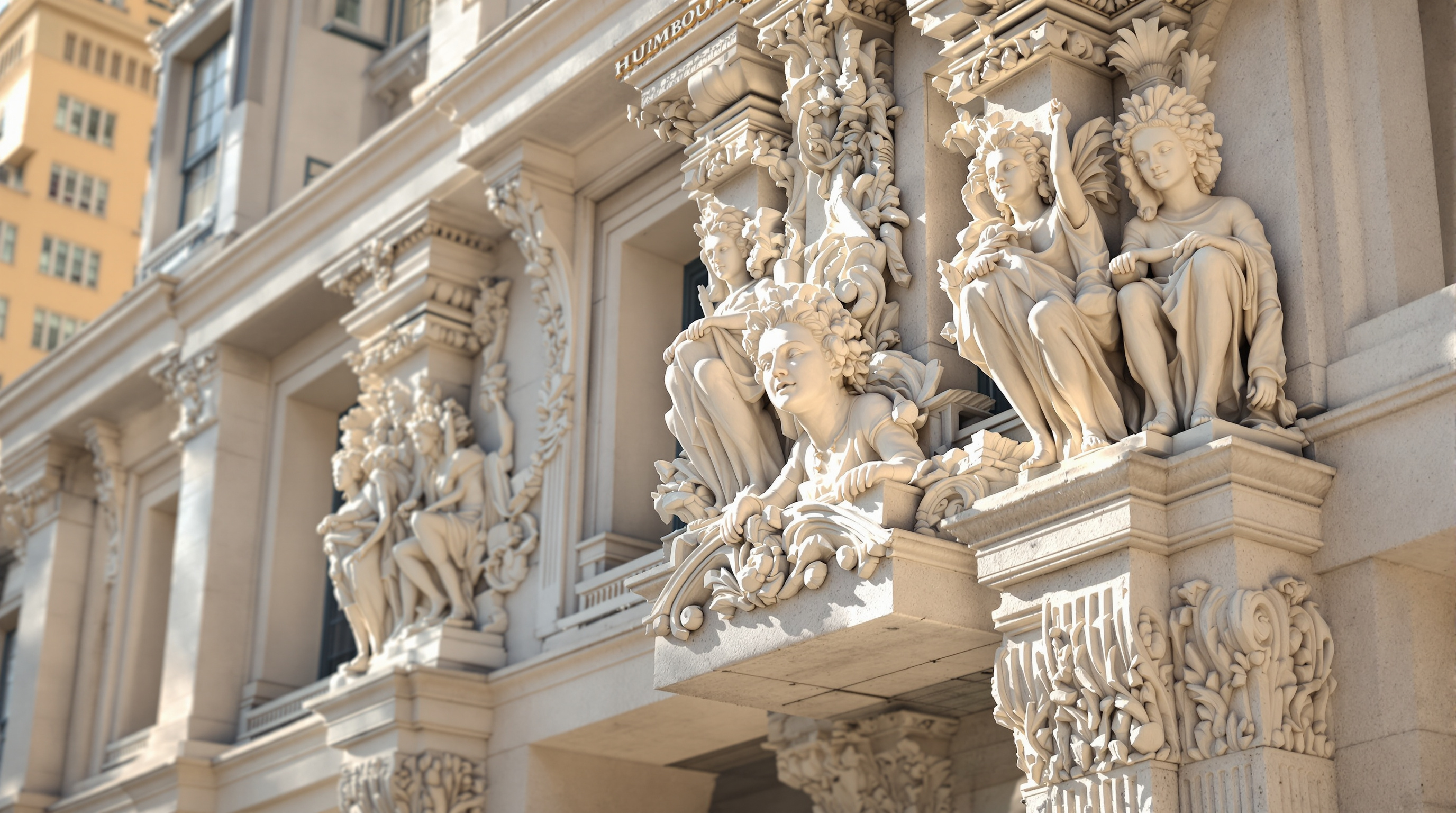
A dedicated workshop, the Schlossbauhütte ("palace building lodge"), was set up to do it. Sculptors and stonemasons studied historical photographs, engravings and the handful of salvaged fragments, then modelled the ornament first in clay and then in plaster. Reportedly more than three thousand individual carved elements — friezes, capitals, cornices, balustrades, figures — were produced from around three hundred master models. Unique pieces such as statues and high-reliefs were carved by hand; repeating elements were mechanically replicated from the masters and finished by craftspeople. The reconstructed facades are clad in this new sandstone ornament over a modern backing structure.
| Element | The old Berlin Palace | The Humboldt Forum (2020) |
|---|---|---|
| West / north / south facades | Baroque, Schlüter & Eosander, c. 1700 | Faithful facsimile in new carved sandstone |
| East facade (to the Spree) | Baroque | Modern design by Franco Stella |
| Dome and lantern | Stüler, 19th century | Replicated form, with a contested cross and inscription |
| Structure behind the skin | Load-bearing masonry | Reinforced concrete, modern museum services |
| Program | Royal and imperial residence | Ethnological Museum + Museum of Asian Art, forums, event halls |
The result is uncanny. From the plaza, the replica is convincing enough that many visitors do not realise the stone is younger than their phones. That very persuasiveness is what makes the reconstruction a philosophical problem as much as a construction one: a copy this good stops announcing itself as a copy.
The diagram of the hybrid
The clearest way to understand the building is in plan. A single rectangular block, pierced by portals, wraps three courtyards; three of its outer edges are the historical replica and one is modern; and the whole thing is a shell around a contemporary museum core.
Where it sits in the museum chapter
Placed among the contemporary museums of this canon — Guggenheim Bilbao, MAXXI, V&A Dundee, M+ — the Humboldt Forum is the outlier that proves the rule. Most define themselves by novelty of form; the Humboldt Forum defines itself by the deliberate absence of a new form. And yet it is doing the same fundamental job as its neighbours: it is a machine for staging culture. What it stages, and what its costume implies about who that culture belongs to, is where the trouble starts.
Because the collections the building now houses are not Prussian at all. The Humboldt Forum contains the reunited Ethnological Museum of Berlin and the Museum of Asian Art — hundreds of thousands of objects from Africa, Asia, Oceania and the Americas, many of them acquired during the era of European colonialism. The reconstructed imperial palace has become the container for the art of the peoples that empire dominated. The mismatch is deliberate on nobody's part and glaring to everyone.
The third position: an honest reckoning
Studio Matrx's editorial view is that both the admiration and the alarm are earned, and that the building is most instructive when you hold them together.
The strongest critique is not about taste; it is about provenance and politics. The Humboldt Forum's flagship holdings include the Benin Bronzes, looted by British forces in 1897, and a wide range of objects whose acquisition histories are incomplete or coercive. The art historian Bénédicte Savoy resigned from the Forum's international advisory board in 2017, publicly protesting what she saw as insufficient provenance research and a reluctance to confront the collections' colonial origins. Since then Germany has begun transferring ownership of many Benin Bronzes back to Nigeria — a partial answer that the building's own existence made unavoidable. To display contested colonial objects inside a triumphally rebuilt royal palace, critics argue, is to frame plunder as heritage.
A second critique targets the reconstruction itself. The architectural historian Philipp Oswalt has documented how parts of the facsimile, including the dome's golden cross and its Christian inscription, were financed by private donors, some with nationalist or far-right sympathies, and has questioned the transparency of that funding and the Christian-nationalist symbolism it introduces onto a supposedly universal cultural house. Scholars have read the whole project as the "afterlife of a vanished state" — a selective revival of Prussia that quietly writes the GDR, whose Palace of the Republic once stood on this exact spot, out of the story (Colla, 2023).
And yet. The Schlossbauhütte revived stone-carving skills that had all but disappeared. The east facade is a genuine, thoughtful attempt to let the modern coexist with the copy. The reunification of the ethnological and Asian collections in a free, central, public building is a real cultural act, whatever the costume around it. The reported cost — on the order of 677 million euros, funded largely by the German state — bought something no other museum in this canon offers: a full-scale experiment in whether a society can rebuild what it destroyed and mean something new by it.
The Humboldt Forum's answer is ambiguous, and its ambiguity is the lesson. It tells us that reconstruction is back — that in an age suspicious of the new, the copy has become a legitimate and powerful architectural strategy — and that the copy is never neutral. A rebuilt facade always argues for a particular version of the past. The future the Humboldt Forum points to is one in which architects will increasingly be asked not to invent, but to reassemble; and the discipline's hardest question will be less "what shall we build?" than "whose past are we rebuilding, and what are we hiding behind it?"
Why it belongs in the canon
A building can be important because it is beautiful, because it is clever, or because it forces an argument the discipline cannot avoid. The Humboldt Forum is the third kind. It took the most contested urban site in Germany, rebuilt a demolished symbol at vast expense, and filled it with the unresolved inheritance of empire. It is, at once, an act of extraordinary craft and an unfinished ethical reckoning. That is exactly why it belongs here — not as a model to copy, but as the question every future reconstruction will have to answer.
References
- Stiftung Humboldt Forum im Berliner Schloss, "Architecture" — official building history, program and reconstruction data. humboldtforum.org (primary source)
- Franco Stella, "Berlin Palace – Humboldt Forum" — the architect's own project statement (six portals, three courtyards, the modern east facade, the Schlossbauhütte). francostella.eu (primary source)
- Colla, M. (2023). "Whither Prussia? Berlin's Humboldt Forum and the Afterlife of a Vanished State." Central European History, 56(1). Cambridge University Press. cambridge.org (peer-reviewed)
- Dolgoy, R. C. (2017). "Berlin's Stadtschloss-Humboldtforum and the disappearing glass: The museum as diorama." European Journal of Cultural and Political Sociology, 4(3), 306–335. direct.mit.edu (peer-reviewed)
- Oswalt, P. (2023). Bauen am nationalen Haus: Berliner Schlossfassade und Wiederaufbau-Ideologie — book-length critique of the reconstruction's financing, donors and symbolism. (scholarly monograph; author is professor of architectural theory, University of Kassel)
- "Humboldt Forum / Franco Stella." ArchDaily (2020). archdaily.com (architectural press; project data and images)
- Marshall, A. "Germany's Newly Opened Humboldt Forum Is So Controversial." Smithsonian Magazine / New York Times reporting (2020–21), on the colonial-collections debate and Bénédicte Savoy's resignation. smithsonianmag.com (press)
Part of The Future of Architecture in 300 Buildings — Studio Matrx's canon of the buildings asking where architecture goes next. Chapter 14: Museums & Galleries (Contemporary).
Export this guide
Related Guides — Deep-dive reading
Chan Chan: The Vast City of Mud Where Every King Built His Own Palace
On the desert coast of Peru sprawl the ruins of the largest city ever built of mud — a thousand-year-old capital of adobe walls three storeys high, carved with fish and seabirds, that survived only because it almost never rains. It was a city of ten royal palaces, one for each king, driven by a strange rule of inheritance; and today, an earthen city in a warming world, it is racing the rain to survive. The ninth article in our chapter on the palaces and pleasures of worldly power.
Architectural WondersThe Colosseum: The Machine That Fed a City Its Pleasures
Rome's greatest emperors built palaces for themselves; the Flavian emperors did something shrewder — they drained a fallen tyrant's private lake and raised, on the spot, a stupendous arena for fifty thousand ordinary citizens. The largest amphitheatre ever built is a masterpiece of crowd engineering, a hidden stage-machine of lifts and trapdoors, and a place of real, organised killing — all at once. The fourth article in our chapter on the palaces and pleasures of worldly power, and the first on pleasure.
Architectural WondersThe Palace of Knossos: Europe's First Palace and the Labyrinth of Myth
Nearly four thousand years ago on Crete, Europe's first great civilisation built a palace so vast and maze-like — over a thousand rooms on many floors, with running water, flushing toilets and light wells — that the Greeks who came after remembered it as the Labyrinth of the Minotaur. It is a genuine Bronze Age marvel; it is also, thanks to one archaeologist's concrete and imagination, a monument to how we rebuild the past in our own image. The first article in our chapter on the palaces of worldly power.
Architectural WondersRelated Tools — Try Free
Window Orientation Planner
Pick the best window type, glass and shading by wall direction — north, east, south and west.
Window ToolCross-Ventilation Analyzer
Estimate airflow and air changes per hour (ACH) from room size, window areas, layout, and local wind — with NBC 2016 Part 8 compliance check.
Ventilation CalculatorHealing View Impact Calculator
Evidence-Based Design dashboard quantifying the recovery impact of nature view + daylight factor on analgesic use, length of stay, and HCAHPS patient-experience uplift. Calibrated against Ulrich 1984 (Science), Park & Mattson 2008, and the CHD EBD evidence base.
EBD Calculator