

How to Vet an Architect: CoA Credentials Check in India (2026)
By law, only a Council of Architecture (CoA) registered person may call themselves an architect in India. This guide shows you how to vet an architect properly - verifying registration, checking real built work not just renders, speaking to past clients, confirming site visits, and spotting the warning signs that separate a genuine architect from a draughtsman or an unregistered designer.
Almost anyone can hand you a set of drawings and a glossy 3D render and call it "architecture". Far fewer are actually architects. In India the word carries a legal weight most homeowners never realise: by law, only a person registered with the Council of Architecture (CoA) may use the title "architect" or offer services under it. That single fact is the most powerful vetting tool you have, and it costs you nothing to use. Yet many homeowners skip it entirely, hire on the strength of a portfolio full of pretty pictures, and only later discover that the "architect" was a draughtsman, a civil engineer moonlighting on drawings, or a designer with no formal accountability at all.
This guide walks you through how to vet an architect the way a careful buyer should - starting with registration, then education and experience, then the harder question of whether the work you are being shown is real and built rather than rendered, and finally whether this person will genuinely stand on your site while your home goes up. None of this is about distrust. Good architects welcome these checks, because the checks are exactly what separate them from the people who undercut them. The aim is simply that you are not taken advantage of.
Scope and who decides what. This guide explains how to check credentials and judge fit so you hire well. It is not legal advice, and it does not replace the professional's own judgement. Registration status is a legal fact you should verify directly with the Council of Architecture, whose records are the authority - never rely on a screenshot or a number quoted to you. The binding wording of any appointment letter or agreement should be settled with a lawyer, and technical and structural decisions belong to the architect and engineer you appoint. Any fees or timelines mentioned here are indicative and vary by city, project scale and professional.
Why title protection matters when you vet an architect
Under the Architects Act, 1972, the Council of Architecture maintains a register of qualified architects, and the title "architect" is protected: it is an offence for an unregistered person to use it or to practise under it. This is not bureaucratic trivia. A registered architect has completed a recognised five-year professional degree, is bound by a code of professional conduct, and can be held accountable by the Council for misconduct or negligence. Someone who merely produces drawings has none of that framework behind them.
The practical consequence for you is simple. When a registered architect signs and stamps your drawings, that stamp means something to the municipal authority, to a bank, and to a court if anything ever goes wrong. Many local building-approval processes require drawings prepared or countersigned by a registered architect. So verifying registration is not just about honesty - it is often about whether your sanction plan will even be accepted. This is the first and most important step, and everything else in vetting builds on it.
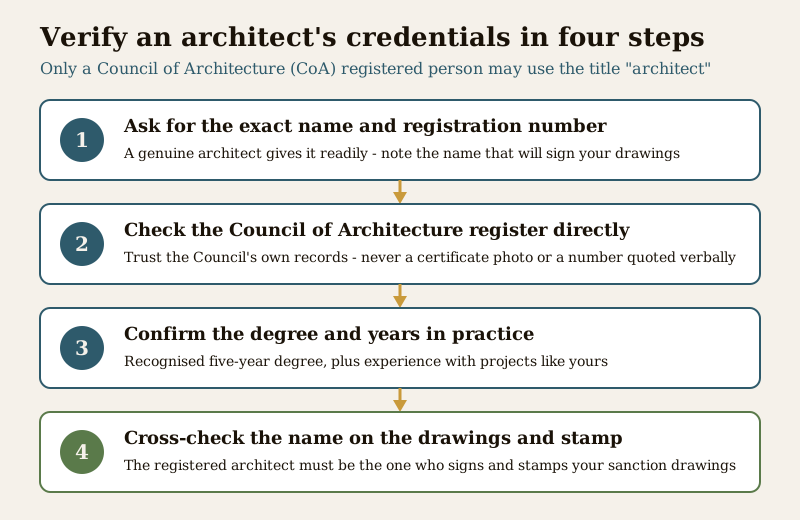
Step one: verify Council of Architecture registration
Start by asking the professional plainly: "Are you registered with the Council of Architecture, and what is your registration number?" A genuine architect will give it without hesitation, because it is a point of pride and a legal requirement. Note the exact name they are registered under, since that is the name that must appear on your drawings and stamp.
Then verify it independently. The Council of Architecture maintains a register of registered architects; treat the Council's own records as the authority, and confirm the person's name, registration number and status there rather than trusting a certificate photo, a business card or a number recited in a meeting. If a firm is doing the work, ask which specific registered architect within it will be responsible for and stamp your drawings - a firm can employ many people, but only registered architects can carry that accountability. If someone becomes evasive, changes the subject, or says registration "does not matter for a house", treat that as a serious red flag, not a minor detail.
Architect versus draughtsman versus "designer" or civil engineer
This is where most confusion - and most mis-selling - happens. Several different people can produce something that looks like an architectural drawing, but they are not interchangeable, and only one of them may legally call themselves an architect. Understanding who can do what protects you from paying architect-level trust to someone with neither the qualification nor the accountability.
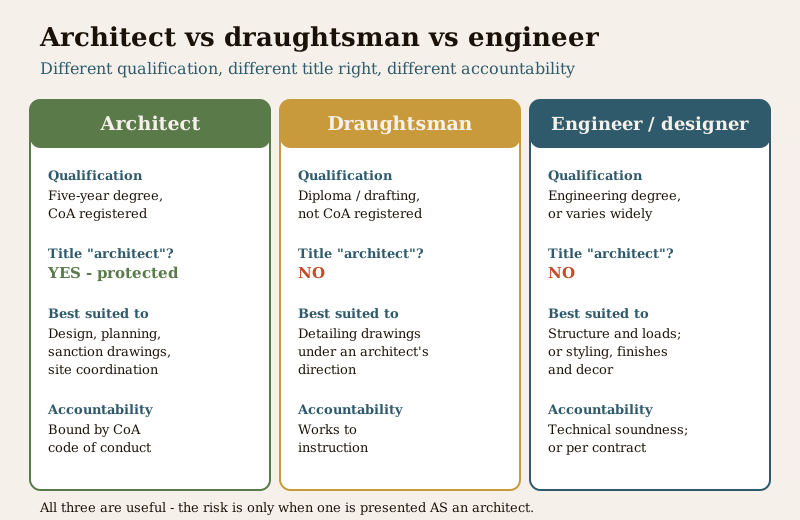
| Role | Typical qualification | May use title "architect"? | Best suited to | Accountability |
|---|---|---|---|---|
| Registered architect | Five-year professional degree, CoA registered | Yes - legally protected | Design, spatial planning, sanction drawings, overall project vision, site coordination | Bound by CoA code of conduct; can be held to account by the Council |
| Draughtsman | Diploma or drafting training, not CoA registered | No | Producing and detailing drawings under an architect's or engineer's direction | Works to instruction; limited independent professional liability |
| Civil / structural engineer | Engineering degree, registered with an engineering body | No | Structural design, load calculations, construction methods and safety | Accountable for structural and technical soundness, not architectural title |
| "Designer" / decorator | Varies widely; often no formal accreditation | No | Aesthetic and interior styling, finishes, decor | Depends entirely on contract; often none by default |
The honest reading of this table is not that draughtsmen and engineers are lesser people - they are essential, and a good project uses all of them. A structural engineer is the right person to size your beams; a skilled draughtsman turns intent into precise sheets. The problem is only when one of them is presented as an architect, or asked to carry responsibility that legally and practically sits with a registered architect. If you want the deeper distinction between the design professions and who owns which decisions, see the companion guides on architect versus interior designer versus contractor and the scope boundaries between architect, designer and contractor.
Education, experience and the right fit
Registration is the floor, not the ceiling. Once you have confirmed someone is a registered architect, the next questions are about depth and fit. Ask where and when they qualified, and how many years they have been in independent practice. Years alone are not everything - a sharp architect five years in can outperform a coasting one of twenty - but experience with your kind of project matters enormously. An architect who has delivered ten individual homes on tight urban plots understands things about setbacks, light and budget that a large-commercial specialist may not.
Ask directly: "How many projects like mine have you completed, and can I see them?" A residential renovation, a new independent house, and a plotted-development villa each demand different instincts. Fit also includes the human dimension - whether they listen to how you actually live, whether they respect your budget rather than designing for their portfolio, and whether communication feels clear. You will be working with this person for a year or more, so a good working relationship is not a luxury.
Look at built work, not just renders
A render is a promise; a building is a result. The single most revealing thing you can ask a prospective architect is to see completed, built projects - not only the shimmering 3D visualisations that every studio can generate today. Renders show intent and skill with software. Built photographs, and better still a visit in person, show whether the intent survived contact with a real site, a real budget and a real contractor.
When you review a portfolio, separate the two mentally. Ask which images are renders and which are photographs of finished buildings. Be wary of a portfolio that is all renders and no built work, especially from someone claiming years of experience - it can mean the projects were never realised, or were realised badly and are not being shown. Ask to see a project from concept render through to the finished photograph, so you can judge how faithfully this architect delivers what they draw. That gap between render and reality is where disappointment usually lives.
Talk to past clients and visit completed sites
References are the vetting step homeowners most often skip and most often regret skipping. Ask for the contact details of two or three recent clients, and actually call them. Architects who do good work are happy to connect you; reluctance here is itself information. When you speak to a past client, ask the questions that reveal behaviour under pressure rather than politeness.
Useful questions to a past client include: Did the architect stay engaged once construction started, or disappear after the drawings were done? How did they handle problems and cost changes on site? Did the final building match what was promised? Would you hire them again? If you possibly can, visit a completed project in person - a home reveals honesty in its details, its finishes and how it has aged, in a way no photograph does. A short site visit with a willing past client is worth a dozen polished portfolio pages.
Confirm they will actually do site visits
Designing a home is only half an architect's value; the other half is watching it get built. Many disappointments trace back to an architect who delivered beautiful drawings and then vanished, leaving the contractor to interpret intent alone. Before you appoint anyone, ask pointedly how their site involvement works: How often will you visit during construction? Who attends site meetings? What happens when the contractor deviates from the drawings?
Get the answer in writing as part of the scope, because a verbal "of course I will visit" is easy to say and easy to forget. The exact frequency and nature of site supervision varies by professional and by how the project is structured, and it should be spelled out in the appointment. For how a registered architect's duties are formally defined, the professional-facing guide on the architect scope of services under CoA is written for professionals but is worth reading so you know what full service can include, and the pillar guide on how to hire an architect in India puts vetting in the wider hiring sequence.
The vetting checklist and the warning signs
Pulling it together, here is a compact checklist to work through with any prospective architect, alongside the warning signs that should make you pause. Treat the checklist as a conversation you are entitled to have - a genuine professional will pass it comfortably.
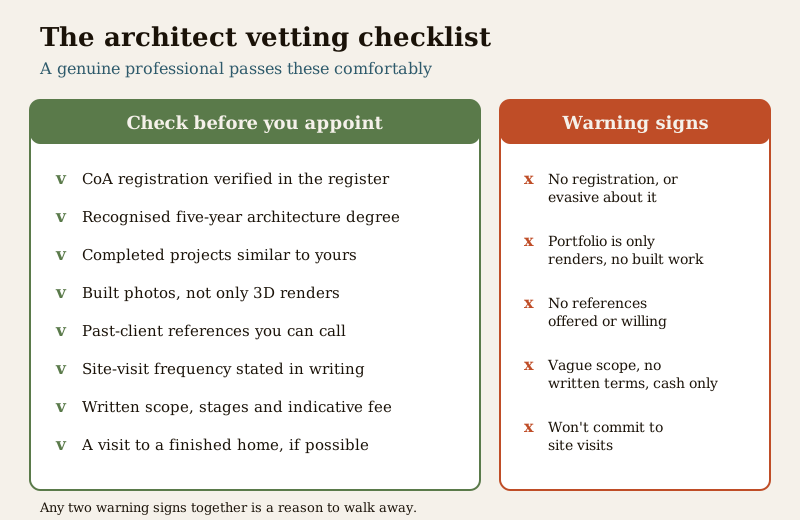
| Vetting check | What good looks like | Warning sign |
|---|---|---|
| CoA registration | Gives number readily; verifiable in the Council's register | Evasive; "not needed for a house"; unverifiable |
| Qualification | Recognised five-year architecture degree | Vague about degree; conflates it with a diploma |
| Relevant experience | Several completed projects like yours | Only very different projects, or none finished |
| Built work | Photographs of finished buildings, visitable | Portfolio is all renders, no built photos |
| References | Offers recent clients to call | Reluctant or unable to give any references |
| Site involvement | Site-visit frequency stated in writing | Won't commit; "the contractor handles that" |
| Scope and fee clarity | Written scope, stages and indicative fee | Vague scope, no written terms, cash-only |
The pattern behind the warning signs is worth naming: unregistration, renders without reality, no references, and vague scope. Any one of these deserves a hard second look; two or more together is a reason to walk away. The same instinct applies right across your build team - the companion guide on red flags when hiring a contractor covers the construction side of the same caution.
Key takeaways
- In India, by law only a Council of Architecture (CoA) registered person may use the title "architect" - so the first step to vet an architect is to confirm registration.
- Verify registration directly with the Council's own records using the person's exact name and number; never rely on a certificate photo or a number quoted verbally.
- An architect, a draughtsman and a civil engineer or designer are not interchangeable - each has a different qualification, title right and accountability, and only the architect may carry the title.
- Judge on built work, not renders; a portfolio that is all 3D visualisations and no finished buildings is a warning sign.
- Call past clients and visit a completed home if you can - references reveal how the architect behaves once construction starts.
- Confirm site visits in writing before appointing anyone; design without supervision is where many homes go wrong.
- The four classic warning signs are no registration, only renders, no references and vague scope - any two together is a reason to walk away.
References
- Architects Act, 1972 (India) - the statute establishing the Council of Architecture and protecting the title "architect"; confirm current provisions and any amendments with the Council or a lawyer.
- Council of Architecture (CoA) - the statutory body that maintains the register of registered architects and the professional code of conduct; treat its own records as the authority on registration status.
- Local municipal and building-approval authorities - for the requirement that sanction drawings be prepared or countersigned by a registered architect, which varies by city and state.
- Studio Matrx companion guides - how to hire an architect in India, architect versus interior designer versus contractor, and the architect scope of services under CoA for professionals.
- A qualified lawyer - for the binding wording of any appointment letter or professional-services agreement.
Indicative and city-dependent. Studio Matrx is a not-for-profit guide; this is educational content, not legal advice. Verify registration directly with the Council of Architecture, and settle any appointment or agreement wording with a lawyer before you engage a professional.
Export this guide
Related Guides — Deep-dive reading
How to Hire an Architect in India: A Homeowner's Guide (2026)
A plain-language walkthrough for homeowners - whether you even need an architect, what one does across the stages, how to find and shortlist, how architects charge, what the scope and agreement should cover, and how to work well together.
Hiring ProfessionalsThe Complete Guide to Planning Your Home Before You Spend a Rupee
Why the cheapest, most powerful work happens on paper — a planning playbook for Indian homeowners before any money moves
Home PlanningDesign/Build vs. Hiring Separately: What Indian Homeowners Should Know
The procurement-model decision behind every home project — one turnkey firm that designs and builds, or an independent designer and a separately appointed contractor — and how to choose the one that fits your time, budget, and appetite for control.
Planning Your ProjectRelated Tools — Try Free
Before vs After — Cost Reality Check
Compare what you expected to pay vs what you actually paid, category by category.
Reality CheckContract Studio
AI generates professional architecture service agreements with milestones and scope.
ArchitectAIFalse Ceiling Cost Estimator
Live ₹/sqft across 8 ceiling types — POP, gypsum, designer, metal, PVC, wooden — with cove and spot lighting for 20 Indian cities.
Cost Calculator