
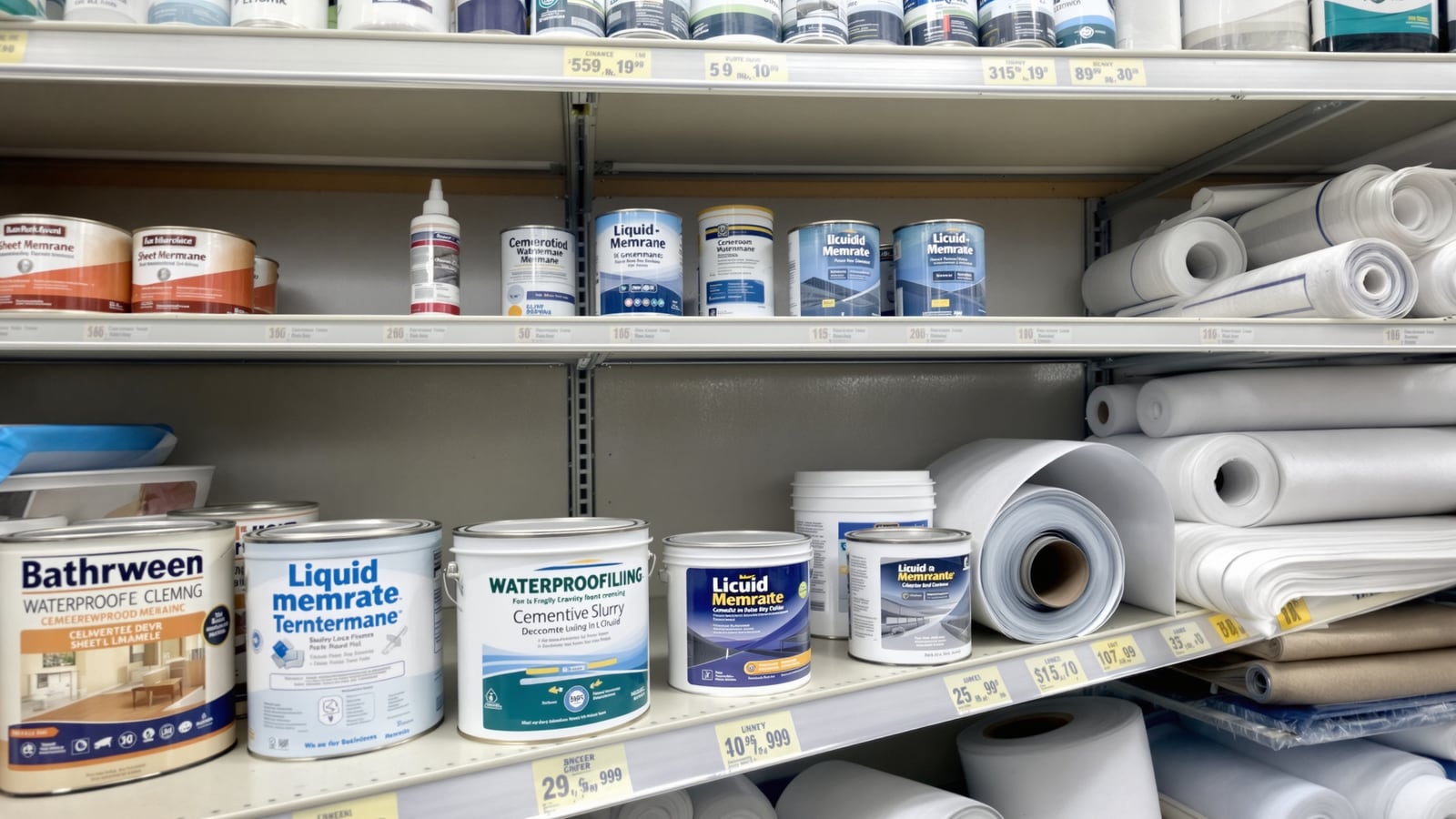
How to Choose a Waterproofing System in India: Buyer's Guide to Membranes, Contractors & Warranty
A buyer's decision guide to choosing a bathroom waterproofing system in India — matching the system to your situation, picking the membrane by budget and performance, judging the contractor and warranty, and reading a quote so you pay for a job that lasts.
Waterproofing is the one bathroom decision you cannot see, cannot easily fix, and cannot afford to get wrong. Everything else — the tiles, the faucet, the vanity — you can swap in a weekend. But the membrane hides under the screed and the tiles, and when it fails, the repair means demolishing a finished bathroom and often the ceiling of the room below. So choosing a waterproofing system is less about buying a product off a shelf and more about buying an outcome: a dry slab, ten years from now, backed by someone who will come back if it leaks.
This is a buyer's guide. It is not the how-to — for the coat-by-coat method, surface prep, coving and tile-over sequence, read the complete bathroom waterproofing guide for India. This page is the decision layer that sits on top: how to match the system to your situation, how to read a quote, and how to tell a contractor who will protect you from one who will disappear.
You are not buying litres of chemical. You are buying a warranted, tested, watertight system — and 70% of what you pay for is the labour and the discipline, not the bucket.
Start with your situation, not the product
The single biggest mistake buyers make is asking "which is the best waterproofing?" before asking "what am I actually waterproofing?" The right system falls out of the situation. There are three common ones in Indian homes, and each points to a different answer.
- New construction, sunken slab. You have a bare RCC sunken slab, dry-ish, and full access before plumbing and screed go in. This is the easy case — a cementitious system with fibre-mesh reinforcement at junctions is the workhorse, and you can flood-test properly before anything covers it.
- Renovation over an existing bathroom. The slab is old, possibly already leaking, access is tight and you are working around finishes below. Here forgiveness matters more than cost — a flexible liquid membrane (acrylic or PU) that bridges existing hairline cracks and turns up walls without demolition earns its price.
- Terrace or exposed deck above a bathroom. UV, 45°C summer heat and sharp day-night thermal swings destroy rigid coatings. This situation demands a high-elongation exposed system — PU or a PVC/HDPE sheet — never a cementitious slurry.
Then pick the membrane by budget and performance
Once the situation narrows the field, the choice between membrane chemistries is a budget-versus-performance trade. Do not treat these prices as the product cost — treat them as system rates including surface prep, primer, the specified number of coats and labour. For the full technical comparison on elongation and durability, see the waterproofing membrane types guide.
| Membrane | Situation it suits | Flexibility (elongation) | Design life | System ₹ / sq ft | Buyer's verdict |
|---|---|---|---|---|---|
| Cementitious (2-K polymer) | Internal sunken slabs, walls | Low (5–15%) | 8–12 yrs | 25–55 | Best value for indoor new build |
| Acrylic / liquid | Renovations, balconies, damp walls | High (100–250%) | 6–10 yrs | 35–70 | Forgiving and easy over old slabs |
| Polyurethane (PU) | Terraces, high-movement wet zones | Very high (300–500%) | 12–20 yrs | 80–160 | Premium, long-life, exposed decks |
| Sheet (bituminous / PVC / HDPE) | Large decks, basements, podiums | Medium–high | 10–25 yrs | 60–180 | Guaranteed thickness, needs skilled crew |
Indicative 2026 metro pricing; rates swing with brand, number of coats and site access.
Good, better, best — what your budget buys
Buyers respond to tiers, so here is the honest version. The jump from "good" to "better" is almost always worth it; the jump to "best" is worth it only when the situation (a terrace, a history of leaks, a premium fitout) justifies it.
| Tier | System | ₹ / sq ft (system) | Coats / build | Warranty you should expect | Best for |
|---|---|---|---|---|---|
| Good | Single brand cementitious, 2 coats, mesh at corners | 25–45 | 2 coats + coving | 5 yrs brand, 1–2 yrs applicator | Budget internal bathroom, new slab |
| Better | 2-K cementitious + acrylic top or full acrylic, mesh throughout | 55–90 | 3 coats + full junction band | 8–10 yrs system | Most homes; renovation over old slab |
| Best | PU or hybrid PU-cementitious, full mesh, primed | 120–200 | Primer + 3 coats + reinforced junctions | 10–15 yrs written system | Terrace, luxury bathroom, leak history |
A typical 45–55 sq ft bathroom therefore runs roughly ₹1,500–2,500 (good), ₹3,000–5,000 (better) or ₹6,500–11,000 (best) as a complete system — a rounding error against the ₹1–3 lakh you will spend on the finished bathroom, and against the ₹40,000-plus a future leak repair costs.
The labour matters more than the product
Here is the truth the brochures bury: a top-tier membrane applied badly leaks, and a mid-tier membrane applied well stays dry for a decade. Field failures are almost never the chemical's fault — they are thin coats, skipped primer, ignored coving at the floor-wall junction, and no flood test. That means the contractor is the product you are really buying. When you evaluate an applicator, judge:
- Brand-certified applicator status. Major brands (Dr. Fixit/Pidilite, Fosroc, Sika, MYK Laticrete, Ardex) train and license applicators. A certified crew unlocks the brand warranty; a random mason does not.
- A joint warranty, in writing. You want two promises: the manufacturer's material warranty and the applicator's workmanship warranty. A product warranty alone is worthless if no one is accountable for the application.
- Photographic method. Good crews photograph surface prep, each coat, the mesh at junctions and the flood test. Ask to see a past job's photo record — its absence is telling.
- Referenceable past work. Two-to-three-year-old bathrooms they waterproofed that are still dry beat any sales pitch.
What a proper quote actually includes
A real waterproofing quote is a method statement with a price on it, not a one-line "waterproofing – ₹X". Before you pay, confirm the quote spells out every line below. If it does not, you are buying a guess.
The flood test deserves special emphasis. Plug the drain, fill the sunken slab or floor with 25–50 mm of water, mark the level, and leave it 48 hours. If the level drops or the ceiling below darkens, the membrane failed and it gets fixed before tiles go on — when fixing costs nothing. A contractor who resists the flood test is telling you they do not trust their own work. Learn the full inspection routine in the waterproofing inspection guide.
Red flags in a cheap quote
A price that undercuts everyone by 40% is not a bargain — it is a list of the steps that were removed to hit that number. Distrust a quote or pitch that:
- Prices "per sq ft" with no system named. ₹18/sq ft with no brand or coat count means one thin coat of diluted slurry.
- Skips the primer or the flood test — the two cheapest things to cut and the two most damaging to lose.
- Offers a "10-year warranty" verbally but will not put the applicator's name and workmanship term on paper.
- Has no mesh or junction line item. Nearly all leaks start at coving and pipe penetrations; a quote silent on junctions is planning to skip them.
- Pushes a "waterproof" additive mixed into plaster as the whole system. Integral admixtures help, but they are not a substitute for a membrane.
- Cannot show one dry, referenceable job from two or more years ago.
Questions to ask before you sign
Treat the sit-down like a job interview. Ask: Which brand and exact product? Are you a certified applicator for it? How many coats and what total thickness? Who covers me if it leaks in year three — you or the brand? Will you do a 48-hour flood test in front of me? Can I see photos and a two-year-old reference? The answers separate a system you can trust from a bucket and a prayer.
For where waterproofing sits in your wider bathroom budget and how it interacts with tiling, plumbing and finishes, step back to the bathroom shopping guide for India. Get this one invisible layer right, and every visible thing above it stays exactly where you put it — dry, sound and unbothered by the next monsoon.
References
- NBC 2016 (National Building Code of India), Part 6 — dampproofing and waterproofing provisions.
- IS 2645 — Integral Cement Waterproofing Compounds — specification.
- IS 3067 — Code of Practice for General Design Details and Preparatory Work for Damp-Proofing and Waterproofing of Buildings.
- IS 13182 / IS 1322 — bitumen and bituminous felt / sheet membrane specifications.
- CPWD Specifications and CPHEEO Manual — accepted waterproofing systems and flood-test practice.
- IGBC / GRIHA — water-leak-prevention and durability credits guiding system selection in green homes.
Export this guide
Related Guides — Deep-dive reading
Cementitious Waterproofing India: Coatings, Coats & Cost (2026)
How cement-based waterproofing coatings work in Indian bathrooms — one- vs two-component, polymer-modified slurries, surface prep, number of coats, curing, where they suit sunken slabs and wet areas, and where their low flexibility lets you down, with rupee costs.
BathroomsBathroom Leak Prevention India: Detailing the Junctions That Stop Water Reaching the Flat Below
Bathroom leaks almost never come from a broken pipe — they come from a badly detailed junction. Here is how to get the wall-floor corner, pipe penetrations, floor trap, nahani trap and door threshold right, plus the flood test that catches a leak before you tile.
BathroomsBathroom Waterproofing India: The Complete Guide to Membranes, Detailing, Testing & Cost
Why and where bathrooms leak, the full waterproofing system layer by layer, how the membrane types compare, the critical junction detailing, the flood test, warranties, and honest ₹ per sq ft costs for an Indian home.
BathroomsRelated Tools — Try Free
Bathroom Renovation Cost Calculator
Cost to renovate an existing bathroom with a replace-vs-keep model — demolition, re-waterproofing, tiles, fittings and the money saved by keeping items.
Bathroom CalculatorMonsoon-Readiness Checklist
Pre-rain home audit across 9 categories — terrace, drains, waterproofing, electrical, HVAC, pest, vehicles, documents.
Seasonal AuditMaterial Schedule Generator
Generate a room-wise finish schedule — walls, floors, ceilings, trim, and joinery by location.
Material Schedule