
Honeycomb (Cellular) Shades: The Insulating Blind Explained (India 2026)
The pleated blind whose hollow cells trap a layer of still air — for real thermal and acoustic insulation on harsh windows. Single vs double cell, light-filtering vs blackout, top-down/bottom-up and cordless, plus honest Indian costs.
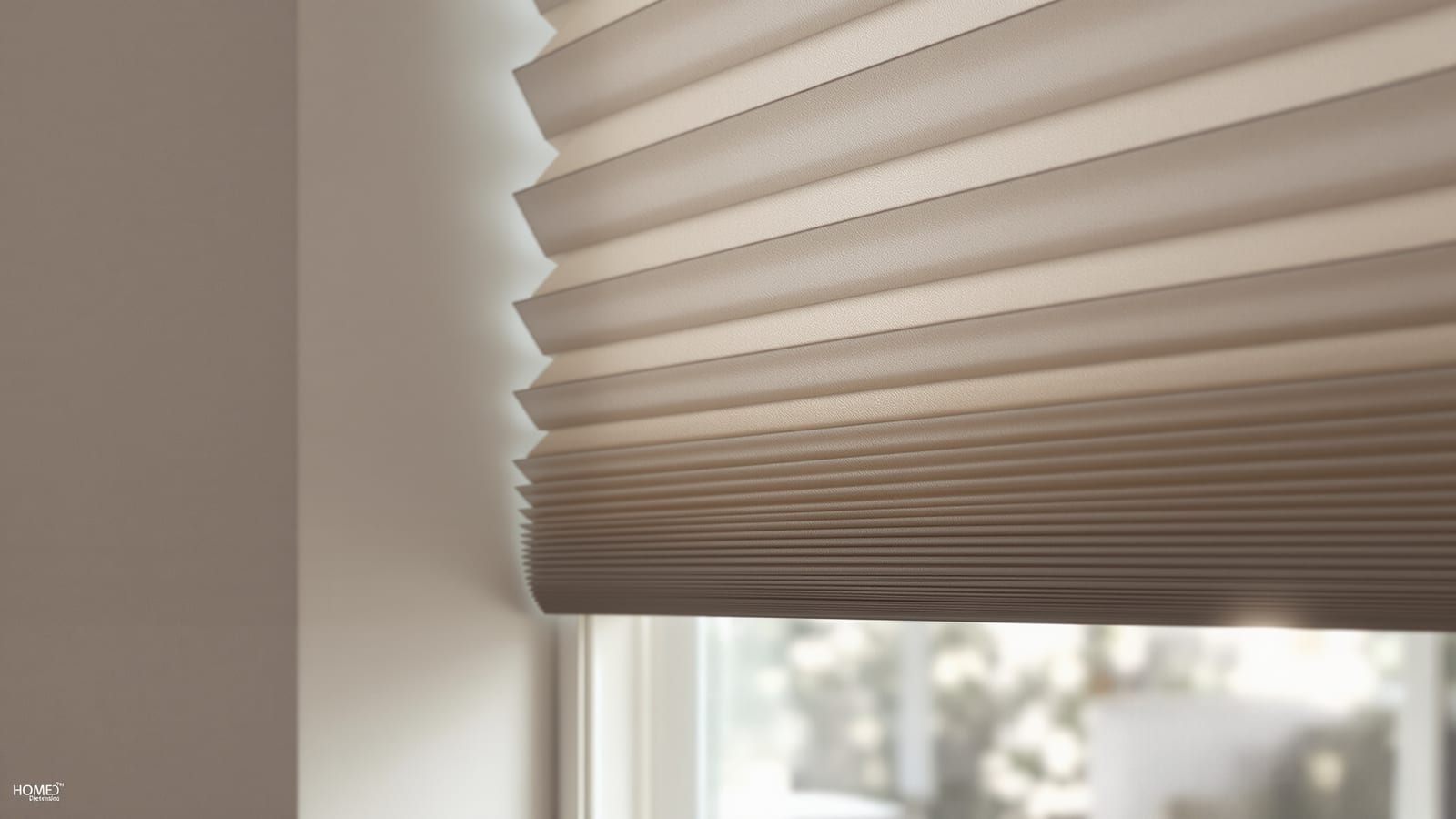
Most blinds are a single flat layer between you and the window. A honeycomb shade is different by design: viewed from the side it looks like a row of tiny hexagonal tubes, each one a sealed pocket of trapped air. That air is the whole point. Still air is a genuinely good insulator, so a honeycomb shade does something an ordinary roller or venetian blind cannot — it slows heat moving through the window in both directions. On a brutal west-facing window in a Pune or Hyderabad summer, that is the difference between a blind that just blocks the view and one that meaningfully cuts the heat hitting your room.
"Honeycomb shade" and "cellular shade" are two names for the same product — the first describes how it looks, the second describes how it works. You will see both on Indian shopping sites, sometimes on the same listing. This guide uses them interchangeably, exactly as the market does.
A honeycomb shade is the only soft window treatment that doubles as insulation. The pleats are not decoration — each cell is a tiny pocket of dead air doing the same job as the cavity in a double-glazed window.
How the cells actually insulate
A roller blind or a curtain blocks light and softens glare, but heat passes through it fairly freely because there is nothing between the fabric and the air to slow it down. A honeycomb shade puts a layer of trapped, motionless air between the room and the glass. Heat struggles to cross still air — it cannot convect, and the soft fabric is a poor conductor — so the shade behaves like a thin, lightweight insulating panel clipped over the window.
That matters most in two Indian situations:
- Hot windows in summer. West and south-facing glass gains serious heat in the afternoon. A closed cellular shade reflects and resists a chunk of it, so the room behind stays cooler and your air conditioner cycles less. Use the Window Heat Gain Calculator to see how much heat a given window is throwing at you before you decide how hard the shade has to work.
- Air-conditioned rooms. The insulation works both ways. In a cooled bedroom, the cells slow the AC's cold air from leaking out through the glass, so the room holds its temperature longer and the compressor rests more.
The same trapped air also softens sound a little — not as much as a heavy lined curtain, but noticeably more than a bare blind. For a street-facing bedroom or a nursery, that quiet is a real bonus.
Single cell vs double cell
The biggest choice is how many rows of air pockets the shade has. A single-cell shade has one row of hexagons; a double-cell shade stacks two smaller rows, doubling the trapped-air layers and the insulation.
| Single cell | Double cell | |
|---|---|---|
| Air pockets | One layer | Two stacked layers |
| Insulation | Good | Best |
| Cell size | Larger (softer, bolder pleats) | Smaller (finer, tighter pleats) |
| Best for | General rooms, mild climates, budget | Harsh sun, AC rooms, cold hill stations |
| Cost | Lower | Higher |
| Stack height (raised) | Slightly more compact | A touch bulkier at the top |
The honest rule: on a genuinely harsh window — west sun, top-floor flat, or a heavily air-conditioned bedroom — pay for double cell. On a north-facing or shaded window where insulation is a nice-to-have rather than the point, single cell is the sensible, cheaper choice. Don't buy double cell out of habit for a window that never sees direct sun; you are paying for insulation you won't use.
Light-filtering vs blackout
Separate from the cell count is the fabric's opacity, and it changes the shade completely:
- Light-filtering (semi-opaque) lets a soft, diffused daylight glow through while still giving daytime privacy. The room stays bright but glare-free — lovely for a living room, study or kitchen.
- Room-darkening / blackout uses a denser fabric, often with a foil or coated lining inside the cells, to block almost all light. This is what you want for a bedroom, a baby's room, or any space where you sleep in the daytime.
A genuine caveat, the same one that haunts every blind and curtain: blackout fabric does not equal a blackout room. A honeycomb shade mounted inside the window recess still leaves thin light gaps down both sides where the fabric clears the wall. For true darkness you either mount the shade outside the recess so it overlaps the wall, or you accept a faint halo at the edges. If total darkness is the goal, read Blackout Curtains: The Complete Guide — the gap-sealing physics is identical, and a blackout curtain layered over a cellular shade is the most reliable way to get a properly dark Indian bedroom.
Top-down/bottom-up and cordless options
Two control upgrades make cellular shades far more useful than they first appear:
- Top-down/bottom-up (TDBU). The shade can be lowered from the top as well as raised from the bottom, so you can open just the upper portion of the window. You get daylight and a sky view across the top while the lower half stays covered for privacy — perfect for a ground-floor room facing the street or a neighbour's window. It is one of the most loved features of this blind type and worth the small premium.
- Cordless / motorised lift. Cordless shades have no dangling pull cord — you simply push the bottom rail up or down by hand, and it stays put. This is the child-safe and pet-safe choice, which is exactly why cellular shades are so popular in nurseries. Motorised versions add a small battery or wired motor for remote and app control, and pair naturally with the kind of automation covered in the motorised-curtains discussions on the pillar guide.
For a child's room the combination to ask for is plain: cordless lift, blackout fabric, double cell. Safe, dark, and quiet.
Pros and cons, honestly
Where honeycomb shades win:
- The best insulation of any soft window treatment — real summer-heat and AC savings on harsh windows.
- Clean, modern, uncluttered look; they sit flat and take up little visual space.
- A small but real acoustic softening.
- Cordless and TDBU options make them genuinely child-safe and flexible.
- Lightweight and easy to raise even on tall windows.
Where they fall short — and you should know before you buy:
- Cost. They are pricier than a basic roller or venetian blind, especially in double-cell or blackout.
- Cleaning. Dust settles inside the cells and is fiddly to remove — a vacuum brush or a hair-dryer on cool to blow dust out, not a wet wipe. In dusty Indian cities this is a real chore.
- No view when down. Unlike a venetian blind, you can't tilt slats to see out; the shade is either up, down, or somewhere between.
- Crushing and fading. Cheap cellular fabric can crease permanently or yellow in years of hard sun — buy a quality, fade-resistant fabric for any sunny window.
- Moisture. They are fabric, so they don't love a steamy bathroom or an open monsoon-facing window; a roller blind handles damp better there. Compare the trade-offs in Curtains vs Blinds.
What honeycomb shades cost in India
Prices vary with cell count, fabric, blackout lining, size and brand, so treat these as honest ranges rather than quotes (per square foot, made-to-measure, including basic fitting):
| Specification | Indicative cost (per sq ft) |
|---|---|
| Single cell, light-filtering | ₹150–₹300 |
| Single cell, blackout | ₹250–₹450 |
| Double cell, light-filtering | ₹300–₹500 |
| Double cell, blackout | ₹400–₹700 |
| Top-down/bottom-up add-on | +₹50–₹150 per sq ft |
| Motorised lift | +₹4,000–₹12,000 per shade |
A typical bedroom window of about 12 square feet in double-cell blackout therefore lands roughly in the ₹5,000–₹9,000 range fitted, before motorisation. That is more than a roller blind but less than a layered curtain-plus-sheer setup — and on a hot window the energy saving claws some of it back. For a like-for-like comparison against fabric, the Curtain Cost Calculator sizes the fabric alternative so you can weigh the two.
Best rooms for cellular shades
These shades earn their premium in specific places:
- Bedrooms, especially with double-cell blackout fabric for dark, cool, quiet sleep.
- West- and south-facing windows that bake in the afternoon — this is where the insulation pays off hardest.
- Nurseries and kids' rooms, for the cordless safety plus blackout for daytime naps.
- Air-conditioned rooms anywhere, where holding the cool in cuts running cost.
- Home offices and studies, using light-filtering fabric to kill screen glare without going dark.
Where they make less sense: humid bathrooms, kitchen windows near the hob, and shaded north windows where you are paying for insulation you'll never feel.
How to decide
Name the window's main job first. If it is heat or AC efficiency, lead with double cell. If it is sleep or daytime darkness, lead with blackout fabric and plan to seal the edge gaps. If it is a child's room, insist on cordless. If it is glare without gloom, single-cell light-filtering is plenty. And if a window faces real damp, a cellular shade is the wrong tool — choose a roller or curtain instead.
Still unsure how cellular shades stack up against rollers, venetians, romans and curtains for your specific window? Run your room through the Window Treatment Selector — it matches your priorities to the right treatment in a minute — then come back to the Window Treatments pillar guide for the full picture across every option.
Export this guide
Related Guides — Deep-dive reading
Curtains vs Blinds: The Complete Comparison for Indian Homes (2026)
Light, privacy, heat, noise, cleaning, cost and looks — a head-to-head verdict on curtains and blinds, plus the under-rated answer most good designers actually use: both.
Window TreatmentsWindow Design for Villas (India): Using the Freedom of All Four Sides
With walls free on all four sides, you can tune every window to its sun: north light for studies, east for bedrooms, shaded south for living, minimal west, plus feature windows, dual-aspect rooms and stairwell glazing.
Windows & GlazingCurtains vs Roller Blinds: Which for Your Window? (India 2026)
A head-to-head on light, privacy, heat, acoustics, cost and cleaning — when a roller blind wins, when curtains win, and the quiet trick of using both on the same window.
Window TreatmentsRelated Tools — Try Free
Window Treatment Selector
Curtains, blinds or a layered system? Answer five questions about your room and get a specific recommendation.
SelectorCurtain Cost Calculator
Get the fabric metres you need plus the total curtain cost by window size, fabric, pleat, lining and hardware.
Curtain CalculatorCross-Ventilation Analyzer
Estimate airflow and air changes per hour (ACH) from room size, window areas, layout, and local wind — with NBC 2016 Part 8 compliance check.
Ventilation Calculator