
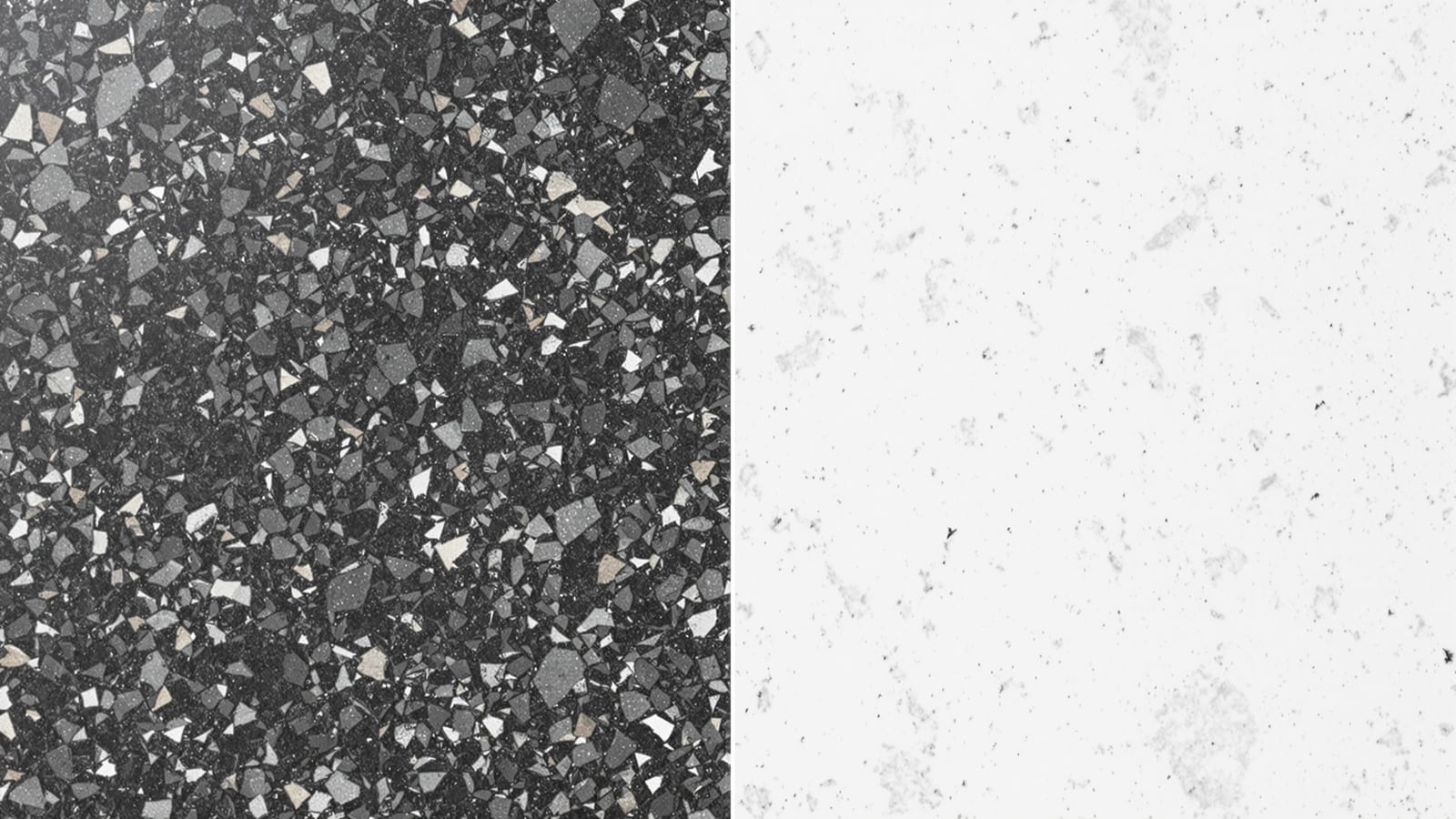
Granite vs Quartz Bathroom Countertop: Which Is Better? (India)
A fair, India-first head-to-head between natural granite and engineered quartz for a bathroom vanity top — sealing and porosity, durability and heat, look, price in ₹, maintenance and availability, with a clear verdict for the common Indian bathroom.
Walk into any Indian stone yard with "bathroom vanity" on your lips and you will be steered toward two slabs: natural granite, the quarried budget workhorse, and engineered quartz, the factory-made low-maintenance rival. Both make an excellent vanity top. The honest truth is that neither is universally "better" — they win on different rows, and the right pick depends on your budget, your water, and how much upkeep you are willing to do.
This is a comparison guide in the Studio Matrx bathroom hub. If you want the full single-material detail, read the granite bathroom countertop guide and the quartz vanity top guide alongside this. For the cabinet and layout the top sits on, see the bathroom vanity guide for India; and if marble is also on your shortlist, the quartz vs marble vanity comparison covers that duel.
For most Indian bathrooms with hard water, quartz is the lower-worry choice — non-porous, no sealing, ever. But granite is genuinely cheaper, tougher against heat, and every slab is unique. If you will seal it on schedule, granite is not a compromise. It is a real toss-up decided by budget and diligence.
The core difference: one is porous, one is not
Everything else flows from a single fact. Granite is a natural, porous stone quarried from the earth; left unsealed it slowly drinks in water, oil, hair-dye, coffee and mehndi, and those stains darken over a season. Quartz is engineered — roughly 90–93% crushed quartz mineral bound with about 7–10% polymer resin — and that resin makes the slab non-porous, so it never needs sealing and never absorbs a stain.
- Granite must be sealed on installation and re-sealed roughly once or twice a year (a five-minute wipe-on job). Skip it and it stains.
- Quartz needs no sealer, ever. You wipe it clean and walk away.
For a busy family bathroom in a hard-water city, that maintenance gap is the headline. But it is only one row of the scorecard.
Sealing and porosity — quartz wins
Granite's porosity is its one honest weakness. A well-sealed granite counter shrugs off water and stains, but the seal wears and must be renewed. Quartz never asks. If you dread maintenance, or the bathroom belongs to children or tenants who will never touch a bottle of sealer, quartz removes the risk entirely. Winner: quartz.
Durability and heat — a split
Both are extremely hard and scratch-resistant — you will not gouge either with everyday grit, jewellery or a dropped tap spanner. The difference is heat. Granite is igneous stone that cooled from magma, so it genuinely tolerates a hot styling iron or a just-boiled geyser bucket. Quartz's resin binder softens and can scorch or discolour above roughly 150 °C, so it wants a trivet under hot tools. On raw impact and edge-chip resistance the two are close; quartz's uniform body resists chipping slightly better at thin edges. Winner: granite on heat; a near-tie on scratch and impact.
Look — taste, not quality
- Granite gives you natural, one-of-a-kind mineral flecks and movement. No two slabs are identical, which is exactly why you should select your actual slab at the yard rather than order by a chip.
- Quartz gives you uniform, predictable colour — clean whites, greys and stone-look veining that repeat consistently across the slab, easy to match to tiles and cabinets.
Neither is "better"; it is whether you want natural character or engineered calm. Winner: personal preference.
Price in India — granite wins
This is where granite earns its default status. Because it is quarried and processed domestically at scale, granite is the cheapest genuine stone top in India. Quartz — especially imported premium — costs more, though good domestic quartz has narrowed the gap.
| Item | Granite (₹/sq ft) | Quartz (₹/sq ft) |
|---|---|---|
| Value / entry slab | ₹80–₹180 | ₹110–₹180 |
| Mid-range | ₹180–₹300 | ₹180–₹320 |
| Premium / imported | ₹300–₹600 | ₹350–₹900+ |
| Fabrication + fitting | ₹150–₹400 / running ft | ₹150–₹400 / running ft |
| Lifetime sealer | ₹150–₹400 / yr | Nil |
For a standard single vanity (about 6–8 sq ft of top), granite is usually the cheaper finished job — but mid domestic quartz is often only a modest premium, and you never buy sealer again. Winner: granite on upfront cost; quartz narrows it over the years.
Maintenance and hard water
Day to day, quartz is the easier surface: wipe with a soft cloth and mild soap, done. Granite is nearly as easy but needs the periodic seal and prefers pH-neutral cleaners (acidic cleaners can dull it). Both handle hard water well; on both, wiping the counter dry after use is the single best habit to stop white limescale marks. Winner: quartz, marginally.
Availability
Granite is available in every Indian town — quarried across Andhra, Karnataka, Tamil Nadu and Rajasthan — with fabricators on every high street. Quartz is widely available in metros and tier-1 cities through branded dealers (Kalinga, Pokarna Quantra, Caesarstone and others), but choice thins in smaller towns. Winner: granite on reach.
Installation and fabrication — the same for both
Once you have chosen, the fitting job is nearly identical. Both are cut and edge-polished at the fabricator's workshop, the basin cut-out is made off-site, and the finished top is carried in and bedded onto the vanity cabinet. A few points apply equally to granite and quartz:
- Slab thickness. Use an 18–20 mm slab for a load-bearing vanity; thinner stone can crack around the basin cut-out.
- Support. The cabinet or frame must carry the weight evenly — an unsupported overhang over 300 mm needs a bracket.
- Seams. Keep any seam away from the basin cut-out, where the top is weakest.
- The basin. Whether you drop an under-counter bowl into a polished cut-out or sit a counter-top basin on the surface, seal the joint with a good silicone to stop water tracking underneath.
The one extra granite step is the sealer coat on the day of fitting, and again once or twice a year after. Quartz skips it. Neither is a DIY job — both need a fabricator with a wet cutter, so factor fabrication and fitting (₹150–₹400 per running foot) into either budget.
Resale and perceived value
At sale or rent time both read as a "solid stone counter" to most viewers, which is well above a laminate or a tiled top. Branded quartz, with its clean uniform look and warranty paperwork, sometimes photographs a shade more premium in a modern flat; characterful granite reads as honest, natural material. The gap is small, and either lifts the room. Winner: quartz, marginally, in modern metros.
The verdict table
| Attribute | Granite | Quartz | Winner |
|---|---|---|---|
| Sealing / porosity | Porous, seal 1–2×/yr | Non-porous, none | Quartz |
| Scratch / hardness | Excellent | Excellent | Tie |
| Heat resistance | Excellent | Softens ~150 °C | Granite |
| Stain resistance (unsealed) | Poor | Excellent | Quartz |
| Look | Natural, unique | Uniform, predictable | Preference |
| Upfront price (India) | Lowest | Modest premium | Granite |
| Lifetime maintenance | Periodic sealing | Wipe only | Quartz |
| Availability | Everywhere | Metros / dealers | Granite |
| Resale / perceived value | Solid | Slightly higher | Quartz |
Which should you choose?
| Pick granite if… | Pick quartz if… |
|---|---|
| Budget is the deciding factor | You want zero maintenance |
| You rest hot styling tools on the counter | The bathroom is for kids or tenants |
| You love natural, one-off stone character | You want uniform, easy-to-match colour |
| You are in a smaller town | You are in a metro with branded dealers |
| You will seal it on schedule | You will never touch a bottle of sealer |
For the common Indian bathroom — hard water, a busy family, a mid-range budget — this is genuinely close. If you are diligent, granite gives you a tougher, cheaper, characterful top that will outlive the bathroom. If you would rather never think about the counter again, mid domestic quartz costs only a little more and asks nothing of you. Our lean for a low-worry, hard-water household is quartz; our lean for a value-led buyer who will seal on schedule is granite. Neither is a mistake.
References
- Bureau of Indian Standards — IS 3316 (structural granite) and related dimension-stone standards.
- National Building Code of India (NBC) 2016 — sanitary and finishing provisions for bathrooms.
- Manufacturer technical datasheets for engineered quartz (quartz content, heat limits and warranty terms) — verify with the specific brand and slab.
Export this guide
Related Guides — Deep-dive reading
Quartz Bathroom Countertop India: Engineered Quartz Vanity Tops, Cost & vs Granite/Marble
A practical, India-first guide to engineered quartz vanity tops for bathrooms — why the non-porous, no-seal surface beats granite and marble on a wet counter, plus thickness, seams, heat caution, brand quality and honest ₹ per sq ft costs.
BathroomsGranite Bathroom Countertop India: Vanity Tops, Sealing, Finishes & Cost
A practical, India-first guide to granite vanity countertops for the bathroom — why granite is the durable, heat- and scratch-resistant budget favourite, how to seal a porous stone against hard water and staining, polished versus leather and honed finishes, edge profiles, basin cut-outs, thickness, and honest ₹ per sq ft versus quartz, marble and solid surface.
BathroomsQuartz vs Marble Bathroom Vanity Top: Which Is Better? (India)
A fair, India-first head-to-head between engineered quartz and natural marble for a bathroom vanity top — porosity, staining and etching, durability, that unmistakable marble veining, maintenance, ₹ cost and an honest verdict for the wet Indian counter.
BathroomsRelated Tools — Try Free
Material Compare — Side by Side
Compare materials side-by-side: granite vs quartz vs marble, laminate vs acrylic vs PU, and more.
ComparisonMaterial Comparison Sheet
India's interior material cheatsheet — plywood, finishes, hardware, countertops, paints, waterproofing.
Reference GuideMaterial Decision Framework (M-Score)
Score 30+ Indian construction materials across cost, durability, climate fit, maintenance, and sustainability.
Materials