
Golconda Fort: The Fortress That Listened, and the City That Gave the World Its Diamonds
How the Qutb Shahi kings built a granite hill-fort with an acoustic alarm system so precise that a clap at the gate could be heard at the summit a kilometre away — guarding the richest diamond market on earth
Most forts in this series are built to be seen — to loom, to intimidate, to command the horizon. Golconda, the great hill-fortress near Hyderabad, was also built to hear. Its most famous feature is not a wall or a gate but a sound: stand beneath the domed portico at its main entrance and clap your hands once, sharply, and the clap can be heard clearly at the royal pavilion on the summit of the hill, nearly a kilometre away and more than a hundred metres higher. This was no accident. Golconda's builders engineered acoustics into the very fabric of the fort, turning the whole hillside into a system for carrying sound — an alarm that could warn the king in his palace at the top the instant an enemy reached the gate at the bottom. It is one of the most remarkable pieces of acoustic architecture anywhere in the world, and it makes Golconda unique among the forts in this collection.
Golconda has a second claim to fame that made it a byword for wealth across the entire early-modern world: it was the fortified capital of a kingdom that controlled the richest diamond mines on earth, and its very name became a synonym for fabulous riches.
The fort that could hear
Start with the acoustics, because they are the wonder that sets Golconda apart.
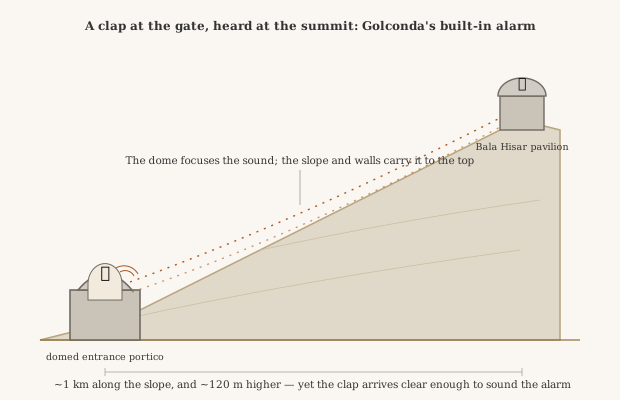
The main entrance, the Fateh Darwaza ("Gate of Victory"), is covered by a domed portico, and the dome is the key. A hand-clap beneath it is focused and reflected by the curved surface of the dome, and the sound is then carried up the fort's rising galleries, walls and the granite slope itself to the Bala Hisar, the royal pavilion crowning the summit. The effect is so reliable that it is traditionally described as a deliberate signalling and alarm system: sentries at the gate could warn the citadel at the very top of any approach, instantly, with nothing more than a clap or a call, long before a runner could have climbed the hill. Whether every detail was designed or partly discovered, the builders clearly understood and exploited the way sound behaves under a dome and along a slope, and they built the fort to use it. In an age before any electrical communication, they turned architecture itself into a telephone line running from the gate to the throne.
This is acoustic engineering of a sophistication we more often associate with concert halls than fortresses, and it belongs to a wider Deccan and Indo-Islamic fascination with the behaviour of sound under domes — the same physics that produces the Whispering Gallery of the Gol Gumbaz at nearby Bijapur, here harnessed not for wonder but for war.
A granite city in rings
Golconda is also a formidable fort in the more conventional sense, and its layout is worth reading.
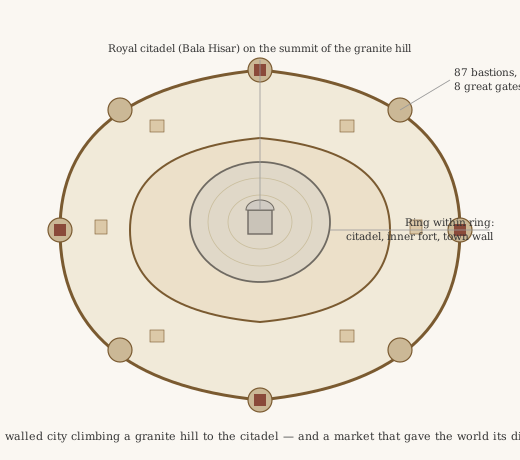
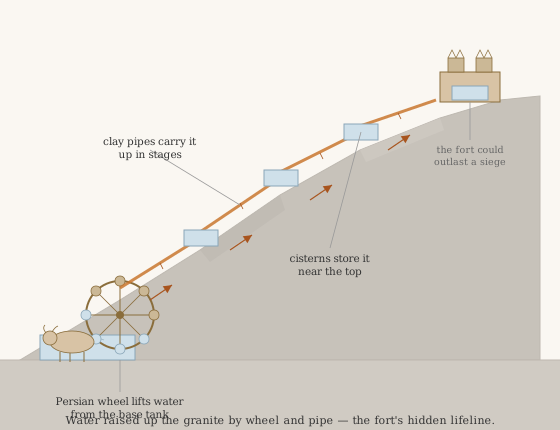
The fort is built up a great granite hill and defended in concentric rings. An outer wall, kilometres long and studded with dozens of bastions — some eighty-seven in all — and pierced by eight great gates, girdles a whole town at the base of the hill. Within it, a second wall encloses the inner fort; and at the centre and summit, on the bare granite dome of the hilltop, stands the innermost citadel, the Bala Hisar, the last refuge and the royal quarter. The gates, like those of the Rajput forts we examined, are studded with iron spikes against elephant charges and set with sharp bends. This is defence in depth: an attacker who breached the outer town wall still faced the inner fort, and then the long climb up the exposed granite to the citadel, watched and, of course, heard the whole way. Ingenious systems of channels and Persian wheels lifted water up the hill to supply the summit, so the fort could withstand a long siege.
Golconda began as a mud fort of the Kakatiya rulers and was rebuilt in massive granite by the Qutb Shahi dynasty in the sixteenth century, when it became their capital — until, as we saw at the Charminar, the crowded, water-short hill-fort drove Muhammad Quli Qutb Shah to found the new city of Hyderabad on the plain below. Golconda remained the treasure-fortress until it finally fell, after a long siege, to the Mughal emperor Aurangzeb in 1687.
The diamonds of Golconda
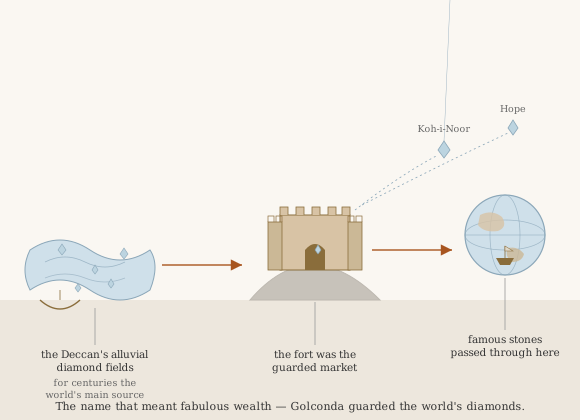
And what a treasure it guarded. The kingdom of Golconda controlled the alluvial diamond fields of the Deccan — for centuries essentially the only significant source of diamonds in the world — and Golconda fort was the fortified market and cutting-centre through which those stones passed to the world. The name became legendary: to say a man had "the wealth of Golconda" was to say he was rich beyond imagining, and the word entered European languages as a synonym for a source of great riches. Some of the most famous diamonds in history are said to have passed through Golconda's market — among them, by tradition, the Koh-i-Noor and the great blue stone that became the Hope Diamond. The fort's mighty walls and its listening architecture were, in the end, guarding the diamond trade of the planet.
Why Golconda matters
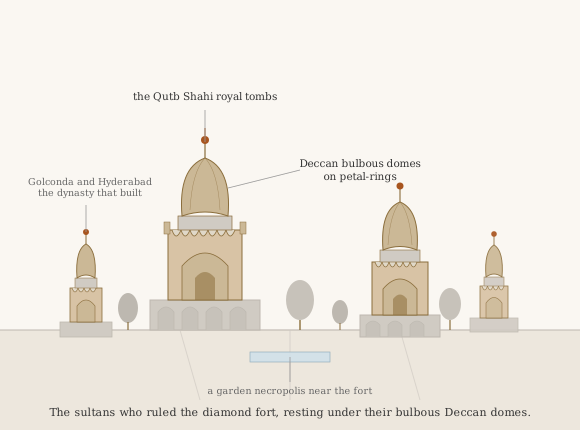
Golconda completes this series' study of the Indian fort by adding a dimension none of the others has: the fort as an instrument of sound and communication. Amber gave us the fort as refined palace; Mehrangarh the fort as impregnable war-machine; Chittorgarh the fort as fortified city and symbol. Golconda gives us the fort as a listening device — a piece of architecture engineered to carry a warning from its gate to its summit through the medium of sound itself. It is a reminder that the builders of these great forts were not only military engineers and masons but, when it served them, acousticians too, who understood how a dome gathers a clap and a slope carries it, and who built that understanding into stone.
Stand today beneath the dome of the Fateh Darwaza, clap once, and imagine the sound running up the dark granite hill to a king in his pavilion four centuries ago, warned in an instant that someone had come to his gate — and you hear, quite literally, the intelligence hidden in one of the great fortresses of the Deccan.
Part of the Architectural Wonders series. For the city its rulers left it to found, read the Charminar; for the Deccan's other great acoustic marvel, the whispering dome of the Gol Gumbaz; and for the Indian fort in its other modes, Mehrangarh and Chittorgarh.
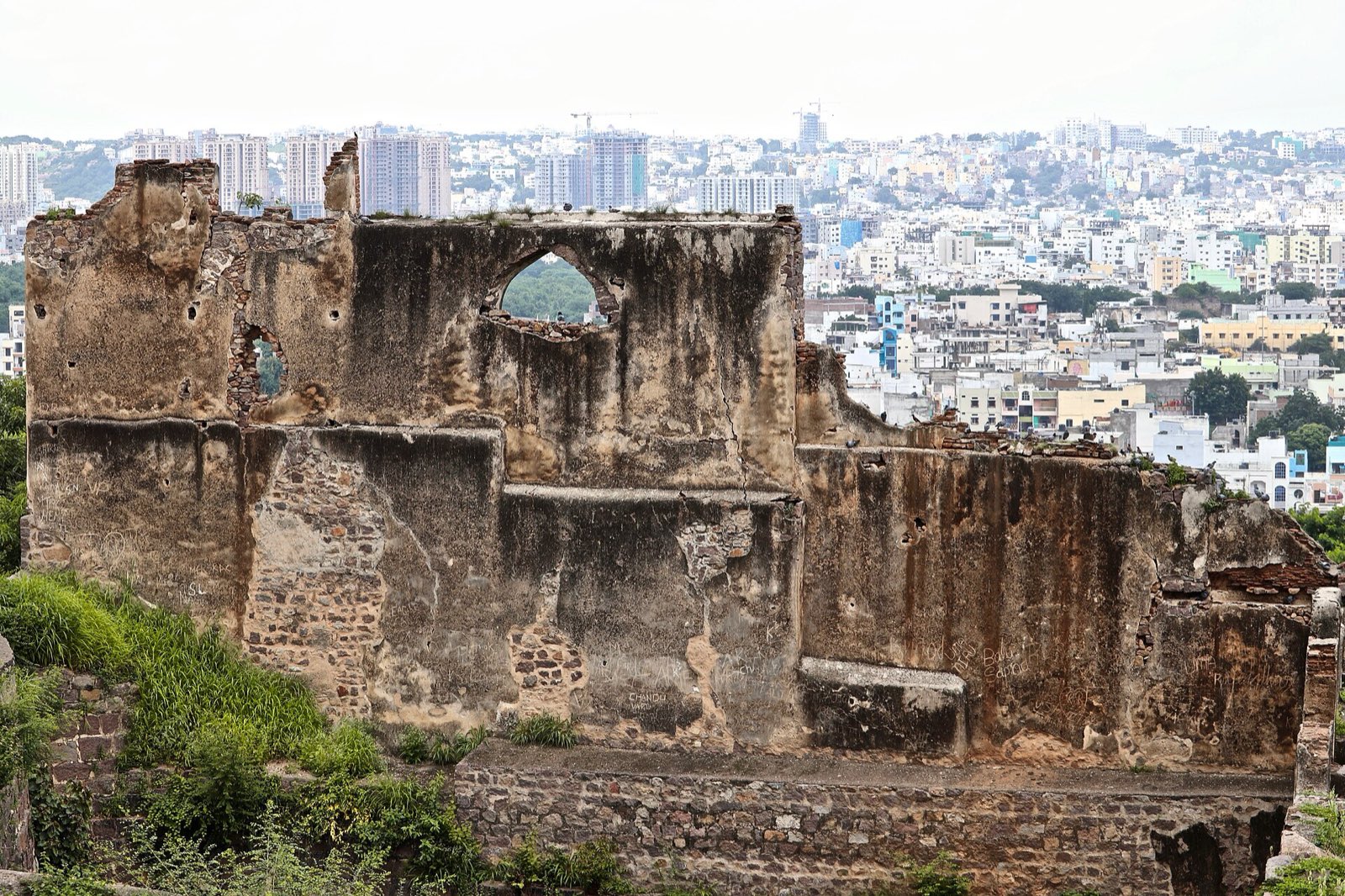
Hero photograph: “Golconda Fort, Hyderabad” by iMahesh, via Wikimedia Commons, licensed under CC BY-SA 4.0.
Export this guide
Related Guides — Deep-dive reading
The Charminar, Hyderabad: A City Founded on a Crossroads
How the Qutb Shahi sultans marked the birth of a new capital with a four-faced arch you drive straight through — part triumphal gateway, part mosque, part the still point at the centre of a planned city
Architectural WondersMehrangarh Fort, Jodhpur: A Citadel Grown from the Rock
How the Rathore kings of Marwar raised one of the mightiest forts in India on a sheer cliff above the blue city — a fist of stone whose brutal walls and trapped gateways guard a hidden jewel of delicate palaces
Architectural WondersAmber Fort, Jaipur: The Rajput Palace That Learned to Speak Mughal
How the warrior-kings of the desert built a fortress-palace up a hillside above a lake — half stronghold, half pleasure-house — where mirrors, lattices and running water turned defence into delight
Architectural WondersRelated Tools — Try Free
Before & After Studio
Generate AI before-and-after renders to preview how your redesign could look.
DesignAIAcoustic Privacy (STC) Visualizer
Indian healthcare acoustic visualizer — compare wall assemblies and noise sources, see received SPL after STC attenuation, and check FGI 2018 / IS 1950 / NABH speech-privacy compliance with live dual-canvas waveform.
Acoustic ToolMain Door Design Selector
Answer a few questions and get a main-door style — traditional, contemporary, luxury or budget-smart — plus material.
Design Selector