
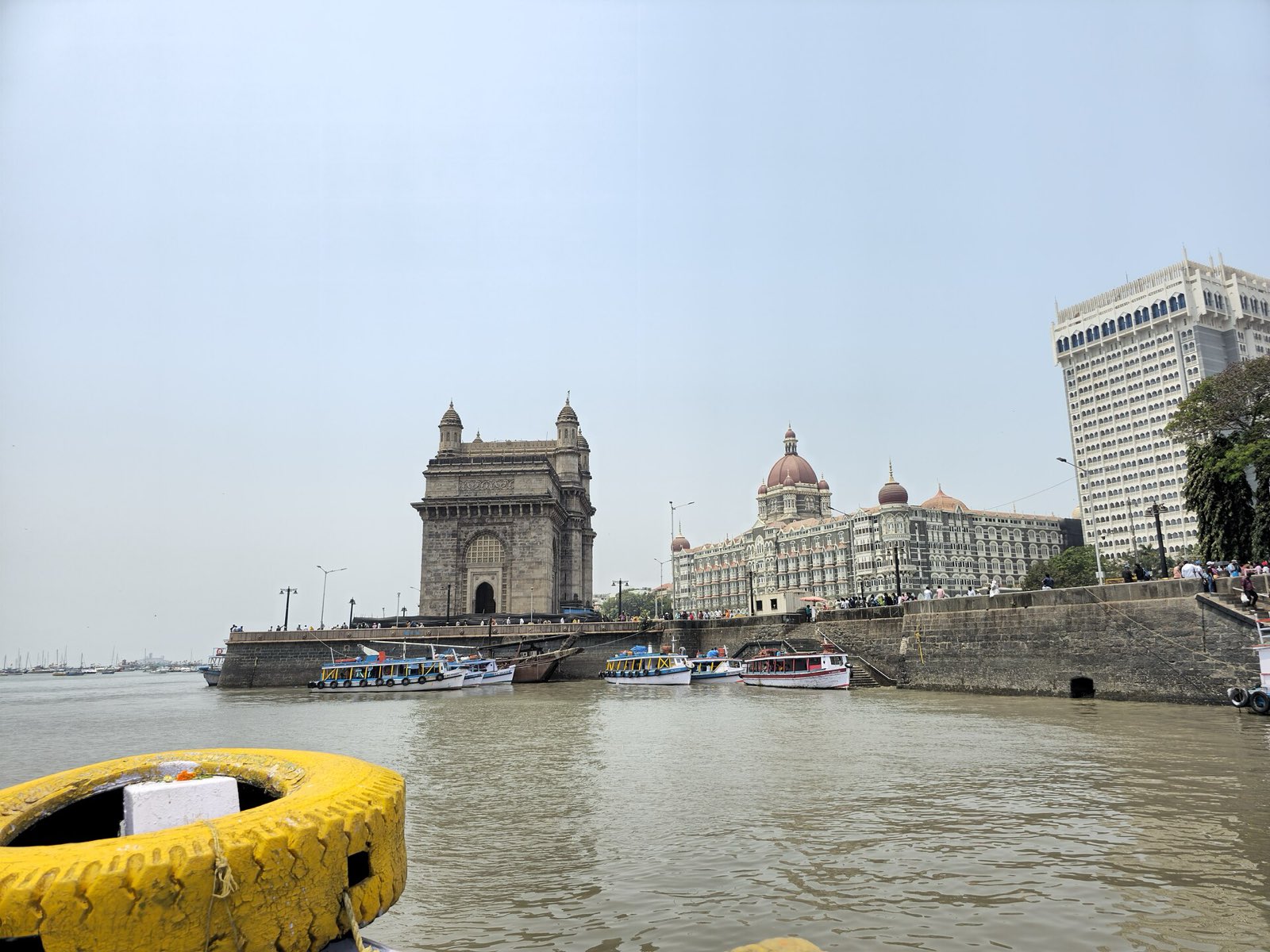
The Gateway of India: The Door an Empire Came Through — and Left By
How Bombay built a great ceremonial arch on its harbour to welcome a king from the sea, in a style borrowed from India's own past — and how, within a generation, the same arch became the door through which the British Empire finally departed
Some buildings mean more than they were meant to. The Gateway of India, the great ceremonial arch that stands on the harbour front of Mumbai, was built for a simple and rather grand purpose: to be a monumental doorway, a triumphal arch on the sea, through which important visitors — above all the British king-emperor — would ceremonially enter India. It is a handsome, confident, Indo-Islamic arch, and if that were all, it would be a minor entry in this series. But history gave it a second and far heavier meaning. The arch built to welcome an empire became, within a single generation, the door through which that empire departed. It is one of the most poignant buildings in India, not for what it looks like, but for what passed through it.
An arch to welcome a king
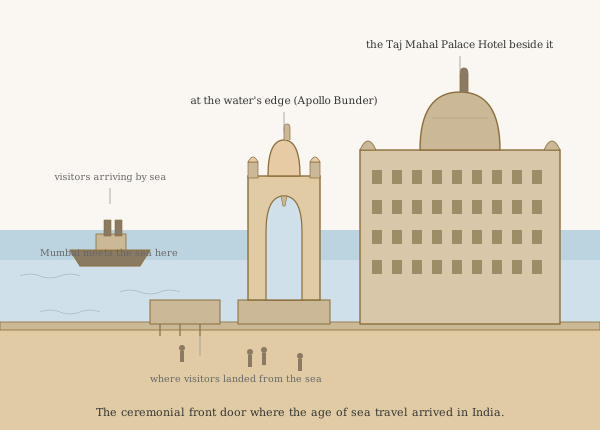
The Gateway of India was built to commemorate the visit of King George V and Queen Mary to India in 1911 — the first time a reigning British monarch had come to the country — when they landed at this spot on the Bombay waterfront, the Apollo Bunder. A grand permanent arch was commissioned to mark the place of the royal landing, designed by the Scottish architect George Wittet and completed in 1924. Built of honey-coloured basalt, its great central archway rising about twenty-six metres, it was conceived as the ceremonial "front door" of British India: the point at which a visitor arriving by sea — and in the age before air travel, the important visitors all arrived by sea — would first set foot on Indian soil and pass, symbolically, through a monumental gate into the empire.
The building is, in the fullest sense, a threshold — a building type as old as architecture, the triumphal arch that marks a passage from one realm to another, here placed at the meeting of sea and land.
An imperial arch in an Indian style
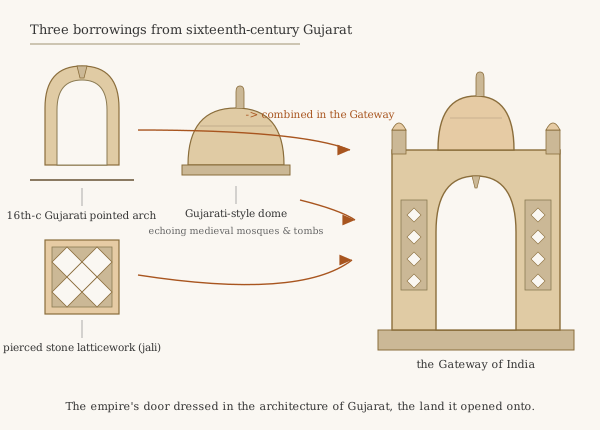
What makes the Gateway architecturally interesting is the style Wittet chose, and it is worth reading closely.
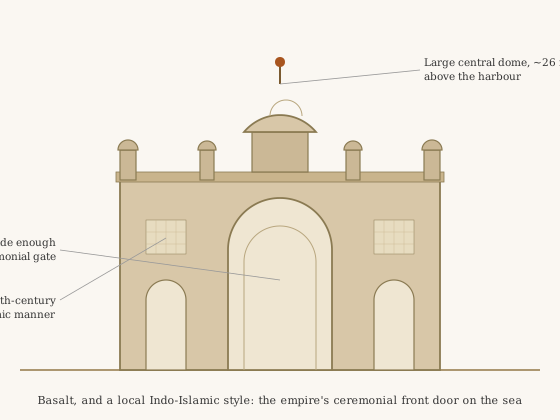
A great central pointed archway is flanked by lower halls, the whole crowned by a large central dome and set with four small turrets and worked with fine latticed screens. This is Indo-Saracenic architecture — the fusion style we met at the Victoria Memorial and Chhatrapati Shivaji Terminus — but Wittet's version is more specific and more locally rooted than most. He drew his forms not from a generic "Mughal" repertoire but quite deliberately from the sixteenth-century Islamic architecture of Gujarat, the region whose great port had long been Bombay's hinterland: the particular proportions of the arch, the latticed stonework, the dome all echo the mosques and tombs of medieval Gujarat. So the empire's ceremonial doorway was dressed, thoughtfully, in the architectural language of the very land it opened onto — a gesture, like the stupa-dome of Rashtrapati Bhavan, of an imperial architecture trying to root itself in India's own forms.
The result is a building that manages to be both an imperial monument and a genuinely Indian one, and Mumbai took it to heart: standing beside the great Taj Mahal Palace Hotel on the harbour, it quickly became, and remains, the single most recognisable symbol of the city — the place where Mumbai meets the sea.
The door the empire left by
And then history turned the building's meaning inside out.
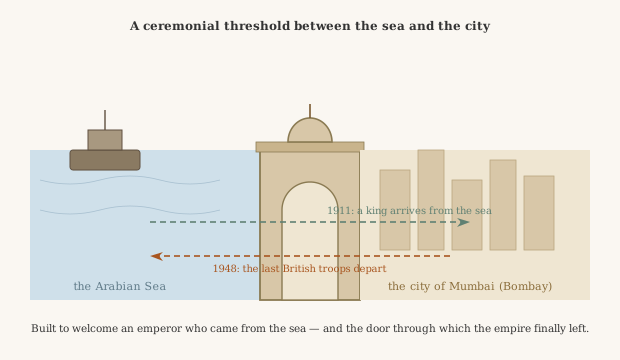
India became independent in August 1947. The following February, the last British troops to leave India — the First Battalion of the Somerset Light Infantry — marched in a farewell ceremony down to the harbour and embarked for home, passing out of the country through the Gateway of India. The arch built in 1924 to welcome the king-emperor arriving from the sea became, in 1948, the door through which the empire made its final exit. The same threshold served both the arrival and the departure of British power: welcome and farewell, framed by the same stone arch on the same stretch of water. Few buildings anywhere carry so neatly, and so movingly, the whole arc of an era — the confident imperial entrance and the quiet imperial leaving, twenty-four years apart, through one gate.
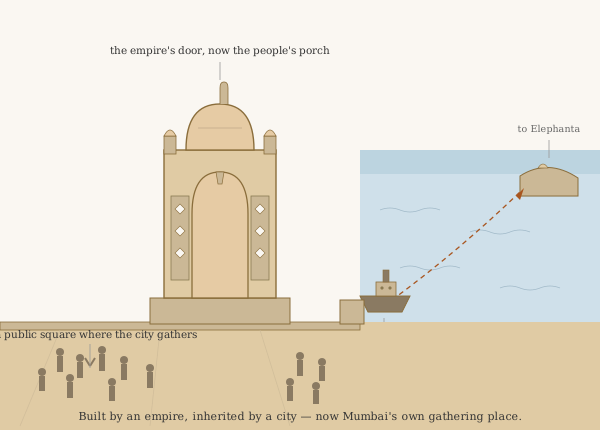
There is a deep and deliberate irony in it that no architect could have designed. Wittet built a monument to the permanence of British India; it ended its imperial life as the monument to that empire's end. And in the decades since, the Gateway has been reclaimed entirely by the city and the nation — a public square where Mumbaikars gather, where boats leave for the Elephanta caves across the harbour, a place of celebration and, in hard times, of mourning and defiance. The empire's door has become the people's front porch.
Why the Gateway matters
The Gateway of India is not a large or a complex building, and it earns its place in this series less for its architecture than for what it teaches about how buildings acquire meaning. It completes the story of colonial architecture that runs through this collection: the Gothic railway cathedral of CSMT, the classical Victoria Memorial, the imperial capital at Lutyens' Delhi, and here the ceremonial arch on the sea — four faces of the empire's attempt to build itself into India. And it shows, more sharply than any of them, that a building's meaning is never fixed at its making: this one was built as an entrance and became an exit, built by an empire and inherited by a republic, built to say we are here to stay and remembered forever as the place from which the visitors finally went home.
Stand on the harbour front at Mumbai, with the sea on one side and the city on the other and the great basalt arch between them, and you are standing in a doorway that history walked through twice — once to arrive, once to leave — and that now belongs, wholly, to the people who were here all along.
Part of the Architectural Wonders series. For the empire's other statements in India, read Chhatrapati Shivaji Terminus, the Victoria Memorial and Rashtrapati Bhavan; and for the island across its harbour, the Elephanta caves.
Hero photograph: “Gateway of India, Mumbai” by Gannu03, via Wikimedia Commons, licensed under CC BY-SA 4.0.
Export this guide
Related Guides — Deep-dive reading
Rashtrapati Bhavan and Lutyens' Delhi: The Empire's Last Capital, Crowned by a Stupa
How the British built one final imperial city at New Delhi — a palace of 340 rooms whose great dome is a Buddhist stupa on a classical body — and how, within eighteen years, it became the house of the Indian republic
Architectural WondersChhatrapati Shivaji Terminus, Mumbai: A Cathedral Built for the Age of Steam
How the British raised a Gothic cathedral to the railway in the heart of Bombay — gargoyles beside peacocks, a ribbed dome over the platforms — the most exuberant and most Indian of all the empire's Victorian buildings
Architectural WondersThe Victoria Memorial, Kolkata: The Raj Answers the Taj
How the British Empire built its own white-marble monument in a Mughal city — a European dome dressed in Indian kiosks and arches, the grandest and most revealing statement of the Indo-Saracenic style
Architectural WondersRelated Tools — Try Free
Design Style Finder Quiz
Answer 10 visual questions to discover your Indian interior style profile with materials and colours.
Interactive QuizCircadian Light Meter
Patient-centric circadian lighting visualizer for Indian healthcare design — time-of-day × intensity → CCT, melanopic lux (EML / mEDI), melatonin suppression, and an alertness curve. Calibrated against WELL v2 L03 Circadian Lighting Design, CIE S 026:2018, Brainard 2001, and Lucas et al. 2014.
Circadian ToolVisitor Access Planner
Size visitor handling at a gate or reception — lanes needed at peak and the temporary-pass pool.
Visitor Flow