
The EYE Filmmuseum: A Building Made of Light
How Delugan Meissl shaped Amsterdam's film museum out of the one thing cinema is made of — light — a white, faceted, cantilevered form on the IJ that changes with the sun, reached by a free ferry, and the spark that brought a forgotten industrial bank back to life.
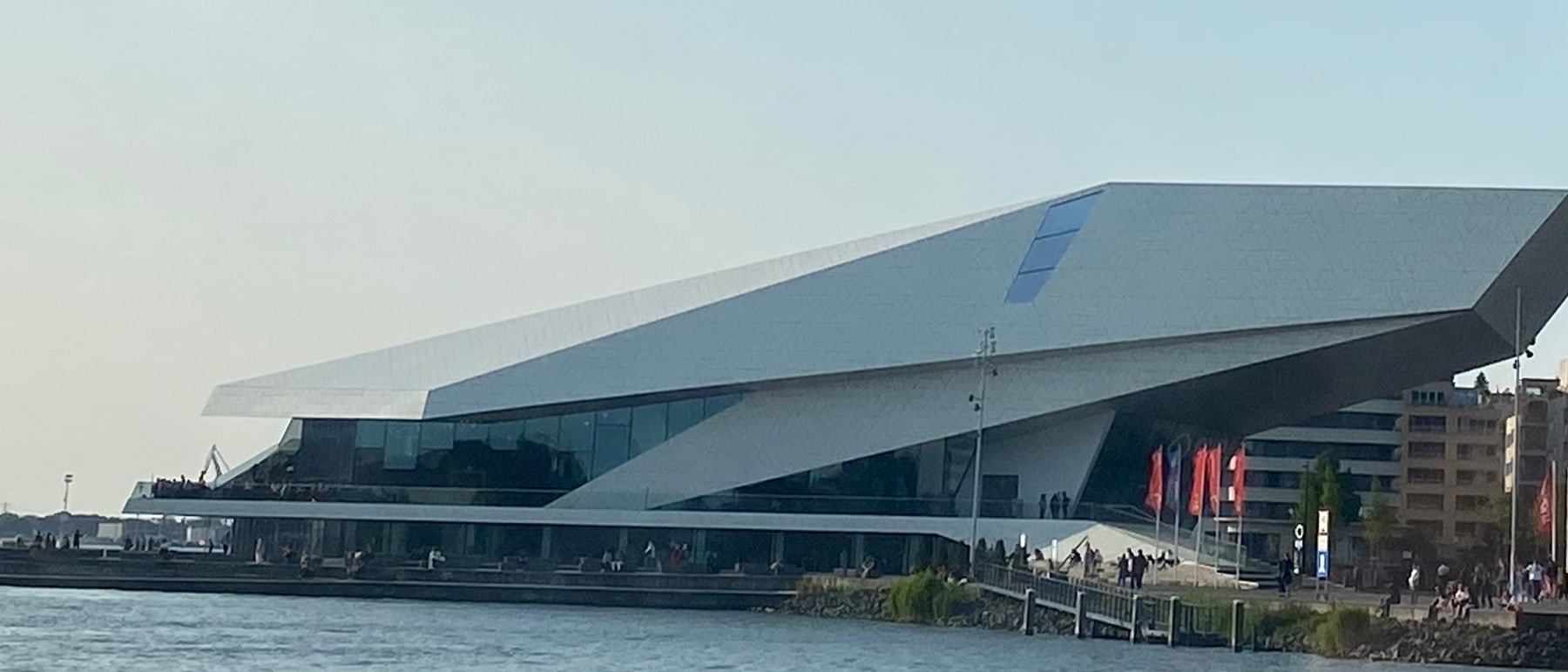
Back across the water in Amsterdam — and to a building that sets itself a lovely, almost impossible task: to be made of light. On the north bank of the IJ, the broad waterway behind Amsterdam's Central Station, a low white shape lies at the water's edge, all sharp folded planes and a great cantilever that seems to lift toward the sky. It has been likened to a seagull about to take off, an eye, an iceberg, an oyster. It is the EYE Filmmuseum, the home of the Netherlands' national film archive, and it was designed by the Viennese practice Delugan Meissl to embody the single thing that cinema is made of.
The architects put it plainly: film is an illusion created by the coordination of light, space and movement. So they built the museum of film out of exactly those materials — a crystalline white form whose faceted surfaces catch and throw the sun so that the building never looks the same twice. For a platform built in memory of a young man who was, among many things, a photographer with a traveller's eye for light, there could hardly be a more fitting wonder to visit.
This is the twenty-ninth article in our Architectural Wonders series.
1. A sculpture of light
Most museums are neutral boxes that keep the light out, the better to protect what hangs inside. EYE does the opposite. It is a museum that is about light, so it makes its own body a thing for light to play upon.
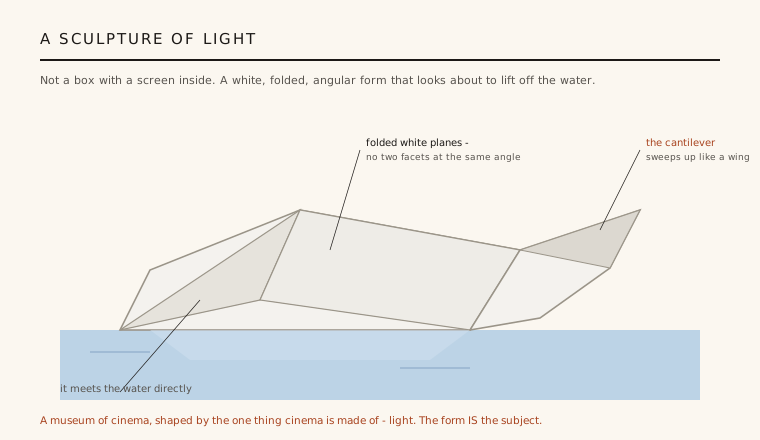
There is scarcely a right angle anywhere. The whole envelope is a composition of sloping, interlocking white planes set at deliberately odd angles, clad in pale aluminium panels, so the form reads as one continuous folded gesture rather than a stack of floors — and at one end it sweeps up into a dramatic cantilever that hangs out over the promenade like a wing. Delugan Meissl are the same architects who made the Porsche Museum in Stuttgart float on its columns; here they make an even bolder claim, that a building can be a piece of abstract sculpture and still be a working museum. The form is not decoration wrapped around the function. The form is the subject: a monument to cinema, shaped like the medium itself.
2. Light and shadow, all day
The genius of choosing white and choosing facets only becomes clear when you watch the building for a while — because the sun does the rest of the design work, for free, all day long.
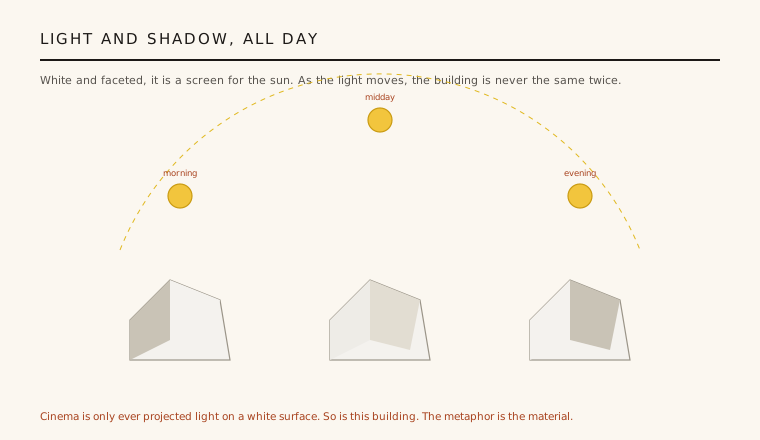
Because the surfaces are pale and many-angled, every plane meets the sun differently — one facet blazes white while the one beside it falls into cool grey shadow, and as the sun arcs across the sky those lights and shadows travel and swap across the building. Morning, noon and dusk give you three different buildings; a passing cloud gives you a fourth. The architects designed the form knowing that its final, moving surface would be painted by the weather. And there is a quiet perfection in it: cinema itself is nothing but projected light and shadow on a white surface. So is this building. The metaphor and the material are the same thing — which is about the most honest a piece of architecture can ever be.
3. A short ferry, another world
You cannot drive to EYE, and that is part of the magic. To reach it you walk to the back of Amsterdam Centraal and step onto a free ferry that crosses the IJ in about five minutes — and lands you in what feels like a different city.
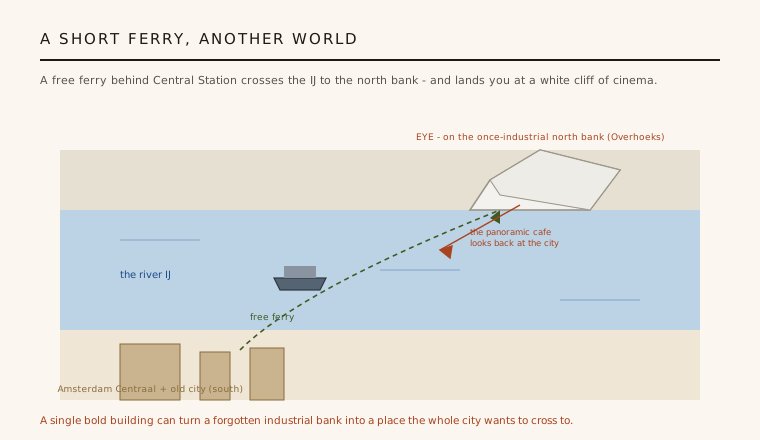
That little crossing matters more than it seems. For most of Amsterdam's history the broad IJ was a barrier: the tourists' city — the canals, the gabled houses — lay to the south, and the north bank was industrial, working, ignored. EYE turned the crossing into an event, and the building rewards it: its great glazed face and its café terrace are turned back toward the water and the old city, so that having crossed to the far shore you sit and look back at the skyline you came from. It is the same deep idea we met across the country at Kop van Zuid — that a neglected bank is reclaimed not by walling it off but by giving people a reason to cross the water to it. A building can turn a river from a wall into a threshold.
4. A landscape, not a set of rooms
Step inside and the second surprise arrives: there are almost no rooms. Where you expect corridors and doors, EYE gives you a single, continuous, flowing interior — what the architects call a "solidified path."
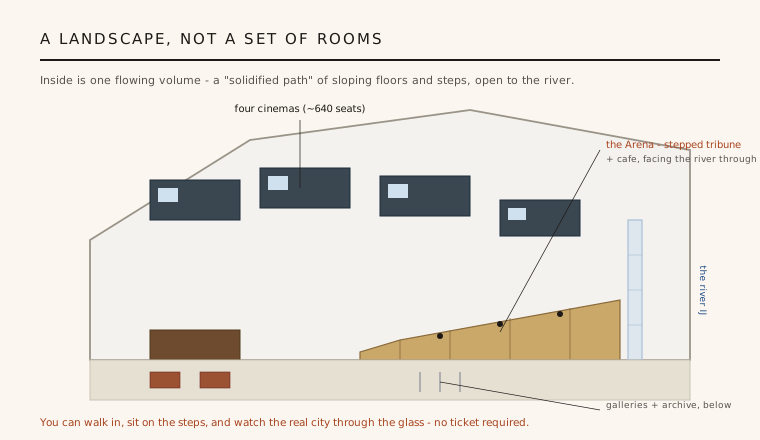
At its heart is the Arena — a great sloping foyer of warm wooden floors and wide steps that double as a grandstand, all facing a full-height glass wall and the river beyond. You can walk in off the ferry, buy nothing, and simply sit on the steps and watch the real city move across the water like a film. Around and above this public living-room are the museum's working parts: four cinemas seating around six hundred and forty people between them (the smallest a jewel-box in Art-Deco style), temporary galleries, and — down in the basement — the exhibition halls and the vast film archive, hundreds of thousands of objects preserving the nation's moving-image heritage. It is the lesson we keep meeting in the best modern buildings, from the Markthal to Rotterdam's station: make the interior a public landscape you want to be in, not a set of rooms you pass through.
5. The bank that came back
Finally, step back onto the ferry, look at the white building shrinking behind you, and understand what it really did — because EYE is not only a museum. It was a catalyst.
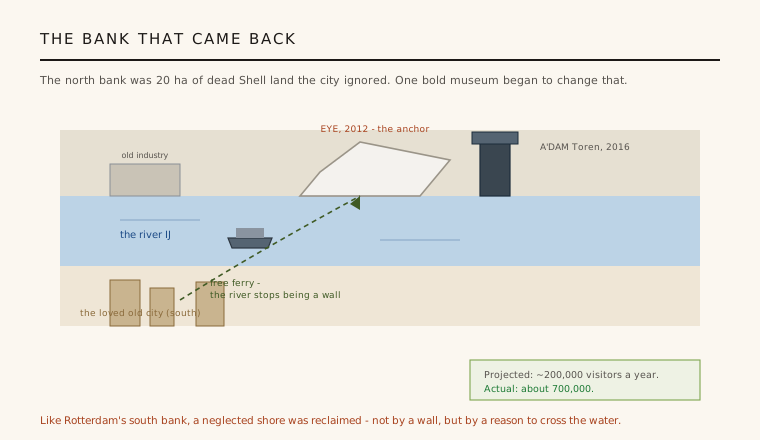
The land EYE stands on was a derelict Royal Dutch Shell site — some twenty hectares of abandoned industry on a bank the city had long since stopped thinking about. When EYE opened there in 2012 it became the first cultural anchor of a whole new district, Overhoeks; four years later the old Shell headquarters tower reopened beside it, reborn as the A'DAM Toren with its rooftop swing, and the once-dead north bank became a place all of Amsterdam wanted to visit. The city had projected perhaps two hundred thousand visitors a year; EYE has drawn closer to seven hundred thousand. Its architect said, tellingly, that Dutch architecture is "strict, straight, logical — and our building was not logical." That was the point. A single, deliberately un-logical, sculptural building — set in the right place, made public, and joined to the city by a five-minute boat — was enough to reach across the water and pull a forgotten shore back to life.
6. What a modern architect can learn from EYE
- Let the form embody the purpose. A museum of light is made of light and shadow, its white facets painted anew by the sun each hour. The most honest architecture makes the building perform its subject, not just house it.
- Design with the sun as a collaborator. Pale, many-angled surfaces turn daylight into a moving artwork for free. Consider how a building will change through the day, not only how it looks in a single render.
- A crossing can be an event. The free ferry makes arriving at EYE part of the experience, and the building faces back to reward it. Think about how people reach a place, and turn the approach into architecture.
- Make the interior a public landscape. The Arena's stepped tribune invites you to sit and watch the city with no ticket. A great interior is a room the public wants to inhabit, not a corridor between functions.
- A single building can be an urban catalyst. EYE reactivated twenty hectares of dead industrial waterfront and helped erase a river-barrier. Placement, publicness and connection can matter as much as the object.
- Know when a place deserves contrast, not continuity. "Our building was not logical" was a decision. A calibrated break from the local grain can become a landmark — used sparingly, and for good reason.
In Amogh's frame
Amogh did not step into this frame — he is behind it. He photographed the EYE from the deck of the ferry as it crossed the IJ, the white museum and the tall A'DAM tower sliding past across the water. It is his eye we are looking through here — the traveller's eye for light that this whole platform was built to honour.
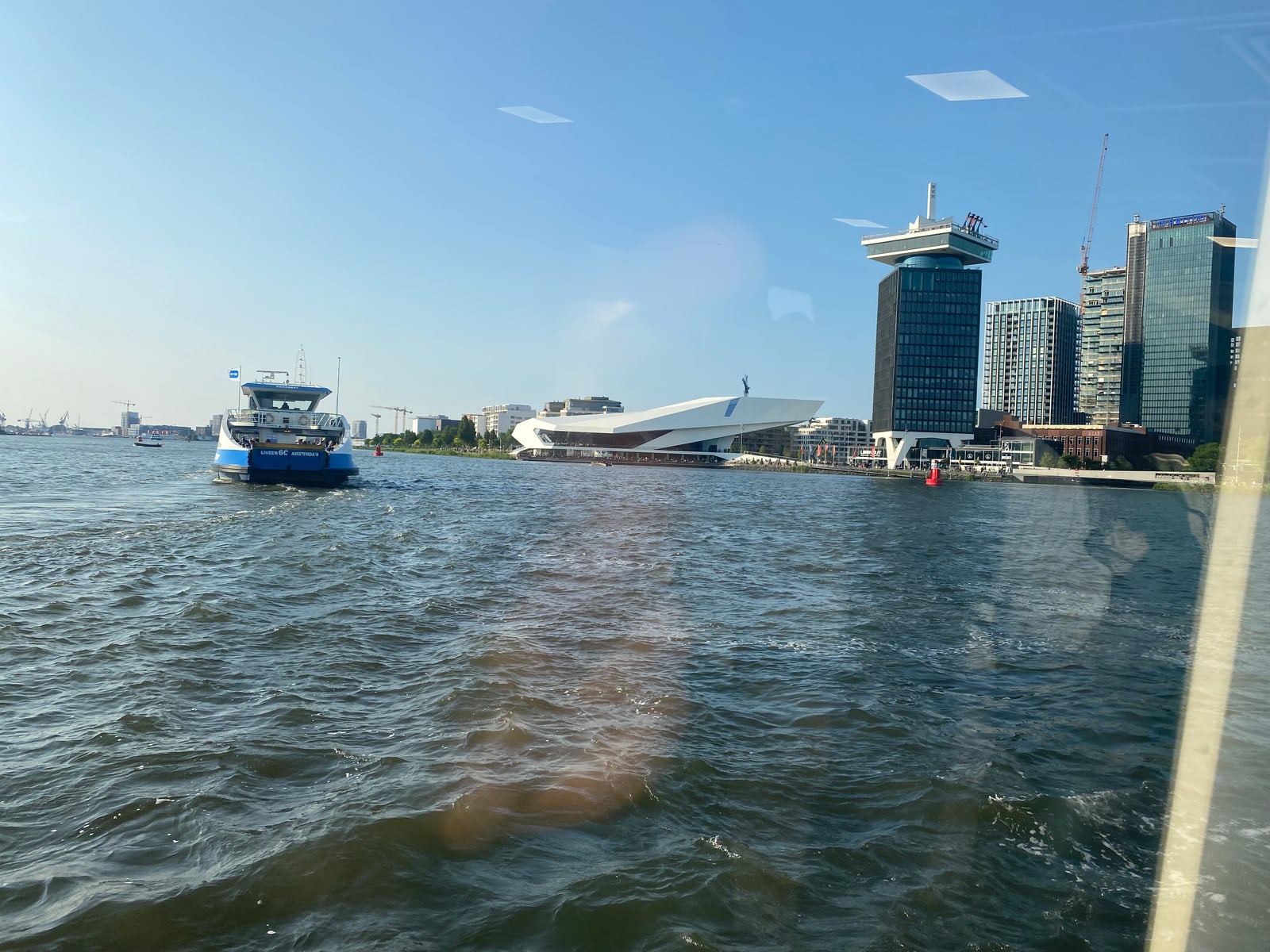
Studio Matrx is built in his memory. Some of these wonders he walked through himself; this is one of them.
References & further reading
1. Delugan Meissl Associated Architects / ArchDaily — EYE — New Dutch Film Institute. https://www.archdaily.com/223973/eye-new-dutch-film-institute-delugan-meissl-associated-architects
2. EYE (official) — Discover our buildings. https://www.eyefilm.nl/en/about-eye/discover-our-buildings
3. Wikipedia — EYE Film Institute Netherlands. https://en.wikipedia.org/wiki/EYE_Film_Institute_Netherlands
4. designboom — Delugan Meissl: EYE Film Institute. https://www.designboom.com/architecture/delugan-meissl-eye-film-institute/
5. Inexhibit — EYE Filmmuseum Amsterdam. https://www.inexhibit.com/mymuseum/eye-filmmuseum-amsterdam/
6. RICS Modus — Buildings that elevated cities: EYE Filmmuseum. https://ww3.rics.org/uk/en/modus/built-environment/urbanisation/eye-filmmuseum.html
Last verified 2026-07-03. Figures vary between sources and are given as widely cited approximations — the EYE Filmmuseum opened in April 2012 (architects Delugan Meissl / DMAA; built ~2009–2012), a building of roughly 8,500–8,700 m² on the former Shell site in Overhoeks, Amsterdam-Noord; it holds four cinemas seating about 640 in total and a film heritage collection variously counted at tens of thousands of titles within some 820,000 objects. The white faceted aluminium form, the free Buiksloterweg ferry, the Arena foyer and terrace, and EYE's role (with the later A'DAM Toren, 2016) in regenerating the north bank follow the established record; the ~€40 million cost is cited by fewer sources and given as approximate.
Export this guide
Related Guides — Deep-dive reading
Blaak 31: The Tower That Steps Aside
How KCAP built a twelve-storey office in the heart of Rotterdam that politely steps and turns away from its neighbours — shifting 2.70 metres every three floors to hand the Markthal next door its light and privacy — all balanced on a great steel truss above the city's live metro tunnel.
Architectural WondersBibliotheca Alexandrina: A Lost Wonder, Reborn in Our Time
How a young Norwegian practice won a global competition to bring the legendary Library of Alexandria back to life — as a vast tilted disc rising from the Mediterranean like a second sun, wrapped in a wall carved with all the world's writing. The series' first modern wonder, and proof its great theme is alive today.
Architectural WondersKop van Zuid: A New City on the Old Docks
How Rotterdam turned a mile of derelict Holland America Line docklands — the pier from which close to a million emigrants sailed for the New World — into a waterfront district of star-architect towers, stitched to the city by a single bridge and built patiently across thirty years.
Architectural WondersRelated Tools — Try Free
Concept Generator
Get 3 AI-generated design concepts for any room with style, materials, and cost estimate.
DesignAIHome Building & Interior Cost Calculator — 20 Cities
Construction + interior costs for 20 Indian cities across kitchen, wardrobes, flooring, painting, ceiling.
Cost CalculatorAcoustic Privacy (STC) Visualizer
Indian healthcare acoustic visualizer — compare wall assemblies and noise sources, see received SPL after STC attenuation, and check FGI 2018 / IS 1950 / NABH speech-privacy compliance with live dual-canvas waveform.
Acoustic Tool