
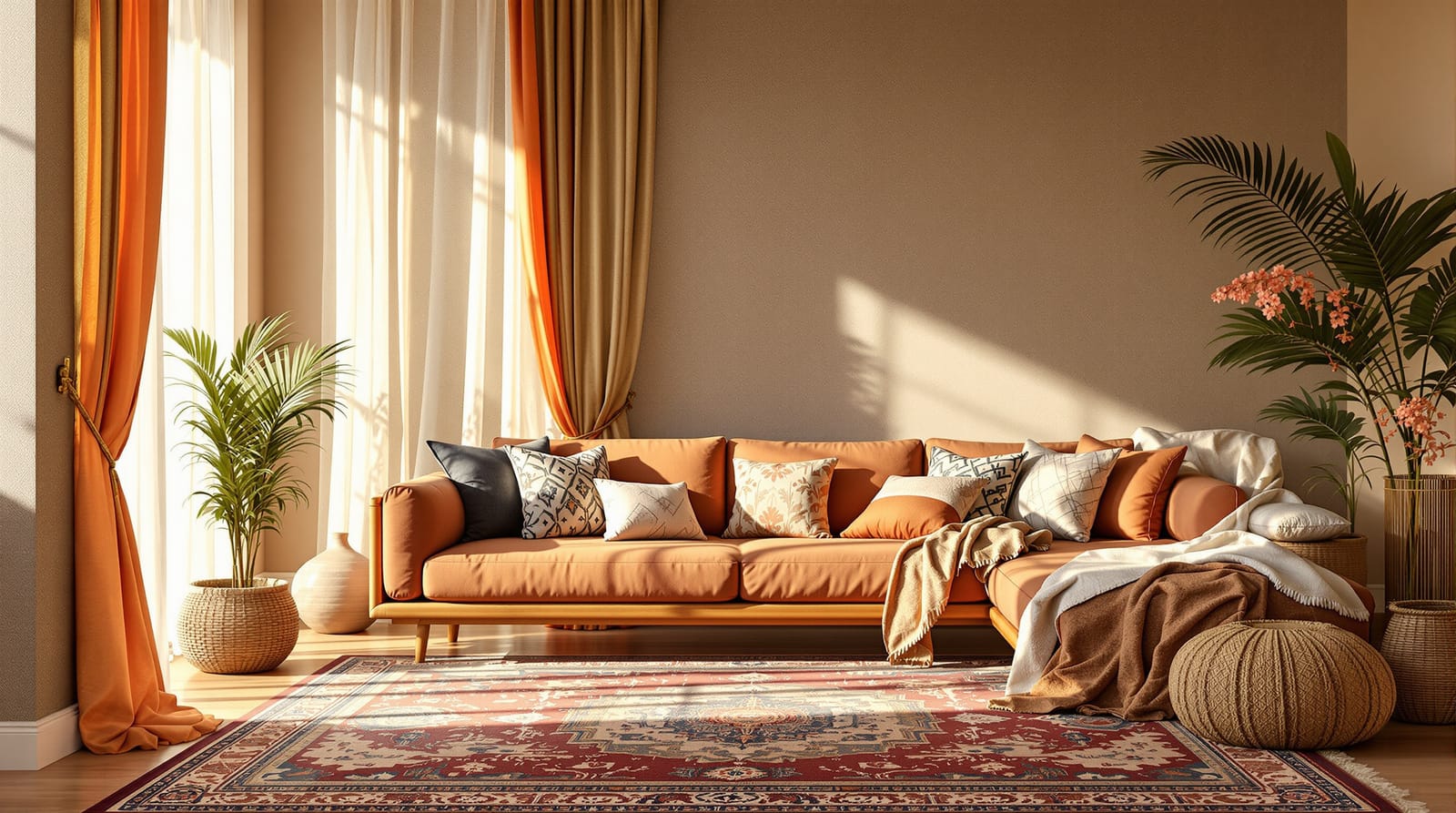
Decorative Textiles & Soft Furnishings — A 2026 Guide for Indian Homes
Cushions to curtains, rugs to throws · Layer texture for warmth, depth and a finished room
Soft furnishings are the cheapest, fastest way to add warmth, texture and a finished feel to an Indian home in 2026. Paint dries, furniture sits where it is delivered, and most of us cannot knock down a wall on a whim. But a stack of cushions, a well-sized rug and a pair of properly hung curtains can transform a flat, echoey room into somewhere you actually want to linger – often over a single weekend and for a fraction of what new furniture costs. This guide walks you through every soft furnishing that matters, how to layer them like a stylist, and exactly where (and for how much) to buy them in India.
Why Soft Furnishings Matter
Walk into a freshly built flat and it feels like a showroom – clean, hard, slightly cold. That hardness comes from unbroken surfaces: vitrified floors, plastered walls, glass, laminate. Sound bounces, light glares, and nothing invites you to sit down. Soft furnishings fix all of this at once.
Texture is the first thing they add. A nubby cotton cushion against a smooth leather sofa, a wool rug under bare feet, a linen curtain catching the light – these contrasts are what your eye reads as "richness." Expensive furniture can still feel flat if every surface is hard and shiny.
Warmth, both literal and visual, comes next: fabric absorbs and softens light instead of reflecting it harshly, and a throw over the arm of a sofa signals comfort before anyone touches it.
Sound-softening is the underrated one. In Indian homes with stone or vitrified-tile floors and minimal carpeting, rooms can be punishingly echoey. Rugs, curtains and upholstery soak up reverberation, making conversation – and the television – easier on the ears.
Finally, soft furnishings make a room feel lived-in rather than staged. They are personal, swappable and seasonal – how a house becomes a home.
The Soft-Furnishing Toolkit
Cushions & throw pillows
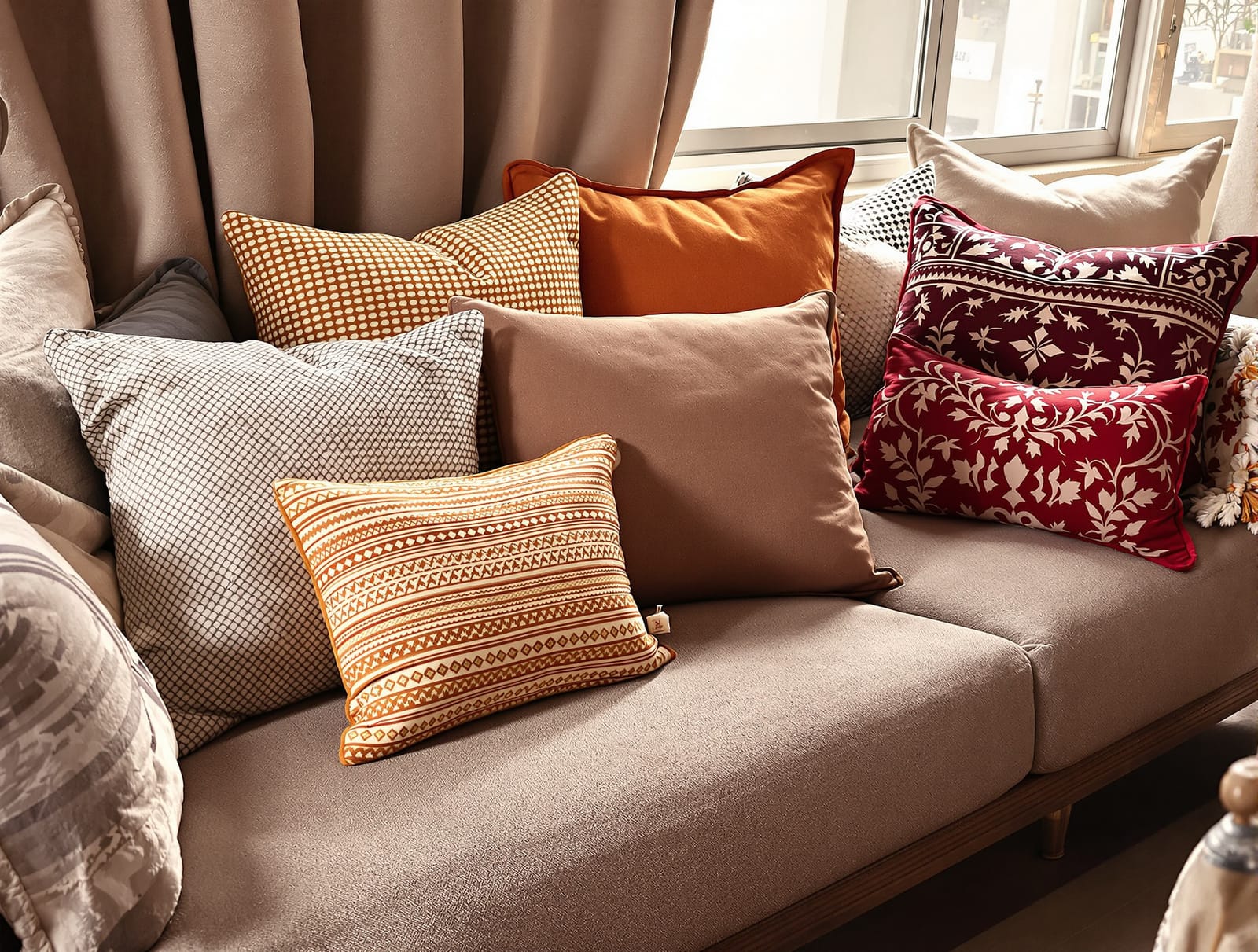
Cushions are the workhorses of soft styling – inexpensive, endlessly swappable, and able to inject colour, pattern and texture in seconds. "Cushions" usually means the larger squares that fill out a sofa; "throw pillows" is the same idea applied loosely, including smaller lumbar and bolster shapes tossed on for accent.
How to use them: build a sofa in layers. Start with larger square cushions (50–60 cm) at the back corners, add a mid-size pair in front, then finish with a smaller lumbar or bolster. Mix one solid, one textured and one patterned rather than buying a matching set.
India note: insist on quality inserts. The thin, flat ₹150 cushions that come free with many sofas collapse in weeks. Buy good covers, then pair them with feather-down or high-resilience hollow-fibre inserts one size larger than the cover for a plump, hotel look. Block-printed and ikat covers are widely available and add instant Indian character.
Area rugs & carpets
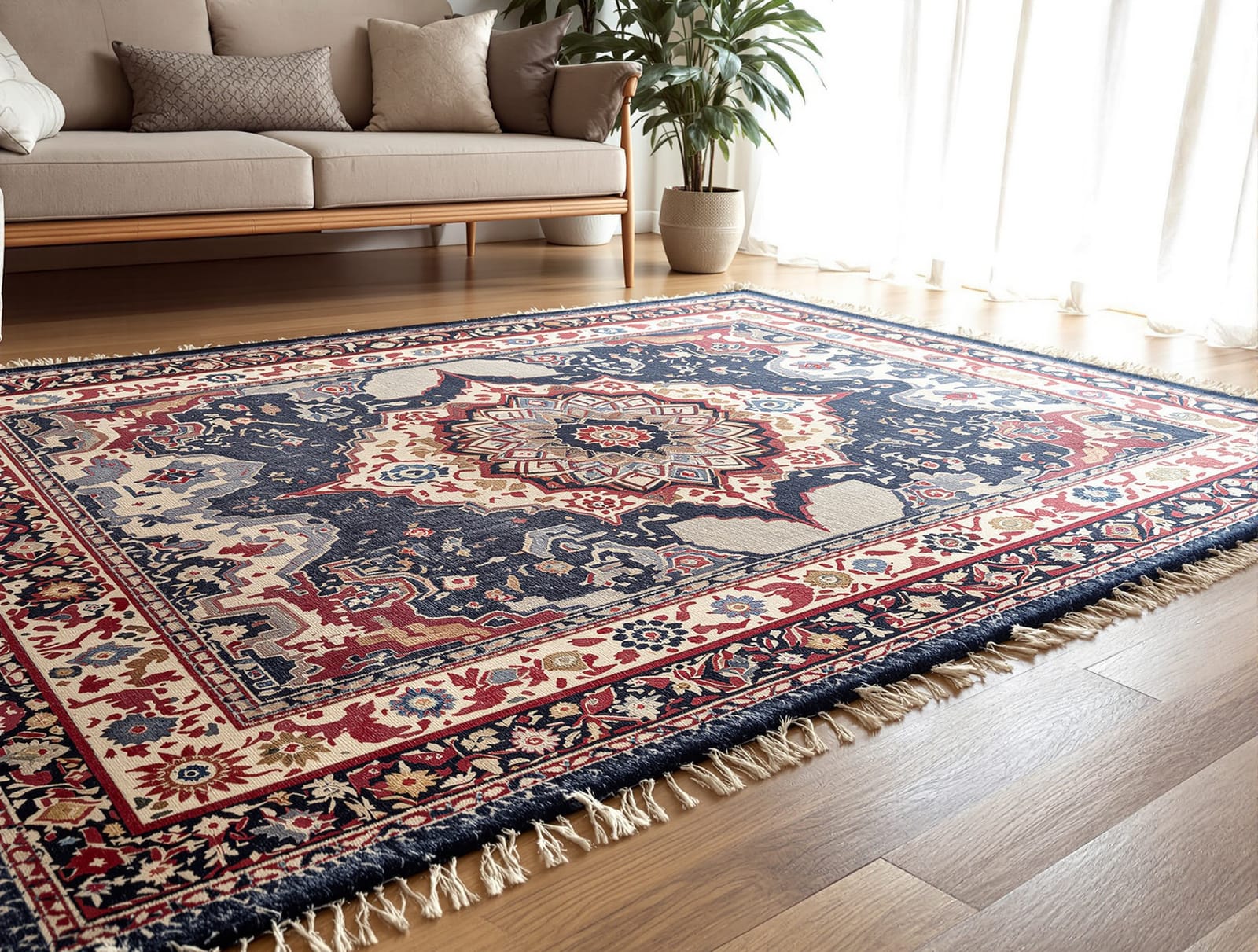
A rug anchors a room, defines a zone, and is often the single most transformative purchase you can make. "Area rug" usually means a piece sitting within a room over a hard floor; "carpet" in the Indian sense often means a larger, heavier, ornate hand-knotted piece, though the words are used interchangeably.
How to use them: a rug should pull a seating arrangement together, not float like a postage stamp in the middle. In open-plan flats, use different rugs to quietly separate the living and dining zones.
India note: India is one of the world's great rug-making nations, with hand-knotted wool and hand-woven cotton dhurries made here at every price point. A flat-woven cotton dhurrie is light, washable and ideal for our dusty, humid climate; wool is plush and durable; jute is hard-wearing and budget-friendly but rougher underfoot.
Curtains & sheer drapes
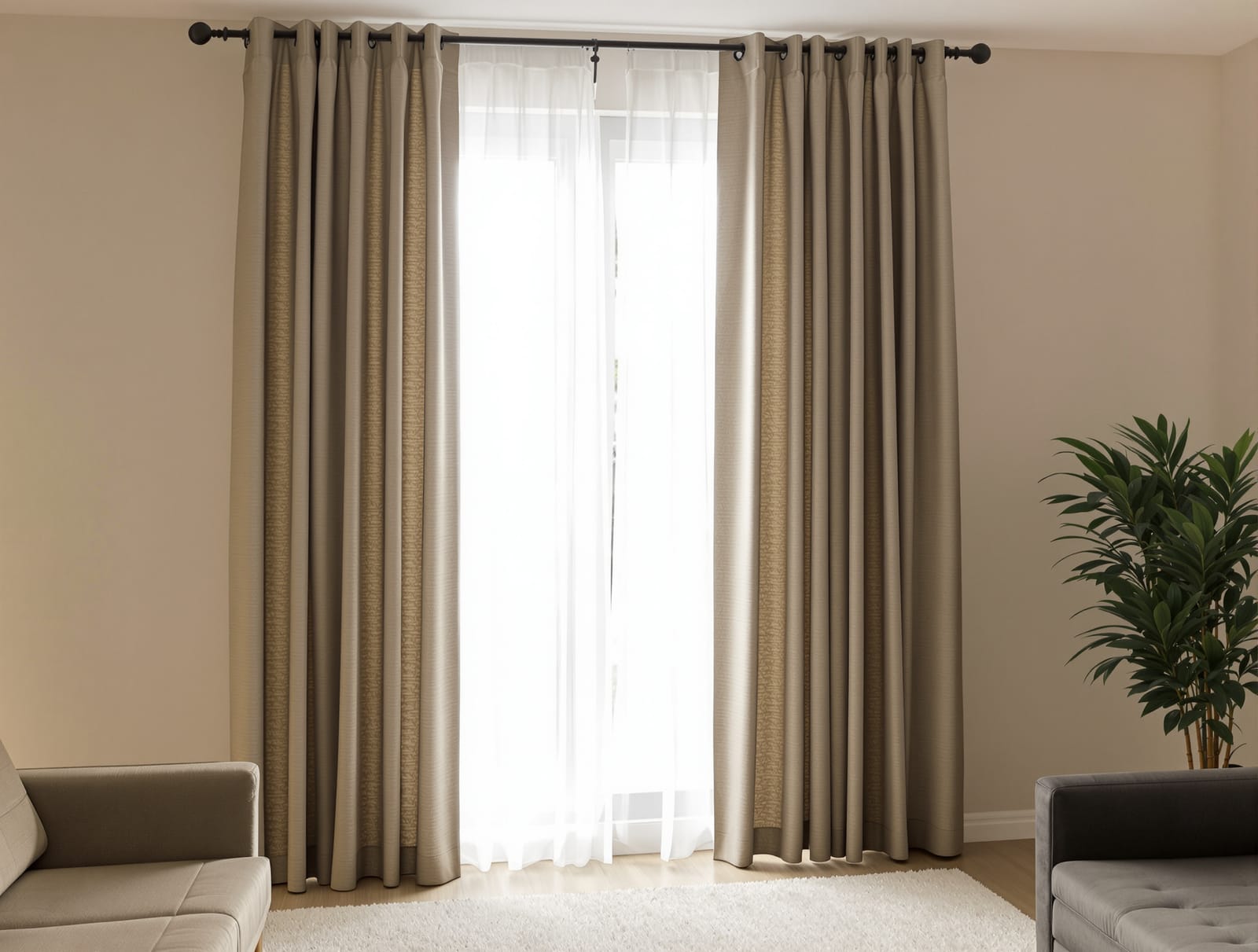
Curtains frame a window, control light, soften the room's edges and add vertical drama. Sheer drapes are the lightweight, semi-transparent inner layer – usually voile or net – that diffuses daylight and gives privacy without darkening the room.
How to use them: the best windows use both layers. Sheers stay closed through the day for soft, glare-free light and privacy; the heavier outer curtains close at night or to block harsh sun. This two-track system is worth the small extra cost.
India note: our sun is fierce, especially on west- and south-facing windows. Sheers take the edge off daytime glare while keeping the room bright; pair them with a heavier or blackout outer layer to tame the afternoon heat that streams in from the west. Cotton and linen breathe better than synthetics in our heat.
Upholstered benches
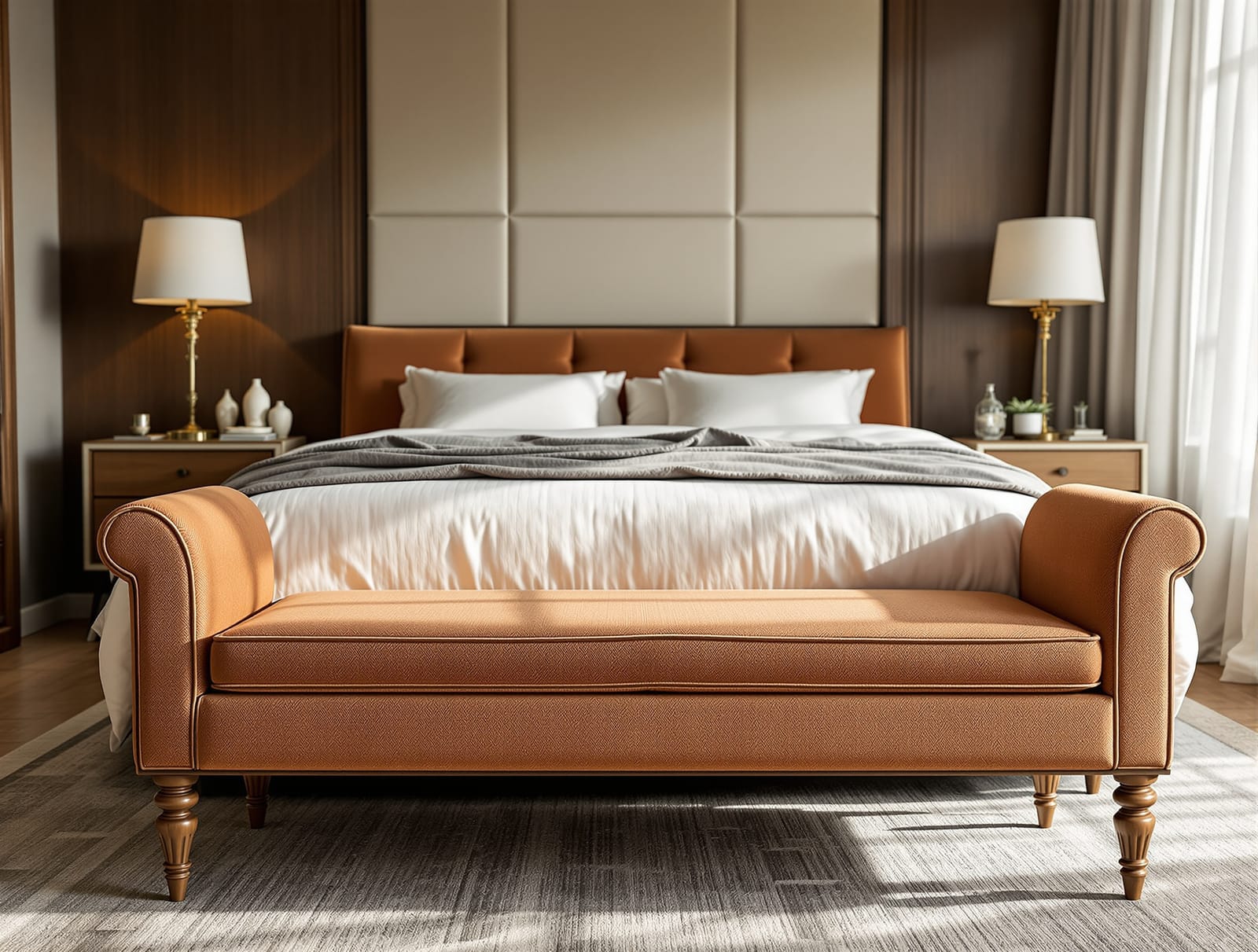
An upholstered bench is a small piece with an outsized styling payoff. At the foot of a bed it adds a hotel-suite finish and a place to sit while dressing; in an entryway it gives somewhere to pull on shoes; under a window it becomes a reading nook.
How to use them: keep the bench narrower than the bed or wall it sits against, and let its fabric either echo the headboard or provide a deliberate contrast – a velvet bench against a linen bed. Drape a throw over one end to soften it.
India note: in compact flats a bench at the foot of the bed doubles as a landing spot for the next day's clothes or a suitcase, and an entryway bench helps manage the shoes-off ritual most Indian homes observe. Choose a wipeable or removable cover near doorways where dust collects.
Throws & blankets
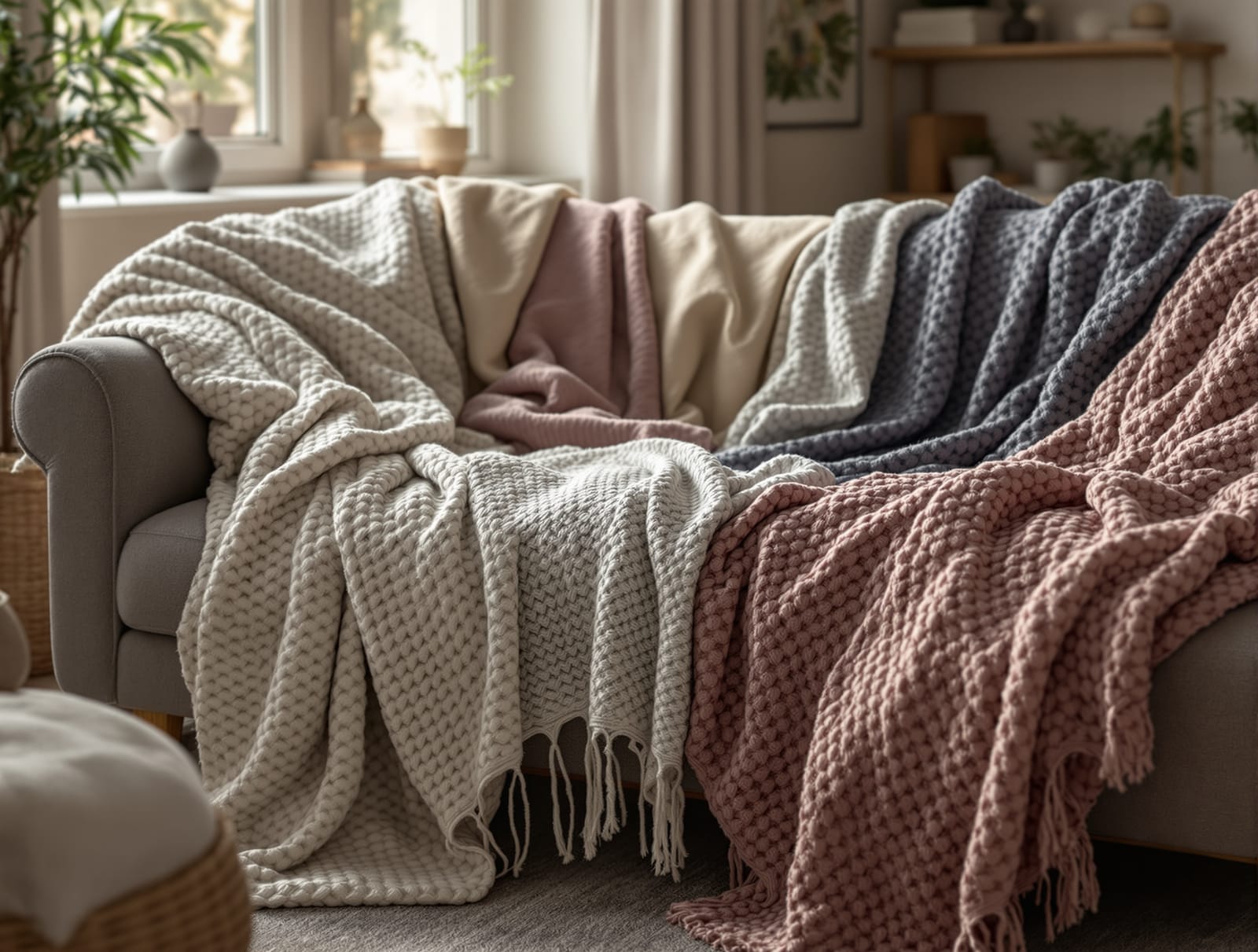
Throws are the easiest finishing touch in the whole toolkit. A casually draped throw adds colour, texture and an immediate sense of comfort – and on cooler evenings it actually gets used.
How to use them: drape, don't fold-and-square. Let a throw fall over one arm of the sofa or trail diagonally across a bed's corner. Choose a texture that contrasts with the surface beneath it – a chunky knit over smooth upholstery, a fine cotton throw over a textured weave.
India note: a lightweight cotton or khadi throw suits most of the year across the plains and the south; keep a heavier wool or a soft Indian dohar for North Indian winters and hill stations. Handloom cotton throws double beautifully as a light summer cover.
The Art of Layering Texture
Layering is the difference between a room that looks bought and a room that looks designed. A few principles do most of the work:
- Mix materials, not just colours. Combine smooth (silk, leather, velvet), rough (jute, raw cotton, wool) and crisp (linen, cotton sateen). A room in three shades of beige still sings if those beiges arrive in five textures.
- Vary texture deliberately. If the sofa is smooth, the cushions should not be. If the floor is hard tile, the rug should be soft and the curtains substantial.
- Work in odd numbers. Three or five cushions read as styled; a perfectly symmetrical set reads as a showroom display. Odd groupings feel relaxed and intentional.
- Play with pattern scale. Pair a large-scale pattern (a bold block print) with a medium one (a stripe) and a small one (a fine geometric) so they complement rather than fight. Never put two patterns of the same scale side by side.
- Run a unifying colour thread. Pick one or two colours that repeat quietly across cushions, rug and throw. This single thread lets you mix many textures and patterns without the room descending into chaos.
Curtains, Done Right
Curtains are where amateur rooms most often go wrong, and where a small change makes the biggest difference.
- Hang high and wide. Mount the rod close to the ceiling (or at least 10–15 cm above the window frame), and extend it 15–25 cm beyond the frame on each side. This makes windows look taller and wider and lets the curtains stack off the glass, so more light enters when they are open.
- Get the length right. Curtains should reach the floor. Aim for the hem to just kiss or "float" a centimetre off the floor – never stop short at the windowsill or, worse, halfway down the wall. Short curtains are the single most common styling mistake in Indian homes.
- Layer sheers with heavier drapes. A double-track system – voile sheers inside, heavier or blackout drapes outside – gives you daytime softness and night-time darkness from the same window. It is the most flexible setup for a bedroom or a bright living room.
- Block the harsh west sun. West- and south-west-facing rooms take a beating from the afternoon sun. A blackout or thermal-lined outer curtain on those windows keeps the room cooler and protects furniture and upholstery from fading.
- Mind fabric weight in the heat. Heavy velvet looks luxurious but traps heat; for most Indian living rooms, cotton, linen or a mid-weight poly-cotton breathes better and drapes well. Save heavy lined velvet for air-conditioned rooms or winter-prone north Indian homes.
Rugs, Done Right
A rug that is too small is the fastest way to make a whole room feel cheap. The fix is simple: go bigger than you think.
- Size by the furniture, not the floor. In a living room, the rug should be large enough that at least the front legs of every seat sit on it. Better still, fit the entire seating group on the rug. A rug that the sofa floats entirely off of looks like a bath mat lost in a hall.
- Mind the placement. Leave a consistent border of bare floor – roughly 20–45 cm – between the rug edge and the walls. Under a dining table, the rug should extend far enough that the chairs stay on it even when pulled out.
- Choose India-friendly materials. A cotton dhurrie is light, flat-woven and machine- or hand-washable – ideal for dusty cities and for homes with children. Wool is plush, warm and remarkably durable, hiding wear well. Jute is hard-wearing and affordable but coarse; pair it with a softer layered rug on top if you want comfort underfoot.
- Plan for dust and cleaning. Indian cities are dusty, so favour rugs you can actually maintain. Flat-weaves shake and vacuum easily; hand-knotted wool benefits from professional cleaning once a year. Always use a rug pad – it stops slipping, reduces wear, and adds cushioning. Rotate the rug periodically so it fades and wears evenly.
Match Textiles to Your Style
The right fabric makes a style read clearly. Build a Moodboards palette first, then pull textiles toward it:
- Minimal & Scandinavian: lean on linen and cotton in undyed, oatmeal and soft neutral tones. Texture does the talking; keep patterns sparse and quiet.
- Luxury & glam: reach for silk and velvet, with sheen, depth and richer jewel or muted tones. Layer in a metallic-threaded cushion or a high-pile rug.
- Indian & craft-led: for ikat, block print, kalamkari and handloom, see Indian Textiles for how to use them without tipping into theme-park ethnic. Mix one bold craft fabric with calmer solids so it reads as collected, not costumed.
Soft furnishings rarely work alone – pair them with Decorative Lighting for warmth and Decorative Mirrors to bounce light and make textured fabrics glow.
Budget — What It Costs in India
Indicative prices for a mid-size living room. Figures are typical 2026 ranges and vary widely by city, brand and craftsmanship.
| Item | Starter | Mid | Premium |
|---|---|---|---|
| Cushion cover (each) | ₹200–500 | ₹600–1,500 | ₹2,000–5,000+ |
| Cushion insert (each) | ₹150–350 | ₹400–800 | ₹900–2,000 |
| Area rug (5×7 ft) | ₹2,500–6,000 | ₹8,000–25,000 | ₹40,000–2,00,000+ |
| Curtains (per window, pair) | ₹1,200–3,000 | ₹4,000–10,000 | ₹15,000–40,000+ |
| Sheer drapes (per window) | ₹600–1,500 | ₹2,000–4,500 | ₹6,000–12,000 |
| Upholstered bench | ₹3,500–8,000 | ₹10,000–25,000 | ₹30,000–80,000+ |
| Throw / blanket | ₹600–1,500 | ₹2,000–5,000 | ₹6,000–20,000 |
A practical first move: spend on a good rug and proper curtains (the room-makers), and keep cushions and throws in the Starter–Mid range where swapping is cheap.
Where to Buy in India
- Fabindia – handloom cushions, dhurries, throws and block-printed furnishings; reliable craft-led staples.
- Jaipur Rugs – hand-knotted and flat-woven rugs direct from weaver communities, across a wide price range.
- D'Decor – one of India's largest furnishing-fabric houses; strong for curtains, upholstery and sheers.
- Sarita Handa – premium home textiles, embroidered cushions and refined bed and living linens.
- Good Earth – luxury Indian-craft homeware; statement cushions, throws and curtains at the higher end.
- Urban Ladder and Pepperfry – broad online ranges for rugs, curtains, cushions and benches across budgets.
- Chumbak – playful, colourful cushions and accents for younger, eclectic interiors.
- Local furnishing markets – every city has them, and they remain unbeatable for value: stitched-to-measure curtains, custom cushion covers and bulk fabric. Take your measurements and a colour swatch.
Ten Common Mistakes
1. Buying a rug that's too small – the number-one error; front legs of the seating should at least touch it.
2. Curtains hung at the window frame – mount the rod high and wide instead, near the ceiling and beyond the frame.
3. Curtains that stop short – sill-length or mid-wall curtains look unfinished; they should reach the floor.
4. Everything matchy – buying a coordinated cushion-and-curtain "set" kills depth. Mix instead.
5. No texture variation – all-smooth or all-flat surfaces read as cold and cheap even when expensive.
6. Cheap, thin cushions – flat ₹150 inserts collapse fast; invest in good fillers one size larger than the cover.
7. Ignoring fabric care – choosing dry-clean-only velvet for a high-traffic, dusty room you cannot maintain.
8. Skipping the rug pad – rugs slip, wrinkle and wear out faster without one.
9. One pattern scale everywhere – two bold prints at the same size fight; vary large, medium and small.
10. Heavy fabrics in hot rooms – dense velvet in a non-AC, west-facing room traps heat; choose breathable cotton or linen.
FAQ
What size rug for a living room in India?
For a standard living room, a 6×9 ft or 8×10 ft rug usually works, sized so at least the front legs of the sofa and chairs sit on it. For a large or open-plan space, fit the whole seating group on the rug. When in doubt, size up – a rug that is too small is far more obvious than one that is generous.
How high should I hang curtains?
As high as practical – ideally close to the ceiling, or at least 10–15 cm above the window frame – and extend the rod 15–25 cm past each side. This makes the window look taller and wider and lets more light in when the curtains are open. The hem should reach the floor.
How many cushions on a sofa?
Work in odd numbers for a relaxed, styled look. A two-seater typically takes three cushions, a three-seater five. Mix sizes (large squares, then mid, then a lumbar) and mix one solid, one textured and one patterned rather than buying an identical set.
What is the best curtain fabric for Indian summers?
Cotton and linen breathe best and handle heat and humidity well, draping nicely without trapping warmth. For glare and privacy, add voile or net sheers. Reserve heavy lined velvet for air-conditioned rooms or cooler North Indian winters, where its insulation is an asset rather than a liability.
Sheer vs blackout curtains – which do I need?
Both, ideally, on a double track. Sheers stay closed by day for soft, glare-free light and privacy without darkening the room; blackout or heavier drapes close at night and on harsh west-facing windows to block heat and light. Bedrooms benefit most from the blackout layer.
How do I clean rugs in a dusty city?
Choose washable flat-weaves like cotton dhurries for easy maintenance – shake, vacuum, and spot-clean regularly. Hand-knotted wool rugs do best with a yearly professional clean. Always use a rug pad, rotate the rug every few months for even wear, and vacuum gently without a hard beater bar on delicate weaves.
Soft furnishings are the most forgiving design decision you will make: low-cost, low-risk, and endlessly editable as your taste evolves. Start with one good rug and properly hung curtains, layer cushions and a throw on top, and let the room grow warmer season by season. When you are ready to visualise it all together, build a palette in Moodboards or generate a styled room with DesignAI.
Last verified: June 2026 · Next verify: June 2027.
Export this guide
Related Guides — Deep-dive reading
Decorative Mirrors — A 2026 Guide for Indian Homes
Space, light and a focal point in one move · Full-height to Venetian · Where to place them and why
Design StylesCurtain Pattern Selection: Solids, Prints, Stripes & Scale (India 2026)
When to go solid versus patterned, how to read a room's existing pattern budget, matching pattern scale to your window, using vertical stripes for height, mixing prints safely, and choosing Indian block-print and motifs with confidence.
Window TreatmentsFlooring Thermal Comfort in India: How Your Floor Affects Heat, Cold and Energy Bills
The physics of why stone and tile feel cool while wood, cork and carpet feel warm, and how to match the floor to your climate zone so the surface under your feet works with the weather instead of against it.
Flooring & SurfacesRelated Tools — Try Free
Curtain Fabric Comparison
Compare curtain fabrics side by side — drape, opacity, care, durability and cost — and get a quick recommendation.
Comparison ToolCross-Ventilation Analyzer
Estimate airflow and air changes per hour (ACH) from room size, window areas, layout, and local wind — with NBC 2016 Part 8 compliance check.
Ventilation CalculatorWindow Cleaning Cost Calculator
Estimate professional window cleaning cost per visit and per year by access and frequency.
Window Calculator