
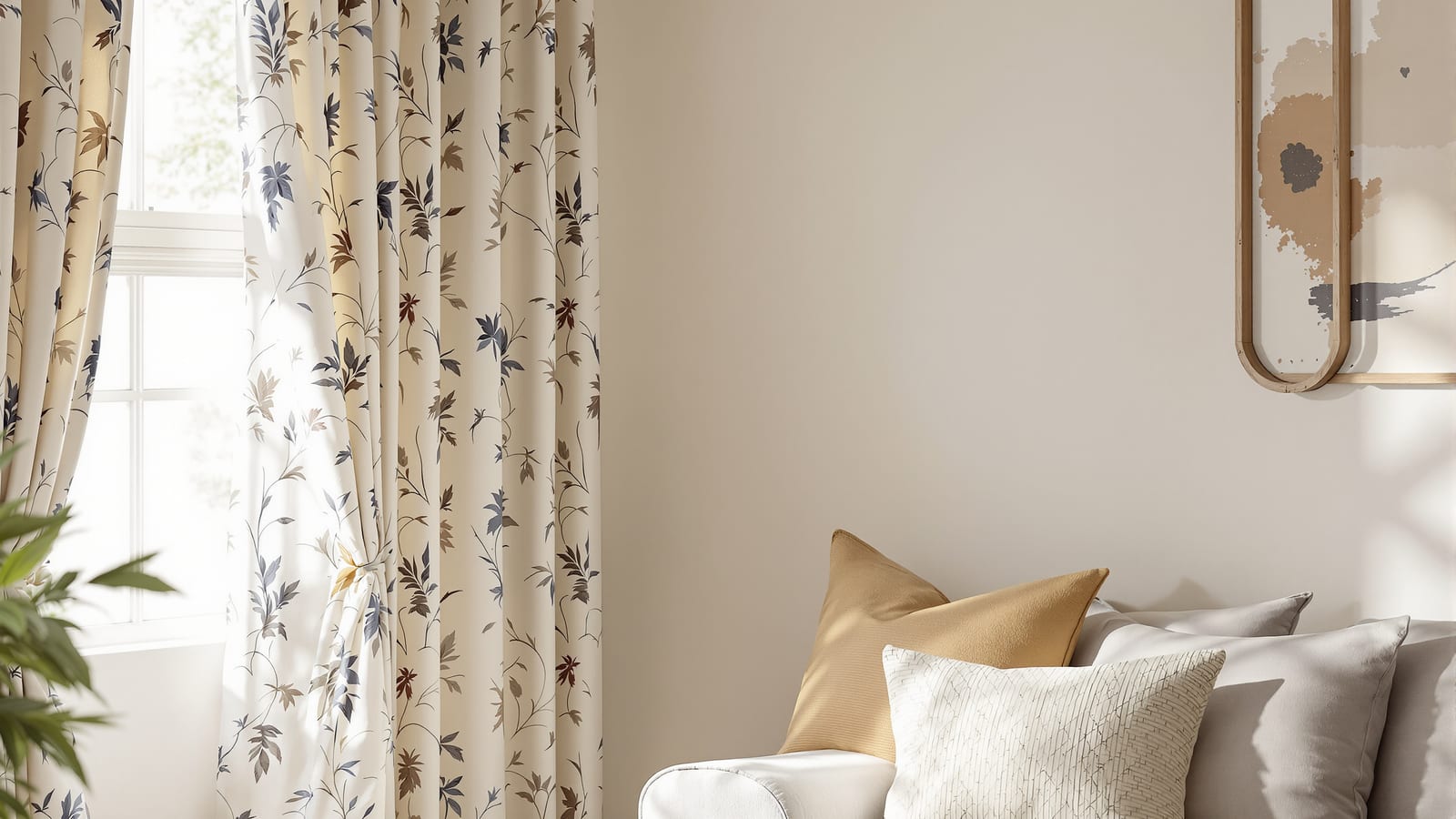
Curtain Pattern Selection: Solids, Prints, Stripes & Scale (India 2026)
When to go solid versus patterned, how to read a room's existing pattern budget, matching pattern scale to your window, using vertical stripes for height, mixing prints safely, and choosing Indian block-print and motifs with confidence.
Pattern is where most curtain decisions go quietly wrong. People fall for a beautiful print on a small folded swatch, hang four metres of it across a wall, and only then discover that the motif fights the sofa, shrinks the room, or simply screams. Pattern is not good or bad in itself — it is a quantity you spend, like money. Spend it in the right place and the room sings; overspend and it feels restless and cheap. This guide is the room-by-room arithmetic of that spending decision.
A patterned curtain is the loudest soft furnishing in the house. Before you choose the print, decide whether this window is where the room should raise its voice — or stay quiet.
This is the pattern companion to our complete curtain guide and a close partner to curtain colour selection. Colour decides the mood; pattern decides the energy. Get pattern wrong and even the right colour will not save the window.
First decide: should this window be solid or patterned?
Start with the room, not the curtain. Look at everything already in the space — the sofa, the rug, the cushions, the wallpaper, the artwork, the flooring — and ask how busy it already is. Every room has a pattern budget, and the curtain is usually the single largest soft surface in it.
- Busy room (printed rug, patterned upholstery, gallery wall, bold tiles): the curtain should almost always be solid or barely textured. It is the calm that lets the rest breathe.
- Calm room (plain walls, solid sofa, neutral floor): a patterned curtain is the easiest way to add personality, and the window is the perfect place to spend that pattern budget.
There is no universal answer because there is no universal room. A solid linen curtain in a richly furnished joint-family living room is not boring — it is disciplined. A bold ikat panel in a bare rental bedroom is not loud — it is the only thing giving the room a soul. Decide the budget first.
Pattern scale: matching the print to the window and room
Scale — the physical size of the repeating motif — matters more than the motif itself, and it is what swatches hide. A print that looks delicate on a 10 cm sample can read as enormous across a 2.4 m drop.
| Window / room | Best pattern scale | Why |
|---|---|---|
| Small window, small room | Small to medium repeat | A large motif gets chopped and looks cramped |
| Large window, big living room | Medium to large repeat | Tiny prints disappear and look fussy at distance |
| Floor-to-ceiling, double-height | Bold large-scale | Big windows can carry, and need, a confident motif |
| Narrow apartment window | Small vertical or fine print | Keeps the slim window from feeling busier than it is |
The honest rule: the bigger the window and the further you sit from it, the bigger the pattern can be. From across a living room, a small print blurs into a flat texture and you have paid for a pattern nobody can see. Up close in a study or small bedroom, a large motif feels overbearing. When unsure, size up slightly for big rooms and down slightly for small ones.
Vertical stripes: the cheapest way to gain height
If your ceilings feel low — a real complaint in many Indian apartments — vertical stripes are the most reliable trick in curtains. The eye follows the lines upward and the room reads taller. Combine vertical stripes with the floor-to-ceiling mounting from the living room curtains guide and a standard 2.7 m flat can feel genuinely lofty.
A few cautions worth stating plainly: stripes are unforgiving of crooked tracks and uneven hems, so they demand careful installation. Wide, high-contrast stripes are bold and can dominate; narrow, tonal stripes (two close shades) give the height without the drama. Horizontal stripes do the opposite — they widen and shorten, occasionally useful on a tall narrow window but rarely what an Indian room needs.
Mixing patterns without it looking chaotic
Mixing patterns is where confidence pays off, but it follows rules, not luck. The two reliable principles:
- Vary the scale. Pair one large pattern with one small, never two mediums. A big floral curtain with small geometric cushions works; two medium florals clash.
- Share a colour. Patterns that pull from the same palette read as a deliberate family. A blue-and-cream block-print curtain happily shares a room with a blue-striped cushion and a cream rug.
A safe formula for most rooms: one pattern, one stripe or geometric, and one solid or texture, all sharing two colours. Keep one large-scale star and let everything else play support. If two patterns are both fighting to be the hero, the room loses. The curtain colour guide covers building that shared palette.
Texture: pattern for people who hate pattern
Not every room wants a print, and not every wall can take one. Texture is quiet pattern — the interest is in the weave and the way light catches it, not in a printed motif. A slubbed linen, a herringbone weave, a basketweave cotton or a self-coloured jacquard adds depth and richness while still reading as "solid" from across the room.
This is the safest choice for a busy room that still feels flat, and it is what high-end Indian interiors lean on: texture survives trends, hides dust and minor unevenness better than a flat sateen, and never dates the way a strong print can. See the modern curtain design guide for the contemporary textured-neutral look in detail.
Indian motifs and block-print: pattern with roots
India has one of the richest textile traditions on earth, and it belongs on your windows. Block-print (Bagru, Sanganeri, Dabu), ikat, kalamkari, and woven jamdani-style motifs bring a warmth and craft that machine prints cannot fake — and they read as intentional rather than catalogue-bought.
Practical notes for using them well:
- Hand block-print has tiny irregularities — slight misalignments and ink variation. That is the charm, not a defect; perfectly uniform "block-print" is usually a digital copy.
- Indigo and madder traditional dyes can bleed on first few washes; wash separately and cold, and expect a gentle softening over time rather than crisp permanence.
- Cotton block-prints are casual and breathable — wonderful in bedrooms, study nooks and informal living rooms; less suited to a formal drawing room, where a woven motif or a richer ground reads dressier.
- Scale still rules: a small repeat block-print is lovely up close but disappears across a large living room — choose a bolder layout or a larger motif for big windows.
How light and fullness change a pattern
A pattern you choose flat at the shop will not look flat on the window — and that changes everything.
Fullness folds the pattern. At the standard 2x fullness, a curtain is gathered to roughly half its flat width, so the print is partly hidden in the folds and only fully visible where the fabric flattens. Big bold motifs survive this; intricate detailed prints get lost in the pleats. If you love a busy print, see it gathered before you commit, or choose a heading with flatter folds.
Light reads through the cloth. On a sheer or light-coloured curtain, daylight makes a printed motif glow and read strongly; on a heavy dim-out, the same print sits quieter and more matte. Print on a sheer is essentially a daytime feature — it shows when backlit and recedes at night.
Run your chosen pattern, fabric and fullness through the curtain cost calculator before you buy: large-repeat prints need extra fabric to match the pattern across panels, and that pattern-repeat allowance is a real, often-missed cost.
The honest caveats
- Patterns date faster than solids and textures. A bold trend print can feel tired in five years; a textured neutral rarely does. On expensive custom curtains you keep for a decade, lean conservative.
- Swatches lie about scale and fullness. Always judge a print at arm's length on a draped length, not on a flat 10 cm square.
- Fading is uneven on patterns. On a bright west window, a multi-colour print can fade patchily and look worse than a fading solid. Reserve strong prints for windows that do not take harsh direct sun, and check fade-resistance.
- Vastu colour and motif preferences are cultural guidance, not physics — follow them if they matter to you, but never let them push you into a pattern that fights the room.
Choosing your pattern, in five moves
1. Audit the room's pattern budget — is it already busy, or calm and waiting?
2. Decide solid/texture (busy room) or print (calm room) accordingly.
3. Match the pattern scale to the window and viewing distance.
4. If mixing, vary the scale and share two colours; keep one hero.
5. View the print gathered and backlit before committing — never just flat.
Not sure if your window wants a pattern at all? Let the window treatment selector read your room and recommend solid, textured or patterned, then return to the complete curtain guide to lock in fabric, pleat and fullness around your choice.
Export this guide
Related Guides — Deep-dive reading
How to Make Apartments Feel Bigger
Perceived space is cheaper than real space — the design levers that make a flat read larger
Apartment LivingJacquard Curtains: Woven Pattern, Weight & Drama (India 2026)
Why jacquard's pattern is woven into the cloth, not printed on it — the texture, weight, two-sided look and durability that make it the formal-room favourite, plus the honest cost and care caveats for Indian homes.
Window TreatmentsCurtain Colour Selection Guide: How to Choose the Right Shade (India 2026)
Blend with the wall or contrast for a statement, pull from the rug, light vs dark, warm vs cool — a practical method for choosing curtain colour in Indian homes.
Window TreatmentsRelated Tools — Try Free
Curtain Cost Calculator
Get the fabric metres you need plus the total curtain cost by window size, fabric, pleat, lining and hardware.
Curtain CalculatorWindow Treatment Selector
Curtains, blinds or a layered system? Answer five questions about your room and get a specific recommendation.
SelectorCurtain Fabric Quantity Calculator
Work out exactly how many metres of fabric a window needs, including pattern repeat.
Curtain Calculator