
CP Fittings & IS Standards in India: IS 8931, IS 1701, Plating Thickness & Spotting Fakes (2026)
A professional reference to the Indian Standards behind chrome-plated (CP) taps and faucets — IS 8931 and IS 1701, the nickel-chromium plating thickness that separates genuine fittings from castings, ceramic-disc cartridge quality, the ISI/BIS mark, and flow and pressure ratings — with a code reference table and a counterfeit checklist.
Two taps sit side by side on a showroom shelf. Both are mirror-bright chrome, both are stamped with a brand, and one is a third of the price. The cheap one is a thin, sand-cast alloy shell with a flash of chrome that clouds within a season; the other is solid forged brass carrying a nickel-plus-chromium coating measured in microns and a ceramic-disc cartridge that survives Indian hard water. Nothing on the surface tells them apart. The Indian Standards do.
This is a professional reference to the codes behind CP (chrome-plated) fittings — the pillar taps, bib taps, mixers and single-control faucets that make up bathroom tapware. It covers which IS standards apply, the plating-thickness rule that separates a genuine fitting from a decorated casting, cartridge and pressure requirements, and how to read the ISI/BIS mark so you can spot a counterfeit before it reaches site. Read it alongside the bathroom building regulations for India, the bathroom faucets guide, and the buyer-facing how to choose a faucet in India. For pipe, valve and material approvals more broadly, see BIS plumbing materials in India.
Caveat first. Standards are revised, withdrawn and superseded, and local municipal bye-laws vary. Treat the code numbers and figures below as a professional starting point, not a specification — verify the current edition on the BIS catalogue and confirm requirements with a licensed plumber or the product's test certificate before you rely on them.
What "CP fitting" actually means
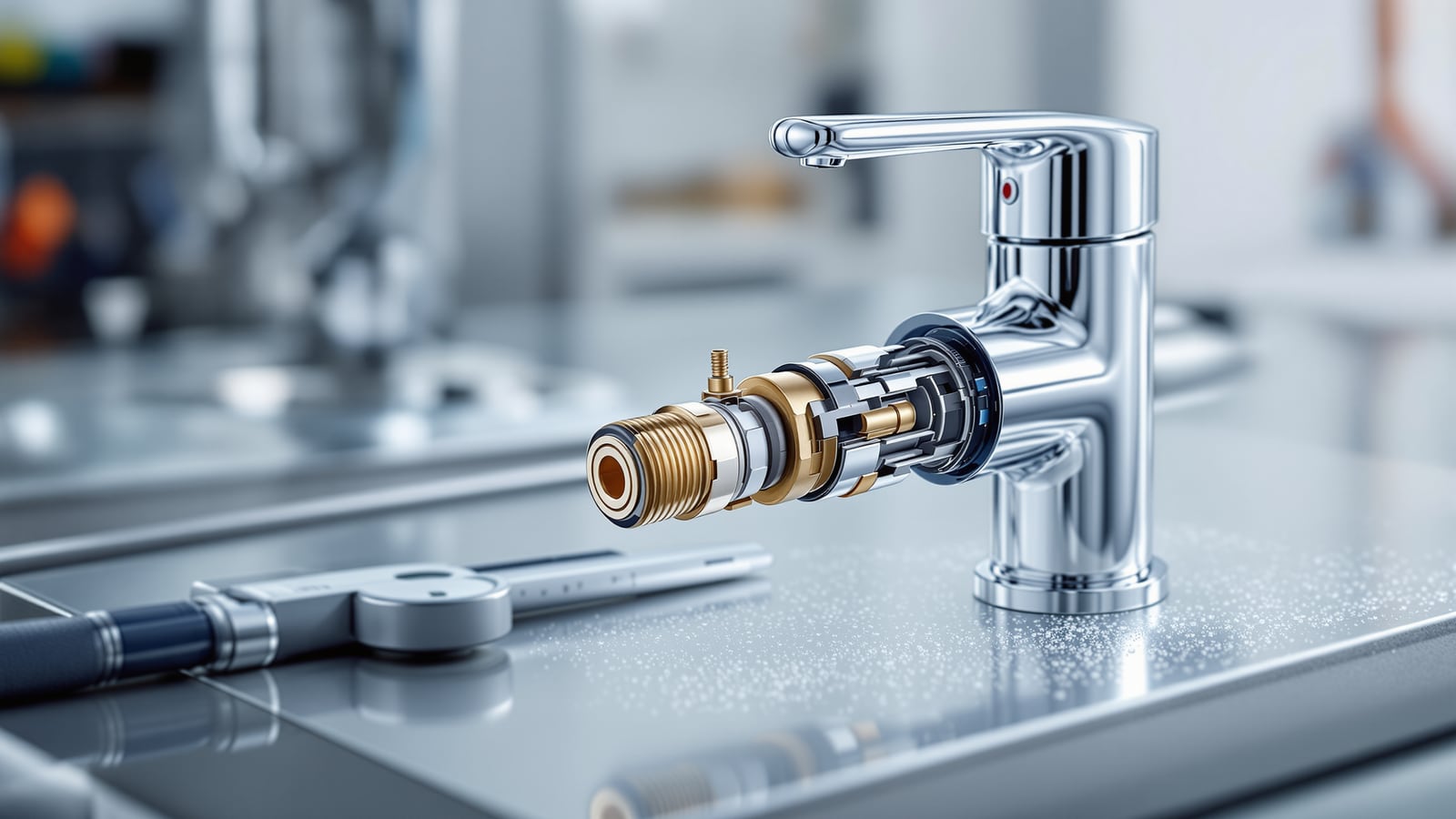
"CP" is a finish, not a material. A quality CP fitting is a copper-alloy body — forged brass or, for higher-corrosion service, gunmetal — that has been electroplated with a layer of nickel followed by chromium. The brass gives strength, machinability and thread integrity; the nickel gives corrosion resistance and levelling; the thin chromium on top gives the hard, bright, tarnish-resistant surface everyone recognises.
The counterfeit trade exploits the fact that the finish hides the substrate. Cheap "CP" fittings replace forged brass with zinc die-cast (Zamak) or thin sand castings, and replace a proper nickel-chromium stack with a single flash of chrome. They look identical new. They fail by dezincification (the alloy leaches zinc and turns porous), by plating blisters and pinholes, and by cartridges that seize in months. The standards exist precisely to pin down the substrate, the plating and the mechanism the eye cannot check.
The Indian Standards that govern tapware
Indian tapware is covered by a family of BIS standards, each scoped to a fitting type. The exact titles and editions should be checked on the BIS catalogue, but the commonly cited codes are below. Where scope is described rather than quoted, treat it as indicative.
| Standard | What it broadly covers | Key requirement to check |
|---|---|---|
| IS 8931 | Copper-alloy fancy single taps, combination tap assemblies and stop valves for water services | Body alloy grade, plating class, pressure test — the core code for single-control CP fittings |
| IS 1701 | Mixing valves for ablutionary and domestic purposes | Hot/cold blending, back-flow safety, endurance of the mixing mechanism |
| IS 1795 | Pillar taps for water supply purposes | Dimensions, thread, seat and washer/disc, hydraulic test for basic pillar taps |
| IS 781 | Cast copper-alloy screw-down bib taps and stop valves | Bib/stop-tap body, spindle and seating; copper-alloy composition |
| IS 4827 (plating family) | Electroplated coatings of nickel plus chromium | Service-condition class governing minimum nickel + chromium thickness |
| IS 2963 | Copper-alloy waste fittings for wash basins and sinks | Wastes, traps and couplings that pair with the tap |
Two things to note. First, the material and plating standards (the IS 4827 nickel-chromium family) are what actually define coating quality; the fitting standards reference them. Second, no single well-known IS number governs the ceramic-disc cartridge itself in the way one governs the body — cartridge quality is assured through the fitting standard's endurance and pressure tests plus the maker's own testing, so it is worth asking for the cartridge's cycle-life rating directly.
The plating thickness that separates genuine from fake
This is the single most useful technical fact in this guide. A real CP fitting is defined by the thickness of its nickel and chromium layers, expressed in microns and tied to a service-condition class in the electroplating standard.
- Nickel does the corrosion work. Indicative figures for indoor sanitary service run in the region of 8-12 microns of nickel; more demanding or humid service calls for thicker, sometimes duplex (semi-bright plus bright) nickel.
- Chromium is only the hard bright cap — typically a fraction of a micron, around 0.2-0.3 micron. It is thin by design; its job is hardness and tarnish resistance, not corrosion protection.
- A counterfeit skips the nickel almost entirely and lays chrome (or a chrome-look lacquer) straight onto zinc alloy. Under a magnetic or eddy-current thickness gauge, or a cross-section under a microscope, the missing nickel is instantly visible.
The consequence for buyers: you cannot judge a CP fitting by shine. Two taps can look identical while one carries a 10-micron nickel underlayer and the other carries almost none. Where it matters — bulk procurement, hotels, hospitals — a coating-thickness test on a sample is cheap insurance and is exactly what the standards are written to be checked against.
Cartridge, pressure and flow
Beyond the body and the plating, three performance properties decide whether a fitting lasts.
- Ceramic-disc cartridge. In a single-lever mixer the cartridge is the wear part. Two polished ceramic discs shear across each other to open, close and blend. Good discs shrug off the grit and scale in Indian water; poor ones score and drip. Ask for a cartridge cycle-life rating (quality cartridges are rated for several hundred thousand open-close cycles) and check the fitting was tested to its standard's endurance clause.
- Working pressure. Fittings are hydraulically tested well above domestic supply pressure. Indicative domestic supply sits around 0.5-3 bar; overhead-tank homes may see under 1 bar, while pumped or high-rise systems and instant geysers can spike higher. Match the fitting's rated pressure to your system, and fit a pressure-reducing valve where mains or pump pressure is high.
- Flow rate and aeration. Flow is set by the aerator and the cartridge bore. A water-efficient basin tap delivers roughly 4-6 litres per minute through an aerator that adds air for a soft, splash-free stream, against 10+ L/min for an unaerated fitting. Lower flow is both a water-saving and a comfort choice.
| Property | Indicative figure | Why it matters |
|---|---|---|
| Nickel layer (indoor service) | ~8-12 microns | Corrosion protection; missing in fakes |
| Chromium cap | ~0.2-0.3 micron | Hardness and shine only, not corrosion |
| Domestic supply pressure | ~0.5-3 bar | Fitting must be rated for your system |
| Cartridge cycle life | several 100,000 cycles | Longevity of a single-lever mixer |
| Efficient basin flow | ~4-6 L/min (aerated) | Water saving and splash-free use |
The ISI/BIS mark and how to spot a fake
The ISI mark — the letters ISI inside a stylised loop, accompanied by a licence number (CM/L-...) and the relevant IS number — signals that the maker holds a BIS licence to that standard for that product. It is a claim you can verify, not just a logo.
- Check the mark for completeness. A genuine mark carries the IS number and a CM/L licence number, not just an "ISI" graphic. A bare ISI-look symbol with no number is a red flag.
- Verify the licence. BIS publishes licence details; the CM/L number can be checked against the BIS records or the BIS Care app rather than taken on trust.
- Weigh the fitting in your hand. Forged brass is dense; a suspiciously light "brass" tap is usually zinc die-cast.
- Look inside the inlet and at unplated threads. Genuine brass shows a warm yellow; zinc alloy looks greyer, and machining is often rougher.
- Distrust the price. A CP mixer at a third of the market rate is not a bargain on the same product — it is a different, cheaper product wearing the same chrome.
A practical procurement checklist
For specifiers and contractors buying at scale, the standards turn into a short list of asks:
- Demand the IS number and CM/L licence on the product and on the invoice, and verify it against BIS records.
- Ask for a test certificate covering body alloy, plating thickness and hydraulic/endurance testing to the relevant IS.
- Pull a random sample for a coating-thickness check on any large order — it is the fastest way to catch a substituted batch.
- Specify the cartridge cycle-life rating in the tender, not just "ceramic disc".
- Fit pressure management (PRV) where the building's supply pressure exceeds the fitting's rating, and match aerator flow to any water-efficiency target.
Get these five right and the difference between the third-price tap and the genuine one — invisible on the shelf — becomes a documented, testable specification. That is the entire point of the standards: to make quality checkable when the chrome will not tell you.
References
- IS 8931 — Copper-alloy fancy single taps, combination tap assembly and stop valves for water services (verify current edition on the BIS catalogue).
- IS 1701 — Mixing valves for ablutionary and domestic purposes.
- IS 1795 — Pillar taps for water supply purposes.
- IS 781 — Cast copper-alloy screw-down bib taps and stop valves for water services.
- IS 2963 — Copper-alloy waste fittings for wash basins and sinks.
- IS 4827 (and related plating standards) — Electroplated coatings of nickel plus chromium; service-condition classes for coating thickness.
- Bureau of Indian Standards (BIS) — ISI mark scheme, CM/L licence records and the BIS Care app for verification.
- National Building Code of India (NBC 2016), Part 9 (Plumbing Services) — for the plumbing context in which fittings are installed.
Editions and clause numbers change; confirm the current standard and your local municipal requirements with a licensed professional before relying on any figure above.
Export this guide
Related Guides — Deep-dive reading
How to Choose a Bathroom Faucet in India: A Buyer's Guide to Cartridges, Brass & Fakes (2026)
A buyer's decision guide to CP fittings — the ceramic-disc cartridge that decides life in hard water, the brass-vs-zinc weight test, finish durability, warranty, honest good/better/best rupee tiers, and how to spot the huge fake-faucet problem in the Indian market.
BathroomsBathroom Faucets India: The Complete Guide to Taps, Cartridges, Finishes & Flow (2026)
Every faucet type explained for Indian bathrooms — pillar taps, basin mixers, single-lever vs two-handle, wall vs deck vs concealed, sensor and thermostatic — plus the ceramic-disc cartridge that survives hard water, CP-fitting quality to IS standards, finishes, aerators and honest rupee ranges.
BathroomsBasin Mixer Tap India: Single-Lever Buying Guide, Spout Height, Cartridge & Cost (2026)
How a single-lever basin mixer blends hot and cold on one control — what supplies it needs, the spout height that matches your basin, the ceramic cartridge that decides its life, pop-up waste, tall vessel mixers, finishes, flow rate, and rupee tiers versus separate pillar taps.
BathroomsRelated Tools — Try Free
Interior Contract Clause Checklist
16 sections and 98 checkboxes covering scope, BOQ, milestones, penalties, warranty, and disputes.
Contract ChecklistPlumbing Pressure-Test & Leak Checklist
Pre-closure pressure and leak test — 9 categories, 60+ checkpoints across water supply, drainage, fixtures, waterproofing, hot water, tanks.
Pre-Closure TestCPCB Compliance Checklist for STPs
Tick off CPCB/SPCB outlet standards, monitoring duties and record-keeping to score your sewage treatment plant's compliance readiness.
Checklist