
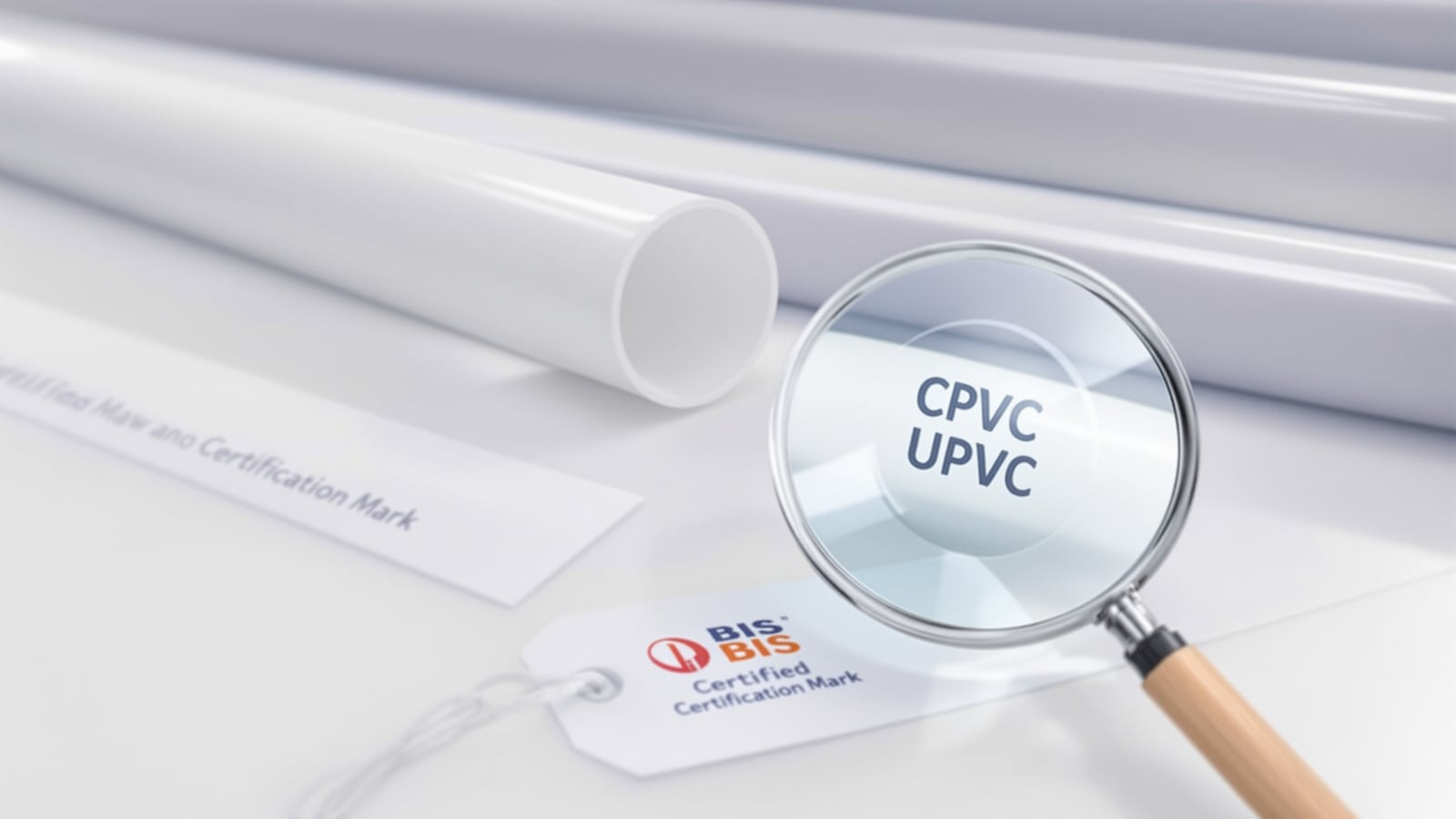
BIS-Certified Plumbing Materials in India: ISI Marks, CPVC (IS 15778), UPVC & Soil-Pipe Standards (2026)
A professional reference to the BIS/ISI standards behind bathroom plumbing materials — CPVC (IS 15778), UPVC pressure pipe (IS 4985), PVC soil and waste (IS 13592), PEX, GI, solvent cements and pressure classes — plus how to read the marking printed on a pipe and why you must insist on the ISI mark.
The tap and the tile get chosen with care; the pipe behind the wall gets whatever the plumber pulls off the truck. That is exactly backwards. The concealed pipe carries pressure, hot water and years of thermal cycling inside plaster you will not open again until the next renovation — so it is the one component where a certified grade matters most and a cheap substitute costs the most. In India, "certified" has a precise meaning: the material is manufactured to a Bureau of Indian Standards (BIS) specification and carries the ISI mark under a valid BIS licence.
This is a professional reference to the standards that govern bathroom plumbing materials — not the layout or the fixtures, but the pipe, the fittings and the cement that join them. It sits under the bathroom building regulations pillar for India and pairs with the practical bathroom pipe materials guide. For the head-to-head on the two supply materials you will specify most, read CPVC vs UPVC pipes in India; for the code side of installation, see the bathroom plumbing codes guide.
Verify before you rely on this. BIS standards are revised, amended and occasionally renumbered, and municipal bye-laws vary by city. Treat the numbers below as the correct standards to ask for — then confirm the current edition on the BIS website or with a licensed plumber before you specify or sign off.
The ISI mark: what it actually certifies
The ISI mark is BIS's product-certification mark. When it appears on a pipe it means three things at once: the product conforms to a named Indian Standard, the factory holds a live BIS licence to use the mark, and the output is subject to periodic BIS surveillance and testing. It is not decoration — an unmarked pipe, or one that only prints the standard number without the ISI monogram and licence, carries no such guarantee.
For plumbing this matters because the failure modes are invisible until they are catastrophic. An off-grade CPVC pipe can meet the size but miss the wall thickness or the resin quality, and it will hold cold water on the day it is fitted and then split under hot water and pressure two monsoons later — inside the wall. The ISI mark and the printed IS number are your only on-site proof of grade and pressure class. Insisting on them is the cheapest quality control available to you.
The material standards — a reference table
Every common bathroom plumbing material maps to a BIS specification. The supply side (pressurised, potable) and the drainage side (gravity, non-pressure) use different standards, and hot versus cold is a hard divide on the supply side.
| Standard | Material & scope | Key requirement to check |
|---|---|---|
| IS 15778 | CPVC pipes & fittings for potable hot and cold water supply | Sized to CTS; pressure class by SDR (SDR 11 / SDR 13.5); rated for continuous hot water |
| IS 4985 | UPVC (PVC-U) pipes for potable cold water supply | Graded into pressure classes; not for hot-water lines |
| IS 13592 | UPVC pipes for soil and waste discharge (SWR), inside & outside buildings | Type A (ventilation/rain-water) vs Type B (soil & waste) — use Type B on WC lines |
| IS 1239 (Part 1) | Mild-steel / GI tubes | Light / medium / heavy grade; galvanised for water service |
| IS 7834 (series) | Injection-moulded PVC fittings for water supply | Fitting class must match the pipe's pressure class |
| IS 14182 | Solvent cement for PVC / CPVC pipes & fittings | Use the cement type made for the pipe polymer (see caveat) |
| IS 1172 | Code of basic requirements for water supply, drainage & sanitation | The umbrella "good practice" code for the whole system |
| NBC 2016, Part 9 | National Building Code — Plumbing Services | Overarching material, sizing & installation framework |
A note on the fittings and cement rows: IS 7834 is a multi-part series, and the exact fitting or cement standard your supplier quotes can differ — confirm the current number rather than assuming. The principle is fixed even when the digits move: the fitting and the cement must be rated for the same pipe polymer and pressure class as the pipe itself.
Supply pipes: CPVC, UPVC and PEX
CPVC (Chlorinated PolyVinyl Chloride), IS 15778. This is the default for concealed supply plumbing in Indian bathrooms because it takes continuous hot water from the geyser without softening. CPVC is sold to CTS (Copper Tube Size) dimensions and its pressure capacity is expressed as an SDR — Standard Dimension Ratio, the ratio of outside diameter to wall thickness. A lower SDR means a thicker wall and a higher pressure rating: SDR 11 is the heavier, higher-pressure class; SDR 13.5 is lighter. Homes on direct pumped or pressure-boosted supply should specify the heavier class; overhead-tank gravity systems can often use the lighter one. The internationally referenced equivalent is ASTM D2846.
UPVC / PVC-U, IS 4985. Unplasticised PVC pressure pipe is graded into pressure classes (working pressures stated in kgf/cm² or MPa at 27°C — pick the class rated above your system pressure). It is excellent, low-cost pipe for cold potable lines and buried service, but it is not rated for hot water and will sag and fail on a geyser run. Never let UPVC substitute for CPVC on the hot side to save a few rupees a metre.
PEX (cross-linked polyethylene, PE-X). Flexible PEX is used for manifold ("home-run") hot and cold plumbing and is valued for fewer concealed joints. In India it is less common than CPVC and its Indian Standard for PE-X pressure pipe should be confirmed with the supplier; internationally it is governed by ISO 15875 and ASTM F876/F877. Whatever the number, insist on marked, certified pipe and matching fittings — the joint system (crimp, press or expansion) is part of the certification.
GI (galvanised iron), IS 1239 (Part 1). Threaded GI steel was the old default and still appears in repairs. It corrodes internally, scales up and restricts flow over time, and it is the one material to retire rather than extend — do not tee new plastic supply lines into aged GI.
Drainage pipes: PVC soil and waste (IS 13592)
Drainage is gravity, not pressure, so soil and waste pipe is a different specification: IS 13592, for UPVC soil and waste discharge (the "SWR" system). Its most useful feature for a specifier is the Type A / Type B split. Type A is the thinner-walled pipe intended for ventilation and rain-water; Type B is the thicker-walled pipe for soil and waste — the discharge from the WC. On a bathroom soil line, specify Type B. The matching SWR fittings carry their own IS numbers; the rule again is that fitting and pipe come from the same certified system so the rubber-ring or solvent joints seat correctly.
Solvent cement and the joint
A certified pipe with the wrong cement is an uncertified joint. Solvent-cement welding chemically fuses the pipe to the fitting, and the cement is polymer-specific: CPVC needs CPVC cement; UPVC needs PVC cement. The yellow PVC tin will not properly weld a CPVC joint, and a mismatched joint weeps slowly inside the wall — the classic hidden leak. The relevant Indian specification for PVC/CPVC solvent cement is commonly IS 14182 (confirm the current number and the cement grade for your polymer); the internationally referenced equivalents are ASTM F493 for CPVC cement and ASTM D2564 for PVC cement. On rubber-ring SWR joints, the equivalent discipline is using the correct lubricant and the matching gasket, not cement.
How to read the marking on a pipe
Every metre of certified pipe is printed with its credentials. Reading them on site takes ten seconds and catches most substitutions. Look for:
- The IS number — e.g. "IS 15778" on CPVC supply, "IS 4985" on UPVC cold, "IS 13592" on soil/waste. The right pipe in the wrong place still fails.
- The ISI mark — the standard mark monogram, printed with the BIS licence number (in the form CM/L-followed by digits). No monogram and licence, no certification.
- Size and class — nominal size and, on supply pipe, the pressure class: SDR 11 / SDR 13.5 for CPVC, the pressure class for UPVC.
- Manufacturer and batch — maker's name or trademark plus a batch/lot and date code for traceability.
What to insist on — a specifier's checklist
- The ISI mark on every pipe, fitting and cement tin — plus a legible BIS licence number, not just a printed IS number.
- Right standard for the duty — IS 15778 for hot supply, IS 4985 for cold, IS 13592 Type B for the soil line.
- Right pressure class — heavier CPVC (SDR 11) for pumped/pressure systems; the correct UPVC class for your head.
- Matched joint system — CPVC cement on CPVC, PVC cement on UPVC, correct gaskets on SWR.
- Pressure-test before tiling — cap and hold the concealed supply run at test pressure before any plaster goes on; a joint that weeps on test is a stain in the flat below later.
Choose the concealed pipe with the same care you give the visible fixture. The tap you can swap in an afternoon; the certified pipe behind it you are committed to until the wall comes open again. For the full material comparison return to the bathroom pipe materials guide, and for the surrounding rules see the bathroom building regulations pillar.
References
- National Building Code of India (NBC) 2016, Part 9 — Plumbing Services (water supply, drainage and sanitation).
- IS 15778 — Chlorinated PolyVinyl Chloride (CPVC) Pipes for Potable Hot and Cold Water Supply — Specification.
- IS 4985 — Unplasticised PVC (PVC-U) Pipes for Potable Water Supplies — Specification.
- IS 13592 — Unplasticised PVC Pipes for Soil and Waste Discharge Systems (inside and outside buildings) — Specification (Type A / Type B).
- IS 1239 (Part 1) — Steel Tubes, Tubulars and Other Wrought Steel Fittings: Steel Tubes (GI service).
- IS 7834 (series) — Injection-Moulded PVC Socket Fittings with Solvent-Cement Joints for Water Supplies.
- IS 14182 — Solvent Cement for use with Unplasticised PVC / CPVC Pipes and Fittings (confirm current edition).
- IS 1172 — Code of Basic Requirements for Water Supply, Drainage and Sanitation.
- ASTM D2846 / F493 / D2564 — CPVC distribution systems and CPVC/PVC solvent cements (internationally referenced equivalents).
- Bureau of Indian Standards (BIS) — ISI product certification (Standard Mark) scheme and licence register.
Export this guide
Related Guides — Deep-dive reading
Bathroom Plumbing Code India: NBC 2016 Part 9, UPC-I & the IS Standards That Govern Pipework
A professional reference to the codes and standards that govern bathroom plumbing in India — the National Building Code (NBC 2016) Part 9 on Plumbing Services, the Uniform Plumbing Code India (UPC-I), the CPHEEO Manual, and the IS standards for water supply, drainage, trap seals, pipe sizing, slopes and venting — with a caveat to always verify the current code and your local authority.
BathroomsIS Codes for Plumbing in India: BIS Standards, the ISI Mark and How to Buy Certified Pipes, Tanks, Valves and Fittings
A professional's plain-English guide to the Bureau of Indian Standards (BIS) system that governs plumbing materials — what the ISI mark actually certifies, how IS standards specify pipes, fittings, tanks and valves, why the marked product is the compliant one, and how to verify a standard on the BIS portal.
PlumbingBathroom Pipe Material in India: CPVC, UPVC, PEX, PPR & PVC Compared
A brand-neutral, India-first guide to choosing supply and drainage pipes for your bathroom — CPVC for hot and cold, UPVC and PEX for cold, PPR, why old GI corrodes and chokes, temperature ratings, jointing, IS/ASTM standards, a comparison table and ₹ cost.
BathroomsRelated Tools — Try Free
Plumbing Pressure-Test & Leak Checklist
Pre-closure pressure and leak test — 9 categories, 60+ checkpoints across water supply, drainage, fixtures, waterproofing, hot water, tanks.
Pre-Closure TestBathroom Drainage Pipe Calculator
Recommended drain and waste pipe sizes, slopes and stack size for a bathroom's fixtures — indicative IS 1172 / NBC plumbing practice.
Bathroom CalculatorMonsoon-Readiness Checklist
Pre-rain home audit across 9 categories — terrace, drains, waterproofing, electrical, HVAC, pest, vehicles, documents.
Seasonal Audit