
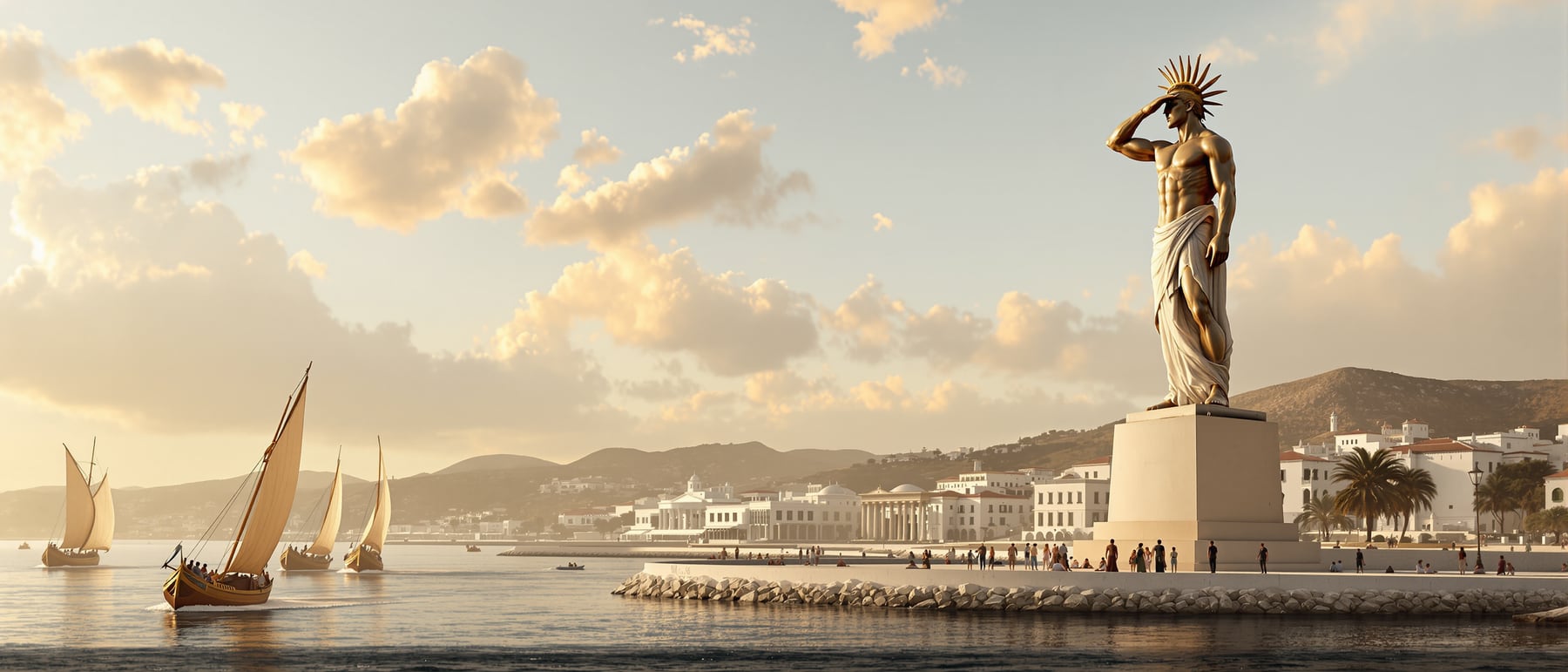
The Colossus of Rhodes: The Giant That Never Straddled the Harbour
How a whole city melted down its defeated attacker's siege engines to cast a 33-metre bronze sun-god — the tallest statue of the ancient world — which stood a mere 54 years before an earthquake felled it, and why its most famous image, striding astride the harbour with ships between its legs, is a myth that never happened.
You already have a picture of this one in your head — and it is wrong. Ask anyone to imagine the Colossus of Rhodes and they will describe a titanic bronze figure standing astride the harbour mouth, legs spread from pier to pier, ships gliding beneath him. It is one of the most famous images in the world. It is also a medieval fantasy that no ancient writer ever recorded and that could not possibly have been built. Clearing away that myth is the whole reason this wonder is such a delight to tell.
The real Colossus of Rhodes is a better story than the legend. It was a 33-metre bronze statue of Helios, the sun-god, raised around 280 BCE by the sculptor Chares of Lindos — the tallest statue of the ancient world, cast (extraordinarily) from the melted-down weapons of a defeated invading army. It stood beside the harbour of Rhodes, in the Greek Aegean, for a mere fifty-four years before an earthquake brought it down. And even shattered on the ground it stayed a wonder for eight centuries more.
This is the thirty-sixth article in our Architectural Wonders series.
1. A giant built from the enemy's weapons
The Colossus was, before anything else, a war memorial — and the way it was funded is one of the great defiant gestures in history.
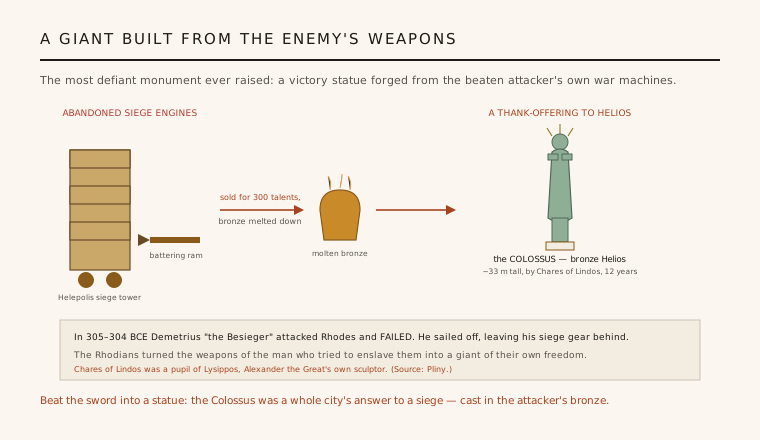
In 305–304 BCE, the warlord Demetrius "the Besieger" threw everything he had at Rhodes — including the Helepolis, a monstrous nine-storey siege tower, and a battering ram so huge it took a thousand men to swing. Rhodes held. Demetrius gave up and sailed away, abandoning his vast, expensive war machines on the shore. And the Rhodians did something magnificent: they sold the enemy's siege engines for a fortune, melted down their bronze, and used it to cast a colossal statue of their protector-god Helios — a thank-offering for their deliverance, made by Chares of Lindos (a pupil of Lysippos, Alexander the Great's own sculptor) over some twelve years. The very metal that had been forged to enslave the city became the giant that celebrated its freedom. There is no purer example in all of architecture of turning a sword into a symbol.
2. It never straddled the harbour
Now the myth — because dismantling it tells you more about the real Colossus than any legend could.
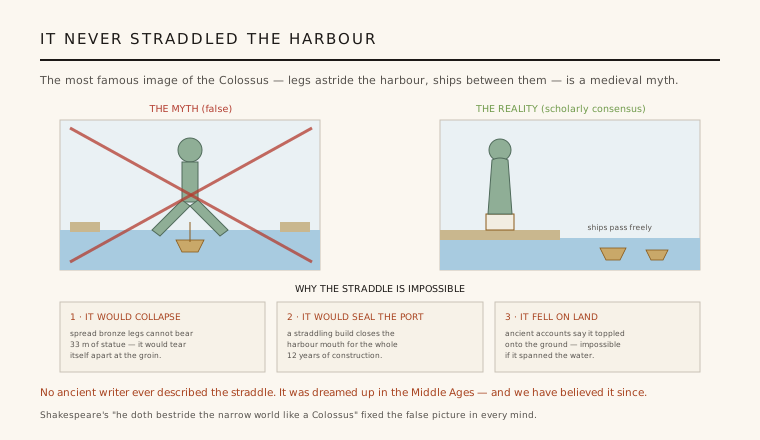
The image of the Colossus bestriding the harbour is a medieval invention — no ancient source describes such a pose, and it is impossible for three plain reasons. First, it would collapse: bronze legs spread wide simply cannot carry thirty-three metres of statue; the figure would tear itself apart at the groin under its own weight. Second, it would have sealed the port: building a straddling giant across the harbour mouth would have blocked the shipping channel for the entire twelve years of construction, which no working harbour could allow. And third — the clincher — the ancient accounts say it fell onto the land when the earthquake struck, not into the water, which is impossible if it had spanned the sea. The scholarly consensus is that it stood upright, beside the harbour, on a marble pedestal, in a stable and conventional pose. The straddle was dreamed up centuries after the statue was gone, and cemented by Shakespeare's line about a man who "doth bestride the narrow world like a Colossus." It is a perfect lesson: the most famous "fact" about a wonder can be pure invention — always ask whether the picture in your head was ever really true.
3. How big, and how made
Strip away the legend and the real engineering is astonishing enough — and, in one respect, a cautionary tale.
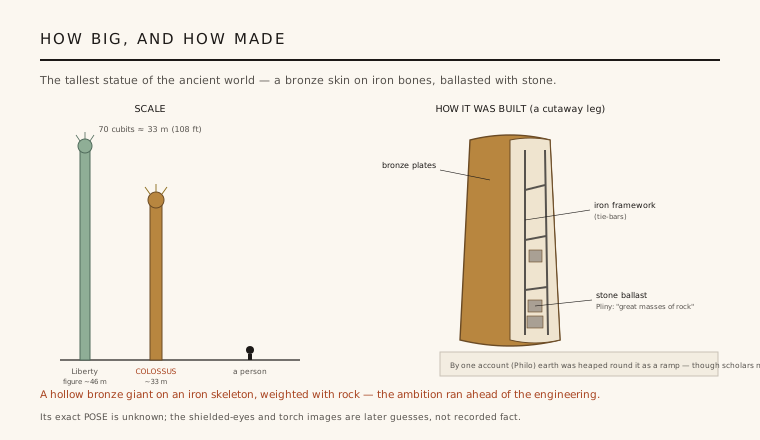
At around 33 metres (70 cubits), the Colossus was the tallest statue of the ancient world — comparable in scale to the figure of the modern Statue of Liberty, and towering over the harbour. It was built the way you might build a ship in reverse: an inner skeleton of iron tie-bars, clad in a skin of bronze plates, with the hollow interior packed with heavy stone blocks for ballast and stability as it rose (Pliny describes those "great masses of rock" inside). One ancient account, by Philo of Byzantium, says the builders heaped earth around the statue as a ramp as it climbed, digging it out at the end — though modern scholars doubt that method. Its exact pose is genuinely unknown: the shielding-eyes gesture and the raised-torch image (the one that shaped the Statue of Liberty) are later guesses, not recorded fact. This was ambition running right at the edge of what the technology could bear — as we will see, perhaps a little past it. Like the Statue of Zeus, it was a colossal figure built over a hidden internal frame; unlike Zeus's protected indoor throne, this giant stood out in the weather, on a fault line.
4. Fifty-four years, then the earthquake
For all its glory, the Colossus had the shortest life of any of the seven wonders — a reminder that height and permanence are not the same thing.
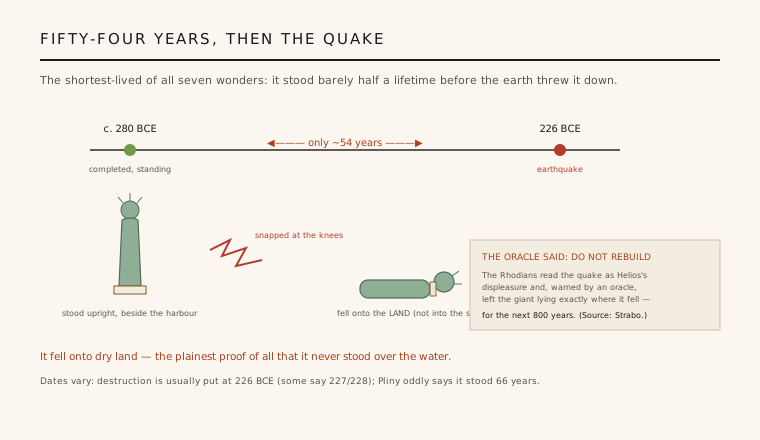
It was finished around 280 BCE and stood for barely fifty-four years before the great earthquake of 226 BCE snapped it at the knees and threw it down onto the land. (That detail — onto the land — is the quiet proof, once more, that it never spanned the water.) And here the Rhodians did something remarkable: they never rebuilt it. Offered funds to restore their giant, they consulted an oracle, which warned them not to — the earthquake was read as a sign that Helios himself was displeased. So they left the fallen god lying exactly where he had toppled, and there he stayed. The tallest statue in the world became the largest ruin in the world, in a single afternoon of shaking earth.
5. Even in ruins, a wonder
And this is the twist that makes the Colossus unique among the seven: fallen, it was arguably more of a wonder than standing.
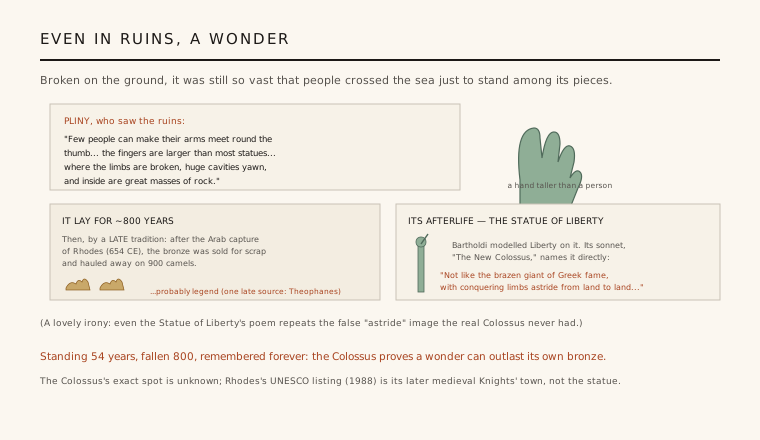
For eight hundred years the broken Colossus lay by the harbour, and people sailed to Rhodes just to see the ruins. Pliny the Elder, who stood among the pieces, wrote the most vivid description of any wonder: "Few people can make their arms meet round the thumb... the fingers are larger than most statues... and where the limbs are broken, huge cavities yawn, and inside are great masses of rock." A single broken finger was bigger than an ordinary statue. Only around 654 CE, after Arab forces took Rhodes, was the bronze finally carried off for scrap — famously, by tradition, on the backs of 900 camels (a late story, probably part legend). But the Colossus never truly died. Its very kind — the colossal bronze standing figure — echoed down the centuries: Rome would raise its own roughly thirty-metre bronze Colossus of Nero, which in turn lent its nickname to the greatest arena of the ancient world, the Colosseum. And the Rhodian giant's memory sailed across two thousand years to New York Harbor: Frédéric Bartholdi modelled the Statue of Liberty on it, and the sonnet at Liberty's feet, The New Colossus, opens by naming it — "Not like the brazen giant of Greek fame, with conquering limbs astride from land to land." (A perfect final irony: even Liberty's poem repeats the false straddling pose the real Colossus never had.) Like the Mausoleum, whose stones were carted into a castle, the Colossus's bronze vanished — but the idea of it lights a harbour still.
6. What a modern architect can learn from the Colossus
- Interrogate the famous image. The whole world "knows" the Colossus straddled the harbour, and the whole world is wrong. Question the received picture — of a building, a site, a "fact" — because the most confident image is often the least examined.
- A monument can transform its meaning. Enemy siege engines became a god of freedom. Materials and structures carry stories; what a thing is made from, and why, can matter as much as its form.
- Ambition must respect the physics — and the ground. The tallest statue of its age stood on a fault line and lasted 54 years. Reach as high as you like, but reckon honestly with load, structure and site, or height becomes fragility.
- Ruins can be as powerful as monuments. Fallen, the Colossus drew pilgrims for eight centuries. A broken thing, at the right scale, still speaks. Don't assume a work only matters while it is whole.
- Design for the disaster you know is coming. The Rhodians knew earthquakes; the statue did not survive one. In seismic country, resilience is not optional decoration — it is the difference between 54 years and forever.
- The idea outlives the object. The bronze is 1,300 years gone, yet the Colossus stands, reborn, in New York Harbor. Build ideas strong enough to be re-imagined; that is the deepest permanence a design can have.
References & further reading
1. World History Encyclopedia — Colossus of Rhodes. https://www.worldhistory.org/Colossus_of_Rhodes/
2. Encyclopaedia Britannica — Colossus of Rhodes. https://www.britannica.com/topic/Colossus-of-Rhodes
3. Pliny the Elder — Natural History 34.18 (Chares of Lindos, dimensions, the ruins), via Attalus. https://www.attalus.org/translate/pliny_hn34a.html
4. Robert B. Kebric — The Colossus of Rhodes: Its Height and Pedestal (Athens Journal of Humanities & Arts, 2019). https://www.athensjournals.gr/humanities/2019-6-4-1-Kebric.pdf
5. National Geographic History — Rise of the Colossus. https://www.nationalgeographic.com/history/history-magazine/article/colossus-of-rhodes-ancient-greece-statue
6. UNESCO World Heritage Centre — Medieval City of Rhodes (inscribed 1988; the Knights' town, not the Colossus). https://whc.unesco.org/en/list/493/
Last verified 2026-07-04. No trace of the statue survives and its exact location is debated, so detail rests on ancient sources — chiefly Pliny the Elder (Natural History 34.18) for the sculptor Chares of Lindos, the bronze from Demetrius's siege engines, the ~12-year build and the ruins, and Philo of Byzantium for the construction method (which some scholars now dispute). Figures are widely cited approximations that vary by source: height ~33 m / 70 cubits (Pliny gives 105 ft); built c. 292–280 BCE; destroyed by earthquake in 226 BCE after ~54 years (some sources 227/228 BCE; Pliny oddly says it stood 66 years). The statue's exact pose is unknown, and the harbour-straddling stance is a medieval invention rejected on engineering and textual grounds — the single most important myth-bust of this article. The 900-camels scrap-removal (c. 654 CE) derives from the late chronicler Theophanes and is likely legendary. The Colossus inspired the Statue of Liberty and Emma Lazarus's sonnet "The New Colossus." Rhodes's UNESCO listing (1988) is its later Medieval City (the Knights Hospitaller old town), not the ancient statue.
Export this guide
Related Guides — Deep-dive reading
The Colosseum: The Machine That Fed a City Its Pleasures
Rome's greatest emperors built palaces for themselves; the Flavian emperors did something shrewder — they drained a fallen tyrant's private lake and raised, on the spot, a stupendous arena for fifty thousand ordinary citizens. The largest amphitheatre ever built is a masterpiece of crowd engineering, a hidden stage-machine of lifts and trapdoors, and a place of real, organised killing — all at once. The fourth article in our chapter on the palaces and pleasures of worldly power, and the first on pleasure.
Architectural WondersThe Lighthouse of Alexandria: The Wonder That Became a Word
How Ptolemy's Egypt raised a 100-metre tower of light on the island of Pharos — the tallest building on earth after the Great Pyramid, the model for every lighthouse since, and so famous its island's name became the word for 'lighthouse' itself — which stood 1,600 years, fell to earthquakes, and was reborn as a fort and a field of ruins on the sea floor.
Architectural WondersĠgantija: The Oldest Temple Standing, Built by 'Giants'
How a Neolithic island people on Malta — with no metal and no wheel — raised the oldest free-standing stone temples on Earth a thousand years before Stonehenge or the pyramids, moving fifty-tonne blocks on stone balls into clover-leaf sanctuaries for a faith we can trace but cannot read, then vanished, leaving stones so vast that later islanders swore only giants could have built them.
Architectural WondersRelated Tools — Try Free
Acoustic Privacy (STC) Visualizer
Indian healthcare acoustic visualizer — compare wall assemblies and noise sources, see received SPL after STC attenuation, and check FGI 2018 / IS 1950 / NABH speech-privacy compliance with live dual-canvas waveform.
Acoustic ToolBefore & After Studio
Generate AI before-and-after renders to preview how your redesign could look.
DesignAIHealing View Impact Calculator
Evidence-Based Design dashboard quantifying the recovery impact of nature view + daylight factor on analgesic use, length of stay, and HCAHPS patient-experience uplift. Calibrated against Ulrich 1984 (Science), Park & Mattson 2008, and the CHD EBD evidence base.
EBD Calculator