

Circle Rate vs Market Value (Guideline Value) in India (2026)
What the government-notified minimum value is, why it rarely matches the price you actually pay, and how the gap changes your stamp duty and tax.
When you buy a plot or home in India, two very different numbers describe the same property. One is the "market value" - what a willing buyer actually pays. The other is the "circle rate" - a value the government has notified for that locality, below which the property usually cannot be registered. Understanding the gap between them is one of the most useful things a first-time buyer can learn, because that gap quietly decides how much stamp duty you pay and can even trigger income tax.
This guide explains what circle rate is, why it exists, why it goes by half a dozen names across India, and how to use it when you negotiate. It is a companion to our plot-buying pillar, How to buy a residential plot in India, and the property registration process guide.
Scope and disclaimer: This is a plain-language explainer, not legal, tax or financial advice. Circle rates, guideline values, stamp-duty percentages and income-tax thresholds are set state by state (sometimes locality by locality) and change often. Every figure and rule here is indicative only. Confirm the current notified value at your sub-registrar office or state registration portal, and confirm any tax consequence with a qualified CA or property advocate before you sign.
What "circle rate" actually is
Circle rate is a government-notified minimum value for property in a defined area (a "circle" of the registration department). It is expressed per unit of land - typically per square foot, per square metre or per acre - and often varies by the type of property (agricultural, residential plot, flat, commercial) and by the road or sub-locality.
The key idea: it is a "floor", not a market price. When a sale is registered, the authorities calculate stamp duty and registration charges on the transaction value - but never on less than the circle-rate value. If the price you declare is below the circle rate, the department simply uses the circle rate instead.
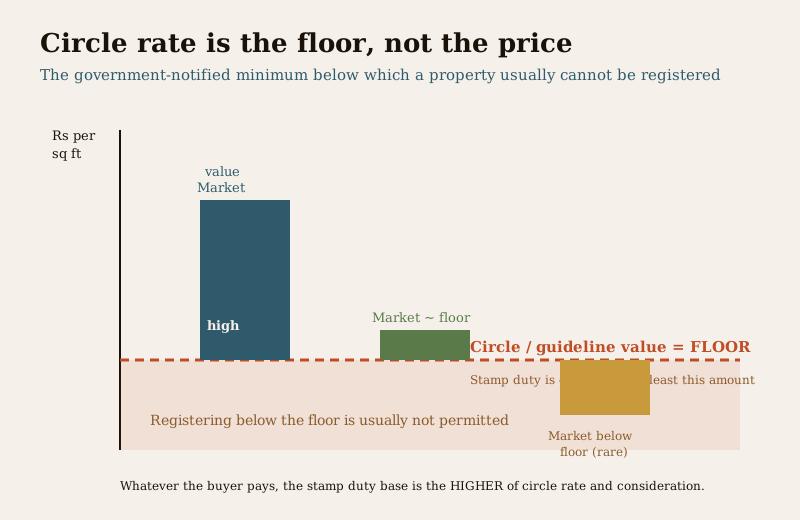
So the working rule to remember is short: stamp duty is charged on the "higher" of the circle-rate value and the actual price (the "consideration"). You can pay more than circle rate and be taxed on what you paid; you generally cannot pay tax on less than circle rate even if you negotiated a bargain.
Same idea, many names
Circle rate is the north-Indian term, but the concept is nationwide. Depending on the state you are buying in, you will hear a completely different word for the same notified minimum. This trips up buyers who move between cities, so it helps to recognise the whole family of names.
| Term you will hear | Where it is commonly used | What it means |
|---|---|---|
| Circle rate | Delhi and much of north India | Notified minimum value per unit for a locality |
| Guideline value | Tamil Nadu, Karnataka, Andhra Pradesh, Telangana | Same floor value, published street or survey-wise |
| Ready reckoner rate (also ASR) | Maharashtra | Annual statement of rates used for stamp duty |
| Collector rate or DC rate | Punjab, Haryana, Himachal Pradesh | Rate fixed by the district collector / deputy commissioner |
| Unit area value | Several municipal systems | Value per unit area used for duty and tax |
| Government value / sub-registrar value | Informal, all over India | Everyday phrase for whatever the local notified rate is |
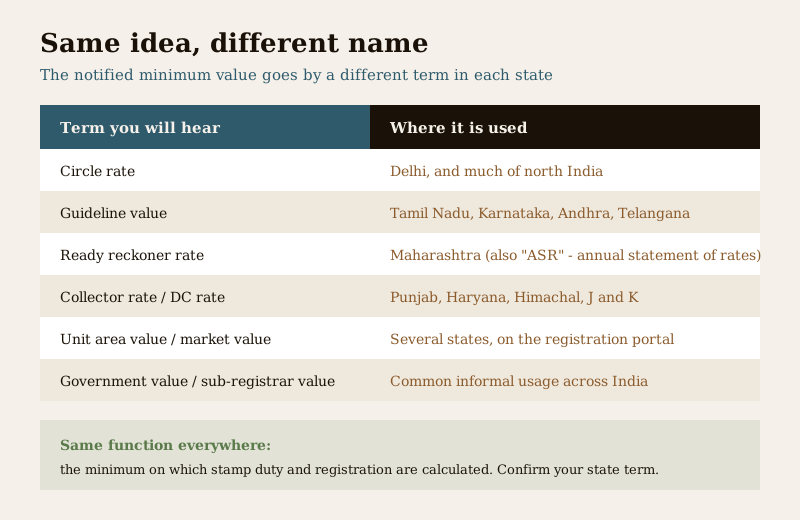
Whatever it is called, the function is identical: it is the minimum value on which the government computes stamp duty and registration fees. When you read a document or a portal, mentally translate the local word back to "the floor".
Why the government sets a floor at all
Circle rates exist for a few connected reasons:
- Stamp-duty base. Stamp duty is a major source of state revenue. A notified floor guarantees a minimum tax on every transfer regardless of what the parties declare.
- Curbing under-valuation. For decades, buyers and sellers under-declared prices to save duty, parking the difference in cash ("black money"). A floor makes gross under-declaration pointless, because duty is charged on the higher circle rate anyway.
- A reference point. Banks, courts, tax officers and municipal bodies use the notified value as a neutral yardstick for lending, compensation and disputes.
Circle rates are meant to track the market and are revised periodically, but revisions lag reality. That lag is exactly why the two numbers diverge.
Why market value drifts away from circle rate
Market value is set by demand, supply, sentiment and the specifics of a particular plot - corner position, road width, a good school nearby, a clear title. Circle rate is a broad administrative number for a whole area. They rarely match, and the direction of the gap tells you something:
- Market value "higher" than circle rate. The common case in cities and fast-growing suburbs. Prices have run ahead of the last revision. Here the circle rate looks low, and stamp duty is charged on the real (higher) price.
- Market value "near" circle rate. Well-revised areas, or steady markets, where the floor is realistic.
- Market value "lower" than circle rate. Less common but real - a stagnant or falling market, a distress sale, or a circle rate that was set high and not corrected. Here you may pay stamp duty on a value greater than what you actually paid, and a tax question can arise (below).
A plot can sit anywhere on this spectrum, so always check the notified value for the exact survey number or street, not a city-wide average.
The tax angle when the two differ
This is where the gap stops being trivia and starts costing money. Two different taxes react to it.
First, "stamp duty and registration". These are always computed on the higher of circle rate and consideration. So if the circle-rate value is above your negotiated price, your duty is calculated on the circle rate - you pay more than you might expect. Model this before you commit using our stamp duty guide and the stamp duty calculator.
Second, "income tax", when the declared price is meaningfully below the circle rate. Indian tax law treats a large under-declaration with suspicion: broadly, the shortfall between circle rate and the stated price can be added to taxable income - potentially to the "buyer" (as other income) and to the "seller" (as higher capital gains, because the sale is deemed to have happened at circle rate). A tolerance band is allowed for small differences, and the exact percentages and thresholds change from year to year. This is named here only in general terms - the precise sections, the tolerance limit and how they apply to your case must be confirmed with a CA. Our capital gains and cost planning hub gives the surrounding context.
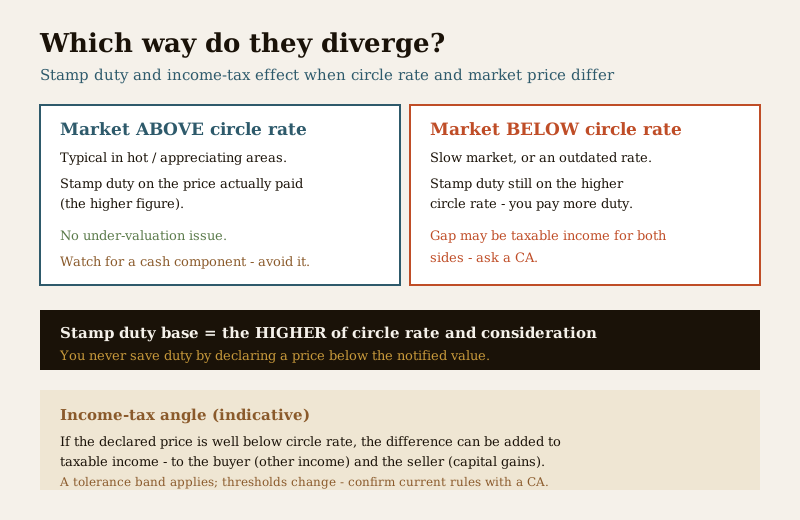
| Scenario | Stamp duty is charged on | Income-tax angle (indicative) |
|---|---|---|
| Price ABOVE circle rate | The actual price paid (the higher figure) | Normal - no under-valuation issue; avoid any cash portion |
| Price NEAR circle rate | Whichever is higher, roughly the same | Usually within the tolerance band; still declare honestly |
| Price BELOW circle rate | The circle-rate value (you pay more duty) | Gap beyond tolerance may be taxed to buyer and seller - ask a CA |
The practical takeaway: never structure a deal to declare a price below the notified value in order to "save" duty. It does not save duty (charged on the floor anyway) and it can create a fresh tax liability plus legal risk for both sides.
How to check the circle or guideline value
You do not need an agent to look this up. Each state runs a registration or "IGRS" (Integrated Grievance Redressal System) portal where the notified value is published:
1. Find your state's registration or stamp-and-registration department portal. Common names include Kaveri (Karnataka), TNREGINET (Tamil Nadu), IGRS (several states), Dharani (Telangana), Maharashtra IGR / the ready-reckoner search, and Delhi's circle-rate notifications.
2. Open the "guideline value", "circle rate", "market value" or "ready reckoner" search tool.
3. Enter the district, sub-registrar office, village or street, and the survey or plot number where available.
4. Read the value per unit and multiply by your plot area. Use our land area unit converter context if the portal quotes a unit you do not use daily.
5. Cross-check the figure at the sub-registrar office, since portals can lag a fresh notification.
Portals, exact menu names and coverage differ by state and change over time, so treat the online figure as a strong indication and confirm it at the counter before you rely on it.
Using circle rate in negotiation
Circle rate is a genuine negotiation tool when you read it correctly:
- As a sanity check. If a seller quotes a price far above circle rate, ask what justifies the premium - a corner plot, wider road, or clear title may. A round number with no story behind it is negotiable.
- As a floor for your budget. Your total outgo is price plus stamp duty plus registration, and duty is set by the higher value. Fold that into your affordability maths with our home-loan affordability guide.
- As a red flag. If a seller pushes you to declare a value below circle rate "to save duty", walk carefully - it does not save duty and it exposes you to tax and legal trouble.
- As a lender's yardstick. Banks lend against valuation, and circle rate anchors it. A price wildly above circle rate can mean a funding gap you must cover in cash.
Use the number to inform your offer, but decide the final price on the property's real merits - title, access, approvals and location.
Key takeaways
- Circle rate (guideline value, ready reckoner rate, collector rate) is a government-notified "minimum" value, not the market price.
- Stamp duty and registration are charged on the "higher" of circle rate and the actual price you pay.
- Declaring a price below circle rate does not save duty and can add the shortfall to taxable income for buyer and seller.
- The same concept has different names in different states - translate the local term back to "the floor".
- Check the notified value on your state registration or IGRS portal, then confirm it at the sub-registrar office.
- Rates and thresholds are state-specific and change; confirm stamp duty with the sub-registrar and tax with a CA.
References
- State stamp-and-registration department portals (IGRS, Kaveri, TNREGINET, Dharani, Maharashtra IGR) - published guideline value and ready reckoner search tools.
- Registration Act 1908 and the Indian Stamp Act (as adopted and amended by each state) - the basis for valuation and duty at registration.
- Income-tax provisions on transfer of immovable property below stamp-duty value - named generally; confirm current sections, tolerance band and thresholds with a CA.
- Studio Matrx guides: How to buy a residential plot in India, Property registration process, Stamp duty in India, Home-loan affordability, and the Cost and budget hub. Estimate charges with the stamp duty calculator.
Last verified July 2026. Circle rates, stamp-duty percentages and tax rules are state-dependent and revised periodically - always reconfirm before you transact.
Export this guide
Related Guides — Deep-dive reading
Stamp Duty in India 2026 — State-wise Guide
Rates, Registration Charges, Concessions & How to Calculate Your Liability
ConstructionHow to Buy a Plot in India: Step-by-Step Due Diligence, Documents and Registration (2026)
The complete, plain-language map of buying a residential plot in India end to end - define your requirement and budget, evaluate the site, run the due-diligence stage (title, documents, encumbrance, khata, land-use, approvals), discover the fair price, sign the agreement, register the sale deed, and get mutation and possession - with a step-by-step process table and a red-flags table.
Buying LandPlot Due Diligence in India: The Complete Pre-Purchase Check (2026)
Before you pay a rupee for a plot, run the full pre-purchase check with your lawyer and a licensed surveyor - legal title, revenue records, planning approvals, physical survey and financial dues. This guide walks through each pillar, gives you a checklist and tells you when to walk away.
Buying LandRelated Tools — Try Free
Stamp Duty Calculator — All Indian States
Stamp duty + registration charges for all 28 states and 8 UTs — gender concessions, urban/rural variants, metro cess built in.
Stamp DutyCapital Gains Tax Calculator — Property
LTCG and STCG on property sale with Cost Inflation Index (CII) indexation, Section 54 and 54EC exemptions, and Budget 2024 dual-method comparison.
Capital GainsBefore vs After — Cost Reality Check
Compare what you expected to pay vs what you actually paid, category by category.
Reality Check