
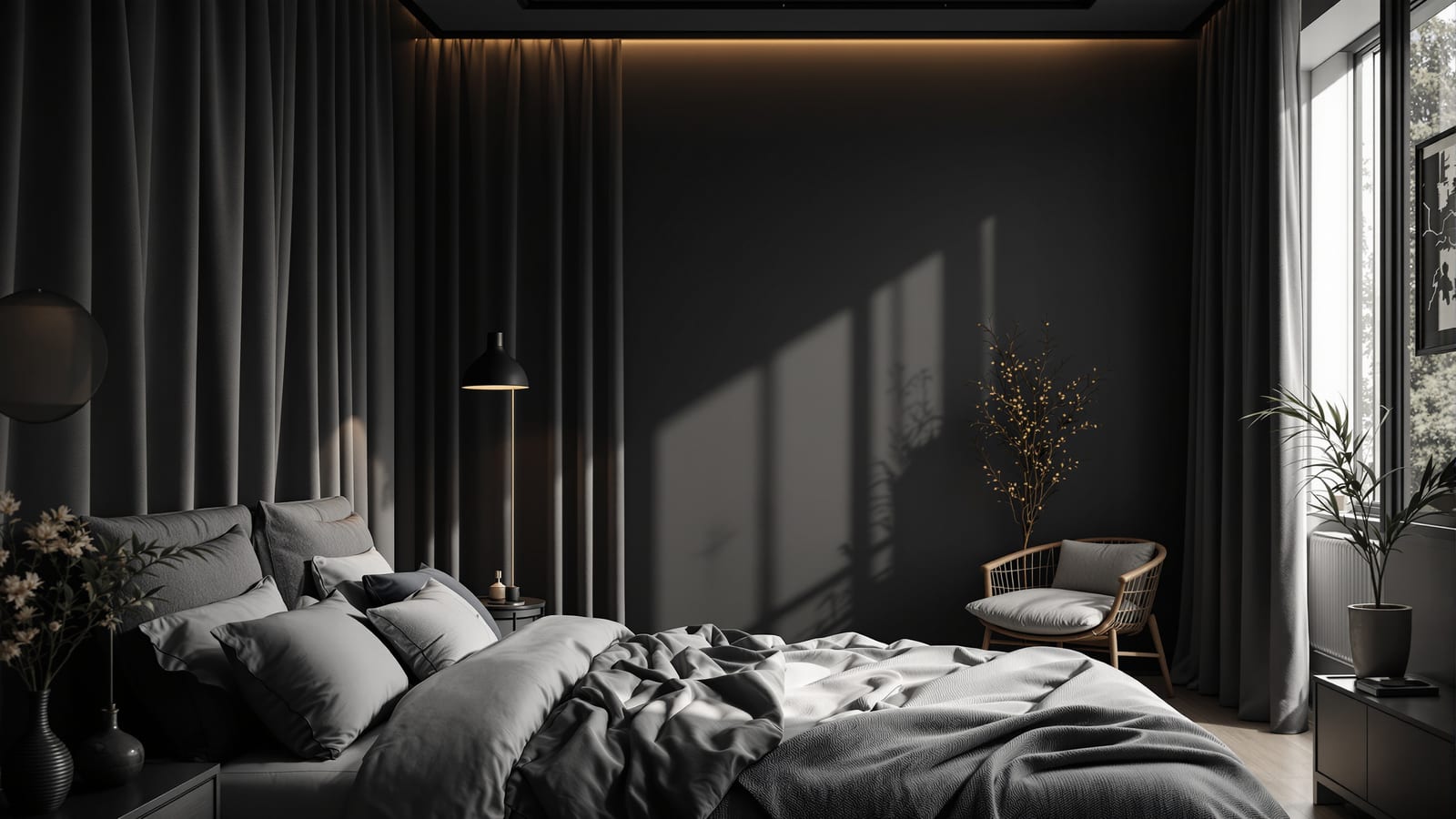
Bedroom Curtains: Blackout, Layering & Calm Sleep (India 2026)
Why blackout is non-negotiable for the room you sleep in, where dawn light actually leaks, how to layer sheer behind blackout, and the fabrics, colours and costs that make an Indian bedroom genuinely restful.
Every other room in your home can compromise on its curtains. The living room can get by with a pretty sheer; the kitchen needs little more than privacy. The bedroom cannot compromise, because the bedroom curtain is doing a job no other curtain is asked to do: it is protecting your sleep. In India that is a harder brief than it sounds. The sun rises early and aggressively — past 5:30 in summer across much of the country — and it rises in the east, which is exactly where a great many bedrooms face. If your curtain leaks, you wake with the sun whether you like it or not.
This guide treats the bedroom window as a sleep instrument, not a décor surface. By the end you will know why blackout is non-negotiable, where light actually sneaks in (it is almost never through the cloth), how to layer for a room that feels soft by day and pitch dark by night, and what the whole thing costs in rupees.
The bedroom curtain has one master job — darkness on demand — and several softer ones. Get the darkness right first and let everything else serve it. A beautiful curtain that wakes you at dawn has failed at the only thing that mattered.
Why blackout is non-negotiable in an Indian bedroom
Sleep science is blunt about this: even modest light hitting your eyes in the early hours suppresses melatonin and pulls you out of deep sleep before your body is done. You do not consciously wake, but the sleep you got was shallower. In a country where the sun is up and bright by 5:45 for months at a stretch, an unprotected east or south bedroom window is a daily alarm clock you never set.
Three Indian realities make blackout matter more here than in cooler, greyer climates:
- Early, intense sunrise. Dawn is not a gentle glow; it is direct, high-angle light within minutes.
- Shift and odd-hour workers. IT, healthcare, BPO, aviation — millions sleep during the day, and a dim-out curtain that is "good enough" for a night sleeper is useless for a day sleeper.
- Heat. West and south bedroom windows gain real heat through the afternoon. A lined blackout curtain is also thermal protection, keeping the room you will sleep in cooler.
So the bedroom is the one room where a sheer-only or dim-out-only window is a genuine mistake. For the full picture on how dark you actually get and what "blackout" really means, the dedicated blackout curtains guide goes deep; this guide is about applying it to the room you sleep in.
The light leaks nobody warns you about
Here is the part that surprises people: blackout fabric blocks light almost perfectly. A room still glows at dawn not because of the cloth but because of the gaps around it. Three leaks do almost all the damage:
| Leak | What causes it | The fix |
|---|---|---|
| Centre overlap | Two panels meet but do not overlap; a vertical seam of light | Overlap the panels 8–15 cm at the centre; use a centre-overlap track or a wave-fold rail |
| Side gaps | Curtain ends flush with the window; light wraps round the edge | Run the track 15–20 cm wider than the window each side; return the curtain to the wall |
| Top & bottom spill | Light over the rod and a high hem | Mount near the ceiling (or use a pelmet); run the drop to the floor, not the sill |
The single biggest upgrade most bedrooms can make costs almost nothing: mount the track wider and higher than the window, and make sure the two panels cross at the centre rather than just touching. A mid-priced blackout fabric hung this way beats a premium fabric hung flush. If your window sits inside a deep reveal, a recessed roller or honeycomb shade plus curtains seals the edges even better — more on layering next.
Layering: sheer by day, blackout by night
The most comfortable bedrooms in India almost always run two layers on the window. This is not luxury; it is solving two different problems that one curtain cannot.
- The sheer (front or window-side layer) softens harsh daylight, gives you daytime privacy, and lets you have light and coverage when you are awake. It is what the room wears during the day. The sheer curtains guide covers fabrics and the day-versus-night privacy trap in detail.
- The blackout (back or room-side layer) is pulled across for sleep, naps and heat. It is the instrument; the sheer is the dress.
A double track (or a single track with two channels) lets you operate them independently — sheer drawn, blackout open, by day; both closed for sleep. If a full second layer is too much fabric or budget, a neat alternative is a recessed honeycomb cellular shade behind a single curtain: the honeycomb shades guide explains how the cell structure adds both darkness and a real insulating layer — useful on a hot west bedroom wall.
The practical rule: never ask a single bedroom curtain to do both daytime softness and night-time darkness. It will do one of them badly. Two layers, even modest ones, transform how the room feels around the clock.
Calming fabrics and colours — what actually helps sleep
Once darkness is handled, the bedroom curtain gets to do its softer job: making the room feel calm. A few choices genuinely help, and a few popular ones quietly work against you.
- Weight and drape. Heavier, fuller curtains (around 2× fullness) read as restful and also soften sound — useful on a road-facing bedroom. Thin, flat panels feel busy and do little for acoustics.
- Texture over print. Matte, textured weaves — cotton, linen-blends, slubbed fabrics, velvet on premium windows — feel quieter than glossy or heavily-patterned cloth. The curtain fabric guide maps which fabrics suit Indian sun, dust and damp.
- Colour. Muted, low-contrast tones calm a room: soft greys, warm taupes, sage, dusty blue, deep teal, muted terracotta. Avoid high-energy reds, oranges and busy contrast prints in a sleep space. Darker colours also feel cocooning and hide the slight day-fade that bright Indian sun causes.
- Honest caveat on "blackout colour". A pale blackout curtain darkens the room just as well as a dark one — blackout is the backing, not the face colour. Choose the face for calm and for fade-resistance, not because you think light colours leak (they do not, if the fabric is genuinely blackout-lined).
Bold practical note: pick the calm colour you love, then insist the workshop line it with blackout cloth. You get the soothing shade and the dark room — you do not have to choose.
Kids' rooms and nurseries
For children and especially babies, the case for blackout is even stronger — daytime naps are non-negotiable for a small child, and that means daytime darkness. A few extra rules apply to little rooms:
- No cords or loose chains within reach. Long cords are a genuine strangulation hazard for young children. Choose cordless operation, motorised curtains, or a wand-operated track; keep any chains cleated high and out of reach.
- Washable, sturdy fabric. Kids' rooms get sticky; a curtain you can take down and wash beats a dry-clean-only velvet.
- Full blackout for nap schedules. A nursery that goes properly dark for the afternoon nap is one of the highest-value curtains in the house. Overlap the centre and run it to the floor exactly as you would in the master bedroom.
- Calm, not over-stimulating. Soft solid colours or gentle patterns rest better than loud cartoon prints — the room is for sleeping, not playing.
Motorised curtains and the gentle dawn-open
The bedroom is one of the two rooms (with the living room) where motorisation genuinely earns its cost. The killer feature is not laziness — it is the scheduled dawn-open: instead of jolting awake to a blaring alarm, your blackout curtain glides open a little before your wake time and lets natural light wake you gradually, which is far kinder to your body clock. On the flip side, a one-tap or scheduled close at night seals the room without you leaving the bed.
What to get right:
- Battery/rechargeable motors retrofit any bedroom without breaking walls and recharge every few months; wired motors are maintenance-free but need cabling planned during construction.
- Quiet operation matters more here than anywhere — you are running it in a room where someone is sleeping. Ask to hear the motor before buying.
- An ecosystem you already run (Alexa, Google Home, a Matter hub) is what enables the dawn-open schedule and voice control.
The motorised curtains guide covers wired-versus-battery, ecosystems and quiet motors in full. Motorise the master bedroom first; the guest room rarely repays it.
What bedroom curtains cost in India
Prices swing with fabric, fullness, lining, stitching, city and whether you go ready-made or custom, so treat these as honest ranges, not quotes:
- Ready-made blackout panels are the cheapest entry and fine for standard windows, though sizes, headings and the all-important centre-overlap are limited.
- Custom curtains are priced by fabric (per metre) × fullness × drop, plus the blackout lining and stitching. A well-made custom bedroom window — calm face fabric, blackout lining, 2× fullness, floor length — commonly lands in the low-to-mid thousands of rupees; large or premium-fabric windows climb from there.
- A second sheer layer adds modestly per window; a honeycomb shade behind adds a shade cost but buys insulation.
- Motorisation adds a per-window motor and track cost on top, plus an optional hub.
The cost driver people underestimate is fullness and lining, not the print. Size the fabric and get a per-window figure in seconds with the Curtain Cost Calculator; the dedicated curtain cost guide breaks down ready-made versus custom and the hidden costs.
Care, climate and the honest caveats
Indian conditions are hard on bedroom cloth. Direct sun fades and weakens fabric over time, dust settles into heavy weaves, and the monsoon brings damp. To keep a bedroom curtain restful for years:
- Choose fade-resistant face fabrics on bright east and west windows; darker, textured weaves hide wear better.
- Vacuum heavy curtains periodically and air them in the monsoon to fight musty smell and mildew at the hem.
- Keep blackout linings off direct contact with hot glass where you can; heat ages the coating.
- Keep tracks and motor rails clean and aligned so panels close and overlap properly — a track that no longer overlaps at the centre is a re-opened light leak.
Two caveats worth stating plainly. Vastu colour and direction preferences for the bedroom are cultural guidance, not physics — follow them if they matter to you, but never at the cost of darkening a window you need dark for sleep. And every figure here is indicative: measure your own windows and price your own fabrics locally before you commit.
The bedroom curtain, in five moves
1. Make darkness the priority — genuine blackout fabric or lining is non-negotiable in a sleep room.
2. Kill the leaks: overlap the centre, run the track wider and higher than the window, and drop to the floor.
3. Layer a sheer in front so the room is soft and private by day, dark for sleep at night.
4. Choose a calm, fade-resistant face colour you love — the blackout is in the lining, not the shade.
5. Motorise the master bedroom for a gentle dawn-open, and make kids' rooms cordless and washable.
Do those five and the bedroom stops being a room that wakes you and becomes a room that lets you sleep.
Plan the room you sleep in with Studio Matrx. Find the right combination for your bedroom window with the Window Treatment Selector, price the fabric with the Curtain Cost Calculator, and start from the full picture in The Complete Home Curtain & Window Treatment Guide. For the wider cluster, browse all window treatments.
Export this guide
Related Guides — Deep-dive reading
Honeycomb (Cellular) Shades: The Insulating Blind Explained (India 2026)
The pleated blind whose hollow cells trap a layer of still air — for real thermal and acoustic insulation on harsh windows. Single vs double cell, light-filtering vs blackout, top-down/bottom-up and cordless, plus honest Indian costs.
Window TreatmentsBlackout Curtains: The Complete Guide for Indian Homes (2026)
What “blackout” really means, how dark you actually get, the light-gap problem nobody warns you about, and how to choose, seal and care for them in Indian conditions.
Window TreatmentsCurtain Cost in India (2026): Ready-Made vs Custom & Hidden Costs
What actually drives the price — fabric per metre, fullness, lining, stitching, hardware and city — plus realistic per-window and whole-home ranges, the costs nobody quotes upfront, and how to save without looking cheap.
Window TreatmentsRelated Tools — Try Free
Curtain Cost Calculator
Get the fabric metres you need plus the total curtain cost by window size, fabric, pleat, lining and hardware.
Curtain CalculatorBlackout Level Estimator
Estimate how dark a room will actually get from a fabric, lining and fit — and why edge gaps matter most.
EstimatorCross-Ventilation Analyzer
Estimate airflow and air changes per hour (ACH) from room size, window areas, layout, and local wind — with NBC 2016 Part 8 compliance check.
Ventilation Calculator