
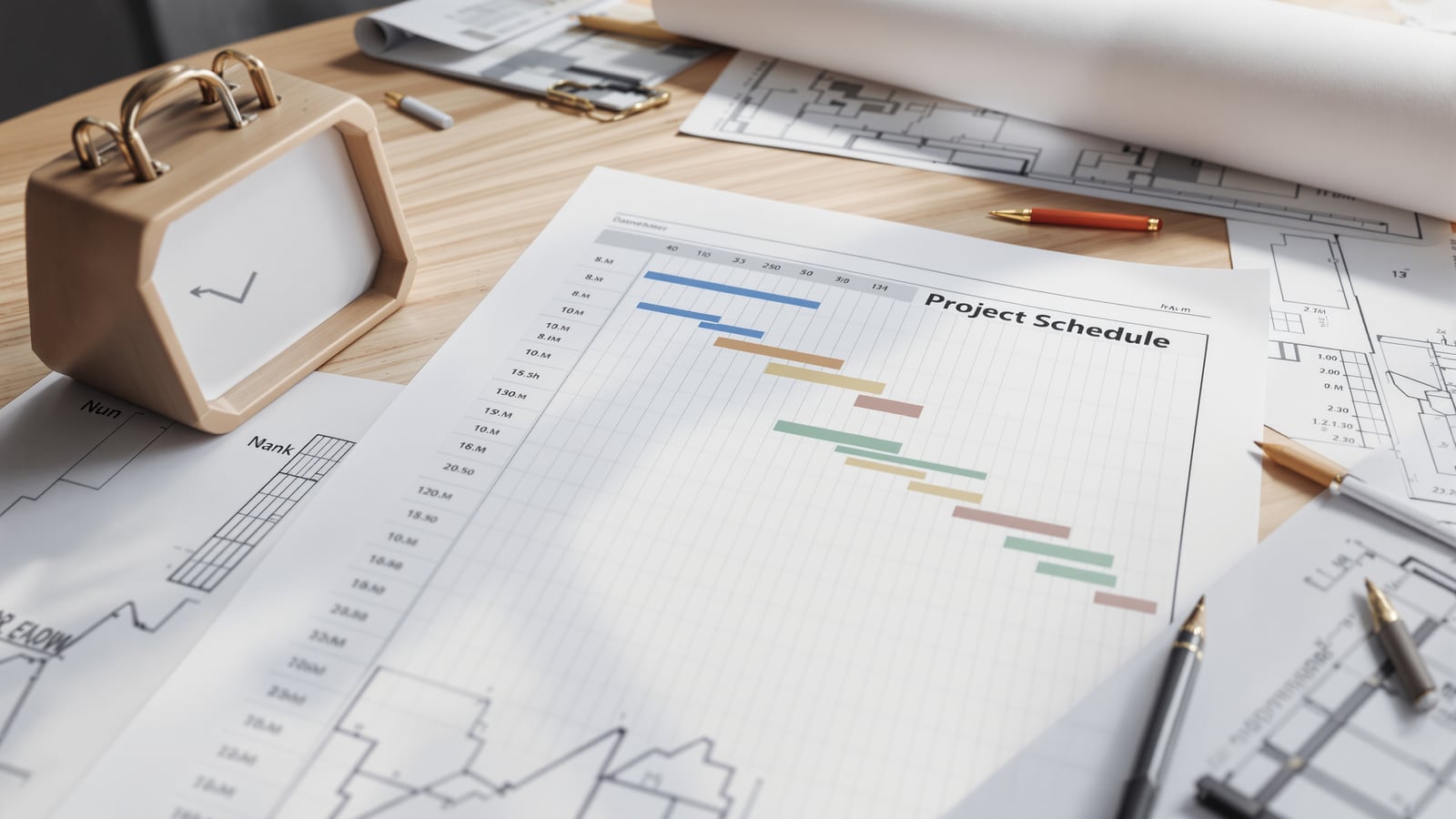
Bathroom Construction Timeline Template (India): A Week-by-Week Schedule with Dependencies & Curing Waits
A copy-and-use programme for building or renovating one bathroom in India — phase durations, what each task depends on, and the curing and flood-test waits you must not compress. Lift the tables straight into your site schedule.
A bathroom is the most dependency-heavy room in any Indian home: every trade waits on the one before it, and two of the waits are not work at all but concrete and membrane quietly curing. Rush the sequence and you do not save time — you tile over green waterproofing, grout onto an uncured screed, and pay for it in a leak six months later. This document is a working programme template you copy into your own site schedule at the planning stage, before the demolition hammer lands.
It sits alongside the bathroom design checklist (which fixes what you are building) and the material procurement schedule (which makes sure the tile, WC and CP fittings arrive before their slot). Read all three together: the timeline only holds if the materials land on time and the design is frozen.
Treat every duration here as indicative. Actual days depend on the city, the crew size, the spec, the weather and how fast decisions get made. What is not negotiable is the sequence and the curing waits — those are physics, not scheduling preference.
How to use this document
- When: at project planning, right after the design and BOQ are frozen and before you issue the work order. Revisit it weekly on site as a look-ahead.
- Who fills it in: the site engineer, contractor or project-managing architect. The homeowner uses it to understand why the room "looks finished but isn't".
- How: copy the phase table below into your schedule (Excel, a Gantt tool, or a printed wall chart). Put real calendar dates against each row, then block out the curing waits as hard, immovable bars so no trade can be booked into them.
- Map each row to a hold point — a stage you inspect and sign off before the next trade starts. The flood test after waterproofing is the single most important hold point in the whole job.
The phase schedule (copy this table)
This is the core deliverable. Durations assume one ordinary residential bathroom (roughly 35–50 sq ft) with a single competent crew. "Depends on" tells you what must be complete and signed off first; "Curing / wait" is dead time you cannot work through.
| Activity | Indicative duration (days) | Depends on | Curing / wait |
|---|---|---|---|
| Site protection, disconnect services, demolition & debris removal | 1–2 | Design frozen, water & power isolated | — |
| Chasing walls/floor; plumbing rough-in (CPVC supply, UPVC/PVC waste, WC & floor-trap positions) | 2–3 | Demolition complete | — |
| Concealed electrical conduiting & back boxes (geyser, lights, exhaust, points) | 1–2 | Runs alongside plumbing rough-in | — |
| Pressure-test plumbing; backfill/level, lay floor screed & falls to drain | 1–2 | Plumbing rough-in signed off | Screed cure 3–7 days |
| Surface prep; apply waterproofing membrane to floor + walls (300 mm min up walls, full height in shower) | 1–2 | Screed cured, surface dry & clean | Membrane cure 24–72 h (per product) |
| Flood test — plug drain, pond ~25–50 mm water, hold & inspect ceiling below | 2–3 | Membrane fully cured | Hold water 24–48 h |
| Wall & floor tiling (with tile adhesive over cured membrane) | 2–4 | Flood test passed, tiles on site | Adhesive set overnight |
| Grouting joints; clean tiles | 1 | Tiling complete | Grout cure 24–72 h before wetting |
| Sanitaryware & CP fixing (WC, basin, taps, health faucet, shower, geyser) | 1–2 | Grout cured, fittings on site | Silicone cure 24 h |
| Electrical fit-out (fixtures, exhaust fan, switches, ELCB/RCD test) | 1 | Tiling done, sanitaryware roughly set | — |
| False ceiling & painting outside wet zone | 1–2 | Services above ceiling complete | Paint dry between coats |
| Deep cleaning, second flood/leak check, snag list & rectification | 1–2 | All fixing complete | — |
Add up the work days and it looks like two weeks; add the curing waits and a single bathroom realistically runs ~3–5 weeks end to end. Compress the waits and you are not faster, only leakier.
The critical waits people wrongly compress
Every schedule dispute on a bathroom site is really an argument about these four rows. A contractor under pressure will offer to "waterproof today, tile tomorrow" — and the day you allow it is the day you build a future leak. These waits are set by the product and the material, not by how busy the site is. Block them out and defend them.
| Wait | Why it exists | Typical hold | If you compress it |
|---|---|---|---|
| Screed cure | Cement screed must gain strength and lose most of its free moisture before a membrane is bonded over it | 3–7 days (thicker beds longer) | Membrane blisters or debonds; trapped moisture; falls slump |
| Waterproofing cure | Acrylic/PU/cementitious membranes need full cure to reach their rated elongation and adhesion | 24–72 h per datasheet | Green membrane tears under tile adhesive; waterproofing fails |
| Flood test | The only real proof the wet area holds water before it is buried under tile | Pond 25–50 mm, hold 24–48 h | You discover the leak after tiling — a full tear-out |
| Grout cure | Cementitious grout must set before repeated wetting or it powders and cracks | 24–72 h before use | Grout washes out, joints open, water gets behind the tile |
The flood test is the cheapest insurance on the whole project. A day of held water costs you a day; a leak found after tiling costs the tiles, the labour, the waterproofing and the ceiling below. For the full method, see the waterproofing guide.
Single vs multiple bathrooms: where parallel-tasking helps
The template above is for one bathroom. On a full home with three or four, you do not multiply the timeline by four — much of the wait time overlaps, because while one room cures, a trade works in the next. The trick is to stagger the rooms so a single crew is never idle and no room's curing wait is on the project's critical path.
| Scenario | How to schedule it | Realistic total |
|---|---|---|
| Single bathroom | Run the phase table straight; the curing waits are unavoidable dead time | ~3–5 weeks |
| 2–3 bathrooms, one crew | Stagger by ~1 phase: demolish all first, then rough-in room-by-room so while Bath 1 screed cures, Bath 2 rough-in proceeds | ~5–7 weeks (not 3× one) |
| Multiple baths, multiple crews | Parallel crews per room; batch the flood tests to one inspection window; procurement becomes the real constraint | ~4–6 weeks, procurement-limited |
| Occupied-home renovation | One bathroom at a time so the family keeps a working WC; add buffer days for dust barriers and debris runs | Add 20–30% buffer |
The single biggest lever on a multi-bathroom job is procurement, not labour — if the tiles or CP fittings for Bath 3 have not arrived, the crew that finished Bath 2 stalls. That is exactly why this timeline is designed to be read next to the material procurement schedule: the two documents share the same dates.
Common mistakes
- Booking the tiler the day after waterproofing. The membrane is still green. Wait for the datasheet cure and a passed flood test.
- Skipping or shortening the flood test to "save two days". This is the one test that stands between you and a buried leak. Never waive it.
- Grouting and then showering the same evening. Uncured grout washes straight out of the joints.
- Treating curing days as slack to be absorbed when the job runs late. They are fixed; absorb delay elsewhere.
- Sequencing false ceiling before the services above it are done, then reopening it for a missed conduit.
- No hold points. Without sign-off gates, the next trade starts on unfinished work and you lose the audit trail when something fails.
- One schedule for a four-bathroom home. Stagger the rooms; batch the inspections; let procurement, not optimism, set the dates.
Print the phase table, put real dates against it, mark the four grey waits as immovable, and the room comes together in the right order the first time. For scope, use the renovation checklist; for what to build, the design checklist. This document only fixes the when.
Related resources & guides
- Bathroom design checklist (India) — freeze the design and spec this timeline is built around.
- Bathroom material procurement schedule (India) — make sure every material lands before its slot on this programme.
- Bathroom renovation checklist (India) — the full scope-and-quality companion for a renovation.
- Bathroom waterproofing guide (India) — the method behind the membrane, cure and flood-test rows that anchor this schedule.
References
- IS 2645 — Integral cement waterproofing compounds; guidance on wet-area waterproofing practice.
- NBC 2016 (National Building Code of India), Part 9 — plumbing and drainage practice for traps, falls and wet-area waterproofing.
- Manufacturer datasheets — Dr. Fixit, Fosroc, Sika and MYK Laticrete waterproofing membranes and tile-adhesive/grout products publish product-specific cure times; always schedule to the actual datasheet on site.
- IS 456 — Plain and reinforced concrete practice, relevant to screed strength gain and curing.
This template is a starting point, not a contract. Verify durations and sequences against your actual project, your work order, local codes and a licensed professional before you commit dates.
Export this guide
Related Guides — Deep-dive reading
Bathroom Plumbing Schedule (India): Point-by-Point Rough-In Heights & Pipe Sizes
A working bathroom plumbing schedule for Indian projects — every water inlet and outlet point with its rough-in height from finished floor level, CPVC/UPVC pipe size and site notes, so your plumber roughs-in the wall correctly the first time and no fixture lands at the wrong height.
BathroomsBathroom Planning for New Homes in India: Get It Right Before You Build
The bathroom decisions you cannot undo once the slab is cast — location and stacking, sunken vs non-sunken slabs, waterproofing, and the plumbing, electrical and ventilation you must coordinate with the civil work, stage by stage.
BathroomsBathroom Material Procurement Schedule (India): A Buy-By-Date Tracker Tied to Lead Times
A copy-and-use procurement schedule for Indian bathroom projects — what to approve, order and receive at each stage, keyed to realistic lead times, so site never stalls waiting for tiles, sanitaryware, CP fittings or an imported item stuck at customs.
BathroomsRelated Tools — Try Free
Plumbing Pressure-Test & Leak Checklist
Pre-closure pressure and leak test — 9 categories, 60+ checkpoints across water supply, drainage, fixtures, waterproofing, hot water, tanks.
Pre-Closure TestFalse Ceiling Cost Estimator
Live ₹/sqft across 8 ceiling types — POP, gypsum, designer, metal, PVC, wooden — with cove and spot lighting for 20 Indian cities.
Cost CalculatorMaterial Schedule Generator
Generate a room-wise finish schedule — walls, floors, ceilings, trim, and joinery by location.
Material Schedule