
Bathroom Design in India: Functional First, Then Beautiful
The compartmentalised master bath, the tub debate, ageing-in-place universal design, fixture clearances, waterproofing, and why private beats shared
The bathroom is the most private room in an Indian home, and rupee for rupee it is often the most expensive. Even the bare floor is costly, because it is almost never just floor; it is tile or stone, waterproofed, sloped, and drained. Before you fall in love with a rain shower or a soaking tub, settle the one thing that decides whether you will be happy for the next twenty years: a bathroom must work before it can be beautiful. This guide walks you through bathroom design the way a careful Indian household actually lives, from the 7 a.m. rush to the quiet 2 a.m. trip, with real dimensions, real rupee bands, and the small decisions that make or break the room.
Function first, beauty second
Most bathroom regret in India does not come from the wrong tile. It comes from a layout that fights you every morning: two adults getting ready at once, a fogged mirror, a single basin, a shower that drips onto the dry floor, a door that bangs into the WC. None of that is a finish problem. It is a planning problem, free to fix at the design stage and ruinously expensive after the plumbing is cast.
The honest starting point is to re-read your own brief and ask how you will actually move through this room. Where do you stand to brush your teeth. Who showers while who shaves. How does the bathroom relate to the bedroom and the wardrobe next door, because that relationship fixes its location, its shape, and where every fixture lands. If you have not written that brief yet, our room programming worksheet turns vague wants into a clear list of needs before a single wall is drawn.
A bathroom is not a collection of fixtures. It is a sequence of movements, and good design is simply that sequence made effortless.
The order that never changes
The hierarchy is always the same: function, then comfort, then luxury. Function is whether two people can use the room at once without colliding, whether the floor stays dry, whether the night trip is safe. Comfort is warm water on tap, a place to sit, good light at the mirror. Luxury is the rain head, the freestanding tub, the brushed-brass fittings. Each layer is wonderful, but luxury can never paper over broken function. A gold tap over a badly sloped floor is still a wet, slippery floor.
Compartmentalise the master bath
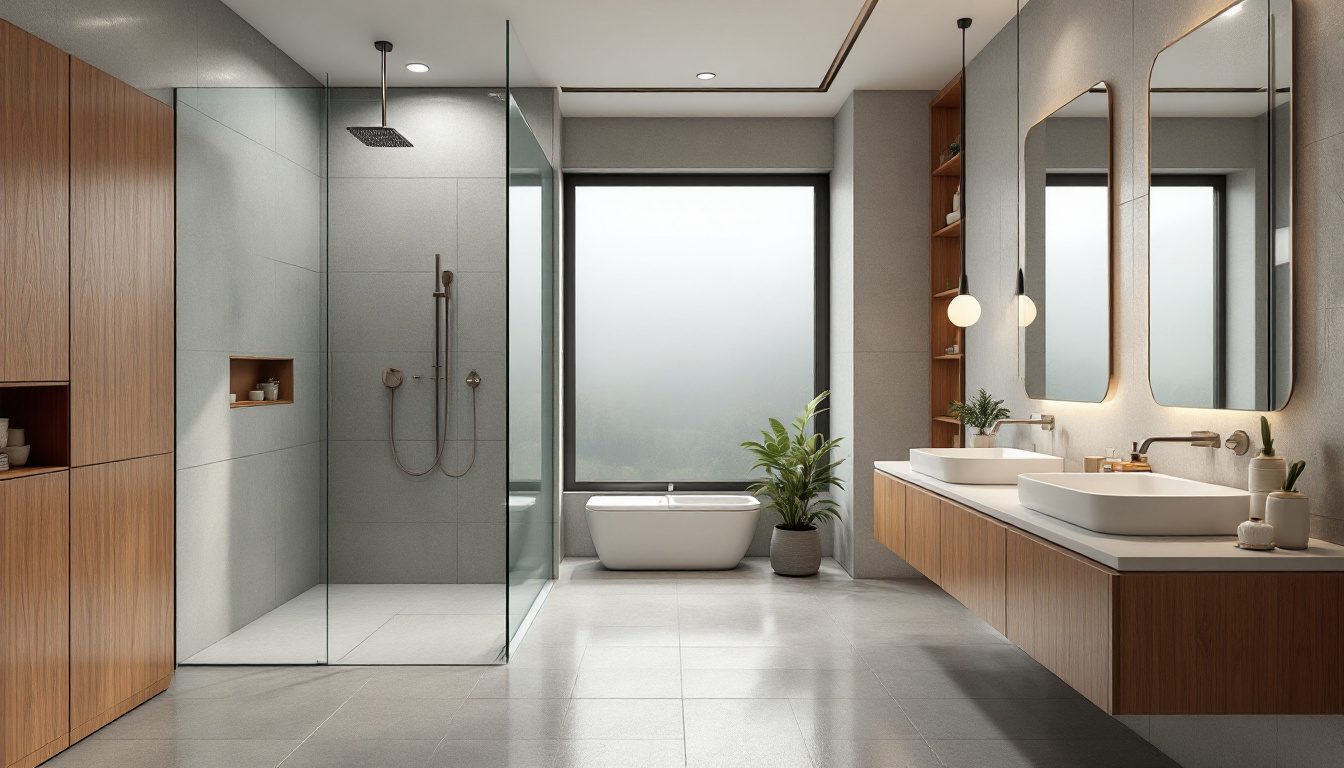
The single most useful idea in modern bathroom planning is to stop treating the master bath as one open room. Break it into zones. Almost always the WC goes into its own small enclosed room behind a door, ideally with its own window for light and air. Then you separate the dry zone, meaning the vanity, the basins, the mirror, from the wet zone, meaning the shower and any tub. A panel of glass or a half-height wall divides wet from dry.
The payoff is immediate. Steam stays off the mirror because the shower is glassed in. One person showers while another does their hair, because the wet and dry zones are physically separate. And the WC, the fixture you most want privacy and odour control around, sits behind its own door with its own exhaust. Two functions, no collision. This is not a mansion idea, it is a sense idea, and it works beautifully even in compact urban bathrooms.
Twin basins and the morning rush
If the master serves a couple, twin basins on a single long vanity are the cheapest peace treaty you will ever buy. A double vanity needs roughly 1500 to 1800 mm of run to feel uncrowded, with basins centred about 750 to 900 mm apart. Below that, elbows clash and you are better off with one generous basin, a wide counter, a long mirror, and good light.
Glass, half-walls, and keeping water where it belongs
The wet zone wants a clear edge: a framed or frameless glass partition, a fixed screen with a walk-in gap, or a half-height masonry wall. What matters is that shower water is contained, the floor outside stays dry, and the slope carries every drop to a drain inside the wet zone, not out across the dry tiles. More on slope under waterproofing, because it is where most Indian bathrooms quietly fail.
The bathtub debate, honestly
Many families agonise over a bathtub or whirlpool in the master. The honest Indian truth: a tub is mostly an object in the room, used a handful of times a year, often never. That is not automatically a waste, a tub can make a room feel generous, lend a spa quality through a stone surround and a window above it, and quietly signal relaxation even on the weeks nobody climbs in. But decide with open eyes, not aspiration.
India is firmly shower-first, for good reasons. A full tub holds 150 to 250 litres per bath, which sits awkwardly against our water bills, our intermittent supply, and our conscience. Tubs collect hard-water scale, need their own cleaning, and eat floor area that a generous walk-in shower would use far better, every single day.
Ask yourself the honest question: in the last five years of staying in hotels with a tub, how many times did you actually fill it? Build for the answer, not the fantasy.
If you will not soak, do not force it. Expand the shower instead, add a built-in bench or a teak stool, and put the saved space and money where you feel it daily. If you genuinely love a long bath, build the tub and mean it, then give it a window, a ledge for a book and a cup, and a view, so it earns its footprint.
Fixtures, clearances, and the dimensions that matter
A bathroom feels cramped or calm for measurable reasons. Every fixture needs clear space in front of and beside it for a body to use it, and these clearances are not negotiable; skimp on them and the room is permanently annoying.

These figures draw on anthropometric standards (Panero and Zelnik) and the National Building Code's logic, translated to Indian bodies and habits.
| Fixture | Minimum clear space | Comfortable | Notes |
|---|---|---|---|
| WC (toilet) | 450 mm to centre from any side wall or fixture | 500 to 550 mm | That is roughly 900 mm total width for the WC bay |
| WC front clearance | 600 mm clear in front | 700 to 750 mm | Knee and standing room; do not let a door swing into it |
| Wash basin | 700 mm standing space in front | 750 to 900 mm | Plus elbow room; twin basins want 1500 mm of run |
| Shower (walk-in) | 900 by 900 mm | 1000 by 1200 mm | Below 900 mm you brush the walls; add an outside ledge |
| Bathtub | 1700 by 750 mm | 1800 by 800 mm | Standard Indian tub footprint; plan an access side |
| Door width | 750 mm leaf | 800 to 900 mm | Wider helps ageing-in-place and moving people through |
Use these to test your plan before tiling. Our scale and proportion calculator lets you drop these clearances into a room outline and see at once whether your 5 by 7 actually holds what you have promised it.
How much room each bathroom type needs
Size follows ambition, but there are sensible floors below which a bathroom stops being pleasant. Indian bathrooms are often quoted in feet, so both are given.
| Bathroom type | Typical size | Holds | Best for |
|---|---|---|---|
| Powder room / common WC | 3 by 5 ft (0.9 by 1.5 m) | WC and a corner basin | Near living area for guests |
| Compact common bath | 5 by 7 ft (1.5 by 2.1 m) | WC, basin, shower | Kids' or second bedroom |
| Standard family bath | 6 by 8 ft (1.8 by 2.4 m) | WC, basin, generous shower, niche | Most bedrooms |
| Comfortable master | 8 by 10 ft (2.4 by 3.0 m) | Compartmentalised WC, twin basin, large shower | Master suite |
| Spa master | 10 by 12 ft+ (3.0 by 3.7 m+) | All of the above plus a tub | When you will truly use it |
A 5 by 7 is the honest minimum for a full three-fixture bath, with the shower glassed in one corner, the WC opposite, and the basin on the entry wall. A 6 by 8 is the sweet spot for most Indian family bathrooms, comfortable without being wasteful. An 8 by 10 is where compartmentalisation, twin basins, and real wet-zone separation finally have room to breathe. Beyond that you are buying a tub and the feeling of space, both legitimate once function is locked.
Wet zone versus dry zone, in materials
Once the room is zoned in plan, zone it in material too. Wet and dry zones have genuinely different jobs, and using the same finish everywhere is how floors get slippery and bills get padded.
| Zone | Surface | What to use | Avoid |
|---|---|---|---|
| Wet floor (shower) | Floor | Anti-skid matt vitrified or ceramic, small format with more grout grip, IS 15622 graded for wet areas | Polished marble, glossy large tiles |
| Wet walls | Walls | Glazed ceramic or glossy vitrified, easy to wipe, up to ceiling | Porous untreated stone |
| Dry floor (vanity) | Floor | Matt or lappato vitrified, stone-look; comfortable underfoot | High-gloss that shows every splash |
| Dry walls | Walls | Larger format tile or moisture-resistant paint above a tiled dado | Wallpaper, untreated MDF |
| Vanity counter | Counter | Granite, quartz, or solid surface; sealed | Unsealed marble (stains from haldi, soap) |
| Ceiling | Overhead | Moisture-resistant POP or PVC false ceiling; conceals exhaust ducting | Ordinary gypsum directly over a shower |
The anti-skid point is safety, not a luxury detail. Bathroom floors are where Indian homes see real injuries, especially for children and elders. Choose floor tiles with a recognised slip rating for wet barefoot areas; the grout lines of a smaller tile add grip, which is why a 300 mm tile or a mosaic beats a single mirror-polished slab inside the shower.
Universal design: the home you will grow old in
If this is a home you intend to stay in for decades, design the bathroom so it never forces you out. The term is universal design, and a handful of choices made now save a renovation, or a move, later. Almost none of them look medical; done well, they simply read as a calm, generous, modern bathroom.

The single cheapest and most valuable move is grab-bar blocking: ask the builder to set a horizontal band of reinforcement, marine ply or a brick course, inside the wall beside the WC and along the shower wall, now. It costs almost nothing today and is nearly impossible to add cleanly later. You may never bolt a bar to it, but if a parent moves in, or you simply age in place, the wall is ready.
Reinforce the walls for grab bars today, even if you never fit the bars. It is the cheapest insurance in the whole house.
| Feature | What to do | Why it matters | Rough cost to add now |
|---|---|---|---|
| Step-free wet area | Flush floor, no kerb; contain water by slope and glass | No tripping edge, wheelchair-ready | Negligible (planning only) |
| Grab-bar blocking | Reinforce walls by WC and in shower | Lets bars be fitted any time later | 500 to 1500 rupees per wall |
| Comfort-height WC | WC seat at 450 to 480 mm | Easier to sit and rise for elders | Same as standard WC |
| Anti-slip floor | Graded matt tile throughout wet zone | Prevents the most common fall | Same or marginally more |
| Wider door | 800 to 900 mm clear leaf | Walker, wheelchair, helping someone | Negligible at plan stage |
| Fold-down seat / bench | Built-in masonry bench or wall seat | Sit to shower, place toiletries | 3000 to 8000 rupees |
| Lever taps and single-lever mixers | Replace knob taps | Usable with weak grip or wet hands | Same as standard fittings |
You do not have to adopt every clause of the Harmonised Guidelines and Space Standards for a Barrier-Free Built Environment in a private home. Pick the choices that genuinely help your family and implement them without wrecking the look. The point is foresight, not compliance.
The midnight path
As bathrooms grow larger, a quiet error creeps in: the WC drifts farther and farther from the bed, often down a winding route. Reverse that instinct. Keep the bed-to-WC path short and straight, and light it gently.

A low-level night light, an LED strip under the vanity, or a motion sensor that triggers a dim warm glow lets you find the bathroom at 2 a.m. without flooding the room with bright overhead light that wrecks your sleep and dazzles you on a wet floor. And never step the bathroom floor up or down from the bedroom; a level change you navigate fine when awake is genuinely dangerous half-asleep in the dark.
Don't over-build every bathroom
The master deserves attention; the other bathrooms can stay refreshingly simple. A useful model is a good hotel bathroom: clean, complete, well-lit, not a second master suite. That is exactly the right level of effort for a guest or children's bath.
The smartest spending rule is to give each bedroom its own private bath rather than a shared Jack-and-Jill between two rooms. The construction cost is often nearly the same once you count the shared bath's doubled doors and locks, the privacy is far better, especially through the teenage years, and the resale market clearly prefers it. You do not need huge bathrooms; you need private ones. To test where your money should land, run the numbers in our cost calculator before committing a tub-sized budget to a room nobody will soak in.
A powder room or common WC near the living area is invaluable: guests should not have to walk through bedrooms to find a bathroom during a gathering, and a compact 3 by 5 ft WC with a basin near the drawing room solves it. If a study or bonus room sits away from the bedrooms, a second door from a guest bath to the hall keeps the bath reachable while the bedroom can be closed.
Waterproofing, slopes, and the failures to avoid
If there is one place Indian bathrooms fail, it is water going where it should not. A beautiful bathroom that leaks into the flat below, or pools on the dry floor, is a failed bathroom. This is invisible work, done before the tiles, and it is non-negotiable.
Waterproofing the wet box
Treat the bathroom floor and lower walls as a waterproof box: a membrane or cementitious coating across the whole floor, turned up the walls at least 300 mm everywhere and full height in the shower, with extra care at the drain, the WC waste, and every pipe penetration. Insist on a ponding test, the floor flooded and held for 24 to 48 hours before tiling, to catch a leak while it is cheap to fix. Skimping here is the most expensive false economy in the whole house.
Slope to the drain
Every wet-area floor must fall to its drain. A slope of about 1 in 80 to 1 in 100, roughly 10 to 12 mm of fall per metre, carries water away cleanly without being steep enough to feel underfoot. The drain belongs at the low point inside the wet zone, with the dry zone set fractionally higher so water never migrates out to the vanity. Get this wrong and you will mop after every shower for the life of the house.
| Common failure | What goes wrong | The fix |
|---|---|---|
| No or weak waterproofing | Seepage into walls and the flat below | Full membrane, 300 mm wall turn-up, ponding test |
| Flat or reverse slope | Water pools, migrates to dry zone | 1 in 80 to 1 in 100 fall to a low-point drain |
| Drain in the wrong spot | Standing water far from outlet | Drain at the floor's low point in the wet zone |
| No exhaust / poor ventilation | Damp, mould, smell, peeling paint | Window plus a rated exhaust fan |
| Door swing into a fixture | Banging, lost clearance | Plan swing out, or use a sliding door |
Ventilation and exhaust
Indian humidity is unforgiving on a closed bathroom: the mirror fogs, the ceiling grows mould, the paint peels, the room smells. The answer is air movement, a window for cross-ventilation wherever possible, plus a rated exhaust fan in the WC compartment and over the shower, ducted to outside rather than just stirring the air. Size the fan to the room volume and run it during and after a shower. An internal bathroom with no window can still be healthy, but only with a serious exhaust.
Geysers, faucets, and hot-water planning
The plumbing rough-in is decided long before you see a single fitting, so think it through now. A 15 to 25 litre storage geyser suits a family bathroom; an instant geyser suits a powder room or single-person bath. Give it a tidy niche high on a wall, on its own switched point, and run a dedicated hot-water line to the shower mixer and the basin. Cold-only is fine at the WC, and a future solar or heat-pump source is easier if the hot line stays accessible.
The health faucet, the jet spray beside the WC, is standard in Indian bathrooms; give it its own angle valve and a sensible reach. A hand shower alongside the overhead earns its keep daily for rinsing, cleaning, and washing hair. Single-lever mixers are easier with wet or weak hands than separate knobs, tying straight into the universal-design thinking above.
What it actually costs
Bathrooms in Indian cities span an enormous range, from a clean functional fit-out to a full home-spa. These are realistic 2026 finished-bathroom bands for a standard 6 by 8 ft bathroom, covering tiling, sanitaryware, fittings, waterproofing, plumbing, and basic electrical, excluding civil shell work.
| Band | Per bathroom (6 by 8 ft) | What you get |
|---|---|---|
| Functional | 90,000 to 1,50,000 rupees | Branded entry sanitaryware, anti-skid tiles, geyser, exhaust, sound waterproofing |
| Comfortable | 1,50,000 to 3,00,000 rupees | Mid-range fittings, glass shower partition, vanity, twin basin, better tiles |
| Premium | 3,00,000 to 6,00,000 rupees | Designer fittings, large-format tiles, concealed cisterns, custom vanity |
| Luxury / spa | 6,00,000 rupees and up | Freestanding tub, rain shower, stone, smart fixtures, heated elements |
Spread your budget the way you use the rooms: fund the master and family bath well, keep the powder room and children's bath in the functional band, but never skimp on their waterproofing or anti-skid floors. Safety and the invisible work are the last places to economise.
Bring it to life with Studio Matrx
Bathroom design is deeply personal, and the right answer for your home lives somewhere between purely practical and full spa. The order, though, never changes: function first, then comfort, then the luxuries that genuinely make you feel good. Tell Studio Matrx how each bathroom will be used, who shares it, and how long you plan to stay, and get layouts that zone wet from dry, place the WC and basins with correct clearances, plan grab-bar blocking and the midnight path for ageing in place, and spend the luxury exactly where you will feel it. Zone it well, keep it safe for every age, give every bedroom its own, and your bathrooms will quietly work for decades.
References
- Bureau of Indian Standards. National Building Code of India 2016 (NBC 2016), Part 9: Plumbing Services. New Delhi: BIS.
- Bureau of Indian Standards. IS 15622: Pressed Ceramic Tiles — Specification (including slip resistance and water absorption classes for wet-area flooring). New Delhi: BIS.
- Bureau of Indian Standards. IS 2556: Vitreous Sanitary Appliances (Vitreous China) — Specification (water closets, wash basins). New Delhi: BIS.
- Central Public Works Department (CPWD). CPWD Specifications and Handbook on Barrier-Free and Accessibility — sanitary, plumbing and waterproofing provisions. Government of India.
- Ministry of Housing and Urban Affairs / CPWD. Harmonised Guidelines and Space Standards for Barrier-Free Built Environment for Persons with Disability and Elderly Persons. Government of India.
- Panero, Julius, and Martin Zelnik. Human Dimension and Interior Space: A Source Book of Design Reference Standards. New York: Whitney Library of Design. (Anthropometric clearances for fixtures.)
- Bureau of Indian Standards. IS 1172: Code of Basic Requirements for Water Supply, Drainage and Sanitation. New Delhi: BIS.
- Hirsch, William J. Jr. Designing Your Perfect House: Lessons from an Architect. Dalsimer Press. (A general inspiration for this series' approach to designing bathrooms that are functional first.)
Export this guide
Related Guides — Deep-dive reading
Bathroom Planning for New Homes in India: Get It Right Before You Build
The bathroom decisions you cannot undo once the slab is cast — location and stacking, sunken vs non-sunken slabs, waterproofing, and the plumbing, electrical and ventilation you must coordinate with the civil work, stage by stage.
BathroomsBarrier Free Shower India: Curbless Zero-Threshold Roll-In Showers (2026)
The curbless, zero-threshold shower with no kerb to step or wheel over: the recessed slab and linear drain that contain water without a lip, whole-wet-area waterproofing, fold-down seat and grab bars, wheelchair transfer and turning space, anti-slip floors, aging-in-place logic and real rupee costs — planned before the slab is cast.
BathroomsShower Niche India: Building a Recessed Wall Shelf That Holds Shampoo Without Ever Leaking
A shower niche is a shelf you carve into the wall instead of screwing onto it. Done right it is invisible and dry for decades; done wrong it is the single most common source of seepage into the room behind. Here is how to size it, which wall you may cut, and how to waterproof, slope and tile the recess so it never leaks.
BathroomsRelated Tools — Try Free
False Ceiling Cost Estimator
Live ₹/sqft across 8 ceiling types — POP, gypsum, designer, metal, PVC, wooden — with cove and spot lighting for 20 Indian cities.
Cost CalculatorChild & Elder Home-Safety Audit
Room-by-room safety audit for households with children or seniors — 10 categories, 70+ checkpoints tagged by audience.
Safety AuditCross-Ventilation Analyzer
Estimate airflow and air changes per hour (ACH) from room size, window areas, layout, and local wind — with NBC 2016 Part 8 compliance check.
Ventilation Calculator