
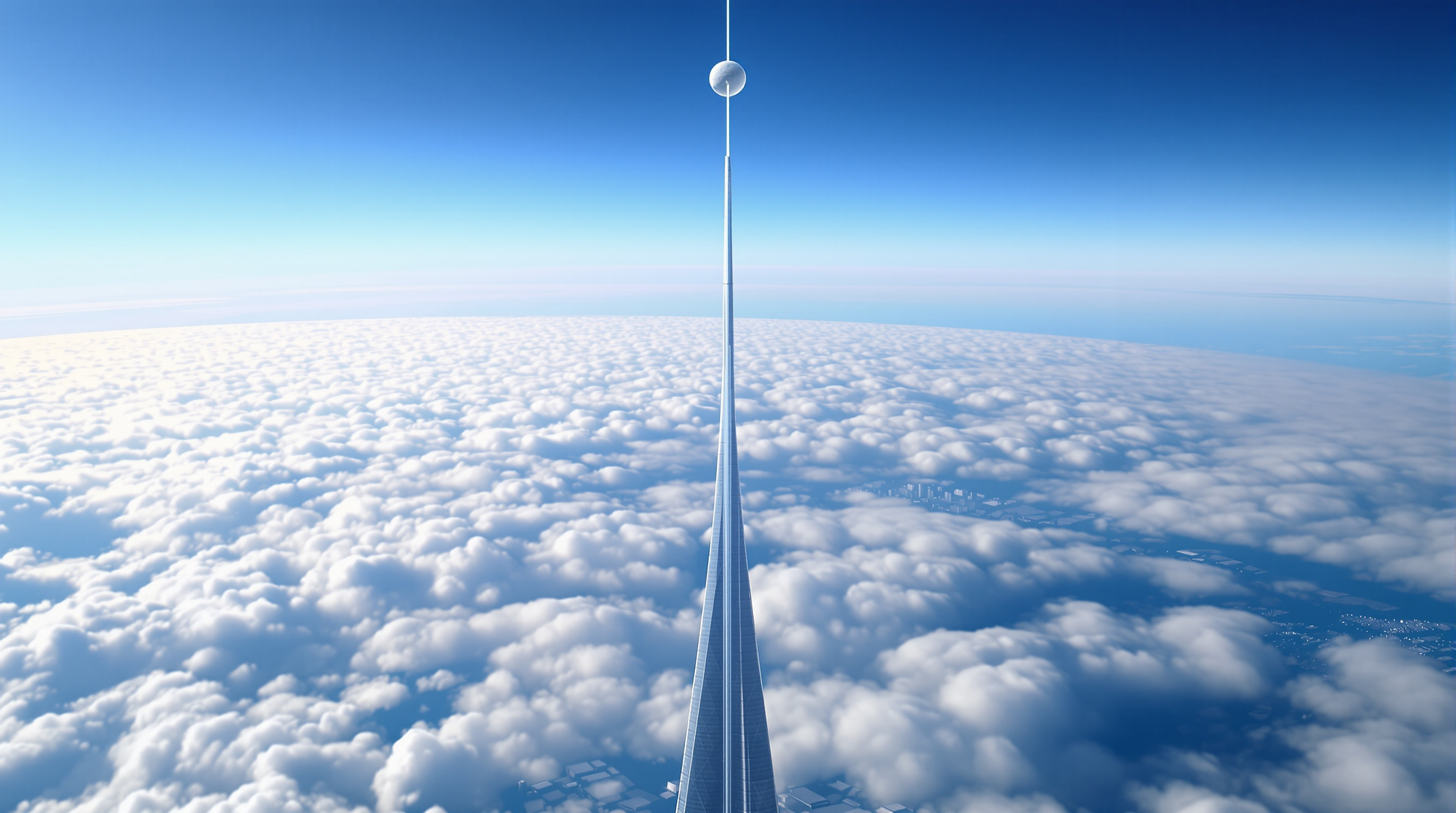
Analemma Tower: The Skyscraper That Hangs From the Sky
Clouds Architecture Office's 2017 provocation inverts the oldest assumption in building — the foundation — by suspending a supertall tower from an asteroid parked in geosynchronous orbit. A concept, not a project; but a thought experiment that asks what architecture becomes when it is cut loose from the ground.
Every building ever made begins with the same gesture: it touches the ground and pushes up. The foundation, the footing, the pile driven into the earth — these are so fundamental that we rarely notice them as choices. They are simply what a building is. In 2017 a small New York practice, Clouds Architecture Office, published a drawing that quietly deleted this assumption. Their Analemma Tower does not stand on anything. It hangs — point-down, like a plumb line dropped from space — from a cable anchored to an asteroid parked in orbit tens of thousands of kilometres above the Earth.
It was never going to be built. Clouds AO said as much, and every serious commentator agreed. But that is exactly why it belongs in a canon of buildings asking where architecture goes next. Analemma is a provocation in the oldest and most honourable tradition of the discipline: the un-buildable drawing that changes how the buildable ones are imagined. It takes the defining constraint of tall-building design — gravity, foundations, the ground — and inverts it, to see what is left of "architecture" when the site itself is gone.
By placing a tower high above the planet, tethered to an asteroid, Universal Orbital Support System frees the tower from the need for a foundation.
The question it poses
Kushner's framing for The Future of Architecture is disarmingly simple: what does this building tell us about where we are going? Most buildings answer with a material, a form, a programme. Analemma answers by removing the question's floor. If a supertall no longer needs land, then the whole logic that governs it — the value of the plot, the load path to bedrock, the lift core fighting gravity — dissolves. What replaces it is a set of questions architecture has never had to ask: where in the sky should a building be? How fast should it move? What does a home feel like at the edge of the vacuum?
This is speculative architecture doing its proper job. The point is not the asteroid. The point is that by following one impossible premise rigorously, Clouds AO exposes just how many of a skyscraper's "givens" are contingent — habits of gravity we mistake for laws of design.
The move: building down from an asteroid
Clouds AO call their conceit the Universal Orbital Support System (UOSS). In their scenario, a large asteroid is captured and manoeuvred into a high orbit; a high-tensile cable is lowered from it; and a tower is suspended from the cable's lower end. Because the support comes from above, the building can in principle be of "almost unlimited height" — the structure hangs in tension rather than rising in compression, so it is not limited by the crushing self-weight that caps a conventional tower.
The design team — Ostap Rudakevych, Masayuki Sono and Kevin Huang — proposed assembling the tower over Dubai, where they estimated construction at roughly a fifth of New York's cost, before the completed structure is walked across the planet to its working position. It is worth pausing on how strange that sentence is. The building is not sited; it is scheduled. Its address is a time of day.
The analemma: why a figure-eight
The tower's name is its cleverest idea. An analemma is the figure-eight that the Sun traces in the sky if you photograph it at the same clock-time every day across a year — the visible signature of the Earth's tilt and its slightly lopsided orbit. Clouds AO borrow the shape for the building's ground track. By placing the asteroid in an eccentric (non-circular) geosynchronous orbit, they make the tower's tip appear to swing north and south each day, drawing a giant figure-eight over the Western Hemisphere rather than hovering over a single point.
The reason is programmatic. An object in a perfectly circular geosynchronous orbit sits motionless over one spot; an eccentric one speeds up and slows down as its altitude changes, and it lingers longest at the top and bottom of its loop. Those slow points — the design places one over New York — become the tower's stations: the moments each day when its lower reaches move slowly enough that people and goods can transfer to and from the surface. The building visits its cities the way a train visits platforms.
Living at the edge of the vacuum
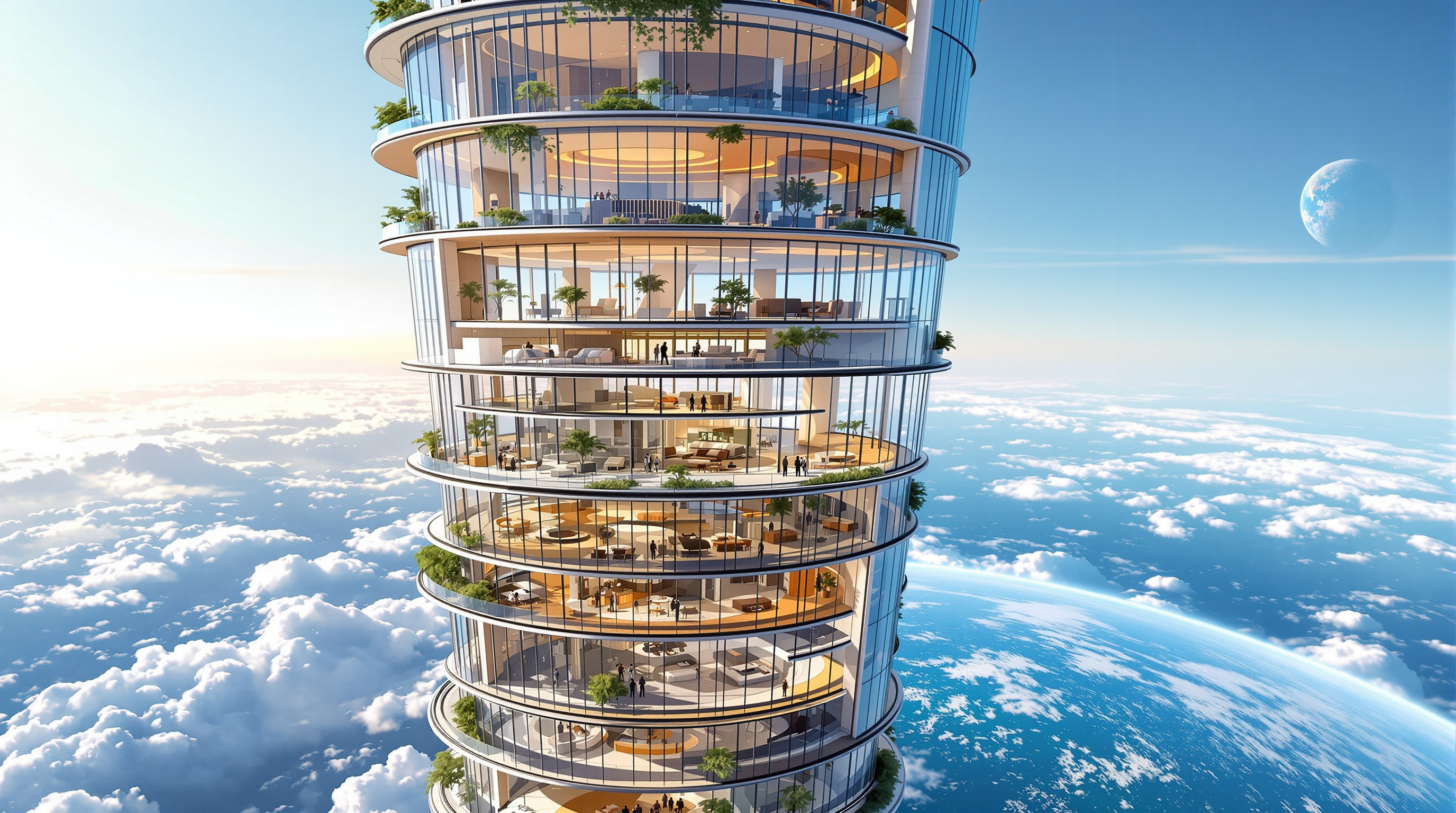
A tower kilometres tall is a stack of radically different climates. Clouds AO's own notes describe a top zone near 32,000 metres where the temperature is around -40°C and the air is close to vacuum — survivable only in the way a space station is survivable, sealed and pressurised, with excursions outside requiring protective suits. Higher up there is more sunlight: the upper floors, above the Earth's shadow line for longer, gain roughly 45 extra minutes of daylight at dawn and dusk. Power comes from solar arrays mounted above the weather, in permanent sun; water is drawn from a semi-closed loop, topped up by cloud condensate and rainwater as the tower sweeps through the atmosphere.
| Zone | Approx. condition | Proposed use |
|---|---|---|
| Upper | Near-vacuum, about -40°C, extended daylight | Solar arrays, sealed technical decks |
| Upper-middle | Thin, cold air; long views | Sleeping quarters, quiet functions |
| Middle | Habitable band | Gardens, offices, communal life |
| Base | Densest, warmest air; lowest speed | Docking, arrivals, water capture |
Read as a serious brief this is absurd; read as a diagram of tendencies, it is oddly prophetic. Every supertall already stratifies — mechanical floors, sky lobbies, pressure zones, wind that changes with height. Analemma simply pushes that stratification until the top and bottom of one building belong to different worlds.
What is real here, and what is not
Honesty is the whole value of a concept like this, so the technical ledger matters. The idea of hanging a structure from orbit is not new science fiction whimsy; it has a genuine engineering literature. Konstantin Tsiolkovsky imagined a tower to space in 1895; the Leningrad engineer Yuri Artsutanov revived it as a tether in 1960; and in 1975 the aerospace engineer Jerome Pearson published the first rigorous analysis of an "orbital tower" in the peer-reviewed journal Acta Astronautica. Later NASA-funded work by Bradley Edwards argued that a ground-anchored space elevator might be feasible if a cable material with the strength-to-weight ratio of bulk carbon nanotubes could ever be manufactured — a very large "if" that remains unmet today.
But Analemma is not a space elevator, and the difference is the crux. A classic space elevator is anchored to the ground and held taut by a counterweight flung out beyond geosynchronous altitude; its centre of mass sits at the geosynchronous radius (about 35,786 km above the surface), which is what keeps the whole assembly hovering. Analemma has no ground anchor at all. It hangs a heavy tower below the orbit point, which drags the system's centre of mass downward — and a centre of mass below geosynchronous altitude cannot, by the plain arithmetic of orbits, keep a 24-hour period. The "eccentric orbit" and the figure-eight are partly Clouds AO's poetic acknowledgement of exactly this instability. Add the unbuildable cable, the fantasy of capturing and re-orbiting an asteroid (NASA's real Asteroid Redirect Mission was cancelled in 2017, the very year Analemma appeared), and the -40°C commute, and the honest verdict is unambiguous: this cannot be built, and the designers know it.
Its place in the chapter: the useful impossible
That verdict does not diminish the project; it locates it. Analemma belongs to Chapter 16 — the not-yet-built, the provocations — and specifically to a lineage of "paper architecture" that has always driven the discipline forward without laying a brick. Archigram's Walking City, Superstudio's endless Continuous Monument, the space-frame megastructures of the 1960s: none were built, all were influential, precisely because they isolated one idea and pursued it past the point of feasibility so that others could see it clearly. A concept building is an argument made in the only medium architecture has — the drawing.
Studio Matrx's third position is to refuse both the credulous headline ("the skyscraper of the future!") and the cynical dismissal ("physically impossible, ignore it"). Both miss the point. Analemma is not a prediction; it is an instrument. Its real payload is the question it forces on every ordinary tower: why does a building have to touch the ground? Once that question is genuinely open, more plausible descendants come into view — tension-first structures, tall buildings conceived as suspended rather than stacked, the slow decoupling of "value" from "plot." The asteroid is a joke the drawing tells so that the serious question can be asked with a straight face.
Why it belongs in the canon
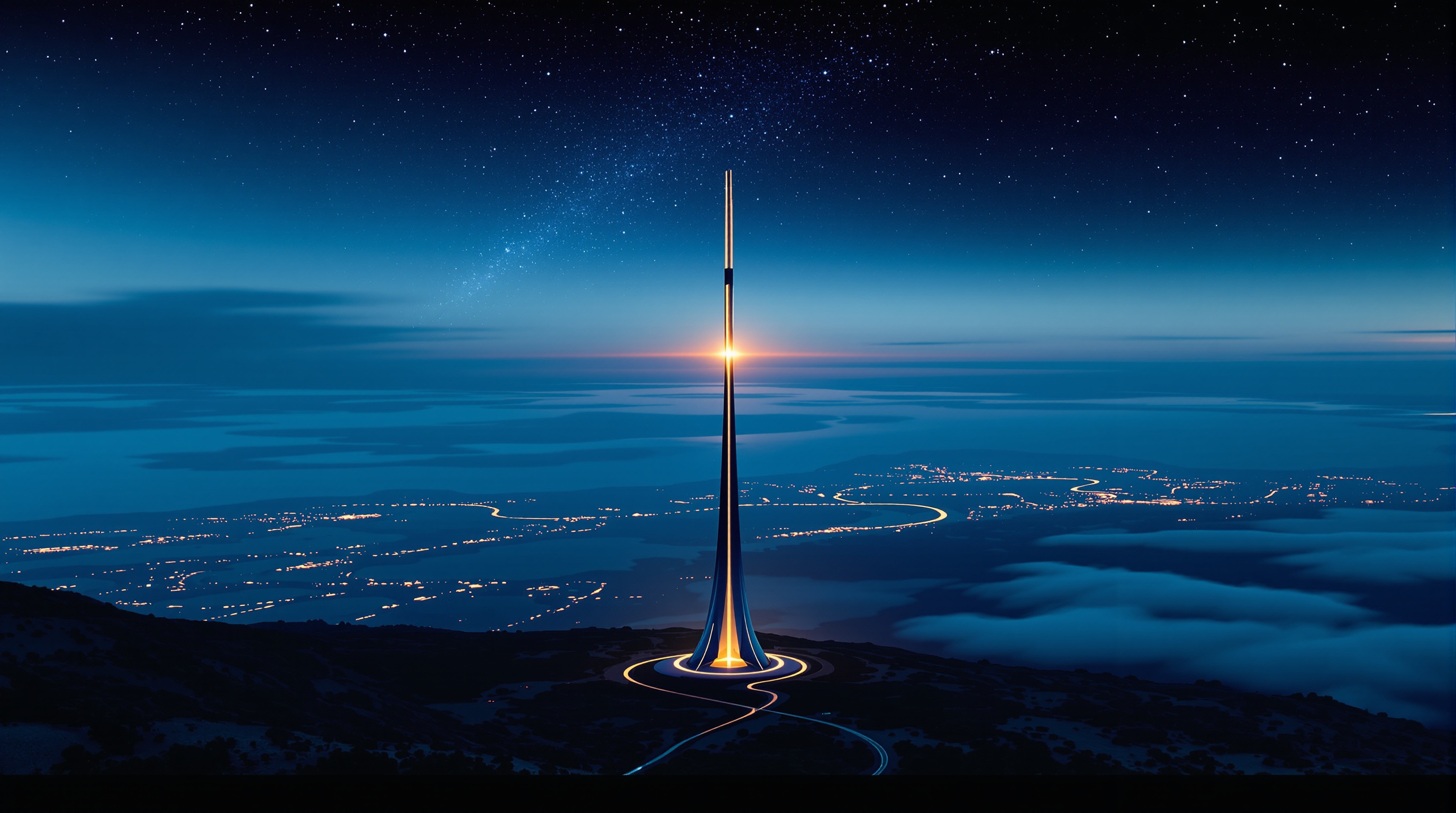
Strip away the spectacle and one contribution remains: Analemma Tower is the cleanest recent statement of a building freed from its foundation. It will not be constructed, and it does not need to be. It has already done the work a provocation is for — putting a crack in an assumption so old we had stopped seeing it as one. The future of architecture will not be a tower hanging from an asteroid. But it may well be shaped by architects who, having once taken that drawing seriously, no longer assume that up is the only way a building can grow.
References
- Clouds Architecture Office (2017). "Analemma Tower" — official project description and drawings (project team: Ostap Rudakevych, Masayuki Sono, Kevin Huang; Universal Orbital Support System; eccentric geosynchronous orbit; construction proposed over Dubai). cloudsao.com/analemma-tower (primary source)
- Pearson, J. (1975). "The orbital tower: a spacecraft launcher using the Earth's rotational energy." Acta Astronautica, 2(9–10), 785–799. DOI: 10.1016/0094-5765(75)90021-1. (peer-reviewed; the foundational analysis of a tether-to-orbit structure)
- Edwards, B. C. (2000–2003). "The Space Elevator: NIAC Phase II Final Report." NASA Institute for Advanced Concepts. (primary technical report; assesses the carbon-nanotube tether on which any such structure depends)
- Frearson, A. (2017). "Supertall skyscraper hangs from orbiting asteroid in Clouds Architecture Office concept." Dezeen, 23 March 2017. dezeen.com (architectural press; publication of the concept)
- Stott, R. (2017). "The Real Deal Behind the Dangling 'Asteroid Skyscraper' Proposal." ArchDaily, March 2017. archdaily.com (architectural press; critical feasibility assessment separating minor from fatal problems)
Part of The Future of Architecture in 300 Buildings — Studio Matrx's canon of the buildings asking where architecture goes next. Chapter 16: Concepts & Provocations.
Export this guide
Related Guides — Deep-dive reading
Concordia Station: Architecture as a Survival Machine on the White Plateau
At Dome C, 3,233 m up on the Antarctic ice and colder than almost anywhere humans overwinter, the Franco-Italian Concordia base answers the oldest architectural question by refusing the usual terms — two eighteen-sided towers on jackable legs, a closed-loop life-support building that Europe's space agencies study as a stand-in for Mars.
The Future of ArchitectureQuay Quarter Tower: How 3XN Kept a Skyscraper Alive Instead of Killing It
In Sydney, 3XN and BG&E chose not to demolish the 1976 AMP Centre but to grow a new tower out of its bones — keeping around two-thirds of the old columns, beams and slabs and almost all of its core. This deep study reads the world's first 'upcycled' skyscraper as a manifesto for what tall buildings become when carbon, not the wrecking ball, sets the terms.
The Future of ArchitectureMapungubwe Interpretation Centre: How Peter Rich Built a Landscape Out of Its Own Ground
Peter Rich Architects, with engineers John Ochsendorf and Michael Ramage, raised a cluster of thin compression vaults over a South African World Heritage site using some 200,000 tiles pressed from the earth beneath them — a case study in funicular form-finding, earth construction, local labour, and what it means for a building to belong to its place.
The Future of ArchitectureRelated Tools — Try Free
Cross-Ventilation Analyzer
Estimate airflow and air changes per hour (ACH) from room size, window areas, layout, and local wind — with NBC 2016 Part 8 compliance check.
Ventilation CalculatorWindow Orientation Planner
Pick the best window type, glass and shading by wall direction — north, east, south and west.
Window ToolBrise-Soleil Visualizer
Interactive horizontal-louvre cut-off angle calculator — sun altitude, louvre depth, and spacing inputs with a live shadow preview. Computes θ = arctan(spacing/depth) for façade shading, ECBC envelope compliance, hospital daylight design, and tropical sun-control detailing.
Sun Shading Tool