
 Lesson 6.1
Lesson 6.1 · Comfort: Light, Sound, Air
Lighting the Workplace
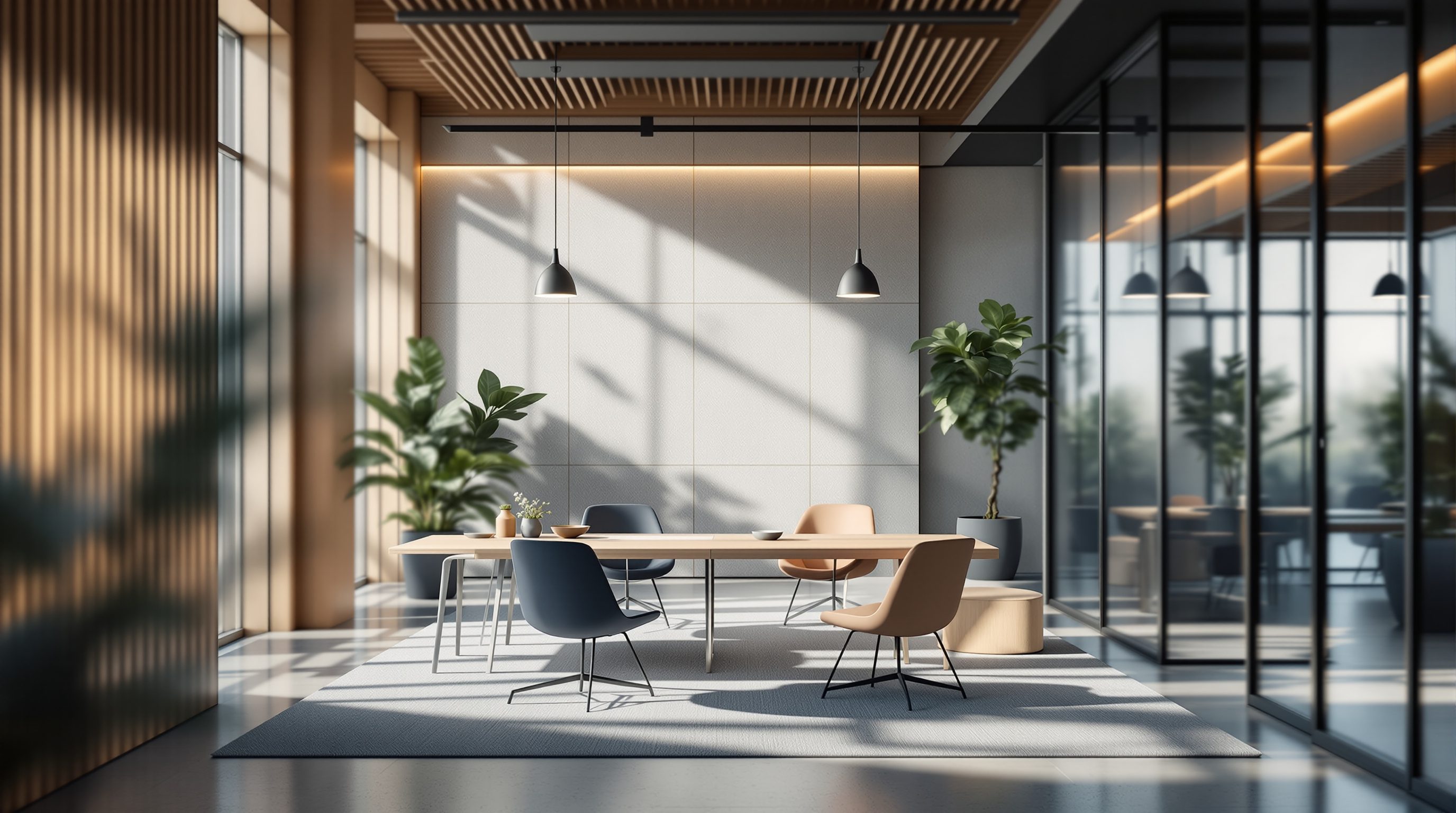
Good workplace lighting begins at the window and builds outward in layers - daylight and views first, then an ambient wash, task light where work happens, and accent for depth - all tuned to glare, the body clock and the person at the desk
Light is the first thing the body notices about a room - and the workplace system people complain about most when it is wrong, yet rarely praise when it is right.
Walk into any office and, before you have registered a single desk, your body has already read the light. Is it bright and flat like a supermarket, or soft and layered? Is there daylight, or only the hum of ceiling panels? Is the sun slicing across a screen, or pooling gently on a wall? Light is the medium through which we experience every other thing a designer does - the materials, the colours, the spaces - and it quietly governs how alert we feel, how well we see our work, and whether a room feels humane or clinical. Get it wrong and nothing else quite recovers; get it right and people rarely notice, which is exactly the point.
This lesson teaches workplace lighting as a design discipline, in the order a good designer actually thinks: daylight and views come first, then electric light is built up in layers - an ambient wash, focused task light where work happens, and accent for depth and emphasis - all tuned to control glare, respect the circadian rhythm of the body, and serve the particular person at the particular desk. Throughout, we hold the course's discipline: the principles and judgement are here, but the binding numbers - illuminance levels, glare indices, uniformity ratios - belong to the current lighting standards and to a lighting designer, not to a rule of thumb.
Brightness is cheap; good light is about where it comes from and what it does NOT shine into your eyes.
Daylight and views come first
Before you reach for a single light fitting, you design for daylight - because it is the light the human body evolved under, and no electric source fully replaces it. Daylight is dynamic: it changes through the day and the seasons, it renders colours and faces truthfully, and it connects people to the world outside. That connection is not decoration. A view out - to sky, greenery, a street, the horizon - lets the eye rest at a distance, relieves the strain of hours at a near screen, and anchors people in time and place. The research on daylight and views is among the most consistent in workplace design: people seated near good daylight and a view report better mood, and teams value those seats so highly that access to them becomes a fairness question a designer must plan, not leave to chance.
So the first moves are architectural and planning moves. Bring light deep into the floor - through generous glazing, higher floor-to-ceiling heights near the facade, light shelves or clerestories where the building allows, and by keeping tall enclosures and storage away from the windows so light reaches the core. Share the daylight and the views democratically - put the open, shared settings and circulation along the glazed edge where everyone benefits, rather than walling the perimeter into a ring of private offices that hoard the best light for a few. Plan desks in relation to the window, not the wall - ideally with the line of sight and the screen roughly parallel to the glazing, so people get daylight from the side without it glaring off the screen or silhouetting a colleague's face.
In India this comes with a hard caveat: daylight and solar heat arrive together, and unshaded glazing that looks bright and modern can turn a floor into an oven and a glare-trap. Daylighting here is inseparable from shading and orientation - external shading, deep reveals, fritted or spectrally selective glass, and careful handling of the harsh east and west sun. The goal is usable, comfortable daylight, not raw sun: soft, diffuse light you can work beside all day. Good daylighting is a design problem solved at the building and planning scale, long before the electric lighting is even specified.
Design the daylight first - it is free, alive, and the light the body trusts. Electric light fills the gaps.
Layered electric light: ambient, task, accent
When the daylight fades or falls short, electric light takes over - and the single most useful idea in lighting design is that good light is layered, not poured from one uniform source. The old office model was a flat grid of identical ceiling panels blasting the whole floor to one bright level, everywhere, all the time. It is easy to specify and miserable to inhabit: shadowless, institutional, tiring, and wasteful, because it lights empty corridors as hard as occupied desks. Layered lighting instead uses three cooperating layers, each doing a different job.
Ambient light is the soft, general wash that lets you move through the space and see it comfortably - the background level. It is best when it is gentle and even rather than glaring, and it is increasingly delivered indirectly (bounced off the ceiling) or from low-glare fittings, so the room is filled with light but the eye never meets a hot, bright source. Task light is focused light placed exactly where demanding visual work happens - a desk lamp, an under-shelf strip, a downlight over a work surface. Because it puts the light where it is needed, the ambient layer can be calmer, and crucially the individual can control their own task light to suit their eyes, their task and their age. Accent light is the expressive layer - the pools on a feature wall, the glow in a social nook, the highlight on materials and art - that gives a space depth, hierarchy and a sense of place, turning a flat box into somewhere that feels designed.
The art is in the mix. A calm ambient level, generous local task light people can adjust, and a few well-judged accents produce a space that is both easy to work in and pleasant to be in - and usually uses less energy than the old blanket grid, because you are not over-lighting everything to satisfy the most demanding task. Different settings want different balances: a focus room wants steady, even task-friendly light; a cafe or lounge wants warmer, lower, more accented light that says 'switch off'; a meeting room wants good light on faces for video. One floor therefore carries several lighting characters, zoned and controlled, not a single flat level imposed on all of it.
Glare, contrast and comfort
If there is one failure that ruins workplace lighting more than any other, it is glare - light that is too bright, or too bright against its surroundings, in the wrong place in your field of view. Glare comes in two flavours the designer must manage. Disability glare actively stops you seeing - the sun reflected off a screen, a bright window behind the monitor you are trying to read. Discomfort glare does not blind you but nags - a bare bright lamp at the edge of vision, a shiny ceiling fitting that draws the eye, the slow fatigue of squinting that people rarely name but always feel. In a screen-based office, where almost all work is done looking at a glossy, self-lit display, controlling glare is not a refinement; it is the core of getting the lighting right.
The tools are mostly about managing brightness and contrast rather than simply adding light. Keep bright sources out of the normal line of sight: use low-glare, well-shielded luminaires and indirect light so people do not stare into a hot source. Handle daylight glare with shading people can adjust - blinds, screens, fins - and by orienting desks so neither the window nor a bright reflection sits behind or directly in front of the screen. Avoid extreme contrasts: a brilliant window beside a dim wall forces the eye to keep re-adapting and is tiring, so balance perimeter daylight with enough interior light that the jump is gentle. Watch surfaces too - high-gloss floors, glass tables and shiny white boards become secondary glare sources that bounce light into eyes.
Contrast is not the enemy, though - it is a tool. You want the right contrast in the right place: enough light and modelling on a task and on faces, some shadow and variation across the room so it reads as three-dimensional and alive rather than flat. A room lit to one uniform shadowless level is as fatiguing in its own way as a glaring one. The craft is a comfortable visual field: the work well and evenly lit, faces and materials modelled kindly, no hot spots stabbing at the eye, and a gentle overall gradient rather than harsh extremes. Where the numbers matter - limiting glare indices, uniformity, luminance ratios - those are for the lighting standards and the lighting designer to verify.
The body clock, colour and control
Light does more than let us see - it sets the body's clock. Through special receptors in the eye, light (especially cooler, bluer, brighter light) signals 'day' to the brain and suppresses the sleep hormone melatonin, while warm, dim light signals 'evening'. This is the circadian dimension of lighting, and it is why a workplace drenched in flat, cool light late into a winter evening can leave people wired and poorly slept, and why the bright, cool daylight of the morning is so valuable for alertness. The emerging practice called human-centric or circadian lighting tries to support this natural rhythm indoors - brighter and cooler in the working morning, warmer and calmer toward the end of the day - so that the electric environment works with the body rather than against it.
Two practical design ideas follow. The first, again, is that daylight is the best circadian tool we have - another strong reason to get people near windows and real daylight, which carries the right intensity and rhythm for free. The second is tunable and zoned electric light: systems whose colour temperature and brightness can shift through the day, and controls that let different zones behave differently - a bright, alert open floor; a calm, warm lounge. This is a genuinely useful idea, but it must be held honestly. The science of exactly how much, when and at what colour is still maturing, the claims of some products run ahead of the evidence, and a poorly tuned 'circadian' system can simply be an expensive way to annoy people. Treat it as a thoughtful principle - support daylight and avoid harsh cool light at the wrong times - not as a gadget to oversell.
Underneath all of this sits the most humane idea in lighting: give people control. Individuals differ enormously - an older eye may need far more task light than a younger one, some people are glare-sensitive, some want warmth and some crisp light. Blinds people can adjust, task lights they can switch and dim, and local zone control turn lighting from something done to people into something they can tune to themselves, which consistently raises satisfaction. Design a good daylit, layered, glare-controlled base - then hand people the dimmer. And leave the binding light levels and metrics to the standards and the lighting designer.
Lighting of interior workplaces (IS / CIE / EN 12464-style standards)
Maintained illuminance (lux), glare rating, uniformity, colour rendering on tasks
Principles and judgement are here; every binding target is set by the current lighting standard and verified by a lighting designer for the specific task and space.
Daylight, energy and green ratings (ECBC, IGBC / LEED, WELL)
Daylight access, lighting power density, controls, circadian and light-quality credits
Requirements change - confirm the current code and rating-system version with the certifying body and services consultant. See Module 8.
Screen-work and ergonomics guidance
Glare on displays, luminance ratios, positioning of desks and monitors to light
Illustrative principles here; verify current ergonomic and display-lighting guidance for the actual task mix with the relevant specialist.
Workshop - read and re-light a real workspace
Lighting is best learned by observing it honestly. In this workshop you will audit the lighting of a workspace you can stand in - your own desk, a library, a cafe, an office you can visit - and propose a better layered scheme, without touching a single calculation.
A workspace you can observe, a phone camera, paper. No light meter or software - this is about seeing light, not measuring lux.
Goal: a qualitative lighting audit and a re-light sketch of one real space.
Inputs: a workspace you can observe at different times + a phone camera + this lesson.
Time: ~45 minutes.
- 1Map the daylight: where are the windows, how far does daylight reach, who sits in it and who never does, and is the sun ever a glare or heat problem? Note the time of day you observed.
- 2Identify the electric layers: is there an ambient wash, task light, any accent - or just one flat level of ceiling fittings doing everything? Sketch where each fitting is.
- 3Hunt for glare: sit where people sit and look for bright sources in your field of view, sun or light reflected on screens, and harsh contrasts between a bright window and dim walls. Photograph the worst offender.
- 4Check control and character: can anyone adjust blinds or task lights? Does the light suit what the space is for (focus, social, meeting), or is one character imposed everywhere?
- 5Propose a re-light in words and a sketch: how you would get more usable daylight to more people, what ambient/task/accent layering you would add, one glare fix, and one control you would give people.
You’ll walk away with
A one-page lighting audit: a daylight map, the layers (or lack of them), the worst glare photographed, and a labelled re-light sketch with your top three moves - handed to a lighting designer, it would brief the real scheme.
Three altitudes on the same idea
Read the band that fits you — or all three.
Most of what makes workplace lighting good or impossible is decided at the base-build, and it is your call. Floor-plate depth, floor-to-floor height, the amount and quality of glazing, external shading, orientation to the harsh Indian east and west sun, and how deep daylight can reach all set the ceiling on what any later lighting scheme can achieve - and they are nearly unchangeable afterwards. Design for generous, shaded, usable daylight and real views, share that daylight across the floor rather than walling it into perimeter offices, and coordinate ceiling strategy and services so a layered, low-glare scheme is possible. Brief the lighting designer early, and defer binding illuminance levels, glare limits and energy metrics to the current standards and that specialist.
The layered scheme, the fittings, the controls and the feel of the light are your craft. Compose ambient, task and accent light so each setting has the right character - calm and even for focus, warm and low for social, kind on faces for meetings - and choose low-glare luminaires, indirect sources and finishes that do not bounce light into eyes. Give people task lights and blinds they can actually adjust; position desks and screens in relation to glazing to kill glare. Treat tunable or 'circadian' lighting as a considered principle, not a sales pitch, and keep binding lux levels, uniformity and glare indices with the lighting standards and the lighting designer you coordinate with.
Train your eye by reading the light in every room you enter: where does it come from, is it flat or layered, is anything glaring, can you see a window? Learn the core moves - daylight and views first, then ambient plus task plus accent, then glare control, then the body-clock and control dimension - because that order is how professionals actually design light. Notice how the same desk feels different under a flat panel grid versus soft daylight with a task lamp. Understand that real lux levels and glare metrics come from standards and lighting designers; your job now is to grasp why layered, daylit, glare-controlled, person-controlled light makes a workplace humane.
“Good workplace lighting just means making the office bright enough - put in plenty of ceiling panels at a high, even level everywhere and people will be able to see fine.”
Do it yourself
No instruments needed - reason from the principles.
- 1Why do daylight and views come first in workplace lighting, and what does sharing them fairly across a floor mean in practice?
- 2Name the three electric lighting layers and the distinct job each one does.
- 3Explain the difference between disability glare and discomfort glare, and give one design move against each.
- 4What is the circadian dimension of light, and why is real daylight the best circadian tool we have?
- 5Why does giving individuals control over their own light raise satisfaction more than simply raising the overall level?
The one line to carry out
Peer-reviewed journals & authoritative standards
- 01Lighting — Wikipedia - Lighting, 2026.
- 02Daylighting — Wikipedia - Daylighting, 2026.
- 03Lighting of workplaces — Wikipedia - Lighting of workplaces, 2026.
- 04Circadian rhythm — Wikipedia - Circadian rhythm, 2026.
Light is only one of the invisible comfort systems a workplace stands or falls on. Next we turn to the one people complain about most of all - sound - and how to absorb, block and cover it.
The author
Amogh N P
Architect, interior designer, and creative polymath. Studio Matrx began in his notebooks — his vision of design made honest, useful, and open to everyone. Its Academy is written and taught in his memory, and free, forever.
More about Amogh →