
 Lesson 7.2
Lesson 7.2 · Hybrid & the Future of Work
Activity-Based Working
The idea is simple and slightly unsettling - you have no desk of your own, and instead choose from a menu of settings the one that fits whatever you are doing right now
Give people no desk of their own, but a rich menu of places to work, and let the task decide where they sit - that is the whole idea, and the whole difficulty.
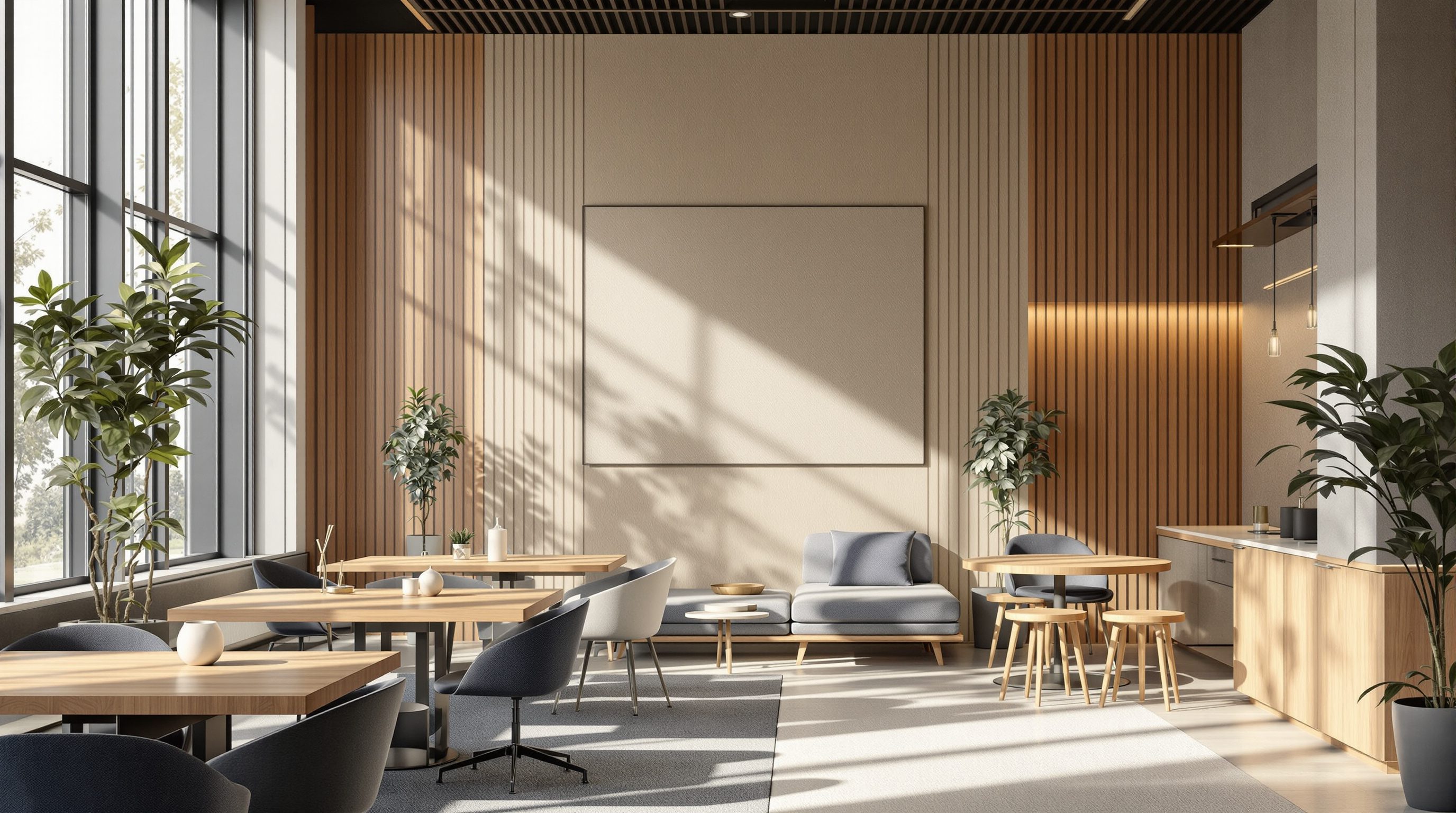
Activity-based working (ABW) is one of those ideas that is easy to state and hard to do well. The premise: nobody owns a desk. Instead, the floor offers a palette of settings - quiet focus rooms, open benches, project tables, phone booths, meeting rooms, lounges, a cafe - and you move to whichever suits the thing you are doing in that moment. Heads-down report to write? A quiet room. A quick sync with two colleagues? A huddle spot. A call you need privacy for? A booth. A casual catch-up? The cafe. The desk stops being a place you are assigned and becomes a tool you pick up and put down.
It is a genuinely good idea, grounded in an obvious truth: a single desk is a compromise that suits no task perfectly, because people do many different kinds of work in a day and each kind wants a different setting. Done well, ABW gives people better places for each activity and lets an organisation share space efficiently into the bargain. Done badly - and it is done badly often - it becomes a demoralising game of musical chairs, a cost-cutting desk-removal exercise wearing a progressive label. The difference between the two is almost never the furniture. It is leadership, change management, etiquette and, above all, whether the menu of settings is rich enough to deliver on its promise.
Not the absence of a nameplate - the presence of a menu. Variety is the whole ballgame.
The principle: a tool for each task, not a seat for each person
The intellectual core of ABW is a rejection of the one-size-fits-all desk. Think honestly about a normal working day: an hour of concentrated writing, a couple of video calls, a brainstorm with a few people, some email triage, a long collaborative working session, a coffee conversation that turns out to matter. Each of those has a different ideal setting - different in enclosure, acoustics, furniture, company and light. A single assigned desk in an open plan is a bland average that serves the concentrated hour and the noisy call and the brainstorm all equally poorly. ABW's answer is to stop averaging: provide the right setting for each activity, and let people move between them as the day demands.
This reframes the unit of design. In a traditional office the unit is the workstation, replicated; in ABW the unit is the setting, and the design question is 'what is the right mix and number of settings for the work this organisation does?' It also reframes ownership. Because no setting is anyone's permanently, all of it is available to everyone, which is what lets the organisation provide a richer variety within the same floor - you can afford four kinds of focus space and five kinds of collaboration space precisely because you are not also buying a hundred and twenty assigned desks that sit empty half the week.
It is worth being clear that ABW is not the same as hot-desking, though they are often confused (lesson 7.3 separates them carefully). Hot-desking can be nothing more than unassigned versions of the same old desks - sharing without variety. ABW is specifically about variety of setting chosen to fit the activity. You can share desks without doing ABW, and the spirit of ABW is the menu, not merely the absence of a nameplate. That distinction turns out to be the whole ballgame: strip the variety out and what you have left is not ABW at all.
A desk is an average that suits no task. ABW stops averaging: the right setting for each thing you do.
The setting menu it depends on
ABW lives or dies by the richness of its menu, so the designer's central task is composing that palette. A workable menu spans three broad families. Focus settings for concentration and confidentiality: quiet open desks in a library-rule zone, enclosed focus rooms for a few hours of deep work, and phone or video booths for calls that need privacy or would disturb others. Collaboration settings for working together: project tables a team can occupy and cover in sticky notes, bookable meeting rooms of various sizes, huddle and video rooms for hybrid calls, and open work lounges for looser group work. Social and restorative settings: the cafe and pantry, touchdown perches for a quick sit-and-send, quiet retreats to decompress, and where possible an outdoor terrace.
The skill is in proportion and distribution, not just presence. Too few focus rooms and the introverts and the concentrators are stranded - the single most common complaint in badly-done ABW, because open-plan evangelism quietly forgot that a lot of valuable work needs quiet. Too few booths and every meeting room gets hijacked for a one-person call. The mix must be read from how the organisation actually works (Module 1), and the settings must be well distributed so that whatever you need is reachable without a trek across the building - a focus room marooned far from where a team sits will stay empty while people suffer at noisy benches nearby.
There is a hard floor beneath all this: enough total seats and settings. ABW shares space, but if it shares too hard - if on a busy day there are visibly not enough good places to work - the scarcity poisons the whole model, because people stop trusting that a suitable setting will be free when they need it, and trust is the currency ABW runs on. The menu also has to be legible: people need to understand what each setting is for and be able to find and, where needed, book it. A gorgeous palette nobody can navigate fails as surely as a thin one.
Why ABW succeeds - or fails
Here is the uncomfortable truth that every experienced workplace designer learns: whether ABW works is only partly about the design, and mostly about the organisation. The same well-composed floor can thrive in one company and be hated in another, and the variables that decide it are behavioural. Leadership comes first: if senior people quietly keep assigned desks or corner offices while everyone else shares, the whole thing reads as a hierarchy dressed as equality, and trust collapses. Leaders have to live in the settings too. Change management is second: ABW is a significant change in daily habit, and imposing it by memo - clearing desks over a weekend with no preparation - breeds resentment, whereas explaining the why, involving people, piloting, and supporting the transition earns buy-in (Module 10 returns to this).
Etiquette is third and often underrated. Shared settings only work with shared rules, agreed and actually followed: clear your desk when you leave so the next person can use it; do not 'camp' in a focus room all day as a de-facto private office; keep the quiet zones quiet; book what should be booked and release what you are not using; take calls where calls belong. These norms are not bureaucracy - they are the social contract that makes sharing bearable, and they have to be taught and gently enforced, not assumed. Storage supports all of it: if people have nowhere to put their things, going deskless is simply miserable, so good lockers and frictionless personal storage are not an afterthought but a precondition.
And underlying everything, as the previous section warned, is enough variety and enough seats. The most common failure mode is an organisation that adopts the word 'ABW' as cover for removing desks to cut property cost, without building the rich menu or doing the cultural work - so people arrive to find fewer, worse places to work and a vague instruction to 'sit anywhere'. That is not ABW; it is a budget cut, and it fails predictably and deservedly. The honest designer's job is partly to protect the client from this - to insist that if the variety, the leadership commitment and the change management are not there, the organisation is not ready, and half-doing ABW is worse than not doing it.
ABW is a behaviour change with a spatial enabler. Leadership, change, etiquette, variety - not furniture.
Designing ABW honestly - and for India
Putting it together, designing ABW well is a combined act of space planning and organisational honesty. On the space side, you compose and proportion the setting menu from a real reading of the work, distribute it so the right setting is always near to hand, provide enough seats that scarcity never bites, add the storage and wayfinding and booking that make it navigable, and pay special attention to the focus end of the palette that enthusiasm so often neglects. On the organisational side, you test - before committing - whether leadership will genuinely share, whether there is appetite for real change management, and whether the etiquette can be established and upheld. If those are absent, the most elegant palette in the world will fail.
The Indian and global-capability-centre context adds its own texture. Large IT and GCC floors in India have adopted ABW and its cousins widely, often at scale, which makes the failure modes very visible: vast deskless floors with too few quiet rooms, or 'neighbourhood' compromises where teams keep a zone (lesson 7.3). Cultural factors matter - attitudes to hierarchy and assigned status, to being reachable at a known desk, to personalising a space - and they vary across organisations and generations; the sensitive designer reads them rather than importing a Northern-European ABW template wholesale. Prayer and quiet-reflection needs, and the realities of long commutes that make the in-day precious, also shape what the menu should hold (Module 5).
As always, treat the numbers as illustrative, as of 2026, and calibrate to the organisation: how many of each setting, the sharing ratio behind the deskless model (lesson 7.3), the balance of focus to collaboration. And defer the binding specifics - egress for the occupied peak, accessibility of every setting type so the model is inclusive for all, ventilation for dense collaboration zones - to the current codes and the specialist consultants. ABW at its best is a humane idea: give people better places for the varied things they do. Design it so that promise is actually kept, and be honest with the client when the conditions for keeping it are not yet in place.
Half-doing ABW is worse than not doing it. If variety, leadership and change work aren't there, they're not ready.
Activity / setting mix
How many of each setting; sharing ratio behind the model
Read from how the organisation actually works; every count is illustrative, as of 2026, to be calibrated with occupancy data. See Module 1 and lesson 7.3.
Accessibility (NBC / Harmonised Guidelines)
Every setting type usable by everyone
A deskless model is only inclusive if each kind of setting is accessible. Dimensions and provisions from the current standards and an accessibility consultant. Module 8.
Acoustics (IS / architectural acoustics)
Separating quiet focus zones from loud collaboration
A varied menu mixes noisy and quiet uses on one floor - acoustic separation is essential. Principles in Module 4; ratings and treatment with an acoustic specialist.
Workshop - compose a setting menu and stress-test it
ABW succeeds on the richness of its menu and the culture around it. In this workshop you will design a setting palette for a real or imagined team, then deliberately try to break it with the common failure modes.
Paper or a simple layout tool, the activity profile, and this lesson. No specialist software required.
Goal: a defensible setting menu plus an honest readiness check.
Inputs: a team or organisation you know (or a realistic 50-person team) + this lesson + paper or a simple layout tool.
Time: ~55 minutes
- 1Profile the work: list the main activities a typical member of this team does in a week (focus writing, calls, brainstorms, meetings, casual collaboration, social) and roughly how much of each.
- 2Compose the menu: propose a specific palette of settings across the three families - focus, collaboration, social/restorative - with rough numbers of each, sized for the team and a sensible sharing ratio.
- 3Distribute it: sketch where the settings sit so the right one is always near to hand, keeping quiet and loud zones apart. Mark the storage (lockers) and how people would find and book a setting.
- 4Stress-test it: walk through the failure modes - not enough focus rooms, leaders keeping private desks, no etiquette, nowhere to store things, too few seats on a busy day. For each, note whether your design survives it.
- 5Write the readiness verdict: state in a sentence whether this organisation is actually ready for ABW - leadership, change appetite, etiquette - and what would have to be true before you would recommend proceeding.
You’ll walk away with
A one-page ABW scheme: the activity profile, the composed and distributed setting menu with numbers, the storage/booking support, a stress-test against the common failure modes, and an honest readiness verdict. Keep it alongside the 7.1 sizing sheet.
Three altitudes on the same idea
Read the band that fits you — or all three.
ABW is enabled or blocked by the shell. A rich setting menu needs a floor plate that can hold enclosed focus and meeting rooms as well as open zones without everything becoming a corridor - which means thinking about structural grid, where cores and risers land, acoustic separation between quiet and loud zones, and daylight reaching the collaborative heart rather than being hoarded by a ring of cellular offices. Services must cope with people clustering unpredictably across the floor rather than sitting at fixed, evenly-loaded desks. Build in adaptability: the setting mix will be tuned after occupancy, so favour demountable partitions and flexible servicing. Defer egress, acoustic separation ratings and accessibility of each setting type to the current codes and the fire, acoustic and accessibility specialists.
Composing the setting menu is the heart of ABW and squarely your work. Read how the organisation actually works, then proportion and distribute the palette - focus rooms, booths, project tables, meeting and huddle rooms, lounges, social and quiet retreats - so the right setting for any task is always close at hand, with special care for the focus end that is so often under-provided. Design the supporting systems that make a deskless model liveable: generous lockers and storage, clear wayfinding, legible booking, and settings that read at a glance. And advise honestly: if the variety, the leadership commitment or the change management are missing, say so - a thin menu is just hot-desking with a nicer name. Calibrate every count to the client's data; defer accessibility and acoustics to the specialists.
ABW is the clearest expression of the 'palette of settings' idea, so it is worth understanding deeply. Grasp the principle first: a single desk is an average that suits no task, so instead of assigning seats you offer a menu of settings and let the activity choose. Then learn the two things that decide success. One is the menu itself - enough variety, enough seats, well distributed, with real focus space, not just open benches. The other is behaviour - leadership that genuinely shares, change management, etiquette and storage. The big lesson: ABW fails far more often from thin variety and weak culture than from bad furniture. When you see a deskless office, ask 'is this a real menu people trust, or just removed desks?'
“Activity-based working just means hot-desking - taking away assigned desks so people sit wherever is free. It is really a way to cut property costs by fitting more people into less space, dressed up in progressive language.”
Do it yourself
No tools needed - reason it through.
- 1State the core principle of ABW in one sentence, and explain why a single assigned desk is a poor compromise.
- 2How is ABW different from plain hot-desking? Why does the difference matter so much?
- 3Name the three families of setting a good ABW menu spans, with an example of each.
- 4Give three reasons ABW fails that have nothing to do with the furniture or layout.
- 5Why might a designer tell a client they are 'not ready' for ABW - and what would readiness look like?
The one line to carry out
Peer-reviewed journals & authoritative standards
- 01Activity-based working — Wikipedia - Activity-based working, 2026.
- 02Hot desking — Wikipedia - Hot desking, 2026.
- 03Change management — Wikipedia - Change management, 2026.
- 04Organizational culture — Wikipedia - Organizational culture, 2026.
ABW and hybrid both rest on sharing space rather than assigning it - which raises the practical arithmetic of how hard you can share, and how people find a seat. That is the subject of the next lesson.
The author
Amogh N P
Architect, interior designer, and creative polymath. Studio Matrx began in his notebooks — his vision of design made honest, useful, and open to everyone. Its Academy is written and taught in his memory, and free, forever.
More about Amogh →