
 Lesson 5.3
Lesson 5.3 · Housing & Neighbourhoods
Affordable & Inclusive Housing
Making the walkable, well-served city one that everyone can afford
A city only its rich can afford is broken
You can design a perfectly walkable, well-served, beautiful neighbourhood and still fail utterly, if only the wealthy can afford to live in it. Housing affordability is not a welfare footnote to urban design; it is the test of whether the city you are shaping is for everyone or only for some. This lesson is about designing so the answer is everyone.
A flat is cheap; the two-hour commute to reach a job is not. Add them before you call anything affordable.
What 'affordable' actually means
The word 'affordable' is thrown around loosely, so begin by pinning it down. The standard international benchmark is that housing is affordable if a household spends no more than about 30 to 40 percent of its income on it, whether as rent or as the cost of owning. By that measure a huge share of urban households, in India and worldwide, are not adequately housed: they either overpay, live in overcrowded or informal conditions, or are pushed to the far edge of the city where housing is cheap but the commute devours the saving. That last point is the crucial one for an urban designer: affordability is never just the price of the dwelling, it is the combined cost of housing plus transport. A cheap flat two hours from work by an expensive commute is not affordable in any meaningful sense; this is the concept of 'location affordability', and it explains why the poor so often, and so rationally, choose a central slum over a distant subsidised flat. It also reframes affordable housing as a location problem, not merely a construction-cost problem. The deepest structural driver of unaffordability is the price of well-located land, which is why simply building cheap units on cheap peripheral land, the default of so many housing programmes, so often fails: it solves the construction cost while worsening the location cost. Understanding affordability as housing-plus-location-plus-transport is the single most important conceptual move in this lesson, because it points every subsequent tool, from inclusionary zoning to slum upgrading, toward keeping affordable homes where the jobs, services and transit already are.
Inclusionary zoning and cross-subsidy
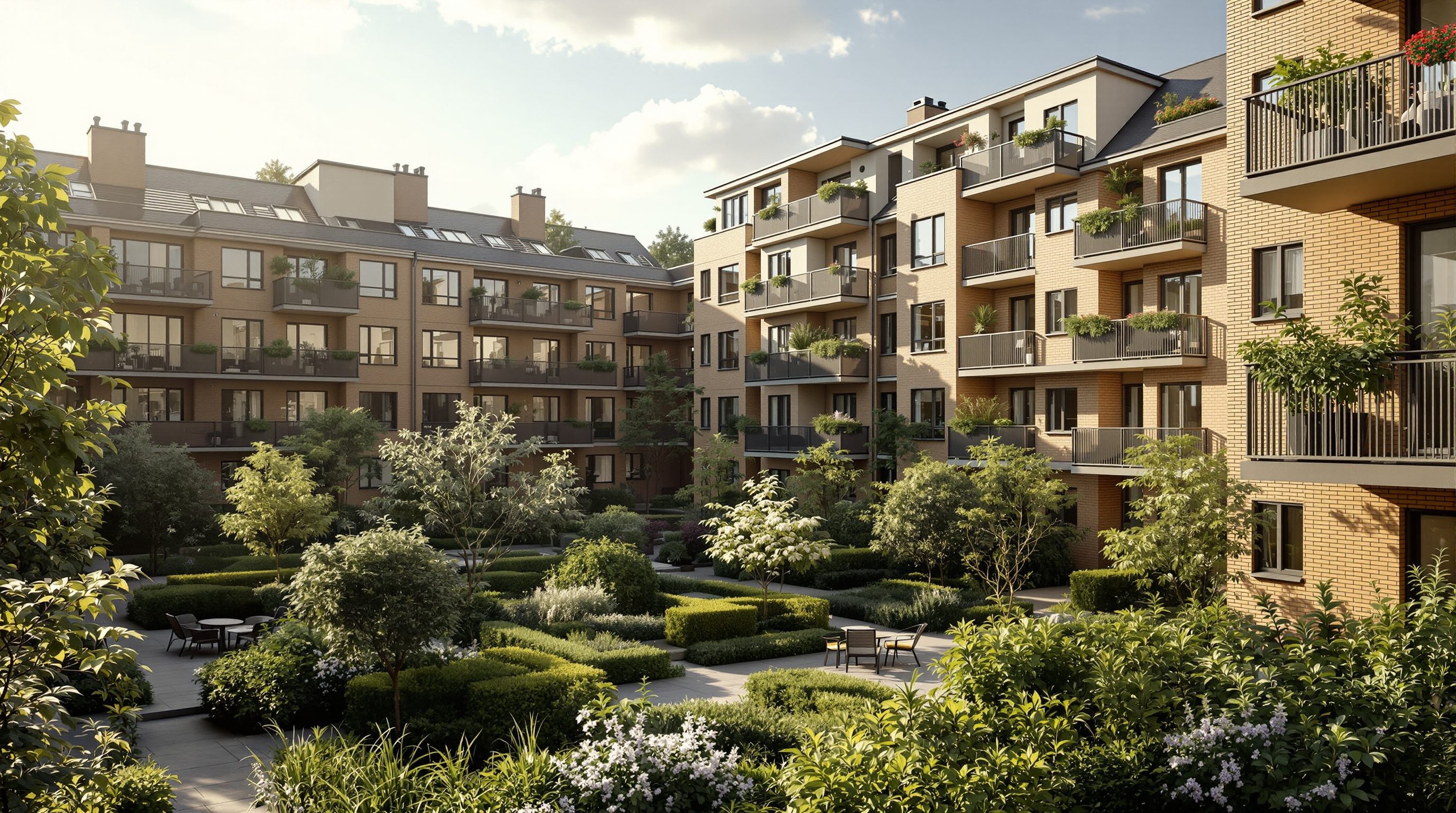
How do you get affordable homes onto expensive, well-located land, exactly where the market will not supply them? The leading planning tool is inclusionary zoning: a rule requiring that a share of the homes in a new development, or a share of the floor area, be sold or rented at prices affordable to defined income groups. The market-rate homes effectively cross-subsidise the affordable ones, and in exchange developers are often offered incentives such as extra FSI, a density bonus, faster approvals or fee waivers. India uses versions of this widely. Many state and city Development Control Regulations require a percentage of units, commonly 10 to 20 percent, to be reserved for Economically Weaker Sections (EWS) and Lower Income Groups (LIG) in larger residential projects, and offer additional FSI in return. The design stakes are high and subtle. A poorly handled inclusionary requirement produces a segregated 'poor door', a separate, meaner entrance or a walled-off EWS block, which technically complies while socially failing. The whole point of inclusion is undermined if the affordable units are dumped in the worst-located, worst-lit corner of the site or hidden behind a different gate. Good practice, sometimes called 'tenure blind' or 'pepper-potting' design, distributes the affordable homes through the development so they are indistinguishable from market units in appearance, entrance and access to amenity. The same principle extends to shared amenities: the playground, the lift lobby, the parking and the green should serve every resident equally, because the moment an amenity is fenced off by tenure the neighbourhood has quietly rebuilt the segregation the policy set out to prevent. The designer's job is to make the requirement produce genuine social mix, not token compliance, and that is a matter of plan, section and detail as much as policy.
Social mix, and its limits
Behind inclusionary zoning lies a contested ideal: social mix, the belief that neighbourhoods work better when people of different incomes live side by side rather than being sorted into rich and poor enclaves. The case for it is strong. Mixed neighbourhoods spread access to good schools, services and job networks; they avoid the concentrated disadvantage that turns a poor area into a poverty trap; and they build the everyday cross-class contact that a shared city depends on. Segregation, by contrast, is corrosive: it concentrates poverty and its penalties in some areas and hoards opportunity in others, and once physical it becomes self-reinforcing. But a mature designer must also hold the honest critiques. Some scholars argue that imposed social mix can disrupt the tight support networks of poor communities, that a token few affordable units among wealthy neighbours can leave low-income residents isolated rather than integrated, and that mix is sometimes used as cover for gentrification that ultimately displaces the very people it claims to help. The lesson is not to abandon mix but to pursue it carefully: aim for genuine integration with shared amenity and a critical mass of affordable homes rather than a symbolic sprinkle, protect existing communities from displacement, and never let 'mix' become an excuse to break up a functioning neighbourhood. The goal is a city that is neither segregated nor cynically tokenistic.
PMAY and the shape of Indian housing policy
India's flagship housing programme is the Pradhan Mantri Awas Yojana (PMAY), launched in 2015 with the ambition of 'Housing for All', operating through both an urban and a rural mission. PMAY-Urban is worth knowing as a case study in policy design because it works through several distinct verticals rather than one method, and each embodies a different theory of how to make housing affordable. One vertical supports in-situ redevelopment of slums using land as a resource, partnering with private developers. Another offers a credit-linked subsidy that reduces the interest on home loans for eligible households. A third supports affordable housing built in partnership between government and private or public agencies. And a fourth, crucially, subsidises 'beneficiary-led construction', giving assistance directly to families to build or improve their own homes on land they already hold. That last vertical quietly acknowledges a profound truth this lesson keeps returning to: the poor are already the largest builders of housing in India, and often the most efficient, so enabling them can beat building for them. Alongside PMAY sit other instruments: HUDCO's long history of financing housing and urban infrastructure, state slum rehabilitation authorities, and RERA, the Real Estate (Regulation and Development) Act, which protects buyers, including affordable-housing buyers, by regulating developers and timelines. As always, treat the specifics as a live, evolving policy field: explain the logic of each approach and direct anyone acting on it to the current guidelines of MoHUA and the relevant state authority.
Site-and-services and incremental housing
One of the most important ideas in affordable housing runs against the intuition that the state should build finished homes for the poor. The 'enabling' or 'incremental' approach, championed by John F. C. Turner from his work in Peru and taken up by the World Bank from the 1970s, argues that low-income families build better, cheaper and more appropriate housing for themselves when given the right support, than any agency can build for them. Its classic form is 'site-and-services': rather than delivering a completed unit, the authority lays out plots with secure tenure and the essential services, water, sanitation, drainage, roads, power and perhaps a starter core of one room and a toilet, and lets families build the rest over time as money allows. Aranya Housing in Indore, designed by B. V. Doshi in the 1980s, is the celebrated Indian and global exemplar: a serviced framework of plots, streets and open spaces designed to be completed incrementally by residents across income groups, so that a poor family and a middle-income family could live on the same street, the settlement growing richer and denser over decades. The insight is that housing is a verb, a process families undertake over years, not a noun the state hands over finished. The corollary tools are security of tenure, so a family dares to invest in a home it will not be evicted from, and small, affordable, well-located plots. Incremental housing is slower and messier than a photogenic tower handover, but it typically produces more homes, better matched to need, per rupee of public money. The figure shows how a serviced plot grows from a starter core into a full house.
Upgrade in place, or relocate?
For the hundreds of millions living in informal settlements, the single most consequential design decision is whether to improve the settlement where it stands or to demolish it and move residents elsewhere. The evidence and the ethics both point, in most cases, toward in-situ upgrading. Slums are not random blights; they are typically located, with hard-won logic, close to the jobs, services and networks their residents depend on. Relocating people to a distant resettlement colony, however new the flats, routinely destroys the livelihoods, the commute economics, the social support and the informal enterprises that made the original location viable, and residents often drift back or fall into deeper poverty. In-situ upgrading, by contrast, keeps people where their lives already work and invests in what is missing: secure tenure, water, sanitation, drainage, paved lanes, lighting, and legalised, improved dwellings. The approach is enshrined internationally in UN-Habitat's participatory slum-upgrading work and echoed in the in-situ vertical of PMAY. It is not always possible, a settlement on a hazardous floodplain, a railway right-of-way or a landslide slope may genuinely need to move, but relocation should be the exception, chosen for safety, not the default reflex of a city that finds a slum inconvenient. Where relocation is unavoidable, it must be nearby, well-connected, participatory and paired with livelihood support. The design principle, echoing the whole lesson, is to build on what people have already built, and to move them only when staying is genuinely unsafe. The figure contrasts the two paths and their typical outcomes.
Pradhan Mantri Awas Yojana (PMAY), MoHUA
National housing mission with in-situ, credit-linked, partnership and beneficiary-led verticals
India's flagship 'Housing for All' programme; consult the current MoHUA guidelines for eligibility and the operative verticals, which evolve.
EWS/LIG reservation in DCR/DCPR (state and city)
Mandated share of units or floor area for weaker sections, with FSI incentives
The statutory form of inclusionary zoning in India; confirm the current percentage and incentives with the local development authority.
RERA, Real Estate (Regulation and Development) Act
Consumer protection, developer registration and project timelines
Protects buyers, including affordable-housing buyers, from delay and misrepresentation; administered by state RERA authorities.
UN-Habitat participatory slum upgrading
International principles for in-situ upgrading and tenure security
A reference framework favouring upgrading in place with community participation over relocation.
Redesign a scheme for real affordability
Take an affordable-housing proposal and test it against location affordability and genuine inclusion, then improve it.
Tracing paper, calculator, local transport-fare data; optional QGIS for accessibility mapping
Pick a real or hypothetical affordable-housing site: a peripheral resettlement colony, or an inclusionary requirement on a central market-rate project.
- 1Estimate the true monthly cost for a low-income household as housing plus transport to likely jobs, and judge whether it clears the 30-40 percent affordability threshold.
- 2If it fails on location, propose a better-located alternative or an in-situ upgrading strategy that keeps people near their livelihoods.
- 3For an inclusionary project, redesign the plan so affordable units are pepper-potted through the scheme with the same entrances and amenity access, eliminating any 'poor door'.
- 4Add an incremental-growth option: show a starter core and how a family could extend it safely over time.
You’ll walk away with
A revised layout plus a one-page note showing the before-and-after housing-plus-transport affordability and how segregation was avoided.
Three altitudes on the same idea
Read the band that fits you — or all three.
Design affordable units to be indistinguishable from market ones, same entrances, daylight, ventilation and access to amenity, so inclusion is real, not a 'poor door'. Master incremental design: draw a starter core and a growth path so a family can extend safely over time. And design for the household's real budget, which is housing plus transport, favouring compact, well-located, adaptable homes over distant, finished, unaffordable ones.
As the urban designer you wield the policy levers: write inclusionary zoning that pepper-pots affordable homes through the site rather than segregating them, use density bonuses to cross-subsidise, and reserve well-located land for affordable housing before the market prices it out. Treat affordability as a location problem: keep affordable homes near transit and jobs, favour in-situ upgrading over relocation, and enable the incremental builder with serviced plots and secure tenure.
Grasp the one reframing that changes everything: affordability is housing cost plus transport cost, so a cheap flat far from work is not affordable. Then learn the tool families use best, incremental self-build on a serviced plot with secure tenure, and study Aranya in Indore. Ask of any housing scheme: does this keep people near their livelihoods, and does it build on what they have?
“The best way to help slum dwellers is to demolish the slum and give everyone a new flat.”
Do it yourself
Quick checks before you move on.
- 1Define affordability including the transport cost, and explain why a cheap distant flat can be unaffordable.
- 2Describe how inclusionary zoning cross-subsidises affordable homes and one way it can go wrong.
- 3Give two reasons in-situ upgrading usually beats relocation for informal settlements.
Pulling it together
Peer-reviewed journals & authoritative standards
- 01Ministry of Housing and Urban Affairs, Pradhan Mantri Awas Yojana (Urban) — Ministry of Housing and Urban Affairs, Government of India, 2015.
- 02Housing and Urban Development Corporation, affordable-housing finance and programmes — HUDCO, 2021.
- 03UN-Habitat, Participatory Slum Upgrading Programme — UN-Habitat, 2020.
- 04World Bank, Urban Development, on site-and-services and slum upgrading — World Bank, 2020.
Keeping affordable homes near jobs and services depends on where the transit goes, which brings us to transit-oriented development and building the city around its stations.
The author
Amogh N P
Architect, interior designer, and creative polymath. Studio Matrx began in his notebooks — his vision of design made honest, useful, and open to everyone. Its Academy is written and taught in his memory, and free, forever.
More about Amogh →