
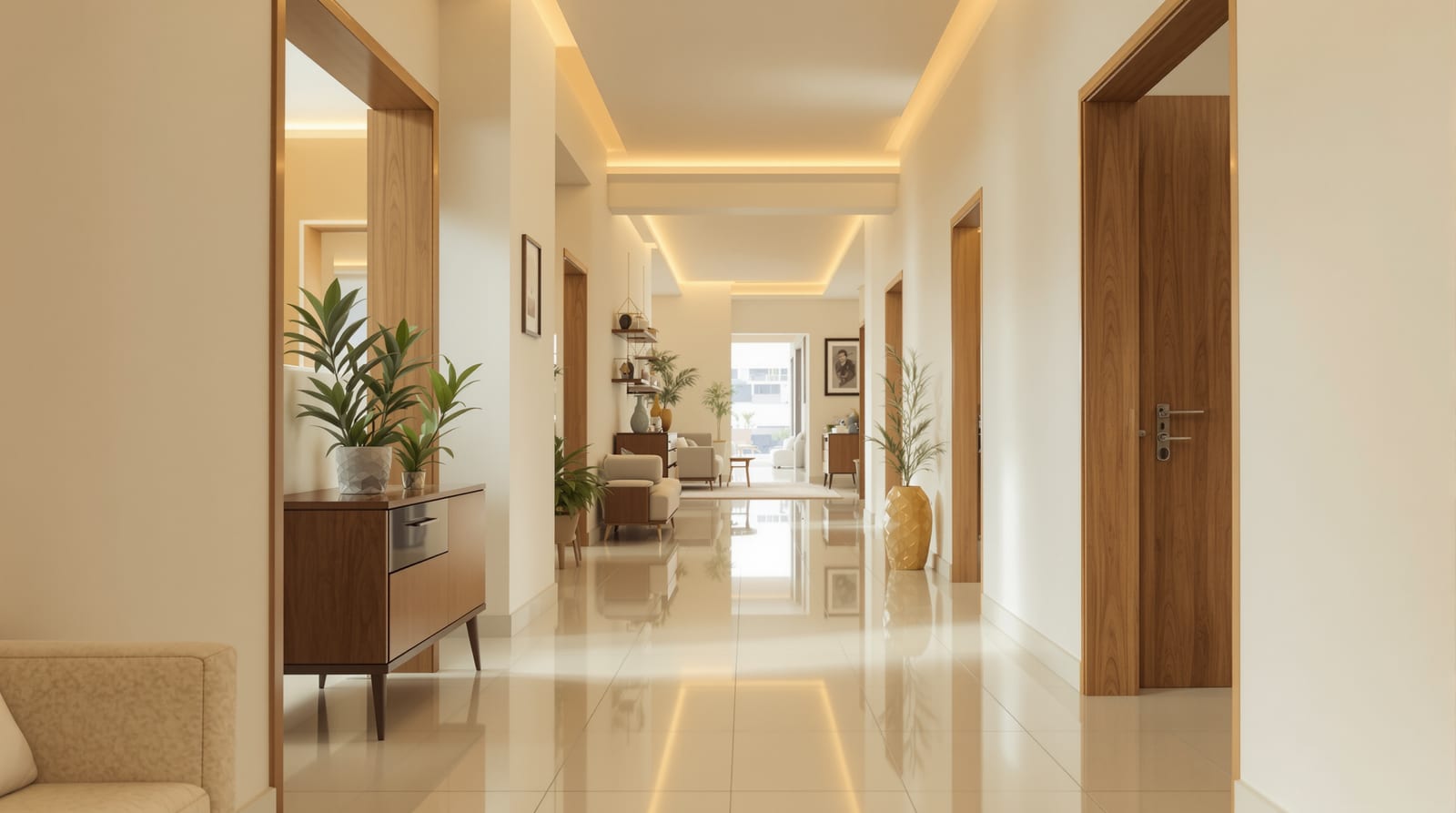
 Lesson 1.1
Lesson 1.1 · Reveal the floor
Circulation as Wasted Space
The first lever is Subtract, and its richest target is circulation — the floor you only walk across. In a compact home, the path between rooms is often the biggest room you never use.
Walk through your home and count your steps between rooms. Every one of those steps is standing on floor that does only one job — and in a small flat, you cannot afford a single-job room.
In Lesson 0.2 you learned to see wasted space through four lenses. This module takes the first lever to its richest hunting ground: circulation — the floor used purely for getting from one place to another.
It feels untouchable, because moving through a home is necessary. But “necessary” and “as much as you have” are different things. Most compact Indian homes carry far more circulation than they need — and unlike a wall or a window, you can often reclaim it without spending a rupee.
The biggest room you never sit in
A corridor is the purest form of wasted floor: it has only one function — movement — and it occupies area you paid for, heat, clean, and walk past every day. In a 1,500 sq ft house, a corridor is a rounding error. In a 500 sq ft flat, the same corridor can be 8–10% of everything you own.
This is the cruel maths of small homes: the smaller the home, the larger the proportional cost of the same wasted circulation. A compact flat can least afford a corridor, yet builders give them the same standard passages as large ones. That gap is your opportunity.
| Home size | A 1.2m × 4m corridor |
|---|---|
| 1,500 sq ft house | ~50 sq ft · ~3% as share of home |
| 800 sq ft 2BHK | ~50 sq ft · ~6% as share of home |
| 500 sq ft 1BHK | ~50 sq ft · ~10% as share of home |
Three kinds, two of them removable
Before you can subtract circulation, you have to see its types. Walk your home and you'll find three:
1 · Dedicated circulation — the removable kind
A corridor or passage whose only job is movement. This is pure waste in a small home, and the first target. It can usually be absorbed into the rooms it connects, or designed out entirely.
2 · Wasteful through-circulation — the reducible kind
A path forced to be longer or wider than it needs to be — you walk around an oversized sofa, or take the long way because furniture blocks the short one. The movement is necessary; the amount isn't. Reduce it by re-placing what's in the way.
3 · Integrated circulation — the kind to keep
Movement that shares space with another function — walking through the living area to reach the balcony, where the “path” is just the open floor of a room you also use. This isn't waste at all. The goal of subtracting circulation is to convert types 1 and 2 into type 3.
How you actually reclaim a corridor
Seeing wasted circulation is one thing; removing it is another. Four moves, from cheapest to most involved:
1 · Re-place the furniture (free)
Most wasteful through-circulation is caused by furniture in the wrong spot. Move the oversized sofa, shift the bed, and the path shortens on its own. Costs nothing but an afternoon.
2 · Absorb the corridor into a room (cheap)
A dead-end passage can often become part of the room it leads to — remove a stub wall, and the corridor's floor joins the bedroom or living area. The movement still happens, but now through usable space.
3 · Pull function into the path (moderate)
If a corridor must stay, make it do a second job — line it with slim storage, a study niche, a reading bench. Strictly this is borrowing Layer, but the effect is to end the circulation's single-job status. (More in Module 4.)
4 · Re-plan the entry sequence (involved)
The deepest move: rethink where you enter and how the home unfolds, so movement runs along the edges of rooms rather than through dedicated corridors. This is the architect's lever, and the subject of Lesson 1.2.
Go deeper — the 15% rule professionals carry
A rule of thumb among space planners: in an efficient compact home, circulation should be around 10–15% of carpet area, and ideally most of it integrated. Push past 20% and the plan is leaking space; some poorly-planned flats hit 25–30% once you add up every corridor, oversized path and awkward approach.
The diagnostic is quick: estimate your home's pure-movement floor, divide by carpet area. Above 20%, circulation is your single biggest Subtract opportunity — worth more than any amount of clever storage. Below 12%, leave it alone and move to Layer. The number tells you where the lever has the most to give, which is exactly how a professional decides where to spend design effort first.
Find the circulation in a real flat
Here's a ~520 sq ft 2BHK. Four pockets of circulation are marked. Tap each to see which kind it is — and whether it's removable. Watch how much of the flat turns out to be pure path.
Fig 1.1a — Marker 4 is integrated circulation: it shares the living-room floor, so it isn't waste. The other three are.
You're auditing a small flat and find that walking from the sofa to the balcony crosses open living-room floor. Should you try to subtract this circulation?
Run the method yourself
Use your measured plan from Lesson 0.3. This is the diagnostic that tells you whether Subtract is your biggest opportunity.
- 1Shade the pure-movement floor. On your plan, colour every area whose only job is getting you somewhere — corridors, passages, the path you walk around furniture. Be honest.
- 2Sort it into the three types. Mark each shaded area: dedicated (removable), wasteful (reducible), or integrated (keep).
- 3Calculate your ratio. Add up dedicated + wasteful floor, divide by your carpet area. That percentage is your circulation waste.
- 4Decide. Above 20%? Circulation is your richest Subtract target — plan to reclaim it. Below 12%? Note it and move on; your space is hiding elsewhere.
- Circulation is floor whose only job is movement — the purest wasted space, and Subtract's richest target.
- The smaller the home, the larger the proportional cost of the same corridor. A 1BHK can least afford one.
- Three kinds: dedicated (removable), wasteful (reducible), integrated (keep). The goal is to convert the first two into the third.
- Reclaim it by re-placing furniture, absorbing corridors, pulling function into the path, or re-planning the entry.
- Audit it: pure-movement floor ÷ carpet area. Above 20% means circulation is your biggest opportunity.
If the deepest way to subtract circulation is to re-plan how a home unfolds, how do you divide space into rooms without building corridors — or even walls — in the first place?
The author
Amogh N P
Architect, interior designer, and creative polymath. Studio Matrx began in his notebooks — his vision of design made honest, useful, and open to everyone. Its Academy is written and taught in his memory, and free, forever.
More about Amogh →