
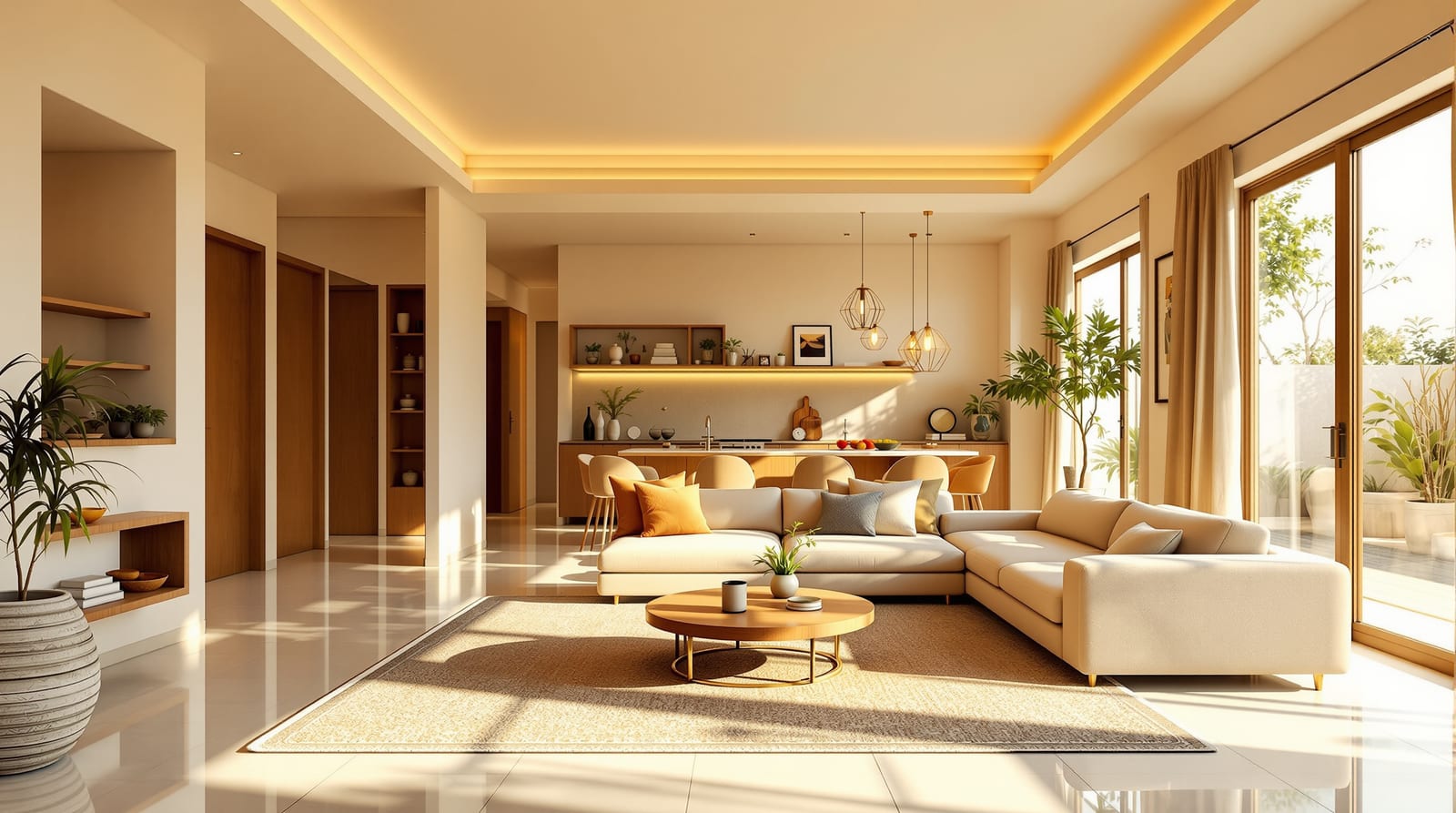
 Lesson 1.2
Lesson 1.2 · Reveal the floor
Zoning Without Walls
A wall divides space by subtracting it. Zoning divides the same space by suggestion — giving you separate rooms without losing a single square foot to a partition.
A wall costs you twice: the floor it stands on, and the light and sightline it blocks. In a small home, the cheapest partition is the one you never build.
Lesson 1.1 freed circulation. This lesson asks a deeper question: if removing walls gives you space, how do you keep the separation a home needs — a place to sleep apart from a place to cook — without rebuilding the very partitions you just took down?
The answer is zoning: defining areas by function rather than by enclosure. A rug, a change in level, a turned bookshelf, a pool of light — each tells the eye “this is a different place” without a single brick. It is the most elegant move in the Subtract lever, because it gives you division for free.
What a wall really costs
We think of walls as free because they came with the flat. But every internal partition is a standing tax on a small home, and zoning avoids all of it.
A wall eats its own footprint — 100mm of floor times its length; blocks light from reaching the room beyond; stops sightlines, making both rooms feel smaller; forces a door, and a door forces a swing of dead floor; and is fixed — wrong once built is wrong for years.
A zone takes zero floor — the division is implied, not built; lets light flow across the whole space; keeps long sightlines, so the home reads larger; needs no door, so no swing is lost; and is flexible — re-zone in an afternoon as life changes.
This is why zoning belongs to Subtract: it lets you remove a wall (or never build one) while keeping the separation that wall would have provided. You subtract the partition and keep the function.
| A wall | A zone |
|---|---|
| Eats its own footprint — 100mm of floor times its length | Takes zero floor — the division is implied, not built |
| Blocks light from reaching the room beyond | Lets light flow across the whole space |
| Stops sightlines, making both rooms feel smaller | Keeps long sightlines, so the home reads larger |
| Forces a door, and a door forces a swing of dead floor | Needs no door, so no swing is lost |
| Is fixed — wrong once built is wrong for years | Is flexible — re-zone in an afternoon as life changes |
Six ways to zone without building
Every zoning device works by giving the eye a cue that one area is distinct. The strongest plans layer two or three:
1 · The rug — The simplest zone-maker. A rug under the sofa says “living room” even with no walls around it. Cheap, movable, instantly re-zoneable.
2 · The level change — A platform raised even 100–150mm makes a powerful break — the Indian baithak tradition. The step says “you are entering somewhere else.” Also great for hidden storage underneath.
3 · The half-height or open divider — A backless bookshelf, a slatted screen, a planter run. It separates without blocking light or sightline — the small-home sweet spot between open and closed.
4 · Light — A pendant over the dining table, a floor lamp by the reading chair. A pool of light defines a zone after dark more sharply than any furniture.
5 · Ceiling & colour — A different ceiling treatment, a painted “rug” on the floor, or one accent wall colour signals a zone with zero physical intrusion at all.
6 · Furniture orientation — Turning the back of the sofa to the dining area draws an invisible line. Furniture facing each way tells you where one zone ends and the next begins.
Go deeper — when a small home actually needs a real wall
Zoning isn't always the answer. Three functions usually still need real enclosure, even in the tightest plan: the bathroom (privacy + water), a parents' sleeping zone where a joint family shares a flat (acoustic and visual privacy at night), and the kitchen where heavy frying makes an open plan spread grease and smell (see Lesson 1.3).
The professional move is the partial enclosure: a wall that stops short of the ceiling, a sliding panel that closes only at night, a glass partition that blocks smoke but not light. You get the separation where it's genuinely needed and zoning everywhere else — the most floor kept open for the least privacy lost. Knowing which functions earn a wall is the whole skill.
Make one room read as three — no walls
Here's an open ~240 sq ft living-dining-work space in a studio. It needs three zones. Tap each tool to see how it divides the space by suggestion alone. Notice the floor never shrinks.
Fig 1.2 — Four ways to say “different place” without a wall. Most rooms use two or three together.
Someone removes every internal wall in their 1BHK for “more space,” and now finds the home feels like one chaotic room with nowhere that feels separate. What did they miss?
Run the method yourself
Take the most open or most chaotic space in your home — the one that tries to be living, dining and work all at once. Bring your measured plan.
- 1Name the zones it needs. List the distinct functions that area must hold. Two? Three? Be specific — “relax,” “eat,” “work.”
- 2Pick a cue for each. From the toolkit, choose how each zone will announce itself — a rug here, a light there, the sofa turned to face away. Aim for the cheapest cue that works.
- 3Check your sightlines. Stand at the entry. Can you still see across the whole space? If a zoning cue blocks the long view, swap it for a lower one. The home should feel divided but never boxed.
- 4Mark which functions still need a real wall. Bathroom, night-time sleeping, heavy-cooking kitchen. Everything else, zone.
- A wall costs floor, light, sightline and a door swing, and is fixed. Zoning gives the same separation at none of those costs.
- Zoning is a Subtract move: it lets you remove a partition while keeping the division it provided.
- The toolkit: rug, level change, open divider, light, ceiling/colour, furniture orientation. Layer two or three.
- Keep long sightlines — a home should read divided, never boxed.
- A few functions still earn a real (often partial) wall: bathroom, night sleeping, heavy-cooking kitchen.
Zoning keeps a home open — but the open kitchen is where that ideal meets the hard reality of Indian cooking. When does open plan actually work, and when does the smoke win?
The author
Amogh N P
Architect, interior designer, and creative polymath. Studio Matrx began in his notebooks — his vision of design made honest, useful, and open to everyone. Its Academy is written and taught in his memory, and free, forever.
More about Amogh →