
 Lesson 2.3
Lesson 2.3 · Reach outward
Air, Depth & the Long View
A room you can see through feels deeper than its walls. A room that breathes feels larger than its air. This lesson reaches for the two quietest forms of borrowed space — the long sightline, and the moving breeze.
Stand at a doorway where your eye stops at a blank wall two metres away, then at one where it travels across a room, through a window, to a tree outside. The second feels twice as deep — and it isn't. Your eye just borrowed the distance.
Lesson 2.2 made light travel. This lesson reaches for two more things a small room can borrow without gaining a square foot: depth, through the long view, and air, through cross-ventilation.
Both matter doubly in India. The long view is how a deep, sealed flat stops feeling like a series of boxes. And cross-ventilation isn't just comfort here — it's how a home stays liveable through heat and humidity without leaning entirely on air-conditioning. A breathing room feels open in a way no sealed room ever does.
The eye borrows distance
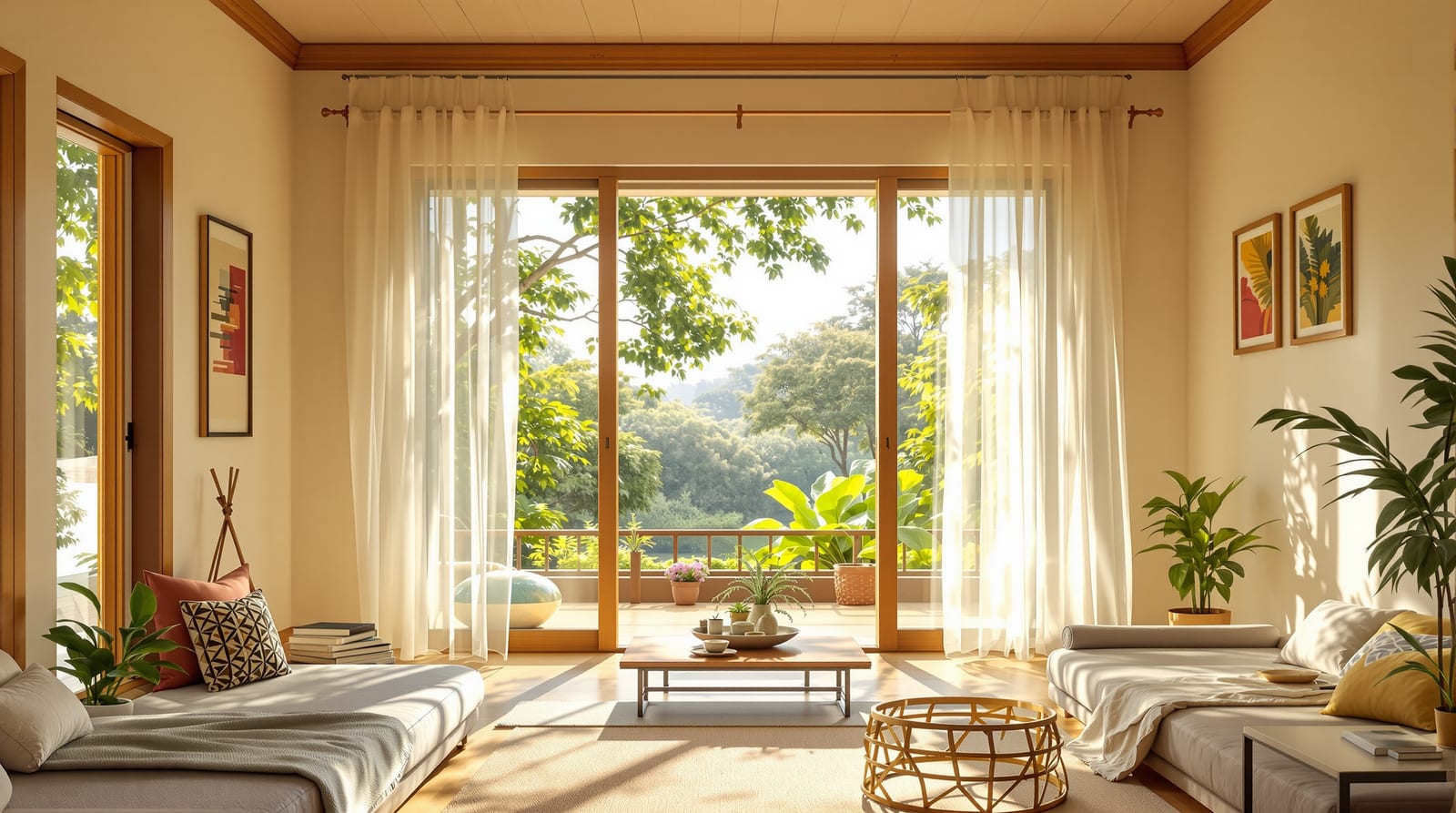
A room feels as deep as the farthest thing you can see from its entrance. If your gaze stops at a near wall, the room reads small, however much floor it has. If it travels across the space, through an opening, to something beyond — the next room, a window, a tree — the room borrows all that distance and reads far deeper.
This is why the longest sightline in a small home is worth protecting above almost anything. The diagonal across a room is longer than any wall; a view that runs from the front door clear through to a balcony makes the whole flat feel like one generous space rather than a warren of cells.
A room that breathes feels larger
Still, stuffy air makes a room feel close and small; moving air makes it feel open and alive. Beyond comfort, cross-ventilation is how an Indian home stays liveable in heat and humidity — and it's a true Extend move, because a breeze connects a room to the outside on both sides.
Cross-ventilation needs two openings on different sides of a space, so air has somewhere to enter and somewhere to leave. One window alone barely moves air; an inlet and an outlet create a through-draught. The art is giving the breeze an unblocked path across the room.
Go deeper — the stack effect and the Indian section
Cross-ventilation works in plan — air moving sideways across a room. The stack effect works in section: hot air rises, so a high opening (a clerestory, a ventilator, the traditional roshandan above the door) lets the hottest air escape at the top while cooler air is drawn in low. This vertical breathing needs no wind at all — it runs on heat alone, which is exactly what an Indian summer provides in abundance.
Traditional Indian architecture is full of this intelligence — the roshandan, the jaali screen that lets air through while cutting glare and sun, the courtyard that pulls a draught through the whole house. Borrowing these into a modern flat (a ventilator above a door, a jaali instead of a solid partition, openings at two heights) extends a room into the moving air around it, and keeps it liveable when the power — and the fan — cuts out. The most resilient cooling is the kind built into the section.
Watch the eye borrow depth, then give the air a path
Same flat, same walls. First toggle between a blocked sightline and an open one, and see how far the eye can travel — and how much deeper the space reads — when nothing stops the view. Then tap each ventilation setup: one window barely stirs; two on opposite sides create a through-draught; add the stack effect and the room breathes on its own.
Fig 2.3a — Lowering one partition and shifting a cupboard off the axis lets the eye run the full ~9m depth. The floor is identical.
Fig 2.3b — One opening barely stirs the air; two on different sides make a through-draught; high-and-low openings let heat self-vent.
Fig 2.3 — Lowering one partition lets the eye run the full ~9m depth; two openings on different sides make a through-draught, and high-and-low openings let heat self-vent. The floor is identical.
A stuffy room has one large window. The owner is surprised it gets no breeze even with the window wide open. Why?
Run the method yourself
Two quick audits on your own home, both standing still and looking.
- 1Find the longest possible sightline. From your front door, where does your eye stop? Is there a partition, cupboard, or door that, if lowered, glazed, or shifted, would let the view run all the way to a window or balcony? Mark it — that's your depth move.
- 2Trace the air path. In your stuffiest room, find the openings. Is there an inlet and an outlet on different sides, or just one? If only one, where could a second opening — a ventilator, a louvered door, a window — give the air somewhere to leave?
- 3Look for a high opening. Is there a roshandan, transom, or space above a door where hot air could escape? The stack effect cools with no wind and no power.
- 4Protect the best of each. Name the one sightline and the one air path most worth designing around. The whole flat will feel deeper and more alive for it.
- A room feels as deep as the farthest thing you can see from its entrance — protect the longest sightline.
- The eye borrows distance: a view running through to a window or balcony makes the whole flat read deeper, at no cost in floor.
- A room that breathes feels larger — and in India, cross-ventilation is liveability, not just comfort.
- Cross-ventilation needs two openings on different sides — an inlet and an outlet. One window barely stirs the air.
- The stack effect (high opening + low) and traditional devices — roshandan, jaali, courtyard — cool with no wind and no power.
Light, depth and air all reach beyond the walls. The largest thing a small flat can borrow is the outside itself — so how do you turn the one piece of outdoors you already own, the balcony, into a real room?
The author
Amogh N P
Architect, interior designer, and creative polymath. Studio Matrx began in his notebooks — his vision of design made honest, useful, and open to everyone. Its Academy is written and taught in his memory, and free, forever.
More about Amogh →