
 Lesson 2.2
Lesson 2.2 · Reach outward
Making Light Travel
Light is the most powerful thing a small room can borrow — and most homes waste the light they already have. This lesson is about catching daylight at the window and carrying it deep into the plan.
You don't pay for daylight, and you can't run out of it. Yet most small homes let it die a metre inside the window — swallowed by a dark wall, blocked by a cupboard, stopped at a solid door. The light was free; we just refused to let it travel.
In Lesson 2.1 you learned that a bright room reads as larger. This lesson is the how: the moves that take the daylight arriving at your windows and carry it deeper, brighter, and further into a compact Indian flat.
The Indian light situation is its own puzzle. We have abundant harsh daylight most of the year — the problem is rarely too little light, but light that's either glaring and hot at the window or pitch dark three metres in. Making light travel means spreading that abundance evenly, without dragging in the heat.
Light falls off fast
Daylight from a window drops sharply as it travels inward — roughly with the square of the distance. A spot one metre from the window can be many times brighter than a spot three metres in. In a deep, narrow Indian flat — the classic builder layout — this means the front is bright and glary while the back needs the lights on at noon.
So “making light travel” is really two jobs at once: tame the harsh light at the window, and carry it to the dark zone at the back. The explorer below shows the moves that do both.
| Distance from window | Relative daylight |
|---|---|
| ~1 m in — Glary near the glass | Bright |
| ~2 m in — Comfortable | Roughly a quarter |
| ~3 m+ in — Dim, lights on by day | A small fraction |
Six moves, brightest first
1 · Pale, matt surfaces — The highest-impact move and the cheapest. Light-coloured walls, ceiling and floor bounce daylight deeper instead of absorbing it; a dark wall is a light-sink. Matt over glossy — gloss creates hotspots and glare, matt spreads light evenly.
2 · A mirror opposite or beside the window — A well-placed mirror nearly doubles a window's reach, throwing light into the dark zone and adding apparent depth at once. The single most effective object you can add to a dim room.
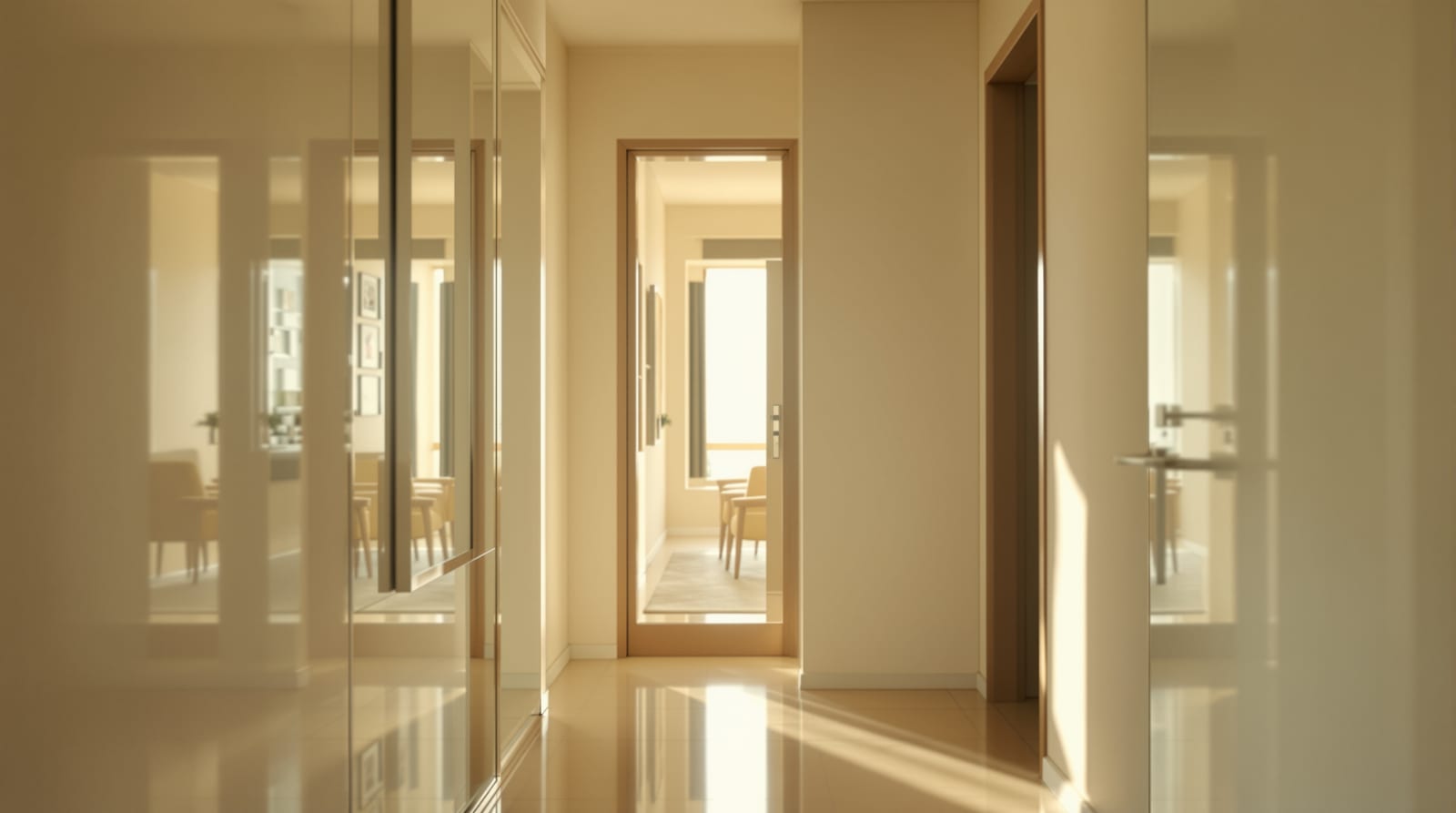
3 · Borrow light onward through glass — The internal glass partition, transom, or glazed door — exactly the move from Lesson 1.3 — lets one room's daylight pass into the darker room behind it. The most powerful way to light an interior room with no window of its own.
4 · Clear the light path — Pure Subtract, in service of Extend: a tall cupboard in front of the window, a heavy curtain, furniture stacked along the bright wall — all of it stops light dead. Move the blockers and the light travels for free.
5 · Tame the glare, don't block it — Indian daylight is harsh. Use sheer curtains, light shelves, or a deep sill rather than heavy drapes — diffuse the hard light into soft, travelling light instead of shutting it out. Blocking glare usually means blocking the light too.
6 · Light colour for the dark hours — When daylight goes, layered electric light (not one harsh ceiling tube) keeps the room feeling open — warm pools at the edges read as larger than a single flat overhead glare. (More in Module 4's lighting note.)
Go deeper — the heat-and-light trade-off in Indian homes
In most of India, daylight arrives with heat, so the professional move is never just “maximise glazing.” A big west window floods a room with afternoon light and bakes it until evening. The skill is to separate the light you want from the heat you don't: prefer north light (bright, even, cool) and gentle east light; shade or screen the harsh south and west; and use light-coloured external surfaces and chajjas (the traditional projecting sunshade) to bounce in brightness while keeping direct sun off the glass.
This is why borrowed-light moves — mirrors, pale surfaces, internal glass — matter so much here: they let you spread a modest, cool amount of daylight deep into the plan, rather than punching a huge hot window that you then have to curtain shut by noon. In the Indian climate, making a little good light travel far beats letting a lot of harsh light pour in.
Four ways to make light travel deeper
Here's a deep room, dark at the back. Tap each move to see how it pushes daylight further into the plan — and watch the depth-of-good-light meter rise. The room's size never changes; only how far the light reaches.
Fig 2.2 — Each move pushes the daylight further from the window. Combine them and the dark zone all but disappears.
A room feels dark at the back. The owner assumes the only fix is a much bigger window. What does the Extend lever suggest first?
Run the method yourself
Take the dimmest room in your home, at midday. Work through the toolkit in order of impact.
- 1Clear the path. Walk to the window. Is anything blocking it or standing in the light's way along the bright wall? Move the blockers first — it's free.
- 2Check your surfaces. Are the walls, ceiling, and key furniture pale and matt, or dark and absorbing? Note what's eating your light.
- 3Place a mirror. Find the wall opposite or beside the window. A mirror there will throw light into the dark zone — mark the spot.
- 4Find a borrow-onward route. Is there an interior-facing room that could take light through a glass panel or transom from this brighter one? That's your deepest Extend move.
- Daylight falls off fast with distance — the back of a deep room is dark unless you help the light travel.
- Two jobs at once: tame the harsh light at the window, and carry it to the dark zone.
- The toolkit, brightest first: pale matt surfaces, a mirror, borrow light onward through glass, clear the path, tame glare, layer electric light.
- In India, separate light from heat — prefer cool north light, shade the harsh west, bounce brightness in without the sun.
- Make a little good light travel far, rather than punching a big hot window you curtain shut by noon.
Light makes a room bright. But a small room also needs to breathe and to feel deep — to be seen through and moved through. How do air and the long view extend a room past its walls?
The author
Amogh N P
Architect, interior designer, and creative polymath. Studio Matrx began in his notebooks — his vision of design made honest, useful, and open to everyone. Its Academy is written and taught in his memory, and free, forever.
More about Amogh →